Showing posts with label community. Show all posts

Saturday, December 6, 2014

EC 456 GoveRment is an aLien People
© Eso A.B.
The Ought of Revolution: To The End of Reconstitution of Viable Community
© Translation Eso A.B.

A chorus is a group of singers or speakers, which the longer the group exists becomes ever more like that of a single body or a community.

This was something well known by my forebears who reconstructed the war torn social fabric of what was once known as Livonia. Indeed, their restitution and healing was so successful that out of their effort, there emerged in the course of time two separate countries: Estonia and Latvia.

Today, however, the two states are falling apart and crumbling, and no one seems to be able to put Humpty Dumpty together again. Why? What has changed? The 18th and 19th centuries were after all still horse and buggy days, whereas today we live not only in the machine age, but the machine rules almost over everything, and is being superseded by the electron and talk goes of a coming age of quantum computers.

The answer is a simple one: Today the states are so centralized and powerful that they cannot envisage ‘running’ a country any other than from the top or from the top down as we say.

If so, did not the Herrnhuters (my forebears) do something wrong? Well, yes, they did. They passed their power and authority to the Lutherans, a ‘reformed’ branch of globalizing Catholic theology. Because they did not believe in violent opposition, but were willing to submit like lambs. The latter according to the teaching of Matthew 10:16 http://biblehub.com/matthew/10-16.htm : “Behold, I send you out as sheep in the midst of wolves; so be shrewd as serpents and innocent as doves….” When the Lutheran clergy pressed the Herrnhuters to vacate their places for the orthodox church, the Herrnhuters withdrew. Of course, some did act shrewdly. My grandfather was one of them. He withdrew from teaching and went into newspapering and hit it big. By way of England, America, and then Russia, they brought to Latvia the penny newspaper concept, which necessarily made the newspaper the vehicle of advertising.

But such individual successes did not manage to keep the values of my grandfather’s predecessors intact. In a few words, the old values argued that there should not stand some other between man, woman and God. An absolute and non-thinking dogma of non-violence retreated meekly when it should have found ways to repell the orthodox attacks. Unfortunately, the means were not discovered.

Yet such means of non=violence exist, as I have argued some hundred blogs or more in the past, where I translate ‘non-violence’ to really carry the meaning of ‘not-violence’. What distinguishes the two words is that ‘not-violence’ defines violence as non-violence against others, but reserves it for itself as a tool of self-sacrifice on behalf of one’s own. Indeed, one Latvian historian, Kaspars Klavins has argued in his book “apSTĀVĒŠANA” that the descendants of Latvian Herrnhuters were noted for their ability to sacrifice themselves for their fellows, when they participated in rebellions against their German overlords.

The concept of not-violence was removed from the values of the Catholic Christian Church, probably due to pressures from secular rulers, just as same had forced some early Eastern  Christians to reject community practices when coming face to face with taxation.  This resulted in power and authority passing to secular parties, who then founded a separate Western tax supporting Church.

Examples of not-violent Gods begin with the Christian God Jesus (and/or John Basil) and reach far far back in time, among the latter which is the Aztec God Nanahuatzin (see previous blog), who due to his self-sacrifice not only came from the ranks of the humblest of gods to become the Sun Itself. In any case, while the doctrine of not-violence existed implicitly in the Herrnhuter teachings, they failed to remember the act of their founders (John and/or Jesus) as they died in a fire pit or on the cross.

The Catholic and Globalist teachings against violence are a matter of dogma today, and are reflected in most Western liberal countries rejecting the death sentence. Given that the elites and government leaders today do not sacrifice themselves, but have been effectively removed from the ranks of common soldiers who must die on orders of their orders, I concur with reservations. That reservation states that it is the leadership that must exercise obligatory self-sacrifice if humankind is to achieve for non-violence a place in the Sun.

My reversal of government imposed values follows ancient theology found in many myths, where it is not only the King who dies, but also where God sacrifices Himself, when he rejects his own prayer by responding to it with an autodictat: "My Father, if it is possible, let this cup pass me by. Nevertheless, let it be as you, not I, would have it."

Saturday, June 8, 2013

Eso’s Chronicles 176
The Moneytheist Commons (VII)
© Eso A.B.

I am among those who believe that God is not a particle, but a wave. To apply the Heisenberg solution to the God problem, enables one to view God as both a wave and a particle, but to prove that He-She is one or both, one has to make the ‘quantum jump’ and jump over an awesome crevice https://www.youtube.com/watch?v=NZJJ99jETLI . That is to say, one has to die to find out.

Because nature knows that this test is inevitable may be one of the reasons why it causes one to age. After all, only when one is old (enough) and has seen what life has to offer, physical exhaustion may make one even eager to see what comes next—even if it is no more than a look into the face of Emptiness https://blogger.googleusercontent.com/img/b/R29vZ2xl/AVvXsEg73QPQLTJIvHL6e0MymkUyP_o8-7ECrj0wDlzJI0ks5URdriVVi-XIryCjijdlrdct7ZHu1jHuy9fzdsojSQhyeYK0JT6YwcgdT8rNrAOGHriiw8P3yy3mlflzERKqmlsdXoDpUZjScac/s400/picture-15.png .


The neo-Christian Church is vociferously opposed to such a perspective. In the following link, the president of the Vatican’s Pontifical Council for Culture, Cardinal Ravasi http://www.bbc.co.uk/news/world-latin-america-22462181, tells that worshipping Santa Muerte (blog 175) is a "degeneration of religion".... Cardinal Ravasi said the practice was "anti-religious". "Religion celebrates life, but here you have death," he said. "It's not religion just because it's dressed up like religion; it's a blasphemy against religion", the Cardinal continued.


Whose ‘religion’ is Ravasi talking about? His own, no doubt. He hits the nail on the head if at the back of his head, he allies his ‘religion’ with  capitalism, which is whence its chief support, ever since Charlemagne decided to remove the spiritual centre from the East and move it to the West, comes from.  Catholicism (and its offshoots), which stand for the exclusivity of human rights for the wealthy (originally the French Princes), which have ever since tried to fool the poor and uneducated that it is their ‘right’ also. The last is a peculiar assertion, given that historically the Vatican has but choreographed empty ceremonies. How did this ‘religion’ become the ruling ideology? “By incorporating a series of crucial motifs and aspirations of the oppressed,” says one philosopher”.* There is no shortage of those who are fooled.


The claim by Cardinal Ravasi that religion celebrates life is simply untrue. At least it was never true before Catholicism tried through yet another Cardinal, one named Peter to impose such a ‘truth cum lie’ on behalf of the wealthy on the poor http://i.qkme.me/3p345z.jpg . To understand the nature of this ‘truth’, we have to take another look at the ritual known as the Last Supper, in which the elders of a given community share in a sacred pie within which is hid a piece of the ‘body of the Gods’, a piece of coal. It was Jesus’ fate to draw this piece, whereby he became a Sacred King.


It was this archaic ritual that ensured (the Last Supper occurred before Jesus arrived in Jerusalem) that their community was ruled in the most ‘democratic’ way possible. Because no one is free of mistakes, knows this, and is prepared to pay for any trespass with one’s life, the community is ever forgiving. This commitment was the reason why the secular lords wished to seize and kill the Chosen One. They could stop the tradition only if they discovered who had drawn the sacred piece of coal before the people learned of it. This is why they arranged with Peter, who acted as the purser of the traveling court of the Sacred King, that he would pay Judas, one of the twelve who acted as Basil’s servants, thirty pieces of silver to kiss Jesus, and indicate through the kiss who had drawn the St. Death card. Foreknowledge gave the authorities time to fabricate a crime with which to blame Jesus. For example, the two ‘thieves’, later said to have been crucified on either side of the heretic ‘King’, were important ‘witnesses’ to the crime. This is what makes it likely that it was the thieves who were taken down from the cross early and recovered, not Jesus), whom they tortured and made beg for his life to escape the pain.


Before the arrival of neo-Christianity, religion used to manifest itself through a Festival celebrated by the whole COMMUNITY. Catholic Christianity succeeded in toppling the Festivals by imposing on people the meme of hubris through the dogma of individual immortality. In this way, the ruling clique succeeded in fracturing communal solidarity by kaleidoscoping into one the ritual of self-sacrifice and the ritual of public execution, and topping it with a promise of immortality. The meme of immortality has been in the ‘works’ for over two thousand years by our time, and has replaced the yeast that raised the dough of the old commons with a community bonded by no more than waterproofed paper Money.


Needless to say, the Bible has little to say about the community. “Bear one another's burdens, and… fulfill the law of Christ” (Galatians 6:2) is about as close as it gets.

Yet there are few oligarchs who have given away their possessions or taken on another’s burdens. The reason is simple:  the ‘others’ are the poor, and the burdens of poverty are hard to bear. This is illustrated by the sharp drop in prices (halving them) for the services of immigrant prostitutes in London http://www.bbc.co.uk/news/uk-england-london-22106546 , while their opposite, the neo-native American presidential penis galore swears innocence before an audience he does not have to make eye contact with https://www.youtube.com/watch?v=KiIP_KDQmXs , then uses his notoriety to make money http://www.nypost.com/p/news/national/bill_clinton_paid_for_minute_speech_YVpCd5lHlDc290PUeU64zN , hand over dick, so to speak. It’s a strange, strange world, Mr. Jack Klinton! https://www.youtube.com/watch?v=A0WvXpyufT8 Is it not?

A reader of my blogs has communicated to me that he believes that God has little to do with life, death, or community, but that the issue is rather one of monotheism vs polytheism. When I was introduced to this perspective, I was compelled to imagine God as a persona suffering from an incurable multi-personality disorder.

A God suffering from a multi-personality disorder makes sense if we remember that the Magna Charta (1209) http://www.bbc.co.uk/history/british/middle_ages/magna_01.shtml was written on behalf of princes and barons in revolt against the authority of the King, aka the Monarch. To the extent that the office of King had abandoned all pretexts to be a self-sacrificial office on behalf of the community, the revolt of the princes was legitimate. However, it is no secret, that England’s princes were not ‘reformers’ of abandoned ancient traditions of government, but forerunners to neo-capitalist anarchism achieved at the price of turning Olympus into a bank for polymorphous currencies.

Money is a flexible tool of exchange: it can be gold, silver, or paper, and it can be broken down into small change, which can be inflated or deflated according to whoever is in charge of the money printing office. In our day, the individual in charge of U.S. Moneytheism is Cardinal Bernank. Moneytheism rhymes easily with monotheism, and blends centralized power into the structure of a pyramid without difficulties.

A Moneytheistic God stands for centralized government over which those who find themselves on the periphery have little to say. In our day, the only people who are consulted from the periphery is a group known [curiously, but tellingly, as the Bilderbergs, i.e., Picturemounts of Iconic wealthy individuals].

A similar problem with regard to actualizing democracy was faced by our forebears. They solved the problem by remodeling the peak of the gold leafed pyramid into an office that symbolized self-sacrifice. Thus, the sacred oath of the Sacred King was that he would give his life. His face thereafter was portrayed as shining in gold leaf.

Unfortunately, a copy of the disciple Peter, the purse carrier of the Sacred King’s sacred Court, is today embodied by someone known as Cardinal Bernank. Cardinal Bernank has passed the kiss on to President Obama, who (in imitation of Stalin’s reaction to the kiss received from Lenin) washes his hands and passes his sacred responsibilities on to a technocratic State bureaucracy.

This buck passing gives the President the ‘legal’ right—if I insist that money today is of paper, while he insists it is of gold—to fly up to my window with a drone helicopter and fire a rocket.

Uncritical surrender to Moneytheism encourages individualism to climb and reach previously unimaginable levels of incoherence—which is where urban society of today locates us. Though the opposition to the present structure of society may be great, there is no mention of this opposition in the Moneytheistic media which has been bought up by the oligarchy.

*Slavoy Zizek, “The Universal Exception”, Continuum, p. 153.


Friday, May 24, 2013

Eso’s Chronicles 171
Fascism as Deconstruction of Community (III)
© Eso A.B.

Thus (see blog 170), if proto-fascism has its beginning in a disintegrating community desiring to heal itself, for those who have the desire to heal, finding themselves being labeled ‘fascists’, further facilitates the disintegration of their community, and places the naming agent in the position of the enemy or his agent. The enemy/ agent works as a:


1) saboteur, a role enhanced by deliberate idiocy;

2) the sabotage occurs for the agent’s own good reasons; and


3) the reason for the sabotage is to access Money, because when there is enough Money, it substitutes for community; i.e., one may do without community, because one can buy an illusion of it.


4) The agent or enemy of community, therefore, is Money; because Money buys ‘freedom’ and ‘liberates’ one of the community and responsibilities toward it.


5) Money opens a new world, a wholly virtual world. As opposed to the Superego of the organic world, who projects in our dreams as a ‘medicine man’, the Superego of the wholly virtual world is a consumer item. For example, a Barbie doll https://www.youtube.com/watch?v=w7P_0_HfTp8. Incidentally, a Barbie doll may be had only through the agency of Money, which is God for real in our time and space. Nevertheless, this money is seldom in the hands of the community, but remains in the possession of the anti-community forces: the billionaires, the millionaires, and the military forces the oligarchs support.


Items 4) and 5) provide the reasons why capitalists sabotage a community’s effort to reestablish itself. The sabotage is accomplished by diverting the healing effort toward self-destructive ends and then call the result ‘fascism’, a word of such evil potency that the victor ‘democratic’ State forbids it to be ever mentioned again.


Among the negative consequences of communities efforts to recover are two gigantic icebergs: Hitler’s fascism and Stalin’s communism.


At their beginning stages, both fascists and communists had enormous popular support. If they had not had such support, they could hardly have succeeded in rising to their eventual dominant positions.

There were, however, forces embedded among communalists, which sabotaged their good cause and earned them ridicule and a bad name for a long time thereafter. In short, in so far as now bygone communism and fascism represented forces of the community that rose against its destroyers, the community in the end became a worse loser than when it had begun its recovery effort. The community was further diluted than it had been at the beginning of the uprisings. By our day, the community no longer exists as a tangible entity.


What has replaced the community is a wholly artificial megalopolis, a centre for the creation of virtualism, which is held together (zusammen) not through personal relationships, but through everyone’s dependency on Money. Money itself is ‘democratic’, in so far as it can be divided among community members more or less equally, but which ‘equality’ fails to become a reality, because the enemies of the community desire to keep the Money, most of it, for themselves.


It is at this stage of political developments that the leaders of the community (not having been forewarned) succumb to the temptation of either 1. Money or 2. Power (a Money substitute). The only way to then continue forward is to divert the attention of the members of the community from the ‘real’ enemy on to a scapegoat.


In the event of Hitler’s community organization, it discovered the enemy in the “Jews” (or gypsies, polaks, russen, homosexuals, avant garde artists, etc.). Because among all the above were certain anti-community factors and phenomena, the untutored have-nots were readily persuaded to turn on one or all of them. The persuasion was given roots when it was conjoined with permissive and officially overlooked killing.


Of the enemies, the community of Jews, the most cohesive community among the above, turned out to be the one which communitarians could be caused to hate and kill most readily. The reasons for why are many, but the most apparent one is that anti-Semitism was not a new phenomenon, but was grounded in an antagonism many centuries old. This ‘old’ antagonism was, in turn, grounded in the unresolved Great Schism that went back to the Civil War among Eastern and Western Christianity, its high point being the so-called Fourth Crusade of 1202-1204.


The Crusade was nominally won by the West when it sacked and plundered Constantinople, and transferred the centre of Christianity from the Byzantine Empire to Rome, Italy. The physical address change was accompanied by a power shift from an autonomous Eastern priesthood, which was rooted among a people familiar with prehistoric shamanism (hence autonomous), to a priesthood rooted as a bureaucracy under the wing of a Western secular king, turned Christianity on its head.


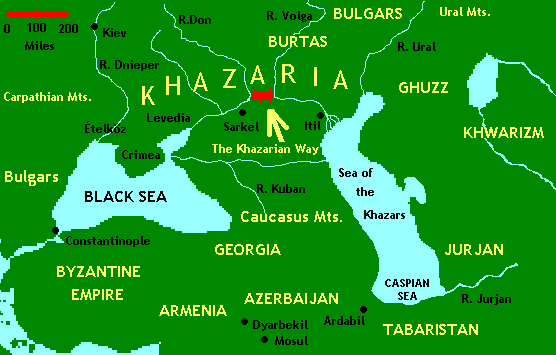
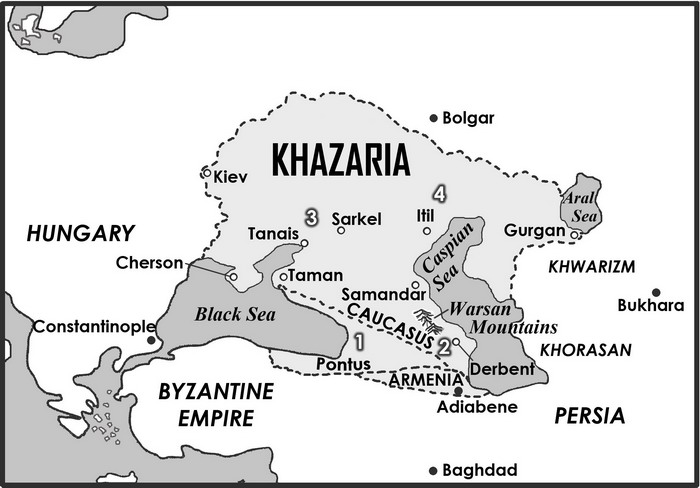
Eastern Christianity, known as Orthodox Christianity, was forced to adopt a Western or Catholic Christian story of the nature of the Son of God. The Orthodox or Eastern version of the story was associated with the Kabalah and the Old Testament, which texts likely had their origins in Jewish of Khazaria http://www.oocities.org/tmajlath/khazaria.gif . Needless to say, the Eastern Christian story of the Son of God differed considerably from that of the Western story. In the Eastern story, the king of Eastern Christianity is burnt by the traitorous Byzantine Emperor Alexius I at the Hippodrome in Constantinople about 1118, whereas the Western story was pure theatre and spectacle.


The community movement led by Hitler took advantage of Western Catholic bureaucracy’s (The Habsburg Empire was Catholic and centered in Vienna, Austria) antagonism toward the Jews, and subsequently identified the movement with Italian fascism, which took its name from a bundle of fascio (hazel) sticks as disciplinary tools.


Community building by Lenin and Stalin took an opposite tac, when it found its enemy not in the Orthodox priesthood (though it killed thousands of priests), but in the tsarist oligarchy, its sympathizers among the Russian bourgeois, and a peasantry (Kristi-yan) that had risen to a ‘kulak’ http://www.britam.org/pics/KhazarEmpire.jpg  status.


What was missed by Lenin, Stalin, and Hitler was that neither the ‘community’ of the Germans nor Slavs identified with industrialized workers community. What the proto-Revolutionary and disintegrating community wished for was an organic community, the one they and their forebears had had for centuries, except it had become demoralized by those seeking wealth and progress as the only way to overcome the repressive princes, boyars, and barons.


As everyone knows, Stalin’s Soviet Union and Hitler’s Reich did not fulfill the dreams of the community movement, but the community movements in Europe and Russia (aided by American capital) met with a catastrophic defeat instead.


The answer for the causes of this defeat is indeed to be sought in Western capitalism, which built itself on the idea of a ruthless exploitation of our planet’s natural resources and made a huge investment in advertising and evangelizing militant capitalism. Additionally, defeat of the community was facilitated by the fact that none of the community leaders and no one in their bureaucracies or churches came to think that the rebuilding of a community requires of the leadership an ultimate self-sacrifice and that its goal is a subsistence, not capitalist, economy. The leadership of the community then and now remains all too attached to its own well being.

Wednesday, May 22, 2013

Eso’s Chronicles 170
No Room For Me at Home (II)
© Eso A.B.

The Merriam-Webster dictionary defines fascism as: http://www.merriam-webster.com/dictionary/fascism (please read link) :

“1: often capitalized: a political philosophy, movement, or regime (as that of the Fascisti) that exalts nation and often race above the individual and that stands for a centralized autocratic government headed by a dictatorial leader, severe economic and social regimentation, and forcible suppression of opposition

2: a tendency toward or actual exercise of strong autocratic or dictatorial control “early instances of army fascism and brutality — J. W. Aldridge”; etc.

Anyone with some analytical ability will note that both 1 & 2 definitions are not definitions, but transparent  pejoratives and a priori denouncements dressed in a language tuned to imitate a definition.

Let us take a closer look at the 1st ‘definition’: “….a political philosophy, movement, or regime (as that of the Fascisti) that exalts nation and often race above the individual and that stands for a centralized autocratic government headed by a dictatorial leader, severe economic and social regimentation, and forcible suppression of opposition…

The second (2) ‘definition’ is no less propagandistic and serving those  (Merriam?) in whose interests it is to weaken and ultimately destroy COMMUNITY as a legitimate social phenomenon.

Let us look at the items separately and in the context that sees said ‘definitions’ as politically deliberate and pejorative redefinitions of a community of human beings:

1. A political philosoph:
Is ‘community’ a political philosophy or a necessity of the human condition? http://dictionary.reference.com/browse/community The reader should read the text at link to see that the enemies of the COMMUNITY are those who stand against it: 1. a social group of any size whose members reside in a specific locality, share government, and often have a common cultural and historical heritage.

2. regime:
http://dictionary.reference.com/browse/regime?s=t Items 1. (above) + 2. should suffice for us to get the anti-community gist: 1. a mode or system of rule or government: a dictatorial regime. 2. a ruling or prevailing system.

3. exalts nation and often race above the individual:
synonyms: extol,  glorify, elevate, praise, raise. In and of themselves the synonyms are harmless, but put in combination with words such as “nation” or “race above the individual”, it instantly acquires a negative coloration in reference to the ‘known unknown’ COMMUNITY that inevitably stands just behind the curtain.

4. centralized autocratic government headed by a dictatorial leader:
a definition of ‘autocracy’: http://en.wikipedia.org/wiki/Autocracy : An autocracy is a system of government in which a supreme power is concentrated in the hands of one person, whose decisions are subject to neither external legal restraints nor regularized mechanisms of popular control (except perhaps for the implicit threat of coup d'état or mass insurrection).

5. economic and social regimentation:
if this is the prevailing mode of communal existence, then COMMUNITY again appears in a negative light.

6. forcible suppression of opposition:

here we return to the Merriam Dictionary: fascism noun: Philosophy of government that stresses the primacy and glory of the state, unquestioning obedience to its leader, subordination of the individual will to the state's authority, and harsh suppression of dissent. Martial virtues are celebrated, while liberal and democratic values are disparaged. Fascism arose during the 1920s and '30s partly out of fear of the rising power of the working classes; it differed from contemporary communism (as practiced under Joseph Stalin) by its protection of business and landowning elites and its preservation of class systems. The leaders of the fascist governments of Italy (1922–43), Germany (1933–45), and Spain (1939–75)—Benito Mussolini, Adolf Hitler, and Francisco Franco—were portrayed to their publics as embodiments of the strength and resolve necessary to rescue their nations from political and economic chaos. Japanese fascists (1936–45) fostered belief in the uniqueness of the Japanese spirit and taught subordination to the state and personal sacrifice. See also totalitarianism; neofascism.

While it is true that the above mentioned states and regimes did use the stated methods for gaining and staying in power, it is just as clear that said governments had no or little understanding of the place of a community in the scheme of human society or the state as a mechanism for the facilitation of communal values. On the other hand, it cannot be said that the impulses that lead to the creation of a fascist state did not originate with a desire by a disintegrating community to preserve the community.

The question over what forces create a community necessarily lead us to consider the nature of human being, consciousness, the Superego, the subjective mind, primal times, and more.


Any attempt to look at the community leads one to look at the nature of human being. We begin as children, and as children our natures are as needful of parental protection and love as we as remain barbarous, anarchistic, and largely untutored in our behavior. As babes, we all insist that we are born billionaires, and the first billion that we own is attached to the nipple of our mother’s breast.


Because parents have gone through the experience of learning that the physical habitat we are born into does not offer us a cornucopia of everything we want, they must wean the child not only off the mother’s breast, but that instead of getting two pieces of candy, we may have to be satisfied with one, and sometimes none at all. This is when the cornucopia appears in heaven and the figure of God. However, ‘God’ and ‘heaven’ (or Paradise) are meaningless words until these are supplemented with images and stories that create the illusion that these promises are real. By the time the child discovers that a storyteller tells lies, he-she has reached puberty and discovers the pleasures of sex, which discovery may have been caused by parental sex education. Instead of being truly educational, it more likely lead to self-education through masturbation. Because for a man the desire of his penis tends to be stronger than the man himself, the penis provokes fantasies of women as cornucopias. Since a boy knows that the women of his own family are no cornucopias, his fantasies project to women of other families and/or tribes, and results in stealing for himself a ‘wife’.


It may be that the first communities began through the act of rape, which deed was resolved by the myth that women ‘enjoyed’ being raped. While today we seem to ‘unknowingly know’ that rape is an unmentionable, this was not necessarily so for our forebears. While the reason for rape for a man was sexual pleasure, its consequences were assured pregnancy culminating in the birth of a child. Another inevitable consequence was social turmoil: one small social unit, one family (in prehistoric days headed by a woman) had intruded into the space of another family. Conflict was always just short of being imminent, even though it was not always inevitable.


Imminent conflict could be avoided by following a number of simple tactics. One of these was rape, an immediate (asap) deflowering of the stolen-kidnapped maid. This fait accompli act defused the conflict, because the brothers of the maid, who gave chase (the father always was no one knew where) knew enough about ‘facts of life’ that a child could be the consequence. If a child was indeed the consequence, it was better for the families of the two women (one of the groom, the other of the bride) to live in peace. In other words, the custom that prevails to this day in pre-borgeois ‘organic’ communal life, which encourages the raped woman’s family to blame her rape on the woman, is not because it favors rape or wishes to besmirch one of their own, but to avoid mortal conflict between the brothers of the two families.


Another tactic employed was to carry the stolen ‘bride’ beyond easy reach of her pursuing brothers, such as carrying the maid across a natural barrier, say, a river. The barrier means that the pursuers will be delayed, during which time the sexual act will be consummated.

Yet another tactic is to take advantage of everyone’s desire to avoid death. Thus, both sides invented numerous excuses for avoiding conflict. In a Latvian folk song, after the maid is carried across the river, her brothers, still on the other shore, call their sister and urge her to come back, but the maid (no doubt already sexually compromised) shouts back: “Dear brother, I will not come back, your wife treats me harshly….”


Still, while direct conflict between the families has been avoided, a sense of humiliation may linger. Sometimes this results in brawls among the men-brothers at the next community festival, where inebriating drink may loosen tongues and resolve to control one’s self. If grudges result in conflict long after the original provocation, other tactics need to be exercised to avoid violence. It is these tactics that call for the involvement of elderly men, commonly known as community elders; and it is at this point that the Superego invents another story. The story may come by way of a dream (ever respected because its source is not one’s personal and wilfull consciousness) or may be consciously inspired and meet with communal approval. One may call the story, “Piece of Coal in the Cake”.


The elders of the various families who participate in the Festival, come together for a Salmagundi (a meal of peace*) at which they confirm that together they form one community, and all, do or die, stand as one. To confirm this resolve, the men divide among themselves a cake, into which has been baked a piece of black coal. Whoever gets the piece of cake with the coal in it will self-sacrifice himself on behalf of all, i.e., the community. In this way, he will overcome death and violence on behalf of all.


Incidentally, such an extended community avoids becoming centralized, but consists of autonomous communities. The bond among the communities is expressed and reasserted at festivals, which come together on the basis of habit and tradition. They often occurred on astronomically significan days: summer and winter solstices. The man who ‘wins’ the peace of coal, pays for the ‘win’ with his life, though in times of conflict, he may become the King or leader of the community and goes to repel the ‘outsiders’ or ‘unfriendlies’. By becoming the leader of armed men, the King is in no way forgiven death, but becomes the leader, because death is already his fate. If he survives the battle, he will fulfill his pledge perhaps at the next festival


The need to select a King in wartime may create Kingship as a centralized office for the entire community. The office does not lead to fascism or the dissolution of communal bonds in preference of a hunta or junda. The organic nature of the community continues to be confirmed through self-sacrifice.


*Salmagundi—while the dictionary informs us that it is a salad, the word ‘salma’ (like salam) probably stands for ‘peace’, while the word ‘gundi’ likely stands for a ‘gathering’.

Saturday, February 6, 2010

© Eso Antons Benjamins, a.k.a. Jaņdžs

NOT-VIOLENT TERROR
79 Climbing Mt. Citheron (XII)

Given the rapid breakdown of the community and community oriented hegemonies and the exponential rise of atomized individuals cultured into being by consumerist broths, society is footloose and free to do as it may. With money in the pocket, anyone may dance his or her way to almost anyplace they wish. Those without money also may go their way and many do, but the process of numbing one’s self with alcohol enough not to feel no pain of death in the cold, is a process that may take years. It’s a strange world, Mr. Jack.

A long time ago “freedom” meant having the opportunity to live away from princely courts and find refuge in a subsistence economy. Last time this was tried in the U.S. was when the hippies moved to the states of Oregon, Washington, and British Columbia in Canada in the 1960s. Some of them survive to this day by growing Johns Grass. In the rest of the world subsistence living—free but subject to finding food at the garbage dump, young women earning a living through prostitution, men growing and selling Johns Grass, and people dying as if they never were—is still the experience of the majority of humankind. Consumers may watch this world by taking "slum tours" as part of their consumption of vacation time. They may be preparing themselves for the rising tide of poverty that may force them to be discarded by the failed brain of our age of technology. On the other hand, there is also something to be said for wanting to live at the level of our forebears. Many would be happy to join them if using a horse and no car would free them from having to pay the government taxes.
It is a paradox of our civilization that it has not only rejected but also forgotten how the first human beings came into existence in conditions that offered them a comfortable subsistence living. In our own day, we are witnesses to how the advantage that an Earth full of fruit and life offered our ancestors has been squandered by using up ever more “lebensraum” (living space) in pursuit of consumption. Though Hitler failed in his attempt to carve out more living space for the German people by means of war (a nationalist activity often going by the name of fascism), a worldwide increase in poverty is only now beginning to see in consumerism a form of fascist dictatorship. Of course, I am speaking of a “soft” fascist dictatorship. For many Latvians going back to the ways of their forebears (if the world of the forebears could be recreated) would be an improvement over a country created with such foresight that 150,000 have left it, a no lesser number would like to, and the remainder wondering what fate had in mind when it put them ashore in Latvia
In the world as a whole, “Lebensraum” (living space) comes in many different sizes and shapes. There is concern over enough space for a growing population [risen from 2 billion inhabitants in 1950 to 6.5 billion by 2010, sixty years later, and expected to rise to 9 billion by 2040], but along with the growth of human population, the size of the ruling class has increased as well. It is, therefore, something like two billion Earth inhabitants stealing a living from the 4.5 billion others. Unfortunately, while the steal is successful, it is a steal that fails, because the theft helps increase the size of the middle classes on a planet of diminishing resources, certainly of such as are relatively cheap. Meanwhile, that part of humankind that was persuaded to abandon the ways of antiquity, yet never have had the opportunity to rise above the poverty level, continues to bring to life more people like itself than ever.
The majority of consumers live in cities, and it is around the cities that the human nakeds fill the slums. What once was a land for the original human subsistence dwellers, has become the private property of monster farms (probably bank owned) and the “bonus receivers” among bank employees, who invest and use retirement money of the middle classes for their own and the bank’s benefit. One may say that the natural order at the time when the first human beings appeared on Earth has been completely reversed: the haves then are the have-nots of today while the rulers-pretend-not-to-be are the Socialist Oligarch Party, SOP, of today.

More “growth” is obviously not a solution, but a problem to all areas that live as much on borrowed money as on borrowed time for lack analysis of the sustainability level of society and how to implement it. Sometimes a culture overgrown by a myth no longer either useful or principled may hinder the development or survivability of society as a whole.
While Latvia is a small nation, and one may think that it should escape notice of how it falls apart with all attention directed to the “biggies”, Latvia may play a big role in other ways. The current government is a perfect afterimage of what happens to those suffering from delayed gratification. The zeitgeist of consumer fascism shines bright in the eyes of almost everyone who knew the torture it was to stand in the long lines at stores during Soviet rule, yet was privy to television soaps from abroad. Such subjectivities obviously filled the heads of those who served Latvia’s bureaucracy and those who came to office as ministers and politicians. If consumer fascism is often well camouflaged in the West, it shows up in clear relief in post-Soviet Latvian morality.

Rather blatant presumption of hegemony among consumers translates itself best in images of television advertisements. The hegemony of images in advertising are unmistakeable. However, the modeling of the image began at the top, at top business and government level. There were no speed limits or blocks against running off the tracks. The examples of behavior in Latvia were set at the top and devolved down toward the valley where the people lived.
 The dazzling brightness of economic wisdom in the halls of Latvia’s “refounders” made plans to built "A Castle of Light"  to house a library that would put the Library of Congress in Washington to shame, but cost a mere ~140 million lats (~$300 mil.). It built the world’s most expensive bridge (~ Ls 600 million, with the lats almost twice as costly as the dollar, i.e., $ 1.2 billion) before its need was proven, and 27 million lats have simply gone missing. These and other objects reflect the high expectations of elected and unelected officials with no direct responsibilities to the voters—from 1991 on until the present 2010 election campaign. What an ironic spectacle of not only a lack of vision, but of the post-Soviet mindset revealed in all its dullness and primitiveness in the circles of the post-Soviet apparatchiki of Latvia.
The run for the sill began immediately after Latvia was retrieved—with help from the U.S.—from Soviet grasp. With America’s support, and soon part of NATO, the Latvian government felt safe. Latvian men went boar hunting and ate boar’s balls to prove the men they are. They could care less about Putin in Moscow waving red handkerchiefs and sending unkind messages, for we have in Latvia a partidocratic and zionationalist consumer nation on wheels already. Of course, consumer fascism does not smell but of coconut oil and olive skin. Latvia had one of the fastest growing economies in Europe a few years ago.

In any event, naked greed, sometimes robbery (but through an escape hatch in the ceiling always out of reach of prosecution) took the high chair of setting the public an example of correct behavior, and though there was talk of honor and honesty, the money did not go into education or its promotion. Today the founding institutions of Latvian consciousness, the village choirs and the Festival of Choirs that meets every five years to train their voices together, goes without state support. The ad hoc organizers and interested parties are left on their own, in effect homeless. If on some other occasion hard times are an opportunity for innovations, the government of Latvia is now saying in so many words that there is no mandate from the people for the choirs to stay among the living. Ligo Latvia! (Viva Latvia!)

I have already suggested using a “not-vote” as the occasion for choirs to meet near polling places and invite everyone to a not-vote sing-along.

Asterisk & Notes of Interest:
On the theme of “more-equal-than-others” see George Orwell's "Animal Farm"
A recommended read: “The Theory and Practice of Oligarchical Collectivism” by Emmanuel Goldstein (A book within a book from George Orwell's "1984" ). 
Of great interest to me is this and like articles . It presents some of my reasons for supporting the growing of Johns Grass in Latvia.
These blogs tend to be a continuum of an idea or thought, which is why—if you are interested in what you read—you are encouraged to consider reading the previous blog and the blog hereafter.
Partial entries of my blogs may be found at LatviansOnline + Forum Home + Open Forum –ONLATVIANPOPULISM vs LATVIJASLABEJIE. If you copy this blog for your files, or copy to forward, or otherwise mention its content, please credit the author and http://esoschroniclnes.blogspot.com/ 

Monday, May 4, 2009


NOT-VIOLENT TERROR
5 Terror In The Pasture


In order to become fully conscious, a human being needs to see his and her shadow. That is to say, if you are walking along the beach on a sunny afternoon and take no notice that you have no shadow following you, it is most likely that you are not consciously aware of yourself. Oh, yes, you are there. You put your foot or paw before you and see where you are going (proof being that you avoid walking into the sea), but no matter how long your shadow, you see it no more than most animals see themselves in the mirror.

We may take the above scene and substitute for the shadow a community of human beings. The stress is on the word “community”. Let us imagine that these human beings are the first apes forced at that very moment out of the trees they have always lived in. As far as the apes can remember, they had always lived in the rain forest and in trees. Then years of drought arrived. The forest dried out, and one day, today, lightning struck a tree and started a forest fire.

Whereas they needed to eat and shit just like any other creature, because of their lives spent living in trees, these apes—soon to become human beings) had not taken note that they shat. Their excrement simply dropped to the ground and was lost there. Nor did these apes—while living in trees—need to take note of their shadows. Nor had they taken any particular note that they lived together as a tribe. This is why when they came onto the beech, they did not know—at first—that they shat, that they had a shadow, or that they were a community. To find themselves on the beach was a most awkward moment, but at the same time, it fascinated.

Of the new things to discover and take note of, our ancestors probably learned to recognize their shadows first. After all, the shadow cast by our bodies has a real shape, even though when we touch it, we touch it without touching it. It is and it is not there. Then we went about learning toiled training. We made our first skirts and draped them around our ugly red behinds (living in trees we had not taken note of this), thus becoming able to cover up also our fur—an unwelcome reminder now of the days we had lived in trees. After we had learned to do all that, only then did we discover death and through death that we live in communities.

As strange as it may seem, the first human beings had not taken much of a notice of death, because death was too much like shit. When we lived in trees and died, we simply fell to the ground and out of sight. Even getting used to toilet training—a notable advance in consciousness—was something of a paradox. By letting our excrement drop in a hole and doing our shit as solitaries, we learned manners and to be discrete. We also transferred our new orientation to the dead. In those days, when individual faces still went unrecognized, death was noticed only by its stink and the area was avoided. Now, if you stank you were buried. Because a dead body was recognized to be no ordinary turd, the entire community came together for the burial. but for a long time burial did not become any greater ceremony than that.

How did the discovery of death and how did the community come about? The answer may sound as surreal as making an effort to imagine ourselves in the sun without a shadow, but here it is: we discovered death through cattle. To help us see the connection, let us recall weaver ants. These ants live in trees in rain forests. The ants cut up leaves, string their bodies together into “bridges”, “milk” sugar from caterpillar larvae, and exhibit other intricate tricks of their species at the same time as they have limited cognitive capacity and no consciousness. See http://tinyurl.com/d4dg6r and also
http://tinyurl.com/cq6w7s
It may be that before human beings became aware of themselves as a community—though they were living in groups or tribes—they, like the weaver ants, were gardeners without too much consciousness of themselves as a community of special gifts. Except in the early days, the apes were gardeners of convenience. That is to say, after they had eaten the fruit of one garden, they moved through the trees to another garden of tree fruit.

But when the apes came out of the trees, they had to discover another kind of fruit. This is how they discovered edible roots. Then we discovered that mothers of animals gave milk, that this milk could be stolen from their young, and that the milk would keep flowing if the udder was routinely stimulated. Thus, we discovered milk could be had from goats, sheep, cows, yaks, lamas, camels, reindeer, pigs. Milk is so bound up with human food consumption and sense of well being, that in some societies even males offer babies their breast to comfort them. http://tinyurl.com/cyya8f

It should not come as a surprise to us that human beings learned to exploit animals and themselves a long time ago (almost as soon as we came out of the trees and onto the plains), and that such exploitation was not necessarily a violent one. Animals were gathered, domesticated (conditioned to accept the human environment, castrated if need be), conditioned to accept a human hand on the udder to be milked, and then taken by a herded to pastures belonging to the community. The herder kept an eye over the flock to protect it from wolves, mountain lions, and thieves from neighboring communities.

It is, thus, likely that it was a herder who was the first to die defending the interests of a community. This made the community all the more conscious of the importance of the herder. It also made the community more conscious of itself. Many of us already know this story, though it is told in a different version. For example, most of us have heard the story of Abraham and his son Yitzak. I retell the story somewhat differently. All the same, it involves a goat, its herder John, and Abraham, the community elder and father of John.