© Eso Antons Benjamins
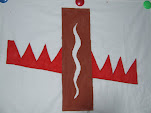
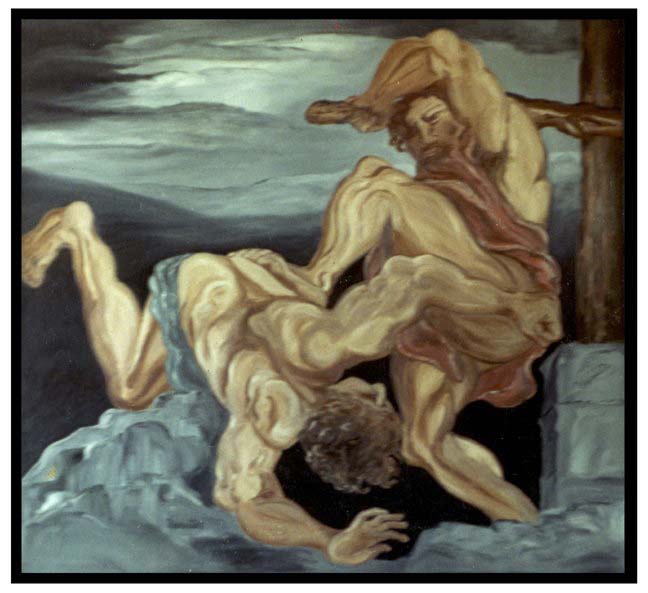
I call the picture on the right "The Last of Johns". It is taken from the photo album "Jāņu Foto Albums", Norden AB, 2007, p 37. The photo is from the LNVM collection. Taken on "Johns Day" in 1927 at Daugavpils, Rudzetu estate. The LNVM Collection captions the photo "A Poor Man on Johns Day". Other photos are snapshots of work in progress at "Black John, a Temple for the Missing Forests" near the writer's home.
NOT-VIOLENT TERROR
57 The People of Johns (I)
Circumstances have kept the people of Latvia almost invisible. This is not only the case during the founding of Latvia as a nation and the writing of the Latvian Constitution, when self-awareness ought to be at its hight. The reason for the “invisibility” of the Latvian people is rooted in the distant past. However, if the roots before the 12th century are hid for lack of records, from about the 12th and 13th centuries on the roots may be inferred from peoples sharing similar circumstances.
Caterina Bruschi, a lecturer at Birmingham University, has just published an innovative account of the Catholic Inquisition in Languedoc, now part of France. Her account takes into consideration the point of view of not only the inquisitors, but also the “heretics”. “The Wandering Heretics of Languaedoc”, published by the Cambridge University Press this year, is a study of the testimony of what Bruschi calls “non-conformist itinerants”, and how their depositions were effected not only by fear, but their dissent from the Catholic orthodoxy as well. http://tiny.cc/hv43e As the readers of my blogs know, I never call the name of so-called “Christianity” other than “neo-Christianity”. That is to say, what neo-Christians generally refer to as orthodox Christianity, I call it neo-Christianity. Therefore, in my parlance, the Christians of old who dissented from orthodoxy are what I call “arch-Christians”.
My interest in the Cathars of Languaedoc was first aroused, when it became increasingly likely to me that the fate of the Latvian “Children of Johns” (Jāņu bērni) was in some way related to the fate of the Cathars, the Waldesians, the Bogomils, in fact to all the confessions, which in one way or another could be imagined to have a connection with the name “John”—of which the Latvian “Jahnis” is a cognate.
As the reader probably knows, the Latvian “Children of John” (their festival is celebrated on Midsummer’s Eve) are a complete mystery today—especially to the Latvians themselves. This is in spite of the fact that almost all Latvians celebrate “Johns Eve” on an annual basis and have done so since time immemorial. The closest explanation for “Johns” that one comes across in public is that Johns Day is either “St. John the Baptist’s Day” or a common name’s day for John, the latter because it is the Latvian tradition to celebrate one’s name almost as if it were one’s birthday. In any event, if the mystery of whence “John’s Eve” was as much of a mystery in the 1930s as it is today, at least in the 1930s many country people still knew how to sing “the Songs of John”. Today after the holocaust of the Soviet occupation only the refrain “lihgo” (līgo) and perhaps a few phrases of once hundreds of songs remain part of popular memory. One noteworthy phrase exclaims “Ai, Johnny, son of God”; another tells us that “Johnny comes (?returns) every year”. The first phrase connects John to neo-Christianity, the other to antiquity, the latter because the words “every year” suggest that the origin of the festival is to be sought in antiquity. These remembrances are in our day continued only by community choirs (such as may remain) however, and it is only through such reminders that the community remains cognizant of Johns.
Bruschi does not mention in her book the “Children of Johns”. Nevertheless, she quotes an inquisitor who refers to the efforts of the Inquisition in Prussia, a region that in his days belonged to a tribe of Baltic people. Humbert of Romans, Dominical Master General from 1254-1264, writes from Paris:
“O, how much your charity would rejoice with me over the holy fervours of our brothers, if you knew how many of them, from assorted provinces [!], offered themselves with most fervent desire to the hardships of this task [of conversion]….” Though Bruschi does not quote Humbert in full, she ads the name of Prussia in her analysis of the phrase: “…the foreign missions here referred to [are]… the Cumans, Maronites, Tartars, Georgians, Saracens and Prussians.” For my part, I imagine many other tribes of the Balts were exposed to similar “fervours”, and know that all such “charity” exacted blood drawn by the sword.
Wherefrom the neo-Christian violence?
We should recall that when Humbert wrote his letter, it from the time that was before the Avignon papacy (1309-1378) http://tiny.cc/EIVej . We should also recall that the pope moved to Rome only in 1378. There was no pope in Rome before that time whatever the neo-Christian themselves may claim. Moreover, the Crusade against the Cathars of Lanquedoc ended with a Cathar holocaust in 1230, long before Rome existed as the seat of either neo-Christianity or the Pope. At thaT time, neo-Christianity was but an organization advancing the secular interests of certain kings and princes. Indeed, if one takes seriously the need for a revision of historical chronology, place names and locations (as per Anatoly Fomenko with whose views I generally agree), we cannot exclude the possibility that Humbert of Romans is a “Roman” from Byzantium, the capital of which, Constantinople, was sacked by proto-neo-Christians during the 4th Crusade in 1204.
The Balts—the Prussians, Courlanders, Semigalians, Latgalians, various tribes of the Lithuanians, etc.—were all subdued by the Germans (the French and the Brits joining in the early years of the Inquisition). As a consequence, some Balts assimilated themselves to the ways of the Germans or, if you will, of the West, the invaders, sooner than later. A major tool that forced the assimilation was neo-Christianity’s ability to bringing “the good news” through the above mentioned fervourous mouths of Dominican brothers and their ability to advertise their views through writing, which enabled them not only tokeep records, but to write and rewrite laws as they found it necessary.
The arch-Christian nature of the “Children of Johns” of Latvians has survived only to the extent that what was once the most holy day among the Balts, Midsummer’s Eve, has survived as a celebration, a festival. Way back then, I expect that the teachers of the Balts, “the wandering heretics”, were were killed or otherwise silenced. The martyrdom of the Johns broke the links between the various Baltic communities, leaving them isolated.
In their early days, the communities of the Balts lived mostly along the shores of rivers, lakes, the seashore, and whatever natural clearings there were to be found. Centuries later, after the various Indo-European tribes that settled Europe began to form what we now know as “the nations of Europe”, nation-forming engulfed the Balts in the wars of many princes. The Balts often took refuge by fleeing deeper into the surrounding forests and swamps, and became “the People of the Forest” (mežvides ļaudis). Of course, these seekers of safer harbors took the songs and their memories of the Johns Eve festival with them.
Eventually, the Balts of Livonia (one of the regions that was believed to have been native to the Balts) rediscovered their existence—that is to say, they become conscious of themselves as a larger-than-life community again. This was about the 16th century. Not surprisingly, such self-consciousness reawakened only when it was safe again to gather at markets and hold song festivals. This is when the Johns’ or “lihgo” songs reemerged and came to play an important role in the discovery of the Latvians as a people again. Somehow, the songs of Johns Eve had survived. http://tiny.cc/Axv1U
…………………………
Asterisk & Notes of Interest:
On the theme of “more-equal-than-others” http://tiny.cc/RRviK ; http://tiny.cc/1NFQJ
An eyeball view of Latvia (and its forests) http://tiny.cc/TSghu While some sources claim that Latvia is covered by a 47% forest cover, none of it is old growth forests. The Latvian news media provides little coverage of the rapid pace of deforestation. Anecdotal evidence of deforestation in progress from a neighbor of mine: “This fall there were far less mushrooms than last year, because the forests we used to go to are gone.”
These blogs tend to be a continuum of an idea or thought, which is why—if you are interested in what you have read—you are encouraged to consider reading the previous blog and the blog hereafter.
If you copy this blog for your files, or to forward, or otherwise mention its content, please credit the author and http://esoschroniclnes.blogspot.com/
Showing posts with label terror. Show all posts
Sunday, September 27, 2009
Copyright Eso Benjamins, aka Jaņdžs
NOT-VIOLENT TERROR30 Not-Violent Populism (II)
The trouble with assisted “suicide” is that governments, to the extent that they end up supporting such programs, present it as a matter beyond criticism and that government has taken into account the concerns of all traditional concepts of religion. Nevertheless, a presumption of secular religion as the replacement of traditional religions is also made clear.
As stated in the link in Blog 29 [see box therein]: “The Swiss Academy of Medical Sciences… wants regulations requiring a patient to have repeated discussions with his or her doctor over an extended period.” In short, neither my nor your conscience can function nor make sovereign decisions and consult with whoever it chooses without the intercession of government law and a government agent. The agent is of course the doctor maneuvered into the role of priest.
Secular religion, as defined above and long disguised as neo-Christianity, thus makes officially acknowledged (documented) citizens enjoy their human rights, while it keeps for itself only your sovereign right over your death. Thus, the slum dwellers may remain sovereign in their poverty and street traditions, yet are outside the pale of responsible citizenship and, thus, “democracy”.
The experience of the 20th century and earlier times proves that a democratic political system works only among economic equals, but becomes dysfunctional the moment economic equality is no longer enforced as an absolute requirement. The moment democracy meets with a situation of economic inequality, democracy becomes possible for only those who are economically more equal than others. In short, democracy is not a workable political system for our time in the sense that it is inclusive of all people.
What is absolute economic equality and how does democracy work in such a society?
Anthropologist Michael Taussig in his book “Mimesis and Alterity” (Routledge, 1993) discusses economic democracy among the aborigines of Tierra del Fuego and its fate following the discovery of the Fuegians by the West. Toussig quotes Charles Darwin, who because of his travels on the famous research ship HMS Beagle is almost the first among outsiders to meet them. Darwin writes in his Journal: “The perfect equality of all the inhabitants will for many years prevent their civilization, even a shirt or other article of clothing is immediately torn to pieces.”
A shocking literal interpretation of “equality”, is it not? But it is certainly democratic. According to Toussig, who studies the extraordinary mimetic abilities of aboriginal peoples, such economic equality and democracy is the result of the profound human ability to mime, thus, to empathize.
Standing opposite of such a mimeticized world is (to quote Taussig): “[A] disenchanted [world], one [that] is home to a self-enclosed and somewhat paranoid, possessive, individualized sense of self severed from and dominant over a dead and nonspiritualized nature, a self built antimimetically on the notion of work as an instrumental relation to the world within a system wherein that self ideally incorporates into itself wealth, property, citizenship, and of course ‘sense data’, all necessarily quantifiable so as to pass muster at the gates of new definitions of Truth and Accountability.”
Notwithstanding Taussig’s long and complex sentence, it can be reduced to a few horror filled facts. In the words of The Daily News, London, 1882: “It is thought that the country of Tierra del Fuego would prove suitable for cattle breeding, but the only drawback to this plan is that to all appearances it would be necessary to exterminate the Fuegians.” Toussig then continues: “The serious exterminating [had already] beg[u]n with the discovery of gold in 1878, and acquired a thoroughgoing character with the setting-up of sheep ranches by whites shortly thereafter…. Paid hunters were encouraged to wipe out the Indians*…. they (Toussig cites Gusinde, another anthropologist) were offered the same price for a pair of Indian ears as the going rate for a puma—one pound sterling. A pregnant woman’s ears together with those of the fetus extracted from her womb paid more….”
This is how “democracy” arrived to Tierra del Fuego. Similar “democratic” politics—though better disguised—continue to be practiced in “democratic” European Union. At the time this is being written, the International Monetary Fund (IMF) with the agreement of Brussels, the capital of the European Union, has saddled the “dumb Latvians” (according to Latvia’s own sociologists, politicians, and ‘politologues’) with a debt the service that will kill thousands of its elderly, cause untold suicides among others, and will virtually destroy the birth rate among the young. This horror to be visited on a country that was in the throes of a demographic burnout before the debt was incurred. There will be nary an empathetic tear shed by the “democratic” people among the more equal than others people of such countries as England, France, Germany, Sweden, you name them.
How is democracy to be realized in times, where Truth and Accountability are clearly caused to be dysfunctional by the likes of IMF, helped along by the ruling and academic classes of Latvia itself? Whatever praises are sung to democracy in our day, it is faith based, self-induced political religious gobbledygook of which its “God” (democracy) is far removed from Earth. Jesus Christ lies frozen in a man-made Heaven somewhere in the sky. Must we return to the early years of the 19th century in Tierra del Fuego, this time because Europe needs to grow and cut more trees to have 3 and 4-ply toilet paper, and Latvia has plenty of land for growing trees?
The answer to the problem among “developed” nations is plain: the nation and its military and police forces will prevent problem from becoming a problem—as they have done in the past. Moreover, this exceptional presumption is because (to quote Georges Bataille) “National and military life are present in the world to try to deny death by reducing it to a component of a glory without dread.” In other words, make death cheap or irrelevant not only in current wars, but from the very foundation of society’s dysfunctional faith in a God removed from Earth.
This is why a renewal of democracy demands a return to the reality of death.
The Latvians, currently in late-early phase of a die-out are most certainly gripped by the fear of collective disappearance. But, alas, the Latvians have no military force worth speaking of to start a desperate war against someone, anyone. If such a war—against the European Union for dumbing down the Latvians—were to be fought, the Latvians would simply die sooner. Which raises the question if resistance to demographic death (without seeking immortality) is possible in the first place? In addition, is the reported death of the neo-Christian God (first reported by Nietzche, circa 1883) actually true?
The answer is yes and no. No—if self-sacrificial public death is shied away from for reasons of mind-paralysis resulting from faith in the virtual God of nations and military armies. Yes—if Latvians begin to practice self-sacrificial public death at the doorstep of the European Union and the IMF. Though the Latvians may not survive their daring and dread (if they ever do dare), they may begin an overdue reconstitution of society the globe over.
If you copy this blog for your own files, or to be forwarded, or its content is otherwise mentioned, please credit the author and http://esoschronicles.blogspot.com/
Labels:
Children of Johns,
democracy,
IMF,
Latvia,
Latvians,
Taussing,
terror,
Tierra del Fuego
Sunday, September 13, 2009
Copyright E. A. Benjamins aka Jaņdžs
NOT-VIOLENT TERROR
26 The Whence of Zion
The story of Zionist Israel is a copy of the history that ground down the Jews in the past, an event that had its inception following the rise of neo-Christianity and the repression of its arch-brethren, the arch-Christians. The latter are still known as the Children of Johns among the Latvians, though the Latvians know nothing about the history of these “children”. Zionist Israel is real for sure, but the history that legitimizes it is no more valid than the one created for themselves by the Latvians sans the Children of Johns.
Here is one of the problems to the problem: while the word “Zion” echoes to Ion, Yon, John, i.e., Zion=Y(i)on, the Jews pay it no attention. Instead, we hear of archeological digs that discover old walls, but a potential archeological find of John as a statue a thousand feet long buried under the ground at Bamiyan ( John or Yan of Bami) or nearby in Afghanistan, is paid no attention to—either by Israelis or Latvians.
http://tinyurl.com/m2arvr
Whatever one wishes to believe about the existence of an ancient Israel in Palestine some twenty-eight centuries BE, it would make greater sense to seek the origin of Jews among gift collectors (later tax collectors) in the service of the temple and sacred kings. As servants of the kings and princes, the Jews enjoyed the protection of their sponsors (at a later time such protection became devious and exploitative). The relatively recent emergence of Jews as a people has more to do with the emergence of neo-Christianity (serving promiscuous secular power bent on eliminating opposition from arch-Christians) than it has to do with the lands or beliefs of the Semites. This is made clear by the fact that neo-Christians did not intervene in any self-sacrificial manner when the killing of arch-Christians began. Not surprisingly, neither did such intervention occur when the target became the Jews.
As argued throughout these blogs, Jews and neo-Christians, emerged from an arch-Christian foundation that has left traces of itself on all continents. Alas, these traces are simply ignored. It is worth remembering that the word “Christian” consists of two segments: cross + yan, and that Christ is a mythological meaning grafted to the word “cross”, leaving “yan” to become its “live” modifier. In other words, Christian derives from Cross+Yan or Krishyan [another possible spelling: Crnichan]. In 14th century Bosnia the name of an arch-Christian leader, Krishyan, is a personal name in some European countries to this day.
At the same time, the arch-Christians of Bosnia in the middle ages are themselves but a branch of the Johns, whose origins are to be traced to the “gans” (yans—herders) of animals in prehistoric times. The appearance of the Johns as Jews (or Hebrews) has more likely to do with the time when they were engaged in the transport of embalmed corpses from Europe and Asia for burial in the sands of Egypt. As gift collectors, the Yevreys (Jews in Russian) were most likely entrusted with the items that were to be buried with the corpses in Egypt. It is likely that they also became knowledgeable embalmers themselves. The transportation of the dead put the Jews in position of becoming knowledgeable in the ways of the body, not only embalming, but the art of healing as well. Their earnings (an excessive accumulation of gifts) enabled the Jews to enjoy a spiritual overflow (or esoterica of the mind that comes with leisure) that resulted in the Torah, the Bible, and other mimesis of “holy” writ.
The Jews—a caste within the arch-Christian tradition—became Judaized only after their arch-Christian base was repressed. It was only after the Jews, protected by the king let us remember, experienced a numerical surge due to the flight of arch-Christians seeking refuge from neo-Christians, that they became a political threat. The neo-Christians resented the sudden numerical advantage gained by the Jews, which caused them to attacks Jews also. The path of resistance by the Jews (really the Jews + the Children of Johns) resulted in the Judaization of arch-Christendom in the sense that “judaization” is a synonym for demonization of arch-Christianity. When the demonizing ceased, Judaism (the refuge of Children of Johns) became a catch-all for neo-Christianity’s ills: it forgot its John-Jewish roots, became a heretic hunter, and made violence rather than self-sacrifice (equally for all human kind) a trait of its political culture.
When the neo-Christian kings rewrote the story of John-Basil and made its hero Jesus, they simultaneously began a “holy” war against the Johns and their followers. The Albigensian Crusade (1234) is one such war. The crusades against the Slavs and Balts are other such. While there remain legends and poems of the Albigensian troubadours, all that remains of the Balts and their Children of Johns are some songs and—among the Latvians—the name, re: the Children of Johns (Jāņu bērni). The fruits of the neo-Christian victory over the Balts and arch-Christianity continue to be exploited by the neo-Christian Church even today. For example, neo-Christians in Latvia continue speak of the Johns Festival as St. John the Baptist’s Festival (which would be fine if Johns were to be understood as the college of sacred wanderers of whom Jesus was but one) or neutralize Johns Day by calling it “Summer Solstice Festival”. The Children of Johns chose the midsummer solstice as their high holy day, because the Johns were indeed not only the sons of the Sun, but the remnant of those wanderers who after their wanderings returned home.
With all the instruments of repression working against them, how did the name of the Children of Johns survive?
1) The Balts and Slavs were for the most part people of the forest. Forests and swamps covered their vast real estate. The Catholic neo-Christian Crusaders had a hard time penetrating all the nooks and crannies of this vast forested country. The “Day of Johns” continues to be celebrated by Latvians, who once upon a time on this day understood themselves part of a Children of Johns community. Unfortunately, the mind locks of the 20th century silenced the sacred in favor of a family picnic and/or sousing one’s self on beer.
2) The elimination of Johns Children by neo-Christians among the Balts was not as immediately fatal as it was among the Cathars of Albigensia. The Children of Johns in Latvia apparently survived for a while, perhaps along the lines of the Bosnian Church, which had its own hierarchy, and whose leader swore an oath to none. When neo-Christians began to persecute Johns Children as social deviants and anti-Christs, heretics all, and invented or, better, overemphasized ancient pagan mythology to replace arch-Christianity, the natives escaped death by hiding among a sect that was part of the greater Children of John community, the Ivreys, who were were the king’s tax collectors, which was why the king protected them. The Children of Johns began to call themselves Ivrejs or Jews. Since it was the tax collectors who invented writing (by way of keeping records), the other (exiled) Children of John picked up the art of writ of the Ivreys by osmosis and necessity. This was, psychologically speaking, a mind-locking, tongue-biting, and depressing time in the life of all who belonged to the Johns community. Eventually, the community, lacking written resources, succumbed to the neo-Christian ethos, and left the survival of its truths to the human psyche to sort out.
While at its foundation, 80% of Israelis were Ashkenazi Jews from Slavic and Baltic lands, few question how they got to those lands from far-away Palestine. The truth is that they were the inhabitants of the Slav- and Baltic lands all the time. The same goes for the Sephardic Jews. Their origin is the same as that of the Children of Johns among Latvians, but they come by way of North Africa and Spain.
If you copy this or otherwise mention the content of this blog, please credit the author and http://esoschronicles.blogspot.com/
NOT-VIOLENT TERROR
26 The Whence of Zion
The story of Zionist Israel is a copy of the history that ground down the Jews in the past, an event that had its inception following the rise of neo-Christianity and the repression of its arch-brethren, the arch-Christians. The latter are still known as the Children of Johns among the Latvians, though the Latvians know nothing about the history of these “children”. Zionist Israel is real for sure, but the history that legitimizes it is no more valid than the one created for themselves by the Latvians sans the Children of Johns.
Here is one of the problems to the problem: while the word “Zion” echoes to Ion, Yon, John, i.e., Zion=Y(i)on, the Jews pay it no attention. Instead, we hear of archeological digs that discover old walls, but a potential archeological find of John as a statue a thousand feet long buried under the ground at Bamiyan ( John or Yan of Bami) or nearby in Afghanistan, is paid no attention to—either by Israelis or Latvians.
http://tinyurl.com/m2arvr
Whatever one wishes to believe about the existence of an ancient Israel in Palestine some twenty-eight centuries BE, it would make greater sense to seek the origin of Jews among gift collectors (later tax collectors) in the service of the temple and sacred kings. As servants of the kings and princes, the Jews enjoyed the protection of their sponsors (at a later time such protection became devious and exploitative). The relatively recent emergence of Jews as a people has more to do with the emergence of neo-Christianity (serving promiscuous secular power bent on eliminating opposition from arch-Christians) than it has to do with the lands or beliefs of the Semites. This is made clear by the fact that neo-Christians did not intervene in any self-sacrificial manner when the killing of arch-Christians began. Not surprisingly, neither did such intervention occur when the target became the Jews.
As argued throughout these blogs, Jews and neo-Christians, emerged from an arch-Christian foundation that has left traces of itself on all continents. Alas, these traces are simply ignored. It is worth remembering that the word “Christian” consists of two segments: cross + yan, and that Christ is a mythological meaning grafted to the word “cross”, leaving “yan” to become its “live” modifier. In other words, Christian derives from Cross+Yan or Krishyan [another possible spelling: Crnichan]. In 14th century Bosnia the name of an arch-Christian leader, Krishyan, is a personal name in some European countries to this day.
At the same time, the arch-Christians of Bosnia in the middle ages are themselves but a branch of the Johns, whose origins are to be traced to the “gans” (yans—herders) of animals in prehistoric times. The appearance of the Johns as Jews (or Hebrews) has more likely to do with the time when they were engaged in the transport of embalmed corpses from Europe and Asia for burial in the sands of Egypt. As gift collectors, the Yevreys (Jews in Russian) were most likely entrusted with the items that were to be buried with the corpses in Egypt. It is likely that they also became knowledgeable embalmers themselves. The transportation of the dead put the Jews in position of becoming knowledgeable in the ways of the body, not only embalming, but the art of healing as well. Their earnings (an excessive accumulation of gifts) enabled the Jews to enjoy a spiritual overflow (or esoterica of the mind that comes with leisure) that resulted in the Torah, the Bible, and other mimesis of “holy” writ.
The Jews—a caste within the arch-Christian tradition—became Judaized only after their arch-Christian base was repressed. It was only after the Jews, protected by the king let us remember, experienced a numerical surge due to the flight of arch-Christians seeking refuge from neo-Christians, that they became a political threat. The neo-Christians resented the sudden numerical advantage gained by the Jews, which caused them to attacks Jews also. The path of resistance by the Jews (really the Jews + the Children of Johns) resulted in the Judaization of arch-Christendom in the sense that “judaization” is a synonym for demonization of arch-Christianity. When the demonizing ceased, Judaism (the refuge of Children of Johns) became a catch-all for neo-Christianity’s ills: it forgot its John-Jewish roots, became a heretic hunter, and made violence rather than self-sacrifice (equally for all human kind) a trait of its political culture.
When the neo-Christian kings rewrote the story of John-Basil and made its hero Jesus, they simultaneously began a “holy” war against the Johns and their followers. The Albigensian Crusade (1234) is one such war. The crusades against the Slavs and Balts are other such. While there remain legends and poems of the Albigensian troubadours, all that remains of the Balts and their Children of Johns are some songs and—among the Latvians—the name, re: the Children of Johns (Jāņu bērni). The fruits of the neo-Christian victory over the Balts and arch-Christianity continue to be exploited by the neo-Christian Church even today. For example, neo-Christians in Latvia continue speak of the Johns Festival as St. John the Baptist’s Festival (which would be fine if Johns were to be understood as the college of sacred wanderers of whom Jesus was but one) or neutralize Johns Day by calling it “Summer Solstice Festival”. The Children of Johns chose the midsummer solstice as their high holy day, because the Johns were indeed not only the sons of the Sun, but the remnant of those wanderers who after their wanderings returned home.
With all the instruments of repression working against them, how did the name of the Children of Johns survive?
1) The Balts and Slavs were for the most part people of the forest. Forests and swamps covered their vast real estate. The Catholic neo-Christian Crusaders had a hard time penetrating all the nooks and crannies of this vast forested country. The “Day of Johns” continues to be celebrated by Latvians, who once upon a time on this day understood themselves part of a Children of Johns community. Unfortunately, the mind locks of the 20th century silenced the sacred in favor of a family picnic and/or sousing one’s self on beer.
2) The elimination of Johns Children by neo-Christians among the Balts was not as immediately fatal as it was among the Cathars of Albigensia. The Children of Johns in Latvia apparently survived for a while, perhaps along the lines of the Bosnian Church, which had its own hierarchy, and whose leader swore an oath to none. When neo-Christians began to persecute Johns Children as social deviants and anti-Christs, heretics all, and invented or, better, overemphasized ancient pagan mythology to replace arch-Christianity, the natives escaped death by hiding among a sect that was part of the greater Children of John community, the Ivreys, who were were the king’s tax collectors, which was why the king protected them. The Children of Johns began to call themselves Ivrejs or Jews. Since it was the tax collectors who invented writing (by way of keeping records), the other (exiled) Children of John picked up the art of writ of the Ivreys by osmosis and necessity. This was, psychologically speaking, a mind-locking, tongue-biting, and depressing time in the life of all who belonged to the Johns community. Eventually, the community, lacking written resources, succumbed to the neo-Christian ethos, and left the survival of its truths to the human psyche to sort out.
While at its foundation, 80% of Israelis were Ashkenazi Jews from Slavic and Baltic lands, few question how they got to those lands from far-away Palestine. The truth is that they were the inhabitants of the Slav- and Baltic lands all the time. The same goes for the Sephardic Jews. Their origin is the same as that of the Children of Johns among Latvians, but they come by way of North Africa and Spain.
If you copy this or otherwise mention the content of this blog, please credit the author and http://esoschronicles.blogspot.com/
Labels:
arch-christianity,
Children of Johns,
Latvia,
neo-christianity,
terror,
Zion
Sunday, August 30, 2009
Copyright E. A. Benjamins aka Jaņdžs
NOT-VIOLENT TERROR
24 A Function of Awe
The civil war that began round about the year 1117, when Alexius I threw Basil (according to my theses also known as Jesus or John) into the pit of fire continues to this day.
After killing Basil (and the subsequent destruction of the empire of Alexius I by the French in a “Crusade”), Basil-John’s Holy Office was removed (1305) from Constantinople to Avignon. Seventy-three years later, in order to make the priesthood in Avignon look less French, the office was moved once more, this time to Rome. The Byzantine people were not happy, but perhaps this spiritual violence was mitigated by a promise that Basil-John would sit in Rome, where western princes would surely protect him from oriental despots like Alexius I. The protection, if such was offered, proved a lie. No Pope has ever sacrificed his life as John-Basil and his retinue of Johns routinely did before secular kings put them to death. Instead, the early popes—the brothers or in-laws of kings—called (actually renamed) John Jesus and wrote a new myth about his divinity.
While today neo-Christianity is a show that entertains a dead God, western thinkers stubbornly cling to western (Scaligarian and Petavian) chronology of history. Even atheists cannot shake off this lighter than air God and remain bound to a God, they claim not to believe in.
From the very beginning of this religious civil war, which essentially polarizes people in two economic camps, the allies of Jesus have had the upper hand. It is thus that they are able to impose on the world their version of the story-history of John. Indeed, the princes invented the story about Jesus we know. At the same time, this invention is the reason why the fire pit death of Basil is practically unknown.
The civil war is at its bloodiest today, even though to one of the economic poles it may appear to be bloodless. No matter how many thousands of images of dismembered and dead men, women, and children are shown on the internet and television they are as if not seen. This is because such scenes take place far away from the viewers living inside the protected zones of the powers-that-be.
Being the apparent winner of the civil war, the successors of Alexius I (symbols of state power and righteousness) claim to speak in the name of love and peace, and let the bloodguilt fall on unnamed secularist armies (their own and that of their enemies) as though these appeared outside the bounds of western foreign policies. Worse, the oligarchs (or their like) have not only killed Basil-John and changed his name to Jesus, but have installed Jesus-Basil as the ruler of heaven, where all his energies are consumed trying to sit on air.
Perhaps the “victory” of the successors of Alexius I will be carried forward yet another thousand years. However, there are reasons to doubt this. The torn social bonds that are the price of appearing to be victor of this war have turned the populace into an army of the dumb. This is not without its corrosive effects. Unable to resist the oligarchs, the poor play a waiting game. That is, they wait for the rich and their own to exhaust the resources of our planet, because it is only after the resources are exhausted will everyone be able to let the Earth go fallow and gradually resume a normal life again.
Poets, often true, but physically weak seers, have watched—real time and their mind’s eye—ignorant armies http://tinyurl.com/qk7mqr rush to be devoured by chaos http://tinyurl.com/2lhyc4 . Brazen men with brazen promises are in leadership positions http://tinyurl.com/pdujkd . Mountaintops (bald for loss of snow and forest cover) and deserts (jumping from Africa to Europe) have replaced the ancient Johns with Apocalypse sans Jesus in real time.
Waiting still, the poets see no sacrifice charismatic enough (whether by John, Jesus, or anonymous soldiers blowing their heads off in the field) to save humankind. Governments with high decibel sugars glaze all protests.
But wait! Is it not curious that the present winners of the civil war appear to hate most “suicide terrorists”? Is it not a “suicide terrorist” one who takes not only his-her own life, but the lives of everyone around, the lives of the innocent as well as the guilty? Does not such self-sacrifice speak of utter moral depravity, which gives the ruling elite moral authority by default? Most likely this is because the powers-that-be presume such moral authority as much as the terrorists do.
At this time, the losing side, the poverty stricken and superfluous, use tactics that they have learned from the winning elite, who camouflage their violence from the eyes of the ordinary citizens by controlling the communications media. We hear of remote controlled drones killing the opposition leader, but it takes a long time for the news to reach us that along with the leader, the dead include the bride, the groom, and most of the wedding guests. http://tinyurl.com/ncgx2m . While the tactics of both sides of the civil war are roughly the same and equally brutal, it nevertheless appears that only the side of the poverty-stricken and superfluous ones, has the option to practice true self-sacrifice. At a time when the internet is replacing newspapers, radio, and television as primary media as the disseminator of news and other information, the tools are available that will record and broadcast the self-sacrificial deed and censure it and keep it anonymous. The failure to express protest by using self-sacrificial death as a tool (what John-Basil-Jesus taught), may be seeing the end of its days.
Slavoy Žižek, a Slovenian philosopher and at this time the director of the Birbeck Institute in London, approvingly cites Brecht, the German playwright. Writes Brecht (in “Baden Learning Play on Consent”): “To encourage a man for his death, the interveningly thinking one (der eingreifend Denkende) asks him to give away his goods. When the man gives away everything, what is left over is only life. Give away more, says the thinking one.” The ‘interveningly thinking one’, one assumes, is one’s own inner voice. [No doubt, the language is a bit heavy.]
Žižek then writes (“The Monstrosity of Christ”, pp 300): “This ‘give more’ is a true ethical answer to the false spirit of sacrifice: it hits the narcissistic satisfaction provided by sacrifice in the eye. Brecht’s real target here is the pathetic gesture of sacrifice….”
Nevertheless, one may object: What if sacrifice is essential, a kind of mirror of the Big Other mentioned in a previous blog, so that human kind will be reminded of itself by reminding itself to mind, which reminder is essential to the formation of a larger-than-life or virtual society?
What if with the mirror, which reflects back to one one’s true terror of death, puts the same one in awe of the (“pathetic”) sacrifice and breaks down the refusal of one’s otherwise ungovernable ego to submit to the compromise that is necessary to create a society larger than one’s immediate family and intimates?
If you copy this or otherwise mention the content of this blog, please credit the author and http://esoschronicles.blogspot.com/
NOT-VIOLENT TERROR
24 A Function of Awe
The civil war that began round about the year 1117, when Alexius I threw Basil (according to my theses also known as Jesus or John) into the pit of fire continues to this day.
After killing Basil (and the subsequent destruction of the empire of Alexius I by the French in a “Crusade”), Basil-John’s Holy Office was removed (1305) from Constantinople to Avignon. Seventy-three years later, in order to make the priesthood in Avignon look less French, the office was moved once more, this time to Rome. The Byzantine people were not happy, but perhaps this spiritual violence was mitigated by a promise that Basil-John would sit in Rome, where western princes would surely protect him from oriental despots like Alexius I. The protection, if such was offered, proved a lie. No Pope has ever sacrificed his life as John-Basil and his retinue of Johns routinely did before secular kings put them to death. Instead, the early popes—the brothers or in-laws of kings—called (actually renamed) John Jesus and wrote a new myth about his divinity.
While today neo-Christianity is a show that entertains a dead God, western thinkers stubbornly cling to western (Scaligarian and Petavian) chronology of history. Even atheists cannot shake off this lighter than air God and remain bound to a God, they claim not to believe in.
From the very beginning of this religious civil war, which essentially polarizes people in two economic camps, the allies of Jesus have had the upper hand. It is thus that they are able to impose on the world their version of the story-history of John. Indeed, the princes invented the story about Jesus we know. At the same time, this invention is the reason why the fire pit death of Basil is practically unknown.
The civil war is at its bloodiest today, even though to one of the economic poles it may appear to be bloodless. No matter how many thousands of images of dismembered and dead men, women, and children are shown on the internet and television they are as if not seen. This is because such scenes take place far away from the viewers living inside the protected zones of the powers-that-be.
Being the apparent winner of the civil war, the successors of Alexius I (symbols of state power and righteousness) claim to speak in the name of love and peace, and let the bloodguilt fall on unnamed secularist armies (their own and that of their enemies) as though these appeared outside the bounds of western foreign policies. Worse, the oligarchs (or their like) have not only killed Basil-John and changed his name to Jesus, but have installed Jesus-Basil as the ruler of heaven, where all his energies are consumed trying to sit on air.
Perhaps the “victory” of the successors of Alexius I will be carried forward yet another thousand years. However, there are reasons to doubt this. The torn social bonds that are the price of appearing to be victor of this war have turned the populace into an army of the dumb. This is not without its corrosive effects. Unable to resist the oligarchs, the poor play a waiting game. That is, they wait for the rich and their own to exhaust the resources of our planet, because it is only after the resources are exhausted will everyone be able to let the Earth go fallow and gradually resume a normal life again.
Poets, often true, but physically weak seers, have watched—real time and their mind’s eye—ignorant armies http://tinyurl.com/qk7mqr rush to be devoured by chaos http://tinyurl.com/2lhyc4 . Brazen men with brazen promises are in leadership positions http://tinyurl.com/pdujkd . Mountaintops (bald for loss of snow and forest cover) and deserts (jumping from Africa to Europe) have replaced the ancient Johns with Apocalypse sans Jesus in real time.
Waiting still, the poets see no sacrifice charismatic enough (whether by John, Jesus, or anonymous soldiers blowing their heads off in the field) to save humankind. Governments with high decibel sugars glaze all protests.
But wait! Is it not curious that the present winners of the civil war appear to hate most “suicide terrorists”? Is it not a “suicide terrorist” one who takes not only his-her own life, but the lives of everyone around, the lives of the innocent as well as the guilty? Does not such self-sacrifice speak of utter moral depravity, which gives the ruling elite moral authority by default? Most likely this is because the powers-that-be presume such moral authority as much as the terrorists do.
At this time, the losing side, the poverty stricken and superfluous, use tactics that they have learned from the winning elite, who camouflage their violence from the eyes of the ordinary citizens by controlling the communications media. We hear of remote controlled drones killing the opposition leader, but it takes a long time for the news to reach us that along with the leader, the dead include the bride, the groom, and most of the wedding guests. http://tinyurl.com/ncgx2m . While the tactics of both sides of the civil war are roughly the same and equally brutal, it nevertheless appears that only the side of the poverty-stricken and superfluous ones, has the option to practice true self-sacrifice. At a time when the internet is replacing newspapers, radio, and television as primary media as the disseminator of news and other information, the tools are available that will record and broadcast the self-sacrificial deed and censure it and keep it anonymous. The failure to express protest by using self-sacrificial death as a tool (what John-Basil-Jesus taught), may be seeing the end of its days.
Slavoy Žižek, a Slovenian philosopher and at this time the director of the Birbeck Institute in London, approvingly cites Brecht, the German playwright. Writes Brecht (in “Baden Learning Play on Consent”): “To encourage a man for his death, the interveningly thinking one (der eingreifend Denkende) asks him to give away his goods. When the man gives away everything, what is left over is only life. Give away more, says the thinking one.” The ‘interveningly thinking one’, one assumes, is one’s own inner voice. [No doubt, the language is a bit heavy.]
Žižek then writes (“The Monstrosity of Christ”, pp 300): “This ‘give more’ is a true ethical answer to the false spirit of sacrifice: it hits the narcissistic satisfaction provided by sacrifice in the eye. Brecht’s real target here is the pathetic gesture of sacrifice….”
Nevertheless, one may object: What if sacrifice is essential, a kind of mirror of the Big Other mentioned in a previous blog, so that human kind will be reminded of itself by reminding itself to mind, which reminder is essential to the formation of a larger-than-life or virtual society?
What if with the mirror, which reflects back to one one’s true terror of death, puts the same one in awe of the (“pathetic”) sacrifice and breaks down the refusal of one’s otherwise ungovernable ego to submit to the compromise that is necessary to create a society larger than one’s immediate family and intimates?
If you copy this or otherwise mention the content of this blog, please credit the author and http://esoschronicles.blogspot.com/
Labels:
Basil,
civil war,
Crusade,
John,
not-violent terror,
Slavoy Zizek,
Slavoy Žižek,
terror
Monday, August 24, 2009
Copyright E. A. Benjamins aka Jaņdžs
NOT-VIOLENT TERROR
22 Terror and Awe
Every child is born expecting love and a breast full of milk. As we grow up, we discover that we do not cease expecting easy access to the breast, because it has come to represent—love. We also learn that love does not come easy, especially after we grow old enough to have to look out for our food and shelter. Some call it “scratching out a living”. We meet others, some of whom may look on us as of another species. If our teachers are without breadth and depth, we may learn to become the same. What started with a positive outlook may turn into a life with a minus (– 1).
In spite of the fact that we grow old and know that we have given back to the world little of what we expect from it, we do not cease to expect it—love. We wish to leave love behind us (as per Jesus’-John’s famous “love one another”), and have love to welcome us back to whence we came, through the door of the Big Zero into the world of -1.
The quantum jump or leap http://tinyurl.com/d3l7jo that we make when we make the transit from +1 and go through the Big Zero to –1 may seem like a mystery, but in approximate terms, it involves but
· – 1 + sexual contact between a man and a woman = passage
0 (a seesaw) through the hole of the Big Zero to possible conception;
· + 1 = conception, living as a fish within the womb of the mother;
· + 2 = emerging from the womb into the world of air;
· + 3 = discovering the mirror, memory;
· + 4 = beginning to walk and talk;
· + 5 = learning to live with others through reflecting;
· + 6 = learning to live our own story;
· + 7 = helping to maintain a community;
· + 8 = preparing for death and survival of death through cloning;
· + 9 = a return to – 1 (perhaps to what the Tibetans call Bardo http://tinyurl.com/c26upc ), and reconstruct from Nothing-Something (–) a Something-Nothing (+).
· +10 = it is probable that reconstructions from out of Nothing-Something differ from each other, because the ultimate goal of Isness is to reach self-awareness, not a different hairdo.
However, mothers experience their child’s “quantum jump” into life rather differently. Whatever the pleasures of the sexual act, many mothers have died in childbirth or experienced terrifying traumas because of the risks involved in giving birth. Of course, for those who survived giving birth to a child, it was a joyful and awesome experience. http://tinyurl.com/cfqegk Few women even today face childbirth without fear or terror. [For near-death birth experience http://tinyurl.com/c2qdr7 For near death experience (scroll to p. 217ff) http://tinyurl.com/c3gk7t ] These examples prove that terror is not necessarily the result of overt violent attacks, but comes with consciousness and begs us to accept the limits of the act of creation. John [Brown] moldering in his grave can only take us to the entry point; the rest has to come from our contribution in carrying the ball of creation forward.
How demoralized the consciousness that allows one to wrap one’s self in dynamite sticks and annihilate everyone around one. How demoralized the moral environment of those who fight such terrorists by vying among themselves over who kills more of them http://tinyurl.com/d9mr8s . This is what a Something-Nothing on the plus (+) side looks like. The moral degradation of the haves who hire such soldiers-terrorists makes it easier for us to see the polarization that military acts create. We begin to understand how violent terror delays the development of humankind from negation to Something, which accepts self-sacrifice as essential.
Self-sacrifice is essential if a community wishes to remain self-aware in body and spirit. If one sacrifices one’s self in the world of Nothing-Something or Bardo, one gives birth to awe, i.e., life. This is how Genesis 2:2 tells its “…and he rested on the seventh day from all his work which he had made.” One may say, without contradicting Genesis, that after “he” had done creating, God died. Such was the assumption of ancient myths. http://tinyurl.com/de7avc We, the created, are in awe of Creation, whether by God or by evolution.
In whichever direction we pass through the 0, whether to – 1 or + 1, it involves sacrifice. From + 1 to – 1 means to die, like it or not. The body must succumb to the limits of matter. From – 1 to + 1 also means to take on the risk of death, but this time less by the time-traveler than the bearer of the traveler, the mother. The birth canal is the only tunnel with a light at the end of it.
When sacred kings died, they were like a mother giving birth. They were full of anxiety before the experience that they had committed themselves to, especially when the hour of delivery drew near. Unlike the common man, the king died conscious. This was leadership by deed (example). A slow death before a public eye, say, by not taking food http://tinyurl.com/c3yu72 , allows the witnesses (embodied by people coming to say good bye) to wonder over man’s (actually their own) will.
Unlike the common man, the sacred kings (Johns) stood before the altar in terror, but also in intellectual awe that their sacrifice—self-sacrifice under ideal conditions—maintains and at the same time repeats the act of creation of society. After they died with no one to witness whether they actually made it through the 0, the people, nevertheless, could only speak of the act with awe. As witnesses, they stand bonded to what they have seen. Strangely (to us, but perhaps not to the sacred kings), the witnesses went away certain that if their community ever needed their lives, they would take strength from the sacred king and join him in a like deeds.
If you copy this or otherwise mention the content of this blog, please credit the author and http://esoschronicles.blogspot.com/
NOT-VIOLENT TERROR
22 Terror and Awe
Every child is born expecting love and a breast full of milk. As we grow up, we discover that we do not cease expecting easy access to the breast, because it has come to represent—love. We also learn that love does not come easy, especially after we grow old enough to have to look out for our food and shelter. Some call it “scratching out a living”. We meet others, some of whom may look on us as of another species. If our teachers are without breadth and depth, we may learn to become the same. What started with a positive outlook may turn into a life with a minus (– 1).
In spite of the fact that we grow old and know that we have given back to the world little of what we expect from it, we do not cease to expect it—love. We wish to leave love behind us (as per Jesus’-John’s famous “love one another”), and have love to welcome us back to whence we came, through the door of the Big Zero into the world of -1.
The quantum jump or leap http://tinyurl.com/d3l7jo that we make when we make the transit from +1 and go through the Big Zero to –1 may seem like a mystery, but in approximate terms, it involves but
· – 1 + sexual contact between a man and a woman = passage
0 (a seesaw) through the hole of the Big Zero to possible conception;
· + 1 = conception, living as a fish within the womb of the mother;
· + 2 = emerging from the womb into the world of air;
· + 3 = discovering the mirror, memory;
· + 4 = beginning to walk and talk;
· + 5 = learning to live with others through reflecting;
· + 6 = learning to live our own story;
· + 7 = helping to maintain a community;
· + 8 = preparing for death and survival of death through cloning;
· + 9 = a return to – 1 (perhaps to what the Tibetans call Bardo http://tinyurl.com/c26upc ), and reconstruct from Nothing-Something (–) a Something-Nothing (+).
· +10 = it is probable that reconstructions from out of Nothing-Something differ from each other, because the ultimate goal of Isness is to reach self-awareness, not a different hairdo.
However, mothers experience their child’s “quantum jump” into life rather differently. Whatever the pleasures of the sexual act, many mothers have died in childbirth or experienced terrifying traumas because of the risks involved in giving birth. Of course, for those who survived giving birth to a child, it was a joyful and awesome experience. http://tinyurl.com/cfqegk Few women even today face childbirth without fear or terror. [For near-death birth experience http://tinyurl.com/c2qdr7 For near death experience (scroll to p. 217ff) http://tinyurl.com/c3gk7t ] These examples prove that terror is not necessarily the result of overt violent attacks, but comes with consciousness and begs us to accept the limits of the act of creation. John [Brown] moldering in his grave can only take us to the entry point; the rest has to come from our contribution in carrying the ball of creation forward.
How demoralized the consciousness that allows one to wrap one’s self in dynamite sticks and annihilate everyone around one. How demoralized the moral environment of those who fight such terrorists by vying among themselves over who kills more of them http://tinyurl.com/d9mr8s . This is what a Something-Nothing on the plus (+) side looks like. The moral degradation of the haves who hire such soldiers-terrorists makes it easier for us to see the polarization that military acts create. We begin to understand how violent terror delays the development of humankind from negation to Something, which accepts self-sacrifice as essential.
Self-sacrifice is essential if a community wishes to remain self-aware in body and spirit. If one sacrifices one’s self in the world of Nothing-Something or Bardo, one gives birth to awe, i.e., life. This is how Genesis 2:2 tells its “…and he rested on the seventh day from all his work which he had made.” One may say, without contradicting Genesis, that after “he” had done creating, God died. Such was the assumption of ancient myths. http://tinyurl.com/de7avc We, the created, are in awe of Creation, whether by God or by evolution.
In whichever direction we pass through the 0, whether to – 1 or + 1, it involves sacrifice. From + 1 to – 1 means to die, like it or not. The body must succumb to the limits of matter. From – 1 to + 1 also means to take on the risk of death, but this time less by the time-traveler than the bearer of the traveler, the mother. The birth canal is the only tunnel with a light at the end of it.
When sacred kings died, they were like a mother giving birth. They were full of anxiety before the experience that they had committed themselves to, especially when the hour of delivery drew near. Unlike the common man, the king died conscious. This was leadership by deed (example). A slow death before a public eye, say, by not taking food http://tinyurl.com/c3yu72 , allows the witnesses (embodied by people coming to say good bye) to wonder over man’s (actually their own) will.
Unlike the common man, the sacred kings (Johns) stood before the altar in terror, but also in intellectual awe that their sacrifice—self-sacrifice under ideal conditions—maintains and at the same time repeats the act of creation of society. After they died with no one to witness whether they actually made it through the 0, the people, nevertheless, could only speak of the act with awe. As witnesses, they stand bonded to what they have seen. Strangely (to us, but perhaps not to the sacred kings), the witnesses went away certain that if their community ever needed their lives, they would take strength from the sacred king and join him in a like deeds.
If you copy this or otherwise mention the content of this blog, please credit the author and http://esoschronicles.blogspot.com/
Labels:
John,
private temple,
sacred king,
terror
Wednesday, August 19, 2009
Copyright E. A. Benjamins aka Jaņdžs
NOT-VIOLENT TERROR
21 No Mirror, No Terror, No Consciousness
The second half of the 20th century saw newspaper articles and discussions on television about “leisure society” on almost a daily basis. The economist Maynard Keynes coined the idea of a leisure society in the early 1930s. From about the mid 1960s, the phrase seemed to be on everyone’s tongue. In the 1980s the talk stopped.
While the rich and well to do continued to enjoy their leisure, it was apparent that the mirror that mirrored the future—a mirror that reflected back to ordinary Americans the fantasies they projected forward—knew that leisure society was not to be after all. Rather, the future arrived as a gradual but steady economic decline loaded with ever-increasing anxiety and stress.
It is very possible that the mirror of the future reflects onto the mirror of the past, which then returns what it knows or sees of the past onto the future again. The innocent and unlearned are the ones trapped in the middle of this play of mirrors, while the not so innocent (the ones who have the power to manipulate) manipulate the mirrors in such a way that the theatre of Truth, the act of life, becomes a circus. While Daliesque distortions of images are possible under any circumstances, malicious distortions that benefit a small clique will, if practiced for a generation or more, cause the forgetting of the real and result in a catastrophe for all. Like it or not, the manipulators cannot influence the real (written with a small r rather than a large one), because it has its own agenda.
The real is limited by what it is. For the real nothing else is real but it. For example, the real accepts (lets happen) that a cat in realizing itself a real cat will hunt and catch mice. My cat obviously delights in catching mice. I can tell this by watching her in an excess of joy playing with the mouse she has caught, even when it is already dead. However, how can I really tell this is so? Actually, I cannot tell, but in the process of being a witness to what I am describing, I try to imagine being my cat. I try to mimic her feelings by a kind of inward dream process. Outwardly, I am horrified by what appears to be sadistic behavior. On the other hand, by imagining myself in my cat’s place (in dreaming myself to have become a cat), I stop myself from calling her a “bad cat”.
Something similar appears to be happening, when I dream of the hieros gamos ritual in a city and bar which I have never before visited. While my public self hesitates from acknowledging the dream as my own because of the moral laws of our civilization, my dreams protect me from humiliation by substituting for me another figure—a stranger. Only then does the dream proceed: the Goddess with the pearly breast and a man’s genitals comes to me to enact our union. Strangely, I become a curious bystander and a witness to someone else sucking the milk of kindness unhesitatingly offered by the Goddess. Thus, the cat hunts and kills, and I let nature take her course in spite of the censorship my conscious mind imposes on my cat’s kill.
Does perhaps death happen in the same manner? After I have done pleasuring my mother (as much as I may refuse to acknowledge any pleasure from living a life which ends in capital punishment), do we continue to embrace as lovers? My subconsciously created dream and my conscious projection of it through acknowledging its existence onto the mirror (the big Other), answers yes. This is why the real needs the big Other—even as we know the big Other is a mirror and an illusion.
To suggest as psychologists and philosophers Žižek and Lacan do, that full consciousness of the real does not need a mediator (heretofore known as God or “the big Other”) is like saying the body has no need of sleep. One common method of torture is sleep depravation, just as the easiest method of making a person look an idiot is to deprive him-her of a mirror.
The need for a big Other may be explained by a feature of the real that has heretofore gone unrecognized, but which we may call “the real of the undead”. That is, when we die, we enter a zone of activity that runs parallel to quantum mechanics: when because of dying a human being becomes a zero (0), he-she simultaneously crosses over, to a greater or lesser degree, to the minus (-) side, meaning that his-her activities take place in a negative environment. It means that the dead (0) become undead (-) and begin to reconstruct reality from scratch.
When after billions of light years of activity in minus territory, consciousness again arrives at zero (inevitable chance happening as understood by dandelion seeds flying over a large forest), he-she may cross over into plus territory. In effect, he-she eventually arrives at the limits of knowledge possible to arrive at by the minus side and which then self-instructs that time has come to try a quantum jump to the Other side. Once on the plus side, he-she again begins to figure out how the real fits together, then tries to advance the interests of consciousness with no less exertion of patience and not-violence than the undead.
Therefore, it is on the Other side (which ever side) that the real enters the evolutionary process, through which we arrive at an understanding of All, the Being that in the interim many knew only as God.
21 No Mirror, No Terror, No Consciousness
The second half of the 20th century saw newspaper articles and discussions on television about “leisure society” on almost a daily basis. The economist Maynard Keynes coined the idea of a leisure society in the early 1930s. From about the mid 1960s, the phrase seemed to be on everyone’s tongue. In the 1980s the talk stopped.
While the rich and well to do continued to enjoy their leisure, it was apparent that the mirror that mirrored the future—a mirror that reflected back to ordinary Americans the fantasies they projected forward—knew that leisure society was not to be after all. Rather, the future arrived as a gradual but steady economic decline loaded with ever-increasing anxiety and stress.
It is very possible that the mirror of the future reflects onto the mirror of the past, which then returns what it knows or sees of the past onto the future again. The innocent and unlearned are the ones trapped in the middle of this play of mirrors, while the not so innocent (the ones who have the power to manipulate) manipulate the mirrors in such a way that the theatre of Truth, the act of life, becomes a circus. While Daliesque distortions of images are possible under any circumstances, malicious distortions that benefit a small clique will, if practiced for a generation or more, cause the forgetting of the real and result in a catastrophe for all. Like it or not, the manipulators cannot influence the real (written with a small r rather than a large one), because it has its own agenda.
The real is limited by what it is. For the real nothing else is real but it. For example, the real accepts (lets happen) that a cat in realizing itself a real cat will hunt and catch mice. My cat obviously delights in catching mice. I can tell this by watching her in an excess of joy playing with the mouse she has caught, even when it is already dead. However, how can I really tell this is so? Actually, I cannot tell, but in the process of being a witness to what I am describing, I try to imagine being my cat. I try to mimic her feelings by a kind of inward dream process. Outwardly, I am horrified by what appears to be sadistic behavior. On the other hand, by imagining myself in my cat’s place (in dreaming myself to have become a cat), I stop myself from calling her a “bad cat”.
Something similar appears to be happening, when I dream of the hieros gamos ritual in a city and bar which I have never before visited. While my public self hesitates from acknowledging the dream as my own because of the moral laws of our civilization, my dreams protect me from humiliation by substituting for me another figure—a stranger. Only then does the dream proceed: the Goddess with the pearly breast and a man’s genitals comes to me to enact our union. Strangely, I become a curious bystander and a witness to someone else sucking the milk of kindness unhesitatingly offered by the Goddess. Thus, the cat hunts and kills, and I let nature take her course in spite of the censorship my conscious mind imposes on my cat’s kill.
Does perhaps death happen in the same manner? After I have done pleasuring my mother (as much as I may refuse to acknowledge any pleasure from living a life which ends in capital punishment), do we continue to embrace as lovers? My subconsciously created dream and my conscious projection of it through acknowledging its existence onto the mirror (the big Other), answers yes. This is why the real needs the big Other—even as we know the big Other is a mirror and an illusion.
To suggest as psychologists and philosophers Žižek and Lacan do, that full consciousness of the real does not need a mediator (heretofore known as God or “the big Other”) is like saying the body has no need of sleep. One common method of torture is sleep depravation, just as the easiest method of making a person look an idiot is to deprive him-her of a mirror.
The need for a big Other may be explained by a feature of the real that has heretofore gone unrecognized, but which we may call “the real of the undead”. That is, when we die, we enter a zone of activity that runs parallel to quantum mechanics: when because of dying a human being becomes a zero (0), he-she simultaneously crosses over, to a greater or lesser degree, to the minus (-) side, meaning that his-her activities take place in a negative environment. It means that the dead (0) become undead (-) and begin to reconstruct reality from scratch.
When after billions of light years of activity in minus territory, consciousness again arrives at zero (inevitable chance happening as understood by dandelion seeds flying over a large forest), he-she may cross over into plus territory. In effect, he-she eventually arrives at the limits of knowledge possible to arrive at by the minus side and which then self-instructs that time has come to try a quantum jump to the Other side. Once on the plus side, he-she again begins to figure out how the real fits together, then tries to advance the interests of consciousness with no less exertion of patience and not-violence than the undead.
Therefore, it is on the Other side (which ever side) that the real enters the evolutionary process, through which we arrive at an understanding of All, the Being that in the interim many knew only as God.
If you copy this or otherwise mention the content of this blog, please credit the author and http://esoschronicles.blogspot.com/
Labels:
big Other,
mirror,
not-violent terror,
quantum jump,
terror
Sunday, August 16, 2009
NOT-VIOLENT TERROR
20 Prisoners of the Law
It is not difficult to get a perspective of what smoke and nicotine does to one’s body and to begin doing right by it. This is why telling a smoker to “break the habit” often works. However, sometimes a habit is difficult to get a perspective on. Two habits difficult to deal with are neo-Christianity and death. Both for their own reasons so saturate our consciousness that try as we may, some of us cannot look at them with a fresh eye.
Following of the imposition of Christianity and peace through violence and terror (“just war”?), the populace found it expedient to submit to Truth as it was told it from Above. The “Truth” of course is nothing more than the Word (edict, law, order) under the control of a bureaucracy that interprets the Word according to the wishes of the powerful princes and their courts. After being taught for several hundred years running that Christianity is love and to associate this love with Jesus Christ in Heaven, the populace is now unbelieving if told that Jesus in Heaven cancels out love. Likewise, after being told for centuries that death is for God and the secular authorities alone to decide upon, people are shocked if told that life as well as death is their own, and that a voluntary and a self-willed death is the goal of consciousness.
However, as my Blog 18 explains, before incest was tabooed and the taboo became engraved in stone as “law”, the laws of the mind prevailed. In the dream, the counter of the bar is made do as the altar, and the barmaid becomes “mother” with male genitals. The dream denies the values of our society, which are not only neo-Christian, but essentially fascistic, that is, they are superficial, positivist, and directed from Above at the public as advertisements (propaganda in an earlier day).
What hides behind the conflict between “natural” law and man-created law? The Greek playwright Sophocles in his play “Oedipus the King” explains this. http://tinyurl.com/c2lr8d The story tells of how a prince marries his mother (as if he did not know who the Queen of Thebes was), how the citizens of Thebes discover the lie, and why as a result Thebes faces social collapse. Unless the king resigns or is cast out, Thebans believe that their city will suffer a fatal demise.
Nevertheless, there is another possible interpretation of the story. It appears in my rewrite of the Oedipus story. See “Tiresias’ Revenge”. [February, 2009 http://esoschronicles.blogspot.com/ ]
My interpretation argues that in order for Oedipus to earn the right to become King of Thebes, he has to suffer the risk of exposure on a mountaintop. If he (as an infant) survives one night on the mountain, it will mean that the Gods look at him with favor. However, Oedipus’ mother does not want her son exposed to such a risk. The queen offers to sleep with the goatherd who is standing watch if he will let her steal away her son. Another baby, quite dead, is to be put in Oedipus’ place.
The problem this “saving” of Oedipus from the risk of death creates is that by gaining a life not risked, he loses a kingdom. He loses the kingship in two ways: a) the other infant’s corpse (drama demands that this baby is murdered) tells everyone that the Gods did not favor him; and 2) Oedipus did not face the test demanded by the society of Thebes through its sacred by-laws.
The mother of Oedipus, Iocaste, however has a solution. When her son becomes old enough to become king, she will have her husband and Oedipus’ father, the king, killed. Following Laius’ murder, she will marry Oedipus, who through her will become king.
The story told by Sophocles follows this latter line, which shifts the guilt of what plagues Thebes onto the incest taboo. The taboo serves the as a sacred by-law as much as the test of the King’s son over his suitability to become king.
If the drama escapes the notice of modern critics and lends itself to the Freudian interpretation, i.e., son desires to sleep with his mother, it is because we desire to escape the kind of maturity that asks us to accept death and go into that good night with understanding. This neo-Christian doctrine, introduced by priests serving secular princes on the make, had its critics, but—as the erasure by Oedipus’ mother of the need for sacrifice and the violent way that neo-Christianity came to power shows—the critics were killed and the incest taboo was accepted as the very truth of God and Nature.
The denial of the need for self-sacrifice and its substitution with state murder (only the state has the right to kill) is the dogma of our day. The dogma that tells us that the individual has no right to take charge of his-her own life-death, penetrates even the circle of so-called revolutionaries. While not averse to war, they have a nihilistic concept regarding self-sacrifice, i.e., one kills one’s self (a better word is one “explodes” as a “suicide terrorist”) to kill as many bystanders as possible. In effect, the resistance of intelligence to neo-Christian dogma and its violence wrought modern state has been cleansed of the arch-Christian concept of death as a responsibility of a mature mind.
The absence of death from the lives of modern individuals has resulted in unsustainable numbers of people populating our planet. Because of habits long preached and enforced by the modern state in alliance (a charade) with state-created neo-Christian religion, one unexpected result is a exponential increase of human births.
The 6.8 billion people on Earth today are far beyond the 2 billion that our planet can support and sustain indefinitely. The established mindset believes that war and pestilence will eventually take care of the surplus billions. At the same time, death of 4.8 or more billion people begs the mind to perform murder on such a scale, that it cannot face it. Nor can it think of a solution. After all, it has condemned the acts of Hitler and Stalin as atrocities. What is to be done?
At the present (see http://www.youtube.com/watch?v=ZlgtbEdqVsk ), we imagine the problem as an invasion of aliens. Since we cannot think of killing them as Hitler would have, we imagine death as a kind of perpetual concentration camp. Still, as the film illustrates, our mindset is not free of fascist solutions.
P.S. A philosopher from the left, Slavoj Žižek, opposes self-sacrifice and taking charge of one’s own death. Žižek, a Slovenian Marxist philosopher, who is now international director of the Birbeck Institute for the Humanities at London University (Financial Times, 3/6/2009) is against individual sacrifice. While in one sense Žižek fresh air in a rancid political environment, the air is so much under the control of inertia that it keeps even Žizak from breaking away from the neo-Christian shadow.
In his book called “Interrogating the real” (2005), Žižek discusses a film called “The Life of David Gale” (2003). According to Žižek, the film supports “[sacrifice] right up to suicidal sacrifice, as the only proper ethical virtue.” Writes Žižek “…the film fails: it endorses an ethics of radical self-sacrifice for the good of others; it is for this reason that the hero sends the full version of the tape [the evidence]… because he ultimately needs the symbolic recognition of his act. No matter how radical the hero’s self-sacrifice, the big Other is still there.”
http://www.youtube.com/watch?v=Pzp_b8qvTRo&NR=1
http://www.youtube.com/watch?v=I4cb1MS9q7Q For Žižek the big Other continues to be big enough to check the will to self-sacrifice.
On the other hand, what if the big Other auto-projects through an act of mimesis? The question that arises is what are we to do with it then, when it is, thus, real?
20 Prisoners of the Law
It is not difficult to get a perspective of what smoke and nicotine does to one’s body and to begin doing right by it. This is why telling a smoker to “break the habit” often works. However, sometimes a habit is difficult to get a perspective on. Two habits difficult to deal with are neo-Christianity and death. Both for their own reasons so saturate our consciousness that try as we may, some of us cannot look at them with a fresh eye.
Following of the imposition of Christianity and peace through violence and terror (“just war”?), the populace found it expedient to submit to Truth as it was told it from Above. The “Truth” of course is nothing more than the Word (edict, law, order) under the control of a bureaucracy that interprets the Word according to the wishes of the powerful princes and their courts. After being taught for several hundred years running that Christianity is love and to associate this love with Jesus Christ in Heaven, the populace is now unbelieving if told that Jesus in Heaven cancels out love. Likewise, after being told for centuries that death is for God and the secular authorities alone to decide upon, people are shocked if told that life as well as death is their own, and that a voluntary and a self-willed death is the goal of consciousness.
However, as my Blog 18 explains, before incest was tabooed and the taboo became engraved in stone as “law”, the laws of the mind prevailed. In the dream, the counter of the bar is made do as the altar, and the barmaid becomes “mother” with male genitals. The dream denies the values of our society, which are not only neo-Christian, but essentially fascistic, that is, they are superficial, positivist, and directed from Above at the public as advertisements (propaganda in an earlier day).
What hides behind the conflict between “natural” law and man-created law? The Greek playwright Sophocles in his play “Oedipus the King” explains this. http://tinyurl.com/c2lr8d The story tells of how a prince marries his mother (as if he did not know who the Queen of Thebes was), how the citizens of Thebes discover the lie, and why as a result Thebes faces social collapse. Unless the king resigns or is cast out, Thebans believe that their city will suffer a fatal demise.
Nevertheless, there is another possible interpretation of the story. It appears in my rewrite of the Oedipus story. See “Tiresias’ Revenge”. [February, 2009 http://esoschronicles.blogspot.com/ ]
My interpretation argues that in order for Oedipus to earn the right to become King of Thebes, he has to suffer the risk of exposure on a mountaintop. If he (as an infant) survives one night on the mountain, it will mean that the Gods look at him with favor. However, Oedipus’ mother does not want her son exposed to such a risk. The queen offers to sleep with the goatherd who is standing watch if he will let her steal away her son. Another baby, quite dead, is to be put in Oedipus’ place.
The problem this “saving” of Oedipus from the risk of death creates is that by gaining a life not risked, he loses a kingdom. He loses the kingship in two ways: a) the other infant’s corpse (drama demands that this baby is murdered) tells everyone that the Gods did not favor him; and 2) Oedipus did not face the test demanded by the society of Thebes through its sacred by-laws.
The mother of Oedipus, Iocaste, however has a solution. When her son becomes old enough to become king, she will have her husband and Oedipus’ father, the king, killed. Following Laius’ murder, she will marry Oedipus, who through her will become king.
The story told by Sophocles follows this latter line, which shifts the guilt of what plagues Thebes onto the incest taboo. The taboo serves the as a sacred by-law as much as the test of the King’s son over his suitability to become king.
If the drama escapes the notice of modern critics and lends itself to the Freudian interpretation, i.e., son desires to sleep with his mother, it is because we desire to escape the kind of maturity that asks us to accept death and go into that good night with understanding. This neo-Christian doctrine, introduced by priests serving secular princes on the make, had its critics, but—as the erasure by Oedipus’ mother of the need for sacrifice and the violent way that neo-Christianity came to power shows—the critics were killed and the incest taboo was accepted as the very truth of God and Nature.
The denial of the need for self-sacrifice and its substitution with state murder (only the state has the right to kill) is the dogma of our day. The dogma that tells us that the individual has no right to take charge of his-her own life-death, penetrates even the circle of so-called revolutionaries. While not averse to war, they have a nihilistic concept regarding self-sacrifice, i.e., one kills one’s self (a better word is one “explodes” as a “suicide terrorist”) to kill as many bystanders as possible. In effect, the resistance of intelligence to neo-Christian dogma and its violence wrought modern state has been cleansed of the arch-Christian concept of death as a responsibility of a mature mind.
The absence of death from the lives of modern individuals has resulted in unsustainable numbers of people populating our planet. Because of habits long preached and enforced by the modern state in alliance (a charade) with state-created neo-Christian religion, one unexpected result is a exponential increase of human births.
The 6.8 billion people on Earth today are far beyond the 2 billion that our planet can support and sustain indefinitely. The established mindset believes that war and pestilence will eventually take care of the surplus billions. At the same time, death of 4.8 or more billion people begs the mind to perform murder on such a scale, that it cannot face it. Nor can it think of a solution. After all, it has condemned the acts of Hitler and Stalin as atrocities. What is to be done?
At the present (see http://www.youtube.com/watch?v=ZlgtbEdqVsk ), we imagine the problem as an invasion of aliens. Since we cannot think of killing them as Hitler would have, we imagine death as a kind of perpetual concentration camp. Still, as the film illustrates, our mindset is not free of fascist solutions.
P.S. A philosopher from the left, Slavoj Žižek, opposes self-sacrifice and taking charge of one’s own death. Žižek, a Slovenian Marxist philosopher, who is now international director of the Birbeck Institute for the Humanities at London University (Financial Times, 3/6/2009) is against individual sacrifice. While in one sense Žižek fresh air in a rancid political environment, the air is so much under the control of inertia that it keeps even Žizak from breaking away from the neo-Christian shadow.
In his book called “Interrogating the real” (2005), Žižek discusses a film called “The Life of David Gale” (2003). According to Žižek, the film supports “[sacrifice] right up to suicidal sacrifice, as the only proper ethical virtue.” Writes Žižek “…the film fails: it endorses an ethics of radical self-sacrifice for the good of others; it is for this reason that the hero sends the full version of the tape [the evidence]… because he ultimately needs the symbolic recognition of his act. No matter how radical the hero’s self-sacrifice, the big Other is still there.”
http://www.youtube.com/watch?v=Pzp_b8qvTRo&NR=1
http://www.youtube.com/watch?v=I4cb1MS9q7Q For Žižek the big Other continues to be big enough to check the will to self-sacrifice.
On the other hand, what if the big Other auto-projects through an act of mimesis? The question that arises is what are we to do with it then, when it is, thus, real?
Tuesday, August 4, 2009
NOT-VIOLENT TERROR
17 Beyond Orgasm
Claiming to be in possession of one of the “great religions”, i.e., Christianity, the politicians of our civilization opened the gates to impermissible freedom (the state of nature) in sexual matters. Not surprisingly, drugs enhanced the sexual “drive”, raised the blood pressure, and sensitized the erectile tissue of sexual organs above normal. Christianity which ought to have checked the drugs and the behavior that resulted from their use, failed to do this, because the servants of the elites, the politicians, had made sure that the inspirational leaders of Christianity, the Johns, were renamed as one name, Jesus, long before all the consequences were obvious. Once the colleges of Johns were sufficiently repressed with burnings and drownings, Jesus was dismissed to Heaven, a non-existent space, whence he could not affect social behavior on Earth.
One of the catastrophes to result from the dismissal of arch-Christianity under John was an increased number of babies, most of who came into the world of our civilization unplanned and unwanted. Neo-Christianity claimed that these births were the result of “an act of God”, and therefore objected to the mother’s (and perhaps the father’s) crude effort to reverse the effects of hyper-sexualization through abortion. The neo-Christian efforts to stop abortion did not (and could not) work, because Jesus, neutralized as a force on Earth by his removal to heaven, could not intervene in the direct ways that the Johns would have.
How would the Johns have intervened? While this is a hypothetical question and, therefore, does not have a sure answer, the search for ways of preventing conception suggest contraceptives, alternate ways of sexual discharge such as hand stroking, and castration and penis removal in extreme cases.
The people endured the catastrophe brought about by hyper-sexualization, because hyper-sexualization (once the sport of princes and princeses) served as a reward for enduring social hypertension. The impermissible freedom, originally secured by the elites for themselves, allowed the elites to act without a conscience when their presumptions to such freedoms was threatened by social upheavals. While reserving for themselves a statistical niche of 5% of the population, they let the rest of the 95% of hyper-energized people to exploit (rape) the Earth without any sense of guilt. This is how in less than a millennium (according to the historian Anatoly Fomenko, the arch-Christian John was burnt and the neo-Christian Jesus sent to heaven in 1184) our planet was turned into a refuse pile and a desert. In other words, the elites—the oligarchs—satisfied their servants less with money, more with hyper-sexualizing their sexual life. Sex as a spiritual experience became something like a sweet potato http://tinyurl.com/clvsna . Paying off the middle and working classes with a payment “hidden” within sex (as permissiveness and by overlooking the damage caused by conception), has resulted in the collapse of our civilization. What was supposed to become a field of wheat, a cornucopia of the good life achieved through intelligence, has turned into a field of tares.
One of the first victims of the catastrophe of our civilization are the small nations, the reservoirs of cultural variety, the seed banks for when hybrid plants fail to adapt to disease that they are not programmed to resist. One such victim is the small nation is Latvia.
Latvia, one of the three Baltic nations, escaped some of the brutal consequences of the rule of elitist theology because of being held in a state of “backwardness” by fifty years of Soviet occupation. However, this backwardness was not the result of self-conscious holding back, but because the Soviet Union—whose aim was to emulate the “developed West”—had to struggle against the West to reach equivalence. The West understood all too well that the planet could not two hyper-populated civilizations and fought the Soviets with a “cold war”. When the Soviet Union failed to reach its economic goals and imploded, the people of “backward” Latvia were on their own.
Predictably, the newly liberated Latvia began to copy the ways of the West. Its political parties became fronts for business groups (led by oligarchs or alliances of oligarchs), and the Latvian people, a people who through their forebears were heirs to an ancient culture, were deprived by their political parties (led by their elites of course) of education, specifically knowledge of their history. Instead of renewing and adapting relevant religious elements from their forebears, the Latvian government subsidized—sometimes directly, sometimes indirectly—neo-Christianity and its theology of Jesus, at the same time as it dispossessed John, the native Latvian “god” and/or symbol of unity, and tried to forget him.
The direct support of neo-Christianity may be seen in the act of the president of Latvia attending neo-Christian prayer meetings and state support for annual catholic pilgrimages to Aglona, a site claimed to be especially blessed for catholics. No such favors or visits are ever made to native Latvian religious groups or Johns Eve celebrations. The indirect methods of facilitating the forgetting of arch-Christianity include the dropping the name of John from the festival altogether. Thus, increasingly the festival is being called by the public media a “summer festival”, a “solstice festival”, “ligo festival” (“ligo” is an ancient refrain to Johns Eve songs, similar to neo-Christian “halleluyah”), “fernleaf blossom festival” (once a reference to the revelation of a spiritual mystery, now become a sexual orgasm), and other.
The Latvian president’s attendance of neo-Christian prayer meetings has now reached the stage of permitting neo-Christians to burn the books of Latvian authors. One neo-Christian priest encouraged his congregation to burn Latvian books in a Johns Eve bonfire and called John and religious folk traditions of Latvians as “an ideology that does it [the congregation?] physical and spiritual evil” (my translation of a citation in Diena, 4.8.09).
Be that as it may, the remnant of John or Johns—once an arch-Christian symbol of communal bonds throughout Europe and beyond—is a phenomenon worthy of the attention of spiritual communities throughout the world. John identifies Christianity (what I call arch-Christianity) not with worship of the supernatural, but as a theology inherent in human nature before it is turned into a theology that serves the oligarchs.
Nearly twenty years after Latvia has regained its independence, the oligarchs and their supporters have turned Latvia into a failed state—both, in terms of confusing Latvians as to their past cultural and spiritual legacy and in terms of bankrupting and pauperizing their country. The de facto bankruptcy of Latvia (it is kept from de jure bankruptcy by accepting a spirit-bankrupting loan from the IMF) is not a result of careful and thrifty planning of how to renew Latvia and its traditions. It is the result of overspending, creating irresponsible debt,and in the words coined by one of Latvia’s oligarchs—“flooring the gas pedal”, no doubt, to drive the nation into a tree or a ditch.
Today the Latvian population (1.4 million), its numbers long held in check through various repressions (war dead, suicides, prostitution, deportations, emigration for political as well as economic reasons), finds itself in a death-spiral. The situation report on Latvia is, as some forebear of the Latvian people might have said it, “Oh John!”
If you copy this or otherwise mention the content of this blog, please credit http://esoschronicles.blogspot.com/
17 Beyond Orgasm
Claiming to be in possession of one of the “great religions”, i.e., Christianity, the politicians of our civilization opened the gates to impermissible freedom (the state of nature) in sexual matters. Not surprisingly, drugs enhanced the sexual “drive”, raised the blood pressure, and sensitized the erectile tissue of sexual organs above normal. Christianity which ought to have checked the drugs and the behavior that resulted from their use, failed to do this, because the servants of the elites, the politicians, had made sure that the inspirational leaders of Christianity, the Johns, were renamed as one name, Jesus, long before all the consequences were obvious. Once the colleges of Johns were sufficiently repressed with burnings and drownings, Jesus was dismissed to Heaven, a non-existent space, whence he could not affect social behavior on Earth.
One of the catastrophes to result from the dismissal of arch-Christianity under John was an increased number of babies, most of who came into the world of our civilization unplanned and unwanted. Neo-Christianity claimed that these births were the result of “an act of God”, and therefore objected to the mother’s (and perhaps the father’s) crude effort to reverse the effects of hyper-sexualization through abortion. The neo-Christian efforts to stop abortion did not (and could not) work, because Jesus, neutralized as a force on Earth by his removal to heaven, could not intervene in the direct ways that the Johns would have.
How would the Johns have intervened? While this is a hypothetical question and, therefore, does not have a sure answer, the search for ways of preventing conception suggest contraceptives, alternate ways of sexual discharge such as hand stroking, and castration and penis removal in extreme cases.
The people endured the catastrophe brought about by hyper-sexualization, because hyper-sexualization (once the sport of princes and princeses) served as a reward for enduring social hypertension. The impermissible freedom, originally secured by the elites for themselves, allowed the elites to act without a conscience when their presumptions to such freedoms was threatened by social upheavals. While reserving for themselves a statistical niche of 5% of the population, they let the rest of the 95% of hyper-energized people to exploit (rape) the Earth without any sense of guilt. This is how in less than a millennium (according to the historian Anatoly Fomenko, the arch-Christian John was burnt and the neo-Christian Jesus sent to heaven in 1184) our planet was turned into a refuse pile and a desert. In other words, the elites—the oligarchs—satisfied their servants less with money, more with hyper-sexualizing their sexual life. Sex as a spiritual experience became something like a sweet potato http://tinyurl.com/clvsna . Paying off the middle and working classes with a payment “hidden” within sex (as permissiveness and by overlooking the damage caused by conception), has resulted in the collapse of our civilization. What was supposed to become a field of wheat, a cornucopia of the good life achieved through intelligence, has turned into a field of tares.
One of the first victims of the catastrophe of our civilization are the small nations, the reservoirs of cultural variety, the seed banks for when hybrid plants fail to adapt to disease that they are not programmed to resist. One such victim is the small nation is Latvia.
Latvia, one of the three Baltic nations, escaped some of the brutal consequences of the rule of elitist theology because of being held in a state of “backwardness” by fifty years of Soviet occupation. However, this backwardness was not the result of self-conscious holding back, but because the Soviet Union—whose aim was to emulate the “developed West”—had to struggle against the West to reach equivalence. The West understood all too well that the planet could not two hyper-populated civilizations and fought the Soviets with a “cold war”. When the Soviet Union failed to reach its economic goals and imploded, the people of “backward” Latvia were on their own.
Predictably, the newly liberated Latvia began to copy the ways of the West. Its political parties became fronts for business groups (led by oligarchs or alliances of oligarchs), and the Latvian people, a people who through their forebears were heirs to an ancient culture, were deprived by their political parties (led by their elites of course) of education, specifically knowledge of their history. Instead of renewing and adapting relevant religious elements from their forebears, the Latvian government subsidized—sometimes directly, sometimes indirectly—neo-Christianity and its theology of Jesus, at the same time as it dispossessed John, the native Latvian “god” and/or symbol of unity, and tried to forget him.
The direct support of neo-Christianity may be seen in the act of the president of Latvia attending neo-Christian prayer meetings and state support for annual catholic pilgrimages to Aglona, a site claimed to be especially blessed for catholics. No such favors or visits are ever made to native Latvian religious groups or Johns Eve celebrations. The indirect methods of facilitating the forgetting of arch-Christianity include the dropping the name of John from the festival altogether. Thus, increasingly the festival is being called by the public media a “summer festival”, a “solstice festival”, “ligo festival” (“ligo” is an ancient refrain to Johns Eve songs, similar to neo-Christian “halleluyah”), “fernleaf blossom festival” (once a reference to the revelation of a spiritual mystery, now become a sexual orgasm), and other.
The Latvian president’s attendance of neo-Christian prayer meetings has now reached the stage of permitting neo-Christians to burn the books of Latvian authors. One neo-Christian priest encouraged his congregation to burn Latvian books in a Johns Eve bonfire and called John and religious folk traditions of Latvians as “an ideology that does it [the congregation?] physical and spiritual evil” (my translation of a citation in Diena, 4.8.09).
Be that as it may, the remnant of John or Johns—once an arch-Christian symbol of communal bonds throughout Europe and beyond—is a phenomenon worthy of the attention of spiritual communities throughout the world. John identifies Christianity (what I call arch-Christianity) not with worship of the supernatural, but as a theology inherent in human nature before it is turned into a theology that serves the oligarchs.
Nearly twenty years after Latvia has regained its independence, the oligarchs and their supporters have turned Latvia into a failed state—both, in terms of confusing Latvians as to their past cultural and spiritual legacy and in terms of bankrupting and pauperizing their country. The de facto bankruptcy of Latvia (it is kept from de jure bankruptcy by accepting a spirit-bankrupting loan from the IMF) is not a result of careful and thrifty planning of how to renew Latvia and its traditions. It is the result of overspending, creating irresponsible debt,and in the words coined by one of Latvia’s oligarchs—“flooring the gas pedal”, no doubt, to drive the nation into a tree or a ditch.
Today the Latvian population (1.4 million), its numbers long held in check through various repressions (war dead, suicides, prostitution, deportations, emigration for political as well as economic reasons), finds itself in a death-spiral. The situation report on Latvia is, as some forebear of the Latvian people might have said it, “Oh John!”
If you copy this or otherwise mention the content of this blog, please credit http://esoschronicles.blogspot.com/
Labels:
Christianity,
failed nation,
Jesus,
John,
Latvia,
terror
Thursday, July 30, 2009
NOT-VIOLENT TERROR
16 How to Immobilize Living Flesh
The peace that sprang into being through violence has begun to break down. However, not everyone sees it that way. After all, the breakdown has not yet affected the upper class skiing down the remains of alpine glaciers and expecting the supersonic train that has run off the tracks http://tinyurl.com/c9rcju to jump back on track.
Neither has the breakdown had much effect on the young and elderly generations, the first as flesh extruded from irresponsible and oversexed parents, the second unable to see that a time comes when the only activity that remains for a body to do is waiting for death. When that time of waiting comes, can one really do no more than wait? The late Picasso, a famous 20th century artist, counts among his last works a self-portrait http://tinyurl.com/mbtdse in which he stares with stark and anxious eyes at death, his face enough to scare any child. Unlike a child, the artist appears to have forgotten that his parent is the universe, and that the spheres of the universe may sing a lullaby.
Though clearly one’s flesh and mind are codependent, the mind may nevertheless transcend the flesh it depends on by instituting a community. Such a community will outlast the individuals it is made of—just like a bee or ant colony may survive a bear come thieving for its honey. However, whereas an individual bee’s consciousness (as surmised by this author) makes the colony be one body of its queen, human consciousness is to each individual. For an individual to become part of a community, he-she has to make a voluntary decision to join one. Moreover, the joining of the community has to be convincing to its already existing members. The deed that convinces consists of two interlocking acts:
1) The individual gives an oath of allegiance to the community that contains the words “I will prove my oath by dying a self-sacrificial death, which I will dedicate to the community”; and
2) Such self-sacrificial death is an on-going practice at the community, which guarantees that the oath of the newcomers is guaranteed by its doability.
Breaking the oath by meeting death through an “act of god” dissolves the community if the majority of individuals decide to go along. On the other hand, once such a community institutes itself through a series of founding acts (a wonder of human perception and will to institute the perceived), it is strongly resistant to dissolution, simply because with the death of the community there must die all the individuals who contributed to its making.
Peace through violence was instituted by neo-Christianity, which usurped arch-Christianity about the time of the 11th century. The founding act of violence was the removal of self-sacrifice (symbolized by Johns of whom Jesus was one) from Earth to heaven. With no active religious act (self-sacrifice) to cause any second thoughts among those serving secular power, the top of the pyramid became the only power on Earth. The original motivation for the founding violence came from the power grab of medieval princes and barons, who then replaced resistant arch-Christianity with a pliable neo-Christianity. The so-called Ponzi or pyramid schemes illustrate the power and wealth grab perfectly.
While great power and wealth came to the princes, demoralization gripped and dumbed-down the populace. The dumbing-down of sexual responsibility is witnessed by the impossibility of stopping SPAM selling a thousand ways to have a sexual orgasm. Those who respond to this are mostly post-pubescents. In spite of having consciousness, self-control (let alone self-sacrifice) has never been taught them. This is not to say there are no exceptions, but the existing situation gives evidence of having been left to its “animal” tracks. As we know, animal communities are unable to transcend themselves for lack of consciousness.
The same may be said about aged flesh. When the neo-Christian church began its drive to oust John from Earth by renaming him Jesus, pushing him up into the clouds, and teaching that Jesus had put an end to further need for sacrifice, not everyone agreed with the “good news”. However, successful resistance at this early time was nigh impossible. Neo-Christianity came equipped with priests-psychologists paid and backed by the sword of princes. The “good news” proselytes soon persuaded all doubters that Jesus had “saved” everyone from further responsibility for having been born a human being. Humankind could relax and leave the job of providing social order to Jesus’ intermediaries, the priests and their supporter, the prince.
To cover the traces of their lies about the “resurrection” (it never happened), neo-Christianity began to distract the attention of the populace by preaching that “at the end of days” everyone was destined to rise from the dead. As if to prove that this was not fantasy, neo-Christian priests preached that material self-sacrifice—that is, death by one’s own will—was against the laws of God (Jesus, Spirit), and punished the relatives of those who took self-sacrifice to the limit by depriving them of the property of the one who had sacrificed him- or herself.
Over a period of time (the so-called middle ages until today) the mind became immobilized and as dead weight as the pound. Such a state of the mind affected the young as much as the old, and while the old bore the responsibility for this state of affairs, the young bore the babies. The wealthy, for their part, bore no burdens but fear. As we have noted, those who incinerated Basil (Johns-Jesus) got over their fears of revenge. After all, since the rulers had no inhibitions to turn their power into violence, they could and did resort to terrorism at their choosing.
There are many examples of state terror. In most cases, the state does not acknowledge any participation in repressions by staying silent. Sometimes the silence is all the greater, because the acts occur in small states whose language is not English and whose connections with the outside world are limited.
One such country with limited outreach is Latvia. It is easy in Latvia to keep things quiet and unknown. For example, one Adolfs Buķis, a Latvian national, who in 1993 took his life in front of the Latvian Freedom Monument in Riga to protest the rising corruption in Latvia. He was quickly declared mentally unbalanced, and the promised investigation of the motives for his self-sacrifice never occurred. Though a number of news articles about Buķis death did appear, these are now all buried in archival stacks (in 1993 the internet was not widely available in Latvia) and unavailable by searching the internet.
Another case of government violence is illustrated by the case of Ken Saro-Wiwa, a writer from Nigeria, who in 1995 was hanged by the Nigerian government for protesting the environmental damage caused by the Shell Company for the financial benefit of Shell and high Nigerian government officials. See http://tinyurl.com/dl6o5o
In 2006, Anna Politkovskaya, a Russian journalist, was killed for her criticism of President Vladimir Putin and his war against the Chechnya people. http://tinyurl.com/cxonx2 There are of course thousands of such cases. http://tinyurl.com/n68fna
Jesus’ death and his removal to heaven makes all self-sacrifices—according to the claims of neo-Christianity—irrelevant. because Jesus was the sacrifice to end all sacrifices.
16 How to Immobilize Living Flesh
The peace that sprang into being through violence has begun to break down. However, not everyone sees it that way. After all, the breakdown has not yet affected the upper class skiing down the remains of alpine glaciers and expecting the supersonic train that has run off the tracks http://tinyurl.com/c9rcju to jump back on track.
Neither has the breakdown had much effect on the young and elderly generations, the first as flesh extruded from irresponsible and oversexed parents, the second unable to see that a time comes when the only activity that remains for a body to do is waiting for death. When that time of waiting comes, can one really do no more than wait? The late Picasso, a famous 20th century artist, counts among his last works a self-portrait http://tinyurl.com/mbtdse in which he stares with stark and anxious eyes at death, his face enough to scare any child. Unlike a child, the artist appears to have forgotten that his parent is the universe, and that the spheres of the universe may sing a lullaby.
Though clearly one’s flesh and mind are codependent, the mind may nevertheless transcend the flesh it depends on by instituting a community. Such a community will outlast the individuals it is made of—just like a bee or ant colony may survive a bear come thieving for its honey. However, whereas an individual bee’s consciousness (as surmised by this author) makes the colony be one body of its queen, human consciousness is to each individual. For an individual to become part of a community, he-she has to make a voluntary decision to join one. Moreover, the joining of the community has to be convincing to its already existing members. The deed that convinces consists of two interlocking acts:
1) The individual gives an oath of allegiance to the community that contains the words “I will prove my oath by dying a self-sacrificial death, which I will dedicate to the community”; and
2) Such self-sacrificial death is an on-going practice at the community, which guarantees that the oath of the newcomers is guaranteed by its doability.
Breaking the oath by meeting death through an “act of god” dissolves the community if the majority of individuals decide to go along. On the other hand, once such a community institutes itself through a series of founding acts (a wonder of human perception and will to institute the perceived), it is strongly resistant to dissolution, simply because with the death of the community there must die all the individuals who contributed to its making.
Peace through violence was instituted by neo-Christianity, which usurped arch-Christianity about the time of the 11th century. The founding act of violence was the removal of self-sacrifice (symbolized by Johns of whom Jesus was one) from Earth to heaven. With no active religious act (self-sacrifice) to cause any second thoughts among those serving secular power, the top of the pyramid became the only power on Earth. The original motivation for the founding violence came from the power grab of medieval princes and barons, who then replaced resistant arch-Christianity with a pliable neo-Christianity. The so-called Ponzi or pyramid schemes illustrate the power and wealth grab perfectly.
While great power and wealth came to the princes, demoralization gripped and dumbed-down the populace. The dumbing-down of sexual responsibility is witnessed by the impossibility of stopping SPAM selling a thousand ways to have a sexual orgasm. Those who respond to this are mostly post-pubescents. In spite of having consciousness, self-control (let alone self-sacrifice) has never been taught them. This is not to say there are no exceptions, but the existing situation gives evidence of having been left to its “animal” tracks. As we know, animal communities are unable to transcend themselves for lack of consciousness.
The same may be said about aged flesh. When the neo-Christian church began its drive to oust John from Earth by renaming him Jesus, pushing him up into the clouds, and teaching that Jesus had put an end to further need for sacrifice, not everyone agreed with the “good news”. However, successful resistance at this early time was nigh impossible. Neo-Christianity came equipped with priests-psychologists paid and backed by the sword of princes. The “good news” proselytes soon persuaded all doubters that Jesus had “saved” everyone from further responsibility for having been born a human being. Humankind could relax and leave the job of providing social order to Jesus’ intermediaries, the priests and their supporter, the prince.
To cover the traces of their lies about the “resurrection” (it never happened), neo-Christianity began to distract the attention of the populace by preaching that “at the end of days” everyone was destined to rise from the dead. As if to prove that this was not fantasy, neo-Christian priests preached that material self-sacrifice—that is, death by one’s own will—was against the laws of God (Jesus, Spirit), and punished the relatives of those who took self-sacrifice to the limit by depriving them of the property of the one who had sacrificed him- or herself.
Over a period of time (the so-called middle ages until today) the mind became immobilized and as dead weight as the pound. Such a state of the mind affected the young as much as the old, and while the old bore the responsibility for this state of affairs, the young bore the babies. The wealthy, for their part, bore no burdens but fear. As we have noted, those who incinerated Basil (Johns-Jesus) got over their fears of revenge. After all, since the rulers had no inhibitions to turn their power into violence, they could and did resort to terrorism at their choosing.
There are many examples of state terror. In most cases, the state does not acknowledge any participation in repressions by staying silent. Sometimes the silence is all the greater, because the acts occur in small states whose language is not English and whose connections with the outside world are limited.
One such country with limited outreach is Latvia. It is easy in Latvia to keep things quiet and unknown. For example, one Adolfs Buķis, a Latvian national, who in 1993 took his life in front of the Latvian Freedom Monument in Riga to protest the rising corruption in Latvia. He was quickly declared mentally unbalanced, and the promised investigation of the motives for his self-sacrifice never occurred. Though a number of news articles about Buķis death did appear, these are now all buried in archival stacks (in 1993 the internet was not widely available in Latvia) and unavailable by searching the internet.
Another case of government violence is illustrated by the case of Ken Saro-Wiwa, a writer from Nigeria, who in 1995 was hanged by the Nigerian government for protesting the environmental damage caused by the Shell Company for the financial benefit of Shell and high Nigerian government officials. See http://tinyurl.com/dl6o5o
In 2006, Anna Politkovskaya, a Russian journalist, was killed for her criticism of President Vladimir Putin and his war against the Chechnya people. http://tinyurl.com/cxonx2 There are of course thousands of such cases. http://tinyurl.com/n68fna
Jesus’ death and his removal to heaven makes all self-sacrifices—according to the claims of neo-Christianity—irrelevant. because Jesus was the sacrifice to end all sacrifices.
Labels:
John,
Johns,
Latvia,
private temple,
self-sacrifice,
terror
Tuesday, July 28, 2009
NOT-VIOLENT TERROR
15 Live Happy, Make Others Happy
After the Johns (innumerable generations of sons of the Sun) had circled their respective communities around the Sun (aka the Big Other of psychologists and philosophers) and secured social stability through the institution of informal self-sacrifice*, there originated a saying that expressed an observation and a sense of accomplishment: “Live happy and you will make others happy”.
The echoes of this saying have many variations. One speaks of smiling and discovering that the whole then world smiles with you. Another finds its way into Jefferson’s phrase in the American Declaration of Independence: “We hold these Truths to be self-evident that all Men are created Equal, that they are endowed by their Creator with certain unalienable Rights that among these are Life, Liberty and the pursuit of Happiness.”
Nevertheless, we note that these statements about happiness appear to be valid only under conditions of social and political stability, i.e., social control achieved by either charismatic self-sacrifice or by violence. Since the vertical State was constructed by visiting military (and bureaucratic) violence upon its horizontal predecessors, the Johns, the descendants of Johns are gene-** and honor-bound to rediscover such not-violent acts as will deflate and end militarist violence.
Today the survivors or the “children” of Johns are all who understand that the neo-Christian spiritual order is a coo coos egg. If the forebears of Johns Children once fell for the trick of the cynic, who was able to lay his egg in their nest simply by calling out: “Cook-coo! Look! Heaven! Believe it!”, today they have the experience not to fall for the trick. However, it remains an open question as to what tactic they are to use to reclaim for themselves a political position.
One idea that presents itself as doable is to found a settlement of not-voters at the periphery of the corporate “democratic” society, i.e., a settlement that collectively refuses to acknowledge the corporate order as a democratic order. If this community does not vote because it is systematically coherent (though still only an egg waiting to hatch), and at the same time thinks of itself as a community of Johns Children, then it is (implicitly) is a political party
Another doable community may justify itself not only by being not-voters, but define their systematic coherence as one interested in reestablishing authority over death. This community may begin as a community of elderly people. Given the orthodox dogma that calls voluntary death “suicide”, the elderly have a special interest in reestablishing their authority over the young and inexperienced, the neo-Christian priesthood, and regain their authority as peacemakers and facilitators of social cohesion.
In short, waiting for the moment of the final collapse of our dysfunctional orthodoxy does not mean practicing political ennui. Time spent waiting may be used in activating self-conscious inactivity, as the examples mentioned above show—by popularizing the notion of staying away from voting booths at election time, by recognizing death to have a creative social function. One may ad communities of Johns Children that refuse to become obscene consumers (but occasionally practice fasts), ones that practice sexual unions that result in no children, but which propagate themselves as clones. Such communities will precondition society to life in a not-violent society, even as it maintains awe for life that violence has dismissed.
At the level of recent history, the first major crack in the “modern” system occurred with the collapse of the Soviet Union in 1991. Though capitalists celebrated the collapse of the Soviet Union as their victory, they forgot that the breakdown of the Soviet order preceded their own. Moreover, the collapse of the Soviets occurred because they could not block their publics from being witness (through their television sets) to the seemy side of the West’s success. The disappointment of the Soviet public over its inability to join the West in consumer binge, i.e., unpunished plunder, set the stage for the collapse of the Soviet bureaucracy that was unwilling to lead by example.
The second crack occurred in the fall of 2008, when the Lehman Brothers Bank, one of the world’s largest, collapsed in the Unites States of America. The collapse sent a wave of panic through the world’s financial systems. Governments ordered their printing presses to grease the banking systems that had locked up their gears as lenders and become savings institutions of and for its investors.
The current economic collapse in the West is not a mere cyclical dip on capitalist charts, but initiates a social meltdown to be replaced by communities of not-violent terror, i.e., terror come to mean but another name for self-sacrifice.*** Of course, we will hear a thousand denials that the system is breaking down, and hear a thousand accusations of fear mongering. Even so, theirs is a militarist presumption of authority and claim that the house they built is the best house ever built. The state (existence) of society no longer can accept this argument as convincing.
The arch-Christians achieved not-violent peace with what psychologists (those raised under the aegis of neo-Christian dogma) call the “death drive”. While the arch-Christians had not heard of quantum mechanics, they understood that the gap (I call it the “possible unknowable”) in our understanding was real and for ever and we had to bridge it by faith. The quantum jump of the arch-Christians was doable through the act of self-sacrifice practiced by Johns and their Children. On the other hand, the neo-Christian act of sending John (as Jesus) to heaven made for a gap that makes 1% of the population oligarchs, 99% poor and worse.
To sum up: the “death drive” stands for a space within which a human being may exercise freedom not determined by choice of mere survival. A human being may say “no” and refuse to do his duty as writ by the laws or demanded by habit. It is true that the same human being may say “yes” to the law and do as ordered, however, it is the “no” that results in the collapse of the house of cards. It is the “no” that offers an opportunity for others to say likewise. It is the refusal to act that is at the root of a community premised on not-violent terror.
*The first most likely routine form of the self-sacrifice to become instituted in society was among the elderly through their refusal to consume food. Evidence of this is seen among the Cathars, re: the “endura”, and statues of Budhist monks http://tinyurl.com/lx52sy .
**“Gene-bound” = an assumption that life is an unrestrainable force, and though it cannot eliminate death, it may outlive it by outwitting it.
***The injunction “Love thy neighbor as thyself” is based on our knowing that at times our selves come as monsters in human dress. This is why self-sacrifice must forgive our monster-like neighbors as did John-Jesus, when he told those who had come to watch him being thrown into the pit of fire: “Brothers and sister, forgive them, for they know not what they do”.
15 Live Happy, Make Others Happy
After the Johns (innumerable generations of sons of the Sun) had circled their respective communities around the Sun (aka the Big Other of psychologists and philosophers) and secured social stability through the institution of informal self-sacrifice*, there originated a saying that expressed an observation and a sense of accomplishment: “Live happy and you will make others happy”.
The echoes of this saying have many variations. One speaks of smiling and discovering that the whole then world smiles with you. Another finds its way into Jefferson’s phrase in the American Declaration of Independence: “We hold these Truths to be self-evident that all Men are created Equal, that they are endowed by their Creator with certain unalienable Rights that among these are Life, Liberty and the pursuit of Happiness.”
Nevertheless, we note that these statements about happiness appear to be valid only under conditions of social and political stability, i.e., social control achieved by either charismatic self-sacrifice or by violence. Since the vertical State was constructed by visiting military (and bureaucratic) violence upon its horizontal predecessors, the Johns, the descendants of Johns are gene-** and honor-bound to rediscover such not-violent acts as will deflate and end militarist violence.
Today the survivors or the “children” of Johns are all who understand that the neo-Christian spiritual order is a coo coos egg. If the forebears of Johns Children once fell for the trick of the cynic, who was able to lay his egg in their nest simply by calling out: “Cook-coo! Look! Heaven! Believe it!”, today they have the experience not to fall for the trick. However, it remains an open question as to what tactic they are to use to reclaim for themselves a political position.
One idea that presents itself as doable is to found a settlement of not-voters at the periphery of the corporate “democratic” society, i.e., a settlement that collectively refuses to acknowledge the corporate order as a democratic order. If this community does not vote because it is systematically coherent (though still only an egg waiting to hatch), and at the same time thinks of itself as a community of Johns Children, then it is (implicitly) is a political party
Another doable community may justify itself not only by being not-voters, but define their systematic coherence as one interested in reestablishing authority over death. This community may begin as a community of elderly people. Given the orthodox dogma that calls voluntary death “suicide”, the elderly have a special interest in reestablishing their authority over the young and inexperienced, the neo-Christian priesthood, and regain their authority as peacemakers and facilitators of social cohesion.
In short, waiting for the moment of the final collapse of our dysfunctional orthodoxy does not mean practicing political ennui. Time spent waiting may be used in activating self-conscious inactivity, as the examples mentioned above show—by popularizing the notion of staying away from voting booths at election time, by recognizing death to have a creative social function. One may ad communities of Johns Children that refuse to become obscene consumers (but occasionally practice fasts), ones that practice sexual unions that result in no children, but which propagate themselves as clones. Such communities will precondition society to life in a not-violent society, even as it maintains awe for life that violence has dismissed.
At the level of recent history, the first major crack in the “modern” system occurred with the collapse of the Soviet Union in 1991. Though capitalists celebrated the collapse of the Soviet Union as their victory, they forgot that the breakdown of the Soviet order preceded their own. Moreover, the collapse of the Soviets occurred because they could not block their publics from being witness (through their television sets) to the seemy side of the West’s success. The disappointment of the Soviet public over its inability to join the West in consumer binge, i.e., unpunished plunder, set the stage for the collapse of the Soviet bureaucracy that was unwilling to lead by example.
The second crack occurred in the fall of 2008, when the Lehman Brothers Bank, one of the world’s largest, collapsed in the Unites States of America. The collapse sent a wave of panic through the world’s financial systems. Governments ordered their printing presses to grease the banking systems that had locked up their gears as lenders and become savings institutions of and for its investors.
The current economic collapse in the West is not a mere cyclical dip on capitalist charts, but initiates a social meltdown to be replaced by communities of not-violent terror, i.e., terror come to mean but another name for self-sacrifice.*** Of course, we will hear a thousand denials that the system is breaking down, and hear a thousand accusations of fear mongering. Even so, theirs is a militarist presumption of authority and claim that the house they built is the best house ever built. The state (existence) of society no longer can accept this argument as convincing.
The arch-Christians achieved not-violent peace with what psychologists (those raised under the aegis of neo-Christian dogma) call the “death drive”. While the arch-Christians had not heard of quantum mechanics, they understood that the gap (I call it the “possible unknowable”) in our understanding was real and for ever and we had to bridge it by faith. The quantum jump of the arch-Christians was doable through the act of self-sacrifice practiced by Johns and their Children. On the other hand, the neo-Christian act of sending John (as Jesus) to heaven made for a gap that makes 1% of the population oligarchs, 99% poor and worse.
To sum up: the “death drive” stands for a space within which a human being may exercise freedom not determined by choice of mere survival. A human being may say “no” and refuse to do his duty as writ by the laws or demanded by habit. It is true that the same human being may say “yes” to the law and do as ordered, however, it is the “no” that results in the collapse of the house of cards. It is the “no” that offers an opportunity for others to say likewise. It is the refusal to act that is at the root of a community premised on not-violent terror.
*The first most likely routine form of the self-sacrifice to become instituted in society was among the elderly through their refusal to consume food. Evidence of this is seen among the Cathars, re: the “endura”, and statues of Budhist monks http://tinyurl.com/lx52sy .
**“Gene-bound” = an assumption that life is an unrestrainable force, and though it cannot eliminate death, it may outlive it by outwitting it.
***The injunction “Love thy neighbor as thyself” is based on our knowing that at times our selves come as monsters in human dress. This is why self-sacrifice must forgive our monster-like neighbors as did John-Jesus, when he told those who had come to watch him being thrown into the pit of fire: “Brothers and sister, forgive them, for they know not what they do”.
Labels:
John,
Johns,
Latvia,
private temple,
self-sacrifice,
terror
Wednesday, July 15, 2009
NOT-VIOLENT TERROR
10 The Intelligence of Persecution
The sense of self-betrayal that afflicts the Latvian people’s psyche and contributes to reducing Latvia to a state administered by strangers from Brussels or, for that matter, by their own leaders’ in-your-face corruption is not only a problem for Latvians, but afflicts people in the United States of America, Russia, China, and other nations great and small. I have in mind the sense of self-betrayal that results from the abandonment of the principle of self-sacrifice, which is the result of the imposition on the people of the dogma of “original sin”. This theological crime, a psychic violence perpetrated in the name of a ruling secular class, not only cripples the mind of society with brain lock, but also enables violence to rule in the name of social order almost indefinitely.
Because of centuries of rehearsal, every politician who today runs for an office in whatever country has a set of phrases that center around “sacrifice for country”. The clichés and phrases are drummed into schoolchildren and the electorate. We only need to remember the often cited phrase by the late American president John F. Kennedy: “Don’t ask what your country can do for you, but what you can do for your country”. Since society takes its cue for action from its leaders, and since no leader as a leader ever sacrifices (except as an exceptional and accidental circumstance), society turns into stone. Even schoolchildren know that saying so does not make it so, but that doing does. All the same, self-sacrifice denies itself to go about and set itself to doing.
Why is the dogma of “original sin”—today perhaps no longer known by that name, but deeply ingrained in social make-up nevertheless—so advantageous to the ruling classes?
Simply put, self-sacrifice exposes liars. Self-sacrifice (what some sociologists and anthropologists call “the founding violence”) puts lies to a test these cannot survive. In our own day, we may call these tests tests of transparency, because self-sacrifice is usually the result of independent thought. Self-sacrifice encourages independence of action, and such action escapes the control of whoever would rule after having taught us that self-sacrifice is an act of violence against Creation, i.e., original sin. Therefore, groups that wish to dominate continuously, continue to persecute self-sacrifice as a heretical practice.
Many centuries of rehersal have taught the rulers that political transparency escapes becoming a reality when the body politic is agitated in such a way that the agitation divides it, but not to the point where agitation causes open violence. Under such circumstances, it is possible to block direct access to the truth by means of a rhetoric that obscures. For example, when in place of the word “self-sacrifice” the authorities use the word “suicide”.
Once the desired level of obscurity is achieved, professional (paid) agitators are sent among the public to demand from it “faith”—trust beyond evidence and logical arguments. In short, the public is to have faith in the rhetoric of the irrationalism of the ruling class.
As the origins of the word “terror” indicate (see Chapter 1), the original meaning of the word was not connected to persecution and murder, but signified “a fight for survival”, i.e., the necessity to get one’s will up for survival in an Earth environment that is not hostile, though it may certainly be demanding in the extreme. The Earth’s demanding-ness asks us to be on the alert, to have our guard up. Moreover, mortality makes human beings vulnerable to death even when we have not reached the age when the body has naturally worn down. We see this vulnerability when Yitzhak-John (see previous blogs) went to defend himself and his flock against thieves with a determination that the thieves did not expect.
While overreaction by human beings to a given situation cannot always be avoided and may lead to deadly consequences, early cultures did all that was possible to minimize violence. For example, two tribes who had a dispute, often squared off one against another, but send only one “hero” from each tribe to wrestle with each other. There have also been occasions when female elders have engaged in sex in the middle ground between the groups to ease the tensions.
Unfortunately, “sacred books” such as the Bible and Qur’an, institute violence by its mention in their beginning chapters, re Genesis 4:9-16 and Qur’an 5:27-31. http://www.cyberstars.com/cain_&_abel.jpg This is not to deny the possibility that two human beings may kill each other upon meeting, however, Cain and Abel are the sons of Adam and Eve, and their a priori antagonism (an editorial fiat) sends signals that violence is a trait that can never be repressed to the point that it rears its head not later, but always sooner.
By making violence “natural” and inevitable, it becomes possible to propose that only “faith” will enable society to escape “original sin”. However, what is “faith” if not a will to believe in something for which there is no proof?
If non-violence is natural and violence a provocation (as this author claims), the dogma of the rulers to the contrary, that it is violence that is natural, it becomes necessary that society be converted to non-violence through “faith”—even if it means persecuting society in order to force it to such a “faith”. Those who resist the simplistic dogma, because they understand its implications—that a violent group wishes to determine say over what is violence—they may end up the losers. By transferring non-violence from natural habit to a habitat of “faith”, the rulers of the “faithful” are able to impose on society an order that holds that a non-violent social order needs to kill those who believe that a non-violent order may only be established through the founding violence of self-sacrifice.
The example of Cain and Abel in the Bible and Qur’an are part of the the dogma that establishes for violence a preeminent position. The said “sacred” documents—established as “sacred” by a caste of secular priests disguised as religious—prejudice society in favor of believing violence to be an unavoidable part of human nature.
“God” did not deliver either the Bible or the Qur’an from a printing house in heaven, but through men who were so used to violence that non-violent behavior was beyond their imagination. This fact suggests that by the time the “sacred” works were written (some scholars—Anatoly Fomenko, for example—claim that this happened no earlier than Middle Ages), self-sacrifice as a tool employed in avoidance of communal violence was already repressed.
Today society has developed and “grown” to the point that it needs violence to maintain what has been constructed by violence.
10 The Intelligence of Persecution
The sense of self-betrayal that afflicts the Latvian people’s psyche and contributes to reducing Latvia to a state administered by strangers from Brussels or, for that matter, by their own leaders’ in-your-face corruption is not only a problem for Latvians, but afflicts people in the United States of America, Russia, China, and other nations great and small. I have in mind the sense of self-betrayal that results from the abandonment of the principle of self-sacrifice, which is the result of the imposition on the people of the dogma of “original sin”. This theological crime, a psychic violence perpetrated in the name of a ruling secular class, not only cripples the mind of society with brain lock, but also enables violence to rule in the name of social order almost indefinitely.
Because of centuries of rehearsal, every politician who today runs for an office in whatever country has a set of phrases that center around “sacrifice for country”. The clichés and phrases are drummed into schoolchildren and the electorate. We only need to remember the often cited phrase by the late American president John F. Kennedy: “Don’t ask what your country can do for you, but what you can do for your country”. Since society takes its cue for action from its leaders, and since no leader as a leader ever sacrifices (except as an exceptional and accidental circumstance), society turns into stone. Even schoolchildren know that saying so does not make it so, but that doing does. All the same, self-sacrifice denies itself to go about and set itself to doing.
Why is the dogma of “original sin”—today perhaps no longer known by that name, but deeply ingrained in social make-up nevertheless—so advantageous to the ruling classes?
Simply put, self-sacrifice exposes liars. Self-sacrifice (what some sociologists and anthropologists call “the founding violence”) puts lies to a test these cannot survive. In our own day, we may call these tests tests of transparency, because self-sacrifice is usually the result of independent thought. Self-sacrifice encourages independence of action, and such action escapes the control of whoever would rule after having taught us that self-sacrifice is an act of violence against Creation, i.e., original sin. Therefore, groups that wish to dominate continuously, continue to persecute self-sacrifice as a heretical practice.
Many centuries of rehersal have taught the rulers that political transparency escapes becoming a reality when the body politic is agitated in such a way that the agitation divides it, but not to the point where agitation causes open violence. Under such circumstances, it is possible to block direct access to the truth by means of a rhetoric that obscures. For example, when in place of the word “self-sacrifice” the authorities use the word “suicide”.
Once the desired level of obscurity is achieved, professional (paid) agitators are sent among the public to demand from it “faith”—trust beyond evidence and logical arguments. In short, the public is to have faith in the rhetoric of the irrationalism of the ruling class.
As the origins of the word “terror” indicate (see Chapter 1), the original meaning of the word was not connected to persecution and murder, but signified “a fight for survival”, i.e., the necessity to get one’s will up for survival in an Earth environment that is not hostile, though it may certainly be demanding in the extreme. The Earth’s demanding-ness asks us to be on the alert, to have our guard up. Moreover, mortality makes human beings vulnerable to death even when we have not reached the age when the body has naturally worn down. We see this vulnerability when Yitzhak-John (see previous blogs) went to defend himself and his flock against thieves with a determination that the thieves did not expect.
While overreaction by human beings to a given situation cannot always be avoided and may lead to deadly consequences, early cultures did all that was possible to minimize violence. For example, two tribes who had a dispute, often squared off one against another, but send only one “hero” from each tribe to wrestle with each other. There have also been occasions when female elders have engaged in sex in the middle ground between the groups to ease the tensions.
Unfortunately, “sacred books” such as the Bible and Qur’an, institute violence by its mention in their beginning chapters, re Genesis 4:9-16 and Qur’an 5:27-31. http://www.cyberstars.com/cain_&_abel.jpg This is not to deny the possibility that two human beings may kill each other upon meeting, however, Cain and Abel are the sons of Adam and Eve, and their a priori antagonism (an editorial fiat) sends signals that violence is a trait that can never be repressed to the point that it rears its head not later, but always sooner.
By making violence “natural” and inevitable, it becomes possible to propose that only “faith” will enable society to escape “original sin”. However, what is “faith” if not a will to believe in something for which there is no proof?
If non-violence is natural and violence a provocation (as this author claims), the dogma of the rulers to the contrary, that it is violence that is natural, it becomes necessary that society be converted to non-violence through “faith”—even if it means persecuting society in order to force it to such a “faith”. Those who resist the simplistic dogma, because they understand its implications—that a violent group wishes to determine say over what is violence—they may end up the losers. By transferring non-violence from natural habit to a habitat of “faith”, the rulers of the “faithful” are able to impose on society an order that holds that a non-violent social order needs to kill those who believe that a non-violent order may only be established through the founding violence of self-sacrifice.
The example of Cain and Abel in the Bible and Qur’an are part of the the dogma that establishes for violence a preeminent position. The said “sacred” documents—established as “sacred” by a caste of secular priests disguised as religious—prejudice society in favor of believing violence to be an unavoidable part of human nature.
“God” did not deliver either the Bible or the Qur’an from a printing house in heaven, but through men who were so used to violence that non-violent behavior was beyond their imagination. This fact suggests that by the time the “sacred” works were written (some scholars—Anatoly Fomenko, for example—claim that this happened no earlier than Middle Ages), self-sacrifice as a tool employed in avoidance of communal violence was already repressed.
Today society has developed and “grown” to the point that it needs violence to maintain what has been constructed by violence.
Labels:
ārch-Christianity,
Johns Eve,
non-violence,
private temple,
terror
Monday, May 4, 2009
NOT-VIOLENT TERROR
5 Terror In The Pasture
In order to become fully conscious, a human being needs to see his and her shadow. That is to say, if you are walking along the beach on a sunny afternoon and take no notice that you have no shadow following you, it is most likely that you are not consciously aware of yourself. Oh, yes, you are there. You put your foot or paw before you and see where you are going (proof being that you avoid walking into the sea), but no matter how long your shadow, you see it no more than most animals see themselves in the mirror.
We may take the above scene and substitute for the shadow a community of human beings. The stress is on the word “community”. Let us imagine that these human beings are the first apes forced at that very moment out of the trees they have always lived in. As far as the apes can remember, they had always lived in the rain forest and in trees. Then years of drought arrived. The forest dried out, and one day, today, lightning struck a tree and started a forest fire.
Whereas they needed to eat and shit just like any other creature, because of their lives spent living in trees, these apes—soon to become human beings) had not taken note that they shat. Their excrement simply dropped to the ground and was lost there. Nor did these apes—while living in trees—need to take note of their shadows. Nor had they taken any particular note that they lived together as a tribe. This is why when they came onto the beech, they did not know—at first—that they shat, that they had a shadow, or that they were a community. To find themselves on the beach was a most awkward moment, but at the same time, it fascinated.
Of the new things to discover and take note of, our ancestors probably learned to recognize their shadows first. After all, the shadow cast by our bodies has a real shape, even though when we touch it, we touch it without touching it. It is and it is not there. Then we went about learning toiled training. We made our first skirts and draped them around our ugly red behinds (living in trees we had not taken note of this), thus becoming able to cover up also our fur—an unwelcome reminder now of the days we had lived in trees. After we had learned to do all that, only then did we discover death and through death that we live in communities.
As strange as it may seem, the first human beings had not taken much of a notice of death, because death was too much like shit. When we lived in trees and died, we simply fell to the ground and out of sight. Even getting used to toilet training—a notable advance in consciousness—was something of a paradox. By letting our excrement drop in a hole and doing our shit as solitaries, we learned manners and to be discrete. We also transferred our new orientation to the dead. In those days, when individual faces still went unrecognized, death was noticed only by its stink and the area was avoided. Now, if you stank you were buried. Because a dead body was recognized to be no ordinary turd, the entire community came together for the burial. but for a long time burial did not become any greater ceremony than that.
How did the discovery of death and how did the community come about? The answer may sound as surreal as making an effort to imagine ourselves in the sun without a shadow, but here it is: we discovered death through cattle. To help us see the connection, let us recall weaver ants. These ants live in trees in rain forests. The ants cut up leaves, string their bodies together into “bridges”, “milk” sugar from caterpillar larvae, and exhibit other intricate tricks of their species at the same time as they have limited cognitive capacity and no consciousness. See http://tinyurl.com/d4dg6r and also
http://tinyurl.com/cq6w7s
It may be that before human beings became aware of themselves as a community—though they were living in groups or tribes—they, like the weaver ants, were gardeners without too much consciousness of themselves as a community of special gifts. Except in the early days, the apes were gardeners of convenience. That is to say, after they had eaten the fruit of one garden, they moved through the trees to another garden of tree fruit.
But when the apes came out of the trees, they had to discover another kind of fruit. This is how they discovered edible roots. Then we discovered that mothers of animals gave milk, that this milk could be stolen from their young, and that the milk would keep flowing if the udder was routinely stimulated. Thus, we discovered milk could be had from goats, sheep, cows, yaks, lamas, camels, reindeer, pigs. Milk is so bound up with human food consumption and sense of well being, that in some societies even males offer babies their breast to comfort them. http://tinyurl.com/cyya8f
5 Terror In The Pasture
In order to become fully conscious, a human being needs to see his and her shadow. That is to say, if you are walking along the beach on a sunny afternoon and take no notice that you have no shadow following you, it is most likely that you are not consciously aware of yourself. Oh, yes, you are there. You put your foot or paw before you and see where you are going (proof being that you avoid walking into the sea), but no matter how long your shadow, you see it no more than most animals see themselves in the mirror.
We may take the above scene and substitute for the shadow a community of human beings. The stress is on the word “community”. Let us imagine that these human beings are the first apes forced at that very moment out of the trees they have always lived in. As far as the apes can remember, they had always lived in the rain forest and in trees. Then years of drought arrived. The forest dried out, and one day, today, lightning struck a tree and started a forest fire.
Whereas they needed to eat and shit just like any other creature, because of their lives spent living in trees, these apes—soon to become human beings) had not taken note that they shat. Their excrement simply dropped to the ground and was lost there. Nor did these apes—while living in trees—need to take note of their shadows. Nor had they taken any particular note that they lived together as a tribe. This is why when they came onto the beech, they did not know—at first—that they shat, that they had a shadow, or that they were a community. To find themselves on the beach was a most awkward moment, but at the same time, it fascinated.
Of the new things to discover and take note of, our ancestors probably learned to recognize their shadows first. After all, the shadow cast by our bodies has a real shape, even though when we touch it, we touch it without touching it. It is and it is not there. Then we went about learning toiled training. We made our first skirts and draped them around our ugly red behinds (living in trees we had not taken note of this), thus becoming able to cover up also our fur—an unwelcome reminder now of the days we had lived in trees. After we had learned to do all that, only then did we discover death and through death that we live in communities.
As strange as it may seem, the first human beings had not taken much of a notice of death, because death was too much like shit. When we lived in trees and died, we simply fell to the ground and out of sight. Even getting used to toilet training—a notable advance in consciousness—was something of a paradox. By letting our excrement drop in a hole and doing our shit as solitaries, we learned manners and to be discrete. We also transferred our new orientation to the dead. In those days, when individual faces still went unrecognized, death was noticed only by its stink and the area was avoided. Now, if you stank you were buried. Because a dead body was recognized to be no ordinary turd, the entire community came together for the burial. but for a long time burial did not become any greater ceremony than that.
How did the discovery of death and how did the community come about? The answer may sound as surreal as making an effort to imagine ourselves in the sun without a shadow, but here it is: we discovered death through cattle. To help us see the connection, let us recall weaver ants. These ants live in trees in rain forests. The ants cut up leaves, string their bodies together into “bridges”, “milk” sugar from caterpillar larvae, and exhibit other intricate tricks of their species at the same time as they have limited cognitive capacity and no consciousness. See http://tinyurl.com/d4dg6r and also
http://tinyurl.com/cq6w7s
It may be that before human beings became aware of themselves as a community—though they were living in groups or tribes—they, like the weaver ants, were gardeners without too much consciousness of themselves as a community of special gifts. Except in the early days, the apes were gardeners of convenience. That is to say, after they had eaten the fruit of one garden, they moved through the trees to another garden of tree fruit.
But when the apes came out of the trees, they had to discover another kind of fruit. This is how they discovered edible roots. Then we discovered that mothers of animals gave milk, that this milk could be stolen from their young, and that the milk would keep flowing if the udder was routinely stimulated. Thus, we discovered milk could be had from goats, sheep, cows, yaks, lamas, camels, reindeer, pigs. Milk is so bound up with human food consumption and sense of well being, that in some societies even males offer babies their breast to comfort them. http://tinyurl.com/cyya8f
It should not come as a surprise to us that human beings learned to exploit animals and themselves a long time ago (almost as soon as we came out of the trees and onto the plains), and that such exploitation was not necessarily a violent one. Animals were gathered, domesticated (conditioned to accept the human environment, castrated if need be), conditioned to accept a human hand on the udder to be milked, and then taken by a herded to pastures belonging to the community. The herder kept an eye over the flock to protect it from wolves, mountain lions, and thieves from neighboring communities.
It is, thus, likely that it was a herder who was the first to die defending the interests of a community. This made the community all the more conscious of the importance of the herder. It also made the community more conscious of itself. Many of us already know this story, though it is told in a different version. For example, most of us have heard the story of Abraham and his son Yitzak. I retell the story somewhat differently. All the same, it involves a goat, its herder John, and Abraham, the community elder and father of John.
Subscribe to:
Posts (Atom)