Showing posts with label Johns. Show all posts

Monday, April 15, 2013

Eso’s Chronicles 158
The Perpetual “ ‘In Life’ Politburo” (3)
© Eso A.B.

I sat up and listened, took note, and pulled the siggee at the foot of the video back 3 x (to 4:27) to hear the former Reagan administration budget director David Stockman say: “[The Fed is] the Monetary Politburo of the Western World” http://www.zerohedge.com/contributed/2013-04-13/entire-economy-ponzi-scheme . Unfortunately, the phrase was soon edited out. Still, the censors kept in enough phrases to make it worth listening to, such as “This [the budget] is a Giant Ponzi Scheme (of the Federal Reserve)….(at 2:27)”, and “the Fed is injecting the heroin….” (at 4:37) , and….

So, who am I to say that the Western scheme (they call it ‘civilization’) is imploding and the sound of a major ‘thud’ is but moments away, when I really think that the scheme is imploding; yet, in spite of what I think, I am not sure that I think so?

“Ah…”, you may reply, “I understand your gobbledygook, because, look! …how normal everything appears. Not a leaf or blade of grass is stirring. The air smells as fresh as if a cloud of O3 just went by.”

I, too, understand what you mean. I am, afterall, conversing with myself. Indeed, ‘normality’ reminds me of a German folksong my nanny taught me when I was a small boy, had hurt myself, and was crying.

The nanny sang: “Kommt ein Vogel geflogen, setzt Sich nieder auf mein Fuss, hat ein Zetterl im Schnabel von der Mutter ein Gruss!” http://de.wikipedia.org/wiki/Kommt_ein_Vogel_geflogen (A little bird comes flying and alights on my foot; it has a letter in its beak with greetings from mother.)

After the song, I had a few hiccups and ran on. I knew that by Friday father would be home with a pay check, and he would take me to the toy store and buy me the ball that I had seen in the window when passing by.

Today, however, I hear behind me the footsteps of the Bilderberg Group http://en.wikipedia.org/wiki/Bilderberg_Group , and see them carrying sacks filled with trillions of dollars in off shore money. If the sacks contain money worth real assets, the Bilderbergs will not catch up with me. However, because the trillions are in fiat currency, and within the next few steps is likely to go “Poof!”, they are likely to overtake me.

Since in my youth I lived for a time on a farm, and got to like the idea of being able to harvest my own potatoes, in my fantasy, I was always able to escape the Bilderbergs and run for my potato patch, where the stems and leaves of the plants were thick enough to cover and hide me if I lay between the furrows. However, with the trillions of the Bilderberg money turning into thin air, they may overtake me yet and rush by me with a funerary dirge on their lips.

I am saved from a premature death by the insights of my favourite on-the- cusp-of-centuries philosopher, Slavoy Žižek. Well grounded in the history of philosophy and an enviable memory, Žižek writes of the profound humiliation suffered by post-enlightenment humankind when it was overtaken and humiliated by the cognitive sciences http://www.merriam-webster.com/dictionary/cognitive%20science . Explains Žižek: “Strictly correlative to the humiliation of ‘man’ is the exponential growth of humankind’s technological domination over nature in modernity.”

What Žižek means by ‘humiliation’ is the discovery that the human mind and body conforms to the rules of technology (the body performs much like a machine and thinks much like a digital computer) and we cannot escape as in former days into believing ourselves to be supernatural beings, say, an icon on the walls of a countryside basilica; or as W.B. Yeats said it in his poem “Sailing to Byzantium” http://www.online-literature.com/frost/781/ : “Once out of nature I shall never take / My bodily form from any natural thing, / But such a form as Grecian goldsmiths make / Of hammered gold and gold enamelling….” http://www.youtube.com/watch?v=vP9FGGMZpYM

To be ‘in nature’ or ‘out of nature’ is such a common experience in our time that our world comes bifurcated, and it does not appear that we know how to bring the two forks of the one road together again.

Those of us who feel particularly ‘humiliated’ have attached ourselves to the ‘in nature’ or cognitive sciences (led by the Word) as the way of escaping shame and recovering our pride. It is this element of the psyche, which beginning with the steam engine created industrial society and all that comes with it. This development was natural, once the ‘out of nature’ psyche (the irretrievable Act) was not only repressed and humiliated in turn, but was, in fact, ‘successfully’ killed. The ‘success’ of the murder is, however, based on the presumption that being ‘in nature’ means life in nature only—as if only the self-consciousness of the living (in leadership circles) matters. This exclusivity of life ‘in life’ enabled Stalin and Hitler to kill without guilt all those who were of ‘in life’, and were deemed harmful by them. They kept alive only those creatures, which they held necessary as servants.

The iconic God of ‘in life’ leadership and humankind is perfectly illustrated by Stanley Kubric’s http://en.wikipedia.org/wiki/Stanley_Kubrick  movie “2001 Space Odyssey” (1968) http://www.youtube.com/watch?v=ML1OZCHixR0 .

Today’s leaders (Roosevelt, Stalin, Hitler, Nixon, Bush, Obama, Putin, etc.) are very much in the image of the ape smashing the dried bones and skull of a hippopotamus, the latter standing for that part of humankind which may not be of one mind with its gone ape leadership.

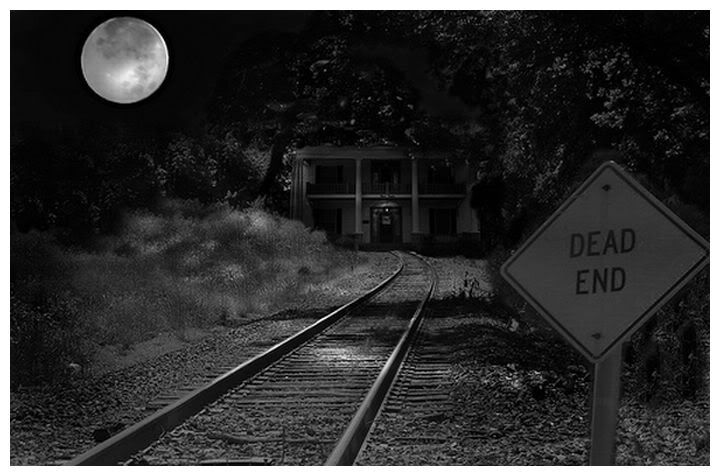
The humans living ‘in life’ claim that the ‘out of life’ God does not exist, even while ‘in life’ philosophers continue to distinguish between an ‘in life’ Real and an ‘out of life’ Another. The difficulty that blocks the road http://i3.photobucket.com/albums/y64/Hands123/deadendtrackedit.jpg  to the rejoining of thought apparently is Death.

Nevertheless, if we can prove for ourselves that there are two realities, an inner and outer, an ‘in’ and an ‘out’, and both are real enough ‘singularities’, then why not an ‘out of life (and body)’ experience for an ‘out of body’ reality, i.e., ? What if phenomenology as fuel for life is only an ‘in life’ phenomenon, but that the ‘out of life’ fuel for life is Mind? Are not atomic and subatomic particles clear evidence that construction of reality continues after death—which is why reality may not yet be fully constructed?

If there is any truth to the above, it remains an open question whether the bifurcation caused by our ‘humiliation’ holds for all time?  At this moment in time however most of those with a ‘higher education’ appear to consider the question as closed and react to their own positivist answer in a sadistic-masochistic manner that causes incalculable harm to nature and the rest of humankind.

To an outside (of ‘in’) observer fantasizing him- or her-self to be less compulsively motivated than Žižek’s ‘man’, the ‘humiliated one’ is charging towards “autistic masturbatory ‘asocial’ joisance”*. The freshmen college anecdote about the monkey pushing the button that causes him an orgasm until he dies from too many convulsions are a social reality, except that for the monkey’s hand levered button, we push the lever just thinking about it http://www.youtube.com/watch?v=BxHxXQPxBTQ .

At the point (in a hypothetical time) where Žižek’s post-modern hyper-man meets with our Great Ancestor (still practicing subsistence economy), there may occur an interesting confrontation.

Our ‘out of nature’ ancestors raise a question which the ‘humiliated’ one may consider yet another humiliation. The question is: “Why are you jerking off so much?”

To which the ‘in nature’ response may go: “Why are you so slow, so unmotivated, and so backward?”

To which the reindeer herders, the Avenks, the travelling Johns reply: “What we took ten billion years to create (yes, we continue to create even when we are so-called dead), you want to do in two centuries. All the living creatures which co-evolved with us, you turn into bones in two decades.”

“Yes, but we can renew our body parts and clone ourselves to live in perpetuity.”

“True, but you have turned our community festivals into Fuck Carnivals, and all the wild animals in the wood are dead because your hunters get an orgasm from each kill.”

 *Slavoy Žižek, “The Universal Conception”, Continuum, pp. 308.

Monday, March 29, 2010


© Eso Antons Benjamins, aka Jaņdžs
THE NOT-UNTHINKABLE
95 The Story of Clever John and Crazy Jane (4)

An old Latvian story retold. For the original see
3.A.327.B.460. A.K. Bramanis Rīgas apg. LP,V,36 (3,1).

The Fourth Leg of the Journey. Having loaded up the wagon with gold, Clever John drove up to the main gate of the castle of King Great Ruler. Over the gate hung a large sign, where large letters spelled “Jersika”, i.e., a Latvian colloquialism for “Jerusalem”. This was the first kingdom of proto-Latvians that anyone has heard of. Six guards rolled their drums to summon the king. King Great Ruler himself came to the gate to greet Clever John. This time the King wore leather boots to his knees. The King’s eyes shone in anticipation.

When King Great Ruler saw the wagon full of gold, he called for his daughter princess Complete Satisfaction even before he greeted Clever John. But the King and Clever John waited in vain. A guard of the Jersika castle came running to say that Complete Satisfaction was delayed. King Great Ruler apologized to John for the inconvenience.

“Since you are Clever John, you surely know how these women are,” said the King. “But do not worry. You will meet her in bed. You will be no worse for the anticipation. Beside, the custom in Jersika is to celebrate the marriage ceremony without the bride present. It is thus that Complete Satisfaction builds up Anticipation for the lihgo she will enjoy with you in bed.”

The wedding ceremony is a great feast. Clever John invites his six brothers to attend. The whole day of the ninth day after “Johns Eve” passes in dancing and tournaments of strength and wit. Clever John’s brothers’ dance with Great Ruler’s other daughters all day long. The daughters appear to the brothers as having been met before, which is why no one is shy. Even the Mother of the Devil and King Great Ruler are seen dancing with each other and their guests.

Who would have ever imagined that bathing seven crickets in the sea would lead to such an awesome ceremony and an all day feast?

At last, evening comes, and it is time for Clever John to go lihgo.

King Great Ruler along with the Mother of the Devil lead Clever John to the bedroom, also known as the Lihgo room. When they come to the door of the room, they give Clever John some last minute advice: “The moment you go inside and by the light of the door see where the bed is, do not wait, but close the door and dive right into the divan. Your prize (the Latvians call it “dahvana”), Complete Satisfaction, is waiting for you. If you hesitate the princess may lose the heat of her desire for you.”

A servant of the King’s court opens the door of the Lihgo room. Clever John sees the divan and dives right into the bed. As the servant closes the door, everything goes pitch black around him.

No sooner is Clever John under the blankets than he begins to feel for the princess. With great anticipation, he feels something soft beside him. He feels the material of a night gown, finds the buttons, and… he feels! he fears! it is straw. Can this be true? “I wasted no time jumping into bed!” shouts Clever John to no one in particular. “You cannot blame me for being late! What the Devi…,” he shouts, but he does not finish the word, because the door of the room suddenly opens and a shaft of light discovers Clever John on all fours on the divan feeling up a straw doll.

Into the Lihgo room come servants with large candelabras of lit candles. Right behind them is Crazy Jane.

As soon as the servants leave and close the door behind them, Crazy Jane wastes no time and says what is on her mind: “What do you take me for, Clever John?” she screams. “Was I not the first woman who you proposed to? Do you really believe that some princess named Complete Satisfaction was here just waiting for you?”

For the first time in his life Clever John is speechless. “But, but…”, he begins, but cannot find other words.

Crazy Jane has been holding in her hands a pair of long leather boots. She throws the boots on the bed. “Put these on,” she commands. Clever John notices that Crazy Jane, too, wears boots.

Clever John does as he is ordered. He pulls on the boots. And the moment that the bottoms of his feet touch the bottoms of the boots, he feels himself seized by a big shake. His skin is transversed by pleasant shivers, and then he is seized by a heat wave that alternates with a cold wave. Crazy Jane has pulled off her night gown and with her boots still on has jumped into the bed and now lies beside Clever John.

From outside each door of the bedroom the chorus of the court of Jersika (Oh Jerusalem!) breaks out in Lihgo songs.

“Lih-go! Lih-go!” (Often the word “Lihgo” is sung as one yodelling in the mountains does it: “Lih-ih-go! Lih-ih-go!”) The voices of King Great Ruler and the Mother of the Devil are heard among the singers.

“Ai, Johnny, son of the Sun,
Lih-ih-go! Lih-ih-go!
Ai Janey, daughter of the Devil,
Lih-ih-go! Lih-ih-go!”

After the chorus is done, the trumpets sound the fanfare fanfare to Clever John and Crazy Jane. It sends shivers through every Latvian who has ever heard or not heard it before.

That is how they once celebrated Johns Eve in Jersika-Jerusalem of proto-Latvia.

This is where the story ends. Clever John and Crazy Jane live to this day in Jersika. It is the Latvian Jerusalem—though today few make the connection between the name Jersika with Jerusalem. One hears that Clever John still has his long boots on, and some people wonder how it is possible for him to keep them on for so long. There is an answer to this mystery, of course.

You see, Clever John and Crazy Jane have never yet climbed out of the bed, and this is why the soles of their boots never are worn down. It is not for nothing why Clever John is also known as the Father of the Dead.

(The end.)

Asterisk & Notes of Interest:
On material depravation in Latvia.
On the theme of “more-equal-than-others” see George Orwell's "Animal Farm".  
A recommended read: “The Theory and Practice of Oligarchical Collectivism” by Emmanuel Goldstein (A book within a book from George Orwell's "1984".  
Of interest to me is this (news on the California elections to legalize Johns Grass) and this article (coca politics in Bolivia). The articles express some of my reasons for supporting the growing of Johns Grass in Latvia.
Interesting material relating to Johns;
A recommended site. 

These blogs tend to be a continuum of an idea or thought, which is why—if you are interested in what you read—you are encouraged to consider reading the previous blog and the blog hereafter.
Partial entries of my blogs may be found at LatviansOnline + Forum Home + Open Forum –ONLATVIANPOPULISM vs LATVIJASLABEJIE. If you copy this blog for your files, or copy to forward, or otherwise mention its content, please credit the author and http://esoschronicles.blogspot.com/

Tuesday, February 9, 2010

© Eso Antons Benjamins, a.k.a. Jaņdžs

NOT-VIOLENT TERROR
80 Climbing Mt. Citheron (XIII)

Tomislav Sunic, a Croatian political scientist, in a paper called “Liberalism and Democracy?  Carl Schmitt and Apolitical Democracy” writes that “…if one assumes that a new type of homogeneity can develop, e.g., homogeneity caused by technological progress, then one cannot dispute the functionality of a liberal democracy in which the homogenized citizen remains thoroughly apolitical: hypothetically speaking, political issues in the decades to come may no longer be ethnicity, religions, nation-states, economics, or even technology, but other issues that could ‘homogenize’ citizens. Whether democracy in the twenty-first century will be based on apolitical consensus, remains to be seen. Schmitt sincerely feared that the apoliticism of ‘global liberal democracy’ under the aegis of the United States could become a dangerous predicament for all, leading not to global peace but to global servitude.”

The above illustrates the thunder clouds approaching. Far in the background one may also hear thunder. Below is a scene of the way it is happening in Latvia with a sketch of the political background of it.

This past week several Latvian “political” parties made yet another step toward apolitical politics when the Citizens Party (PS) declared its readiness to form a coalition with the New Times Party (JL) and Party for Different Politics (SCP). Said coalition is to be called “Unity Party” http://www.uic.edu/orgs/unity/UnityMonthJPEG.jpg , and according to Girts Kristovskis, chairperson of the Citizens Party, it will oppose parties of the oligarchs and pro-Russian parties. The talk among the Unity Party members is to concentrate on “doma” (to think thoughts) of economics. (Source: DELFI.lv, 6.2.10.)
What is Unity Party? Let us start with the definition of “unity”, which at this link is best expressed as (6): “one of the principles by which a uniform tenor of story and propriety of representation are preserved; conformity in a composition to these; in oratory, discourse, etc., the due subordination and reference of every part to the development of the leading idea or the establishment of the main proposition.” In other words, the Unity Party (when officially announced) may present to the public a definite program.

We already know from the news that Unity will be anti pro-Russian and oligarchs. In other words, the political “enemy” is established; however, the economic program is yet at its muz muz stage. The lack of an economic program at this stage indicates that it will likely remain at the muz muz stage even after the founding, which means the Unity Party will remain as apolitical as the activity of muz-muzing usually is. To be any other way, Unity has to choose an authority figure that the rest may join as advisors, but who in all cases will respect the authority figure.
The Karlis Ulmanis regime (1934-1940) of Latvia was a regime that started its life (by way of a coup) on May 15, 1934, but soon became a “soft” dictatorship. K. Ulmanis  main support came from the Farmers Party (Zemnieku partija), the military circles, and, not least, from the inability of the radical and the “we-agree-to-disagree-in-almost-every-case” parties to be unified enough to move along the country’s economic development. In a sense, K. Ulmanis came to power as a result of an ad hoc Unity Party that soon became known as “Ulmanis regime”.

Ulmanis was the authority who spoke to Latvians and spoke on behalf of them. He was the guide in all future projects and, like it or not, he enabled many Latvians to become market savvy. The “market” in its modern guise was a concept that was new to Latvians, especially the bookkeeping part and the discipline to run a business successfully. He used his college education (agronomy and farming) at the University of Nebraska, to raise the level of education for Latvians, most of who were still of peasant stock. Ulmanis returned to Latvia from the U.S. (1913) with a broadened perspective, ready to help develop Latvia with—of course—other Latvians as his helpmates.
However, a year after his return from the U.S., WW1 broke out. The war devastated Europe economically. The new nation of Latvia, which Ulmanis helped found (1918), would need to act with an especial foresight to rebuilt its economy and educate its people. Ulmanis was ready for the task, but its execution, due to many political fractures, was to lag behind. On May 15, 1934, Karlis Ulmanis staged a coup and seized the reigns of the Latvian state.
My grandfather and father, the first the founder and both editors-in-chief of the newspaper "Jaunākās Ziņas"  (since 1911) at the time, saw the political picture with a neutral eye. They appeased social disagreement, such as existed, by printing jokes about the clumsiness of “vadonis” (leader), but never disapproved of him. Apparently, the judgment of the political and economic situation by the editorial staff and publisher, authoritarianism was acceptable for the benefits it brought to the majority of Latvians, and, not least, kept the newspaper from getting shut down as the authorities reminded the staff of such a possibility often enough. A certain antagonism that existed among the newspaper’s publisher, its editorial board, and the Ulmanis regime came from both competing for the populist vote. Ulmanis needed the populists because he needed majority support to stay in power (without going to military rule), while “Jaunākās Ziņas” desired to increase the number of its subscribers and had to keep peace—a tight balancing act sometimes—among newspaper’s editorial staff and a publisher of differing minds.
So, Karlis Ulmanis became an authoritarian leader. He took advantage of the anti-nazi mood in the country by supporting the out-migration of Baltic Germans (many believed to be nazi sympathizers) and appeasing those among the public that were unhappy by making them happy through an increased sense of public pride in being a Latvian. The latter were to be thought of in terms of ethnicity. If one was a citizen of Latvia, one was of Latvia’s first (or second, etc.) generation and thus one of its sovereign owners. Under K. Ulmanis, Latvia was a majority democracy with the majority facilitating its rule through an authoritarian president.

Unfortunately, on Latvia’s eastern border was communist Soviet Union with a definition of cosmopolitanism that identified cosmopolitanism with liberal consumerism. Having encouraged the departure of the Baltic Germans, Ulmanis set up the conditions that would enable the Baltic Germans to be replaced by the Baltic Slavs who arrived into the country with the Soviet times. Are the parties who today represent the Slavs to be the enemies of the Unity Party of Latvia? Does the Unity Party plan to encourage Latvia to continue to be an ethno zionationalist state?
Lest it be the same rhetorical bluff that has guided the ship of the Latvian state since 1991, who in the “Unity Party-to-be” is going to be “the authority”? Who and what is to be the sacrifice?

The climb up Mt. Cytheron has not yet begun, certainly not in the context of our times. As Oedipus of ancient times found out, his story stands for the way of all too human endeavors, and one has to take issue with such “naked” dirty politics that the Unity Party leads one to anticipate. An anti Baltic Slav campaign will lead to the plague that puts the future of all Latvia-born children in hawk.
Asterisk & Notes of Interest:
 On the theme of “more-equal-than-others” see George Orwell's "Animal Farm" .
A recommended read: “The Theory and Practice of Oligarchical Collectivism” by Emmanuel Goldstein (A book within a book from George Orwell's "1984")  
Of great interest to me is this and like articles. It presents some of my reasons for supporting the growing of Johns Grass in Latvia.
These blogs tend to be a continuum of an idea or thought, which is why—if you are interested in what you read—you are encouraged to consider reading the previous blog and the blog hereafter.
Partial entries of my blogs may be found at LatviansOnline + Forum Home + Open Forum –ONLATVIANPOPULISM vs LATVIJASLABEJIE. If you copy this blog for your files, or copy to forward, or otherwise mention its content, please credit the author and http://esoschroniclnes.blogspot.com/  

Saturday, February 6, 2010

© Eso Antons Benjamins, a.k.a. Jaņdžs

NOT-VIOLENT TERROR
79 Climbing Mt. Citheron (XII)

Given the rapid breakdown of the community and community oriented hegemonies and the exponential rise of atomized individuals cultured into being by consumerist broths, society is footloose and free to do as it may. With money in the pocket, anyone may dance his or her way to almost anyplace they wish. Those without money also may go their way and many do, but the process of numbing one’s self with alcohol enough not to feel no pain of death in the cold, is a process that may take years. It’s a strange world, Mr. Jack.

A long time ago “freedom” meant having the opportunity to live away from princely courts and find refuge in a subsistence economy. Last time this was tried in the U.S. was when the hippies moved to the states of Oregon, Washington, and British Columbia in Canada in the 1960s. Some of them survive to this day by growing Johns Grass. In the rest of the world subsistence living—free but subject to finding food at the garbage dump, young women earning a living through prostitution, men growing and selling Johns Grass, and people dying as if they never were—is still the experience of the majority of humankind. Consumers may watch this world by taking "slum tours" as part of their consumption of vacation time. They may be preparing themselves for the rising tide of poverty that may force them to be discarded by the failed brain of our age of technology. On the other hand, there is also something to be said for wanting to live at the level of our forebears. Many would be happy to join them if using a horse and no car would free them from having to pay the government taxes.
It is a paradox of our civilization that it has not only rejected but also forgotten how the first human beings came into existence in conditions that offered them a comfortable subsistence living. In our own day, we are witnesses to how the advantage that an Earth full of fruit and life offered our ancestors has been squandered by using up ever more “lebensraum” (living space) in pursuit of consumption. Though Hitler failed in his attempt to carve out more living space for the German people by means of war (a nationalist activity often going by the name of fascism), a worldwide increase in poverty is only now beginning to see in consumerism a form of fascist dictatorship. Of course, I am speaking of a “soft” fascist dictatorship. For many Latvians going back to the ways of their forebears (if the world of the forebears could be recreated) would be an improvement over a country created with such foresight that 150,000 have left it, a no lesser number would like to, and the remainder wondering what fate had in mind when it put them ashore in Latvia
In the world as a whole, “Lebensraum” (living space) comes in many different sizes and shapes. There is concern over enough space for a growing population [risen from 2 billion inhabitants in 1950 to 6.5 billion by 2010, sixty years later, and expected to rise to 9 billion by 2040], but along with the growth of human population, the size of the ruling class has increased as well. It is, therefore, something like two billion Earth inhabitants stealing a living from the 4.5 billion others. Unfortunately, while the steal is successful, it is a steal that fails, because the theft helps increase the size of the middle classes on a planet of diminishing resources, certainly of such as are relatively cheap. Meanwhile, that part of humankind that was persuaded to abandon the ways of antiquity, yet never have had the opportunity to rise above the poverty level, continues to bring to life more people like itself than ever.
The majority of consumers live in cities, and it is around the cities that the human nakeds fill the slums. What once was a land for the original human subsistence dwellers, has become the private property of monster farms (probably bank owned) and the “bonus receivers” among bank employees, who invest and use retirement money of the middle classes for their own and the bank’s benefit. One may say that the natural order at the time when the first human beings appeared on Earth has been completely reversed: the haves then are the have-nots of today while the rulers-pretend-not-to-be are the Socialist Oligarch Party, SOP, of today.

More “growth” is obviously not a solution, but a problem to all areas that live as much on borrowed money as on borrowed time for lack analysis of the sustainability level of society and how to implement it. Sometimes a culture overgrown by a myth no longer either useful or principled may hinder the development or survivability of society as a whole.
While Latvia is a small nation, and one may think that it should escape notice of how it falls apart with all attention directed to the “biggies”, Latvia may play a big role in other ways. The current government is a perfect afterimage of what happens to those suffering from delayed gratification. The zeitgeist of consumer fascism shines bright in the eyes of almost everyone who knew the torture it was to stand in the long lines at stores during Soviet rule, yet was privy to television soaps from abroad. Such subjectivities obviously filled the heads of those who served Latvia’s bureaucracy and those who came to office as ministers and politicians. If consumer fascism is often well camouflaged in the West, it shows up in clear relief in post-Soviet Latvian morality.

Rather blatant presumption of hegemony among consumers translates itself best in images of television advertisements. The hegemony of images in advertising are unmistakeable. However, the modeling of the image began at the top, at top business and government level. There were no speed limits or blocks against running off the tracks. The examples of behavior in Latvia were set at the top and devolved down toward the valley where the people lived.
 The dazzling brightness of economic wisdom in the halls of Latvia’s “refounders” made plans to built "A Castle of Light"  to house a library that would put the Library of Congress in Washington to shame, but cost a mere ~140 million lats (~$300 mil.). It built the world’s most expensive bridge (~ Ls 600 million, with the lats almost twice as costly as the dollar, i.e., $ 1.2 billion) before its need was proven, and 27 million lats have simply gone missing. These and other objects reflect the high expectations of elected and unelected officials with no direct responsibilities to the voters—from 1991 on until the present 2010 election campaign. What an ironic spectacle of not only a lack of vision, but of the post-Soviet mindset revealed in all its dullness and primitiveness in the circles of the post-Soviet apparatchiki of Latvia.
The run for the sill began immediately after Latvia was retrieved—with help from the U.S.—from Soviet grasp. With America’s support, and soon part of NATO, the Latvian government felt safe. Latvian men went boar hunting and ate boar’s balls to prove the men they are. They could care less about Putin in Moscow waving red handkerchiefs and sending unkind messages, for we have in Latvia a partidocratic and zionationalist consumer nation on wheels already. Of course, consumer fascism does not smell but of coconut oil and olive skin. Latvia had one of the fastest growing economies in Europe a few years ago.

In any event, naked greed, sometimes robbery (but through an escape hatch in the ceiling always out of reach of prosecution) took the high chair of setting the public an example of correct behavior, and though there was talk of honor and honesty, the money did not go into education or its promotion. Today the founding institutions of Latvian consciousness, the village choirs and the Festival of Choirs that meets every five years to train their voices together, goes without state support. The ad hoc organizers and interested parties are left on their own, in effect homeless. If on some other occasion hard times are an opportunity for innovations, the government of Latvia is now saying in so many words that there is no mandate from the people for the choirs to stay among the living. Ligo Latvia! (Viva Latvia!)

I have already suggested using a “not-vote” as the occasion for choirs to meet near polling places and invite everyone to a not-vote sing-along.

Asterisk & Notes of Interest:
On the theme of “more-equal-than-others” see George Orwell's "Animal Farm". 
A recommended read: “The Theory and Practice of Oligarchical Collectivism” by Emmanuel Goldstein (A book within a book from George Orwell's "1984" ). 
Of great interest to me is this and like articles . It presents some of my reasons for supporting the growing of Johns Grass in Latvia.
These blogs tend to be a continuum of an idea or thought, which is why—if you are interested in what you read—you are encouraged to consider reading the previous blog and the blog hereafter.
Partial entries of my blogs may be found at LatviansOnline + Forum Home + Open Forum –ONLATVIANPOPULISM vs LATVIJASLABEJIE. If you copy this blog for your files, or copy to forward, or otherwise mention its content, please credit the author and http://esoschroniclnes.blogspot.com/ 

Saturday, January 30, 2010

© Eso Antons Benjamins, a.k.a. Jaņdžs

NOT-VIOLENT TERROR
77 Climbing Mt. Citheron (X)

"King Oedipus” is a tragedy, which as a play and a story has endured a misreading, the misreading leading to tragic developments for humankind as a whole. That we have come to read the story afresh and gain new meaning from the riddle it presents is the result of a confluence of occulted near and far historical events, a chronal moment and a confluence for the inner consciousness of a writer living in antiquity and our own.

The gyres of occultation, which have enabled us to see something so obviously before our eyes as to have escaped our notice for these many years, are partly related to such events as the death of innocents; bombs upending earth seconds and not many meters behind; the sight—mercifully from a distance—of cities burning; tortured bodies marching by imaged in the clouds; and not least, the stealing from the Latvian people, of whom I am one, the future. The latter is the end result of rule by a government with no ultimate sense of responsibility for the results of its deeds as government. The people, so commonly referred to as “populists” (why not equate populism with a form of “terrorism” then?), have been pushed to the periphery where government feeds on its livers without cost to itself.

The chronal moment of unriddling the riddle (likely related to the universe as a hologram) is driven by a necessity to acknowledge events we have been censured from noting to lasting effect, and, thus, have not been able to give the chorus of dissident voices “out there” an ear. Our necessity is the necessity for truth that comes to every dying entity on its deathbed—to live on through others. So, let it not be said that either Sophocles or myself have invented the story of King Oedipus, but that it has gone unrecognized for the lack in our civilization of self-sacrifice, which has brought us to a time when a majority of people on our planet, little Latvia including, have little more than their naked self.
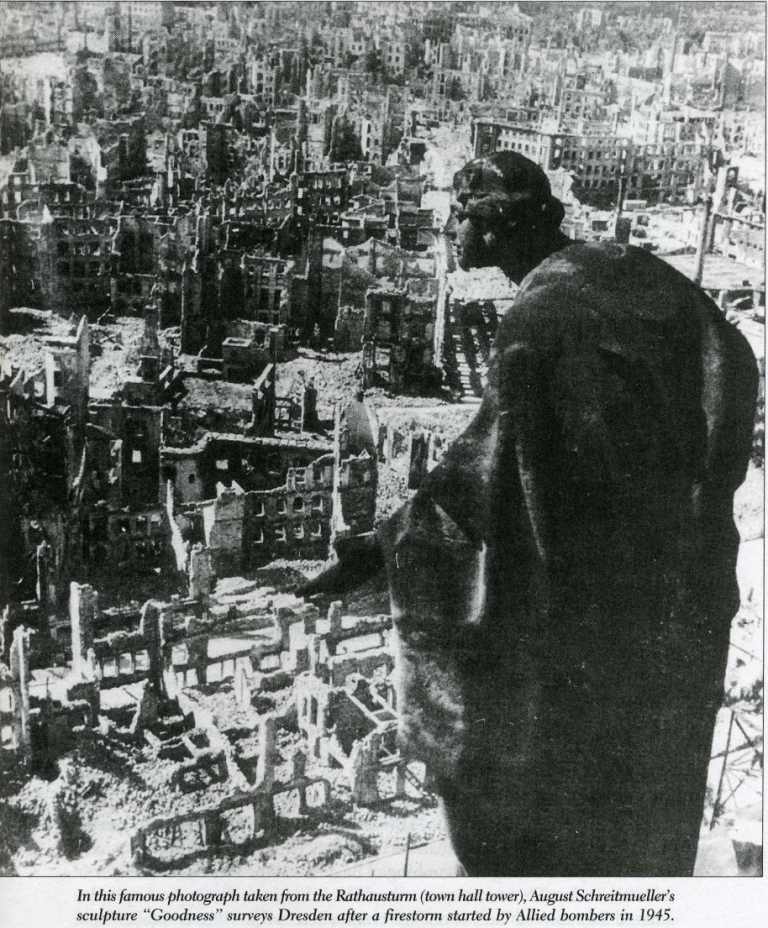
The willful misinterpretation of the role of Oedipus in Sophocles’ “King Oedipus” is the result of a zerstoertes (disturbed) mind. The failure by the mind in our times to look beyond the immediate is as profound as looking over the ruins of Dresden and Hiroshima and not seeing them, and the inability to bring a Stalin, a Churchill, and a Truman even post mortem to court for war crimes. The ruinous events in what so many theatre goers have presumed to be an honest rendering of a tragedy (there was a Nuremberg trial, what else do you want?), turns out to have been Sophocles’ coded scream for help, but unnoticed for the presumption that what makes tragedy has no relation to government.

If “Tiresias’ Revenge” becomes a story of which the riddle went unsolved (for good reason some may claim) for two thousand years (Scaligeri’s chronology), it may contribute toward the removal of so-called “just war” from the bag of pardonable crimes and prosecute it from the perspective of past, present, and future self-sacrifices. Were this to happen, the onus will be on those who fail to acknowledge the equal signs between themselves and the victims as well as beneficiaries of their acts. At this time, the beneficiaries of the government have the power to ignore any call to responsibility. The payment in lives and life styles is still exacted from the weak for the benefit of the strong solely because the latter invented arms that kill at a distance. The mailed fist has for too long allowed a minority to remain in denial that it is the major cause of death of “others”.
The so-called ‘just wars’ are little more than those who are violent claiming for themselves a “more equal than other” status. As the killer drones in Afghanistan prove, the art of ‘just war’ has progressed to the point where the killer kills the victim as if the latter were a figure on a video game screen and the former no more responsible than a child for pushing the buttons in a gaming arcade at a shopping mall.

With death among the violent ones having been replaced by the doctrine of ‘resurrection of the dead’, death among educated “elites” occurs as if in secret still. Indeed, the violent ones have not only eliminated direct knowledge of the death of their victims, but knowledge of themselves as mortal beings. Sure, death remains a matter for tears among one’s immediate relatives, but the laws that tell that the body will upon death be taken to the refrigerator at the mortuary make sure that death remains invisible and will not trouble the dictatorship of positivism. No rulers of hegemonies where consumers are the core of ruling parties will acknowledge that they are the cause of death of millions of—let us call them ‘nakeds’. Such ignorance follows the same line of reasoning which during the current crisis causes governments to treat the most irresponsible banks institutions “too big to fail”, because failure means their fall from power as well.
The subject of violence and death presently discussed is not often met with in the discursive space of modern media. None of the “authorities” who have done and condoned violence has sworn an oath to die a conscious death, yet the same are said to be fully conscious and in alignment with the will of Allness when they send to their deaths millions. No “authority” in our day will extinguish his-her life through his-her own will—even if that is not expected from them sooner than old age—and will censor such a notion as suitable for public space.

The doctrine of self-sacrifice and the ability to extinguish one’s life comes from an imaginary that has expectations of a future in which a larger-than-life community creates an environment that enables it to recreate itself until forces beyond it—rather from within it—end it. It is from this itself that life beyond mere naked life community arises. It is from the larger-than-life community which is able to practice self-sacrifice that the potential of a continuum of self-consciousness arises.
If one wishes to create a hegemonic community, one has to be willing to help create the kind of charismatic bond that memory will not let go of. Death through natural causes may provide the original understanding for the desirability of such a charisma. Death as a result of a violent attack may confirm the power of death’s charisma. However, only self-sacrifice faces the charisma of death (some may wish to call it motivation) in full self-consciousness. This is why one must learn to project, then internalize an image that is powerful enough to displace the image of Jesus in the sky. Innocent as Jesus himself may be, his image was engraved into the vault of the sky by the physical violence of those who reject owing up to the notion that a fully human community can result only when its members have authority over their deaths. In the context of the neo-Christian secular order, which is founded on the high blown words vs the arch-Christian Johns seeking to live with the endura engraved as the grail on their minds, it is the former who die in their beds, while the latter if not dead by fasting, once managed to die on their feet. There are none like these in public space today, unless the space is not only subjective, but hidden, and if discovered is lied about. Hopefully, the solving of the riddle of “King Oedipus” will turn the tide and soon prevent the rule of lies.

Asterisk & Notes of Interest:
On material depravation in Latvia.
On the theme of “more-equal-than-others” George Orwell's Animal Farm. 
A recommended read: “The Theory and Practice of Oligarchical Collectivism” by Emmanuel Goldstein (A book within a book from George Orwell's  "1984"). 
Of great interest to me is this and like articles. It presents some of my reasons for supporting the growing of Johns Grass in Latvia.
These blogs tend to be a continuum of an idea or thought, which is why—if you are interested in what you read—you are encouraged to consider reading the previous blog and the blog hereafter.
Partial entries of my blogs may be found at LatviansOnline + Forum Home + Open Forum –ONLATVIANPOPULISM vs LATVIJASLABEJIE. If you copy this blog for your files, or copy to forward, or otherwise mention its content, please credit the author and http://esoschroniclnes.blogspot.com/

Tuesday, December 29, 2009

© Eso Antons Benjamins, a.k.a. Jaņdžs


NOT-VIOLENT TERROR
68 Climbing Mt. Citheron (I)

“Not-Violent Terror” is a charismatic element more commonly known as death. I believe that the reader readily understands why death is not-violent at the same time that it is ‘terror’ at least to those who have not learned to accept it. One of the reactions against the ‘terror’ of death is well expressed in the words of Dylan Thomas, the Welsh poet, in his poem: “Rage, rage against the dying of the light.” However, for all that an individual may rage against death, it is the element that is essential in the creation-building and maintenance of all long-term communities.

Some anthropologists and philosophers call such community founding deaths “founding violence”. Most expect “founding violence” to be aggressive and violent and directed at an “enemy”. Such ‘cooked-up violence’ is evident in the Zionist settler movement which uses a fabricated myth to justify the use of violence against indigenous Palestinians. For my part, I focus on not-violent death, that is, a violence denying death, from whence the title of this series.

My understanding of “founding violence” includes demonstrative deaths by individuals who wish to impress on their community the importance of social consciousness and solidarity, at the same time as they demonstrate that solidarity is not a given matter. I already have mentioned the Greek philosopher Socrates and his demonstrative death as an example of what I have in mind. Another example that I have mentioned is that of Adolfs Buķis of Latvia. Of course, neither the death of Socrates, or Buķis (Buchis), or Gandhi, or Jesus was without an element of self-directed violence. All these men purposely left open one or many doors for violent attacks against them. While I have little respect for the neo-Christian church for its failure to acknowledge that it came to its influence by way of serving the interests of secular princes, I respect the current Catholic Pope for leaving himself open to the “bumping” he received recently while on his way to say mass. It may be a hint that the neo-Christian church is maturing and coming out of its centuries long nihilist phase, best known for justifying and supporting “just wars” in unjust causes.

I believe it is unconscionable to deny any human being a death that he or she wills and executes by his-her own hand—as long as it causes no physical harm to another. I grant the ‘saviors’ that I, too, am against ‘suicide’, especially by the immature young. The more than 32,000 annual deaths in America (from a total of about 130 million inhabitants) and 527 deaths in Latvia (from a total of about 2.3 million inhabitants) that are the result of ‘suicide’ are a terrible commentary on the stressed social structures in which we are forced to live. On the other hand, if these ‘suicides’ were willed by mature minds and exercised in the name of ‘politics’, I would carry a sign supporting these sacrifices as “political action” of the highest caliber.

With regard to the political situation in Latvia, I mention Adolfs Buchis’s death (1993) in protest of government corruption. Buchis’ death occurs also in the context of ‘founding violence’. He discovered that self-sacrifice was essential for a realistic success of post-‘refounded’ Latvia (1991). For Latvia and perhaps the world, its renewed status as a sovereign nation was a moment of major historical importance, because—as we shall see below—the manner in which a ‘refounded’ Latvia was wired together, and the way it has played out during these years, 1991-2009, not to mention the happenstance that the world as a whole is going through a similar social, financial, and economic crisis, presents Latvia with the opportunity to solve some of the problems plaguing the world by how it solves its own. The opportunity arises from the fact that it is easier for a small ship of state to maneuver on the waters than a ship called “Titanic”. This is not to say that all Latvians wish to seize the opportunity. Many surely do not, but some may think on it, because the dying of the light in Latvia will not reverse itself because of wishful thinking.

Though the state of Latvia was reestablished on the 4th of May, 1991, and five people (two bystanders, two cameramen among them) died from live fire by Omon on January 21 of that year, two years later, in 1993, it was clear to Adolfs Buchis, a tool and dye maker from Jelgava, that the founding violence of 1991 had not reached deeply and effectively enough into of the post-Soviet Latvian social fabric to prevent the “stealing” of Latvia for the benefit of oligarchic interests. No doubt, those in power celebrate ‘the days at the barricades’ with projections of heroic myth, for example, by portraying BearJawBreaker (Lahchplehsis/ Lāčplēsis) http://www.bank.lv/images/img_lb/naudas/images/barikades_rev.gif at the barricades, and reintroducing neo-Christianity, with the President of Latvia taking the role of a neo-Christian evangelist. Nevertheless, a less sentimental analysis of the months of 1991, show that while indeed the expectations of the people were great (as we can see in pictures here and here) and that demonstrations and the reaction of authorities prove a high level of anxiety, the pain was not nearly such that those with political connections in the bureaucracy (which was never shown the door) could not subsequently test, find the new political system wanting, and “steal the country” from under the noses of the majority of Latvians. The Latvian nation beyond the region of Riga (and even in Riga) had no imaginary inkling of what the days centering on January 21, 1991, demanded of them. Of course, the people were happy to be ‘free’, but the lack of sufficient breadth to the ‘founding violence’ left a gap large enough for Adolfs Buchis perception that further efforts to try close with the self-sacrifice of his life was necessary. Buchis no doubt meant not only to bring attention to the theft of the country, but hoped that others may join in similar protests. Not surprisingly, the authorities found Buķis to be ‘mentally unbalanced’. Though they promised an investigation, it never took place. The written note or notes in Buchis pockets were never published, because the Latvian media never pursued the matter further. Very likely the editors were warned by the government that to pursue the matter [originally there was considerable publicity, especially in the newspaper “Atmoda” (long ceased publication) and Jelgava media] risked rousing ‘populist’ sentiments [against the government (corruption)]. Hindsight suggests that the ‘mentally unbalanced’ label attached to Buchis by government (by way of statements from Police officials in Riga) was not a matter of gratuitous innocence such as governments tend to automatically project, but at one level or another served those who had ‘stolen’ the nation’s sovereignty to serve their interests.

This is why this and the next few blogs are titled “Climbing Mt. Cytheron”. Mt. Cytheron is the holy mountain on which Oedipus as a newborn was to be exposed to the elements to see if he was fit to live and be raised to become King. Oedipus escaped the risk through the interference of his mother. The mother’s motives may have been part of an effort to regain for the feminine gender its stolen kingdom. One may argue that the interpretation is far fetched, except when we remember what is at stake. (For the play "Tiresias' Revenge", see blogs 40-47.)

Which is why “not-violent terror” does not necessarily deny ‘violence’ (a deadly moment), but, paradoxically, emphasizes its centrality. It is one of the raisons de etre of this series. I write on the subject as much to discover my own thoughts as to bring along anyone interested in the journey. The difference from a writer of a book in longhand and a writer of blogs is that blogs are ‘chapters’ and occur almost simultaneously in, both, public and private space. Some may object to this exhibitionism, to which I can only answer that I hope they will ignore my foolish persistence and pass by. One thing though, if the material ever finds itself on a disk for sale, there are likely to be three books—the original copy on the internet at http://esoschroniclnes.blogspot.com/, as link at this site, and an edited copy on the shelves of bookstores.

Asterisk & Notes of Interest:

On material depravation in Latvia.

On the theme of “more-equal-than-others”, see Animal Farm.

Of great interest to me this and like articles. It presents some of my reasons for supporting the cultivation of Johns Grass in Latvia.

These blogs tend to be a continuum of an idea or thought, which is why—if you are interested in what you read—you are encouraged to consider reading the previous blog and the blog hereafter.

Partial entries of my blogs may be found at LatviansOnline  + Forum Home + Open Forum –ONLATVIANPOPULISM vs LATVIJASLABEJIE. If you copy this blog for your files, or copy to forward, or otherwise mention its content, please credit the author and http://esoschroniclnes.blogspot.com/

Saturday, December 26, 2009

© Eso Antons Benjamins, a.k.a. Jaņdžs


NOT-VIOLENT TERROR
67 The Future of The Wuerzeltod (V)

With levitation so capably performed on the deck of their sinking ship, moreover with such surreal earnestness on the faces of the high-end lumpenproletariat preparing itself for next year’s elections, the disconnection from reality may seem only virtual. Nevertheless, it is no fake uprootedness such as nearby treetops may reflect in a pond. After all, all the presidents, current and former, wishing to prove that they are not completely out of touch with reality attended church together and listened to the Lutheran Archbishop transmit a message from high above.

To be uprooted may not be as severe a condition as being Wuertzeltod. This is why hope prevails that the disconnections (neglect of education, health care, desertification of the land by deforestation, etc.) have not yet overwhelmed the body with total paralysis. Perhaps Latvians may yet grow conscious of their condition and attempt to grow new roots.

If being ‘uprooted’ is a curable condition, then sinking new roots is also possible. All the same time, it is no longer a matter of the current government saying so. The government (if not its officialdom) is dead (with some administrative functions, like the cut off tail of a lizard, are still thrashing about). The survival of Latvia as a culture under the umbrage of the current leadership as if guarding the people’s sovereignty is no longer possible. It is now entirely up to the people and the nature of their populist sentiments. Whether there is sufficient charisma left among the ranks to prevent death of the community only the future will tell. One may, however, be skeptical, because while personal tragedies as expressed by an increasing number of suicides are on the rise, none yet express themselves as sacrifices for the community.

It is up to the people—for the first time since the kingdom of Jersika in 1209—if they will remember and then accept their roots in the community of the Children of Johns and allow a rediscovered consciousness to define them as a people again. To prevent a still-birth the people need to remember that their loss—if once it could be stated in terms of loss caused by outsiders—that now it is 1) due to visitations of violence from a virus that has become internalized, and is pretending to be as ‘natural’ a gene as ‘original sin’ once was; 2) this internalization of the ‘bad’ gene is going unrecognized due to upteen ‘positivism’ campaigns, not to mention a shortage of social critics and analysts; and 3) due to a failure to understand that internalized violence can only be purged with a cleansing violence, also known as ‘founding violence’.

No doubt, founding violence is problematic issue. Thinking the problem through with the head is one thing; working it out in real life is another. Thinking with the head will not in and of itself create new roots or if created cause them to take root. A charismatic element is needed. And, indeed, I have been pointing at this need sometimes directly, sometimes indirectly, sometimes merely hinting at it since Blog 1. The need has been yeasting for a long time now, and it not only wants, but needs to break open for the sake of the survival of a vital tradition, overcome our disconnectedness from it, and survive as a people. If this does not occur, if the elite are permitted to dismiss populism yet again (they surely did it before 1918, and have been doing it ever since) with campaigns of ‘positivism’, and populist sentiments fail to send them on their way, then good bye Jersika, Baumaņu Kārlis, Rainis, sovereign state of Latvia, the pains and scars of 1941 and 1949, the People’s Front, and all that. As the saying goes, then “lyur, lyur, lyur”, the debt incurred by the government is not toward a better day, but for the bailing out of the Parex Bank and as Latvia’s burial fee.

The readers of “Not-Violent Terror” blogs ought to know that the charismatic element that this writer believes to be necessary is “death”. Of course, I am speaking of a not-violent death. This is why in the previous blog, I mentioned Socrates. Was his death a violent one? My answer is that violence by Socrates is imaginable only if we dare not or forbid ourselves to imagine a self-willed death in the service of the community. There is no charismatic other element sufficiently inspired to root and bond a community than death, i.e., self-sacrificial death. Socrates knew that, and it is not beyond our understanding.

In order to survive as a community Latvians need to rediscover not only not-violent terror, but the reasons for death. Death needs to be put in service of the will to live brought to us not only by Nature, but as the Nature of the nature of our psyche. As Michael Taussig, an anthropologist put it: “…it is useful to think of mimesis as the nature culture uses to create second nature, [but] the situation now is that this famous second nature is foundering and highly unstable.”* I am citing this passage, because to my understanding, second nature may refer to a second culture as well. In other words, if the first culture of humankind resembles that of the people from Fiero del Fuego in 1832, with absolute equality and no leadership as the prevailing cultural form, then what comes between it and our ‘advanced’ culture a la 2009 where banks control governments?

The answer is not in a five minute discussion. For one, such a discussion must remember that “Western civilization” willed itself to forget that the middle road could get us to “Most Advanced Civilization” status with no violence and with no ‘No-Future’ sign barring the road ahead. Why is Latvia so anxious to join this dead-end form of ‘Most Advanced Civilization’, when the latter has identified itself with war and violence to such an extraordinary degree?

The silence on this issue by the Latvian government, its Foreign Ministry in particular, is a practiced silence on behalf of a military system of defense. Does not a military force of European nations serve the EU (and Latvia) better than it being at the behest of NATO? One should think so. However, Latvians are consistently warned by the media that only NATO can protect us from Russia, the god-awful-giant-ever-gorging-Bear on the country’s eastern border. In other words, the Latvian public media is operating as much in a straight-jacket when it comes to thinking out loud than it was under any other regime of occupation.

Incidentally, this writer has no trouble in visualizing the Soviet Army oppressing Latvia. I know well the brutality of the Stalinist regime from way back into my childhood and the prevailing ‘atmosphere’ in civil society at that time and during war ensuing. At the same time, with the Soviet regime gone and with no threat from the Russian government today, Latvia could elbow for itself more room than the visionaries at Latvia’s Foreign Ministry can muster [with apologies to the Swedish Foreign Miister (2007)]. In the setting that has led to and currently envelops Latvia in a financial and economic crisis, the Foreign Ministry gives the appearance of being in the service of “a greater will” (no transparency whatsoever as whom it may be) and having no will of its own. Once again, the Latvian people are being sacrificed to the ‘Lord’ (an empty signifier) above.

Once more one ought to remember that the act of Adolfs Buķis, the Latvian who sacrificed his life in an attempt to free Latvia of corruption in 1993 in Riga, issued an implicit plea for Latvians to think, speak, and do not as their government. That happened seventeen years ago. Alas, we now see that this cannot be done in a space where all those inside it are unfree and the ‘savior’ sits on his hands in Heaven.


Asterisk & Notes of Interest:

*Michael Taussig, Mimesis and Alterity, Routledge, 1993, p. 252.

On material depravation in Latvia.

On the theme of “more-equal-than-others”: Animal Farm

Of great interest to me this and like articles. It presents some of my reasons for supporting the cultivation of Johns Grass in Latvia.

These blogs tend to be a continuum of an idea or thought, which is why—if you are interested in what you read—you are encouraged to consider reading the previous blog and the blog hereafter.

Partial entries of my blogs may be found at Latvians Online + Forum Home + Open Forum –ONLATVIANPOPULISM vs LATVIJASLABEJIE. If you copy this blog for your files, or copy to forward, or otherwise mention its content, please credit the author and http://esoschroniclnes.blogspot.com/

Wednesday, December 23, 2009


© Eso Antons Benjamins, a.k.a. Jaņdžs

NOT-VIOLENT TERROR
66 The Future of The Wuerzeltod (IV)

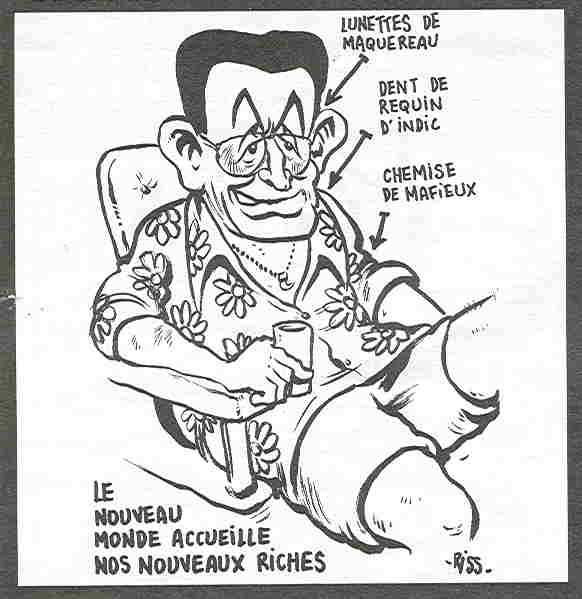
Whenever an Omega man (a rickshaw owner is a candidate for comparison) is ‘emerged’ (—it usually is not of his own doing, but a happenstance, therefore he is ‘emerged’/thrust forth), he overcompensates for his former lowest of social rankings and poverty by wishing to become a millionaire or in some other way reaching a status of equivalency with the high-end of society known as “old money”. There is a word in French for such emerged men and women: nouveau riche.

Sometimes some elements of the old nobility, though coming from a generally well educated class, make fun of the nouveau riche, thus letting everyone who has eyes to see see how arrogant and out of touch with reality some of the old class have become. Ideally though, the old nobility has close links (from way back when) with the temple, because the latter gains its wealth not for its high priest, but for the upkeep of the temple and for the high priest to redistribute a surplus of gifts as he sees it fit. One such person of ‘old nobility’ was Socrates, the Greek philosopher. While renowned as a philosopher, what is particularly striking is Socrates’ attitude toward and acceptance of death. He believed that by dying rather than trying to escape from a death sentence (which he received and had the opportunity to escape), he helped cement his society with greater bonds than can be done by mere law.

Sometimes however the nouveau riche emerges in such great numbers and accumulates such power in political circles (one way to gain equivalency with ‘old money’ is to overwhelm it by seizing control of politics) that they overwhelm both society and culture. That for the most part means the end of leadership of the old aristocracy (visualized in these blogs as a college of Johns) and its substitute with a pseudo democracy. The pseudo democracy is a ‘democracy’ that no longer exists among the common people, but operates among the nouveau riche or, as pointed out above, the heads of corporations. These millionaire upstarts, with a battalion of lawyers in tow, settle their differences ‘democratically’ in the court of law. While technology—originating in wealth making schemes—accelerates, the people of the land are neglected, deprived of a better education, and are ‘dumbed down’ (what an unpleasant but accurate phrase) to the function of laborers and consumers. At the same time, the ‘democracy’ now under control of the nouveau riche describes the peoples’ yearnings for justice and fair politics as populist. In countries like Latvia, words such as ‘populist’ and ‘populism’ are interpreted as synonyms of ‘harm’ and ‘harmful’ which harmful naming serves the interests of the nouveau riche “uzņēmēji”, i.e., producers, investors, anyone with a scheme to exploit nature and people at full throttle.

Currently Greece is in a similar situation as Latvia, except it has many more people and thus is able to expresses its unhappiness through greater social unrest. Furthermore, as one “anonymous” writer at another site put it (I hopeZeroHedge forgives me the steal): “Yes, the Greek public debt situation is unsustainable, but... if a country is idiotic (or captured, or likely both) enough to allow for the opportunity [it is old news].” Another “anonymous” observer writes: “…you can't live [in Greece] on the basic pension anymore. It was true for a long while, but now it's impossible…. Families largely make up for it—thankfully the social fabric is still largely intact in the sense that people feel obliged to cater to their own. But it's getting progressively harder for the average Yiannis (as in ‘average Joe’).”

We know that over the centuries Greek society has changed (like Latvian society) a number of times. First there was, so our history books tell us, “ur(very ancient)-ancient Greece”. This period goes back to the days before Homer, who sang a long poem to those ur-ancient times. Some researchers say that it may be that Homer’s Iliad and Odyssey is sourced in the Baltic area, that is to say, north of present-day Greece. Then comes ancient Greece proper with Socrates, Plato, Thucydides, et al. Then there is the Greece of Byzantium home of Basil, the holy man, whose death so closely parallels that of Jesus that it served the writers of the New Testament as a prototype to the Jesus story. Basil’s executor, Alexius I Commenus was an Alpha male (and one of many princes) emerged from and subject to the high-end lumpenprolitariat (‘Commenus’ by another name?) of his time. Commenus stands out as a crossroads from a community and temple oriented culture to one that robbed the temple for personal ends. Following the destruction of Jerusalem (then located in Constantinople) and the elimination of the Church of the Children of Johns in 1204 as a religious-political force, [John] Basil was replaced with Jesus, who was removed to a nonexistent place trick-a-treated into existence with ‘Heaven’ its name and other sweets.

Jerusalem, too, was relocated first to any land some bishop decided on (Bishop Albert and Riga, for example), later pushed further away from its homeland to Palestine. Of course, the Church of the Children of Johns, known as the Eastern Church today, was forced to take on a Western character, because John, transformed into Jesus in Heaven, could not oppose the secular princes as former Johns could and did. All these changes in “Greek” history had their echoes in the territories of the Slavs and the Balts. After the Eastern Church of Johns was forced to take on a Western cast, that is, after it was taken over by Westerners and/or their influence, the Children of Johns happily “converted” to (actually were coerced to) the worship a figure far removed from realities of life on Earth.

It is telling that eight hundred years after the princes secularized the temple, we have liberal capitalism become a ‘religion’. Its progress is seen in how “it's getting progressively harder for the average Yiannis (as in ‘average Joe’)” to survive not only in Greece, but also in Latvia. The scam known as “globalization”, while it confuses the poor and uneducated folk it addresses with high idealism, actually spells ‘pauperization’ not only for Yiannis, but Jahnis, Jean, Johammed, John, Johan, Han, Huan, Xian, etc. If I may put it bluntly, all these populist names and their bearers have been turned into rich g[y]uano (bird droppings) for the corporate powers that own the governments of our time. This is also why the name Jānis—once the most popular male name in Latvia—may soon disappear from popular names lists. Indeed, Janis (John) no longer appears one of the top ten names for baby boys. Such forgetfulness is the consequence of a cultural demoralization. Such was not imaginable a half a century ago. This tells us of great changes happening and yet to come.


Asterisk & Notes of Interest:

On material depravation in Latvia.

On the theme of “more-equal-than-others”, see Animal Farm.
Of great interest to me this and like articles. It presents some of my reasons for supporting the cultivation of Johns Grass in Latvia.

My most unappreciated work—so far, re “Tiresias’ Revenge”, my reinterpretation of Sophocles’ “Oedipus Rex”. I believe that Sophocles had to hide the true meaning of his play for political reasons. It is apropos of the political situation in the world today, also in Latvia. The play may be found at blogs 40 through 47. Start from Blog 40.

These blogs tend to be a continuum of an idea or thought, which is why—if you are interested in what you read—you are encouraged to consider reading the previous blog and the blog hereafter.

Partial entries of my blogs may be found at Latvians Online + Forum Home + Open Forum –ONLATVIANPOPULISM vs LATVIJASLABEJIE. If you copy this blog for your files, or copy to forward, or otherwise mention its content, please credit the author and http://esoschroniclnes.blogspot.com/