Showing posts with label endura. Show all posts

Monday, August 12, 2013

Eso’s Chronicles 204/ 4
47 Pensioners (5)
© Eso A.B.

Many years ago (~1973), while protesting the building of the Seabrook Nuclear Power Plant in New Hampshire, a number of protesters, myself including, undertook a fast that lasted for two weeks. If I remember right,  the Boston Globe gave us passing notice. Today, I have passed that small self-disciplinary act by several days and am now on day 17. So far so good, except that the store bought juices which I have been drinking are sickeningly sweet and tasteless. Since the apples in my orchard are coming ripe, I am now gathering a few sacks full of them, and a neighbor of mine has promised to press them into apple juice.

A person who is well acquainted with Latvian politics and to whom I have sent blogs 200 & 201 of my Chronicle series, inquired what it was that I was asking of the government. I responded by mentioning several demands (I have written of them in my blogs and in these posts): a quick restoration of the Riga Castle as a symbol of Latvia’s sovereignty. Among a number of other requests, are included a request for a quick passage of the necessary changes to Amendment 68., which will enable Latvia to maintain its sovereignty in the face of expected changes in the Lisbon Treaty moving Europe to become a Federation; and the resignation of the Minister of Justice Bordans who through his actions and words has given strong indications of his indifference to Latvia as a sovereign nation and hints of his tacit agreement to Latvia’s inclusion in Federated Europe.

Way back then—forty years ago—I eventually left the Clamshell Alliance when a small group of people felt that “direct action non-violent protest” included cutting fences at the Seabrook worksite. I felt that such actions nullified non-violent protests such as marching with signs, fasting, or sitting in a tree for a few weeks, which is how one resident of  New Hampshire got the protest movement going. I got back something of a sneer from the more aggressive group, because my reaction to its breaking the consensus vow was verbally explosive, and perhaps because the group felt its tactics were more likely to stop the construction project. It did not.

Because today I am repeating my fasting ‘act’, I am better prepared to explain it than I was then. First, another brief remembrance of the times back in Boston. At the time, I was working as a typesetter for a small newspaper publishing company out of Brookline that published a weekly newspaper called The Boston Ledger and Brookline Chronicle. The editor of the papers, John Van Scoyoc, gave me the opportunity to write a short weekly column. This may have had something to do with the fact that even then, I was much complaining about the state of politics. However, when the opportunity arose to actually write about it, I discovered that I could not bring myself to say anything relevant, and thus my column quickly turned into a rather ordinary kind of ‘chronicle’. The reason for clamming up was a very simple one: American politics was rather like the politics of Latvia are today—positivist, non-controversial, in a rut, and to say anything contradictory would turn anyone into an ogre, he-she was not prepared to be or play.

In the context of the current economic and financial crisis, politics has become potentially more controversial. This is borne out in that a recovery from the economic and financial crisis is not only in doubt, but the very fact that it is in doubt, allows one to think of the consequences of failure. Not just any failure, but a failure with catastrophic consequences.

The presumption of the current Latvian government of PM Valdis Dombrovskis, the Unity Party, and coalition of Nationalist partners to navigate toward a Federal Europe without consulting the nation by holding a referendum (allowed for by the Constitution) violates in a traitorous manner the Latvian Constitution (an understanding between the citizens of the nation and its government). Latvia gained sovereignty (1918) after a hard and bloody fight and paid the price in tens of thousands of lives. Moreover several hundred thousand Latvians escaped from death by fleeing to Russia and other war related events by the skin of their teeth. Later during the Bolshevik times, many were deported to the Gulags. Those who found new homes in the West did not remain loyal to Latvia in their memories or ‘fantasize’ about a free Latvia in the expectation that it would be surrendered to and take orders from an unelected government in Brussels.

While acceding with the arguments of some sociologists that the politics of ‘democratic’ Europe today supersede (by means of methods of a dictatorship) the communities established by nations in earlier times, it is clear that the modern individual will not stand up for the community he-she arise from. Nevertheless, an individual of a differing mind may hope to awaken an asleep community that has forgot its roots or is so attached to fiat currency that it is all that he-she is capable of being loyal to. That individual has the help of current crisis, possibly bringing a new reserve currency within a very short span of time and the inevitable chaos and war this may lead to.

In times when the community was not yet subject to the hegemonic choke of old killer empires that have survived to the present day, situations like those facing Latvia and other nations, met with determined resistance. One telling example comes from Japan, an actual event that involved 47 ronin , i.e. samurai. The story of how they saved Japan from loss of honor (actually as a nation) remains as an inspiration to this day.

I suggest that the story is as applicable to not-violent actions today as it was in the 18th century. To understand what I am about to suggest next the reader should read the story at the above link.

It is possible that--but for the hypnotist’s snap of his fingers to awaken his subjects--such 47 individuals are still to be found today and are awaiting the signal. I am not proposing that these 47 indispensible ones are samurai or soldiers, or subscribe to some Japanese code of honor, but are individuals with a spirit not unlike that residing within any organic community that yet remains. Indeed, given the decentered individual of our time, the untested culture of the cult of youth, the candidate for one of the 47 may, more likely, be found in a nursing home or among pensioners.

The mode of protest on behalf of a nation’s sovereignty was best known in the West before neo-Christianity repressed those Christians who had existed long before the arrival of Catholicism and its state serving offshoots. These early Christians were known as Cathars. While the Cathars were murdered by fire, and though no record remains that they escaped their fate by taking resort to their well known ritual known as the  endura  (after taking consolamentum  from their own priests or by divine inspiration, one begins a fast that ends in death), the precedent is there (was practiced for many centuries if not longer) and its potential remains an option.

I am convinced that in spite of the falsehoods and contempt filled propaganda still surrounding the kind of Christianity practiced by the Cathars, the reawakening of such a spirit is not only a necessity, but remains the only way that will put the arrogance of today’s ‘democratic’ dictatorships back were it and they belongs—in the resort town for the living dead.


Paul Craig Roberts on Role Reversal: http://www.youtube.com/watch?v=buqJP7y115s

Tuesday, February 9, 2010

© Eso Antons Benjamins, a.k.a. Jaņdžs

NOT-VIOLENT TERROR
80 Climbing Mt. Citheron (XIII)

Tomislav Sunic, a Croatian political scientist, in a paper called “Liberalism and Democracy?  Carl Schmitt and Apolitical Democracy” writes that “…if one assumes that a new type of homogeneity can develop, e.g., homogeneity caused by technological progress, then one cannot dispute the functionality of a liberal democracy in which the homogenized citizen remains thoroughly apolitical: hypothetically speaking, political issues in the decades to come may no longer be ethnicity, religions, nation-states, economics, or even technology, but other issues that could ‘homogenize’ citizens. Whether democracy in the twenty-first century will be based on apolitical consensus, remains to be seen. Schmitt sincerely feared that the apoliticism of ‘global liberal democracy’ under the aegis of the United States could become a dangerous predicament for all, leading not to global peace but to global servitude.”

The above illustrates the thunder clouds approaching. Far in the background one may also hear thunder. Below is a scene of the way it is happening in Latvia with a sketch of the political background of it.

This past week several Latvian “political” parties made yet another step toward apolitical politics when the Citizens Party (PS) declared its readiness to form a coalition with the New Times Party (JL) and Party for Different Politics (SCP). Said coalition is to be called “Unity Party” http://www.uic.edu/orgs/unity/UnityMonthJPEG.jpg , and according to Girts Kristovskis, chairperson of the Citizens Party, it will oppose parties of the oligarchs and pro-Russian parties. The talk among the Unity Party members is to concentrate on “doma” (to think thoughts) of economics. (Source: DELFI.lv, 6.2.10.)
What is Unity Party? Let us start with the definition of “unity”, which at this link is best expressed as (6): “one of the principles by which a uniform tenor of story and propriety of representation are preserved; conformity in a composition to these; in oratory, discourse, etc., the due subordination and reference of every part to the development of the leading idea or the establishment of the main proposition.” In other words, the Unity Party (when officially announced) may present to the public a definite program.

We already know from the news that Unity will be anti pro-Russian and oligarchs. In other words, the political “enemy” is established; however, the economic program is yet at its muz muz stage. The lack of an economic program at this stage indicates that it will likely remain at the muz muz stage even after the founding, which means the Unity Party will remain as apolitical as the activity of muz-muzing usually is. To be any other way, Unity has to choose an authority figure that the rest may join as advisors, but who in all cases will respect the authority figure.
The Karlis Ulmanis regime (1934-1940) of Latvia was a regime that started its life (by way of a coup) on May 15, 1934, but soon became a “soft” dictatorship. K. Ulmanis  main support came from the Farmers Party (Zemnieku partija), the military circles, and, not least, from the inability of the radical and the “we-agree-to-disagree-in-almost-every-case” parties to be unified enough to move along the country’s economic development. In a sense, K. Ulmanis came to power as a result of an ad hoc Unity Party that soon became known as “Ulmanis regime”.

Ulmanis was the authority who spoke to Latvians and spoke on behalf of them. He was the guide in all future projects and, like it or not, he enabled many Latvians to become market savvy. The “market” in its modern guise was a concept that was new to Latvians, especially the bookkeeping part and the discipline to run a business successfully. He used his college education (agronomy and farming) at the University of Nebraska, to raise the level of education for Latvians, most of who were still of peasant stock. Ulmanis returned to Latvia from the U.S. (1913) with a broadened perspective, ready to help develop Latvia with—of course—other Latvians as his helpmates.
However, a year after his return from the U.S., WW1 broke out. The war devastated Europe economically. The new nation of Latvia, which Ulmanis helped found (1918), would need to act with an especial foresight to rebuilt its economy and educate its people. Ulmanis was ready for the task, but its execution, due to many political fractures, was to lag behind. On May 15, 1934, Karlis Ulmanis staged a coup and seized the reigns of the Latvian state.
My grandfather and father, the first the founder and both editors-in-chief of the newspaper "Jaunākās Ziņas"  (since 1911) at the time, saw the political picture with a neutral eye. They appeased social disagreement, such as existed, by printing jokes about the clumsiness of “vadonis” (leader), but never disapproved of him. Apparently, the judgment of the political and economic situation by the editorial staff and publisher, authoritarianism was acceptable for the benefits it brought to the majority of Latvians, and, not least, kept the newspaper from getting shut down as the authorities reminded the staff of such a possibility often enough. A certain antagonism that existed among the newspaper’s publisher, its editorial board, and the Ulmanis regime came from both competing for the populist vote. Ulmanis needed the populists because he needed majority support to stay in power (without going to military rule), while “Jaunākās Ziņas” desired to increase the number of its subscribers and had to keep peace—a tight balancing act sometimes—among newspaper’s editorial staff and a publisher of differing minds.
So, Karlis Ulmanis became an authoritarian leader. He took advantage of the anti-nazi mood in the country by supporting the out-migration of Baltic Germans (many believed to be nazi sympathizers) and appeasing those among the public that were unhappy by making them happy through an increased sense of public pride in being a Latvian. The latter were to be thought of in terms of ethnicity. If one was a citizen of Latvia, one was of Latvia’s first (or second, etc.) generation and thus one of its sovereign owners. Under K. Ulmanis, Latvia was a majority democracy with the majority facilitating its rule through an authoritarian president.

Unfortunately, on Latvia’s eastern border was communist Soviet Union with a definition of cosmopolitanism that identified cosmopolitanism with liberal consumerism. Having encouraged the departure of the Baltic Germans, Ulmanis set up the conditions that would enable the Baltic Germans to be replaced by the Baltic Slavs who arrived into the country with the Soviet times. Are the parties who today represent the Slavs to be the enemies of the Unity Party of Latvia? Does the Unity Party plan to encourage Latvia to continue to be an ethno zionationalist state?
Lest it be the same rhetorical bluff that has guided the ship of the Latvian state since 1991, who in the “Unity Party-to-be” is going to be “the authority”? Who and what is to be the sacrifice?

The climb up Mt. Cytheron has not yet begun, certainly not in the context of our times. As Oedipus of ancient times found out, his story stands for the way of all too human endeavors, and one has to take issue with such “naked” dirty politics that the Unity Party leads one to anticipate. An anti Baltic Slav campaign will lead to the plague that puts the future of all Latvia-born children in hawk.
Asterisk & Notes of Interest:
 On the theme of “more-equal-than-others” see George Orwell's "Animal Farm" .
A recommended read: “The Theory and Practice of Oligarchical Collectivism” by Emmanuel Goldstein (A book within a book from George Orwell's "1984")  
Of great interest to me is this and like articles. It presents some of my reasons for supporting the growing of Johns Grass in Latvia.
These blogs tend to be a continuum of an idea or thought, which is why—if you are interested in what you read—you are encouraged to consider reading the previous blog and the blog hereafter.
Partial entries of my blogs may be found at LatviansOnline + Forum Home + Open Forum –ONLATVIANPOPULISM vs LATVIJASLABEJIE. If you copy this blog for your files, or copy to forward, or otherwise mention its content, please credit the author and http://esoschroniclnes.blogspot.com/  

Saturday, January 30, 2010

© Eso Antons Benjamins, a.k.a. Jaņdžs

NOT-VIOLENT TERROR
77 Climbing Mt. Citheron (X)

"King Oedipus” is a tragedy, which as a play and a story has endured a misreading, the misreading leading to tragic developments for humankind as a whole. That we have come to read the story afresh and gain new meaning from the riddle it presents is the result of a confluence of occulted near and far historical events, a chronal moment and a confluence for the inner consciousness of a writer living in antiquity and our own.

The gyres of occultation, which have enabled us to see something so obviously before our eyes as to have escaped our notice for these many years, are partly related to such events as the death of innocents; bombs upending earth seconds and not many meters behind; the sight—mercifully from a distance—of cities burning; tortured bodies marching by imaged in the clouds; and not least, the stealing from the Latvian people, of whom I am one, the future. The latter is the end result of rule by a government with no ultimate sense of responsibility for the results of its deeds as government. The people, so commonly referred to as “populists” (why not equate populism with a form of “terrorism” then?), have been pushed to the periphery where government feeds on its livers without cost to itself.

The chronal moment of unriddling the riddle (likely related to the universe as a hologram) is driven by a necessity to acknowledge events we have been censured from noting to lasting effect, and, thus, have not been able to give the chorus of dissident voices “out there” an ear. Our necessity is the necessity for truth that comes to every dying entity on its deathbed—to live on through others. So, let it not be said that either Sophocles or myself have invented the story of King Oedipus, but that it has gone unrecognized for the lack in our civilization of self-sacrifice, which has brought us to a time when a majority of people on our planet, little Latvia including, have little more than their naked self.
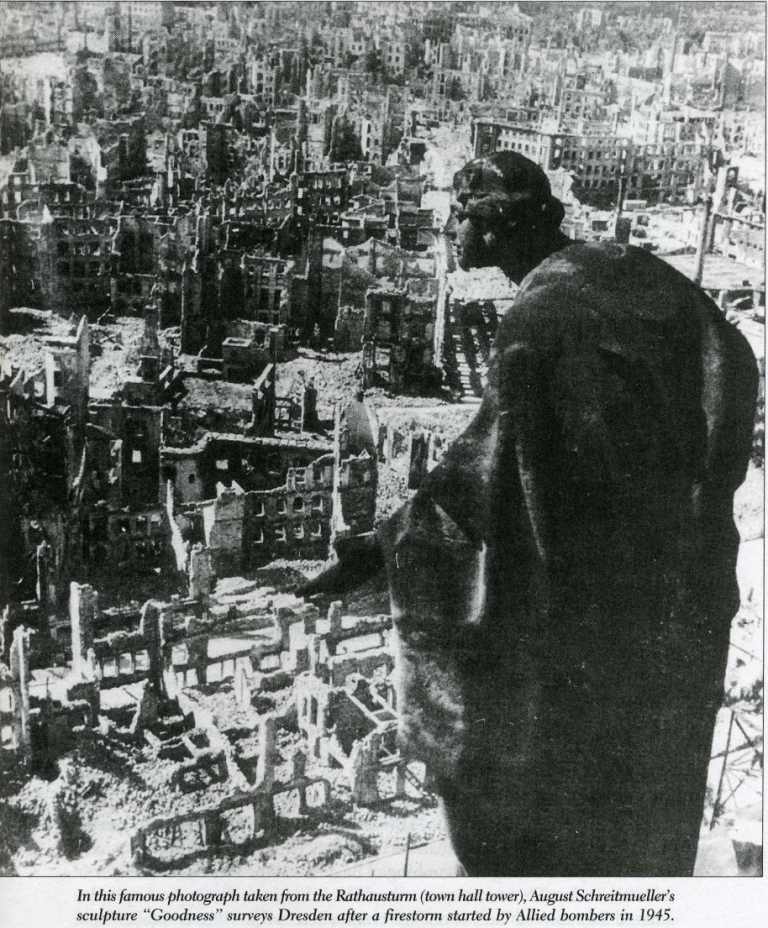
The willful misinterpretation of the role of Oedipus in Sophocles’ “King Oedipus” is the result of a zerstoertes (disturbed) mind. The failure by the mind in our times to look beyond the immediate is as profound as looking over the ruins of Dresden and Hiroshima and not seeing them, and the inability to bring a Stalin, a Churchill, and a Truman even post mortem to court for war crimes. The ruinous events in what so many theatre goers have presumed to be an honest rendering of a tragedy (there was a Nuremberg trial, what else do you want?), turns out to have been Sophocles’ coded scream for help, but unnoticed for the presumption that what makes tragedy has no relation to government.

If “Tiresias’ Revenge” becomes a story of which the riddle went unsolved (for good reason some may claim) for two thousand years (Scaligeri’s chronology), it may contribute toward the removal of so-called “just war” from the bag of pardonable crimes and prosecute it from the perspective of past, present, and future self-sacrifices. Were this to happen, the onus will be on those who fail to acknowledge the equal signs between themselves and the victims as well as beneficiaries of their acts. At this time, the beneficiaries of the government have the power to ignore any call to responsibility. The payment in lives and life styles is still exacted from the weak for the benefit of the strong solely because the latter invented arms that kill at a distance. The mailed fist has for too long allowed a minority to remain in denial that it is the major cause of death of “others”.
The so-called ‘just wars’ are little more than those who are violent claiming for themselves a “more equal than other” status. As the killer drones in Afghanistan prove, the art of ‘just war’ has progressed to the point where the killer kills the victim as if the latter were a figure on a video game screen and the former no more responsible than a child for pushing the buttons in a gaming arcade at a shopping mall.

With death among the violent ones having been replaced by the doctrine of ‘resurrection of the dead’, death among educated “elites” occurs as if in secret still. Indeed, the violent ones have not only eliminated direct knowledge of the death of their victims, but knowledge of themselves as mortal beings. Sure, death remains a matter for tears among one’s immediate relatives, but the laws that tell that the body will upon death be taken to the refrigerator at the mortuary make sure that death remains invisible and will not trouble the dictatorship of positivism. No rulers of hegemonies where consumers are the core of ruling parties will acknowledge that they are the cause of death of millions of—let us call them ‘nakeds’. Such ignorance follows the same line of reasoning which during the current crisis causes governments to treat the most irresponsible banks institutions “too big to fail”, because failure means their fall from power as well.
The subject of violence and death presently discussed is not often met with in the discursive space of modern media. None of the “authorities” who have done and condoned violence has sworn an oath to die a conscious death, yet the same are said to be fully conscious and in alignment with the will of Allness when they send to their deaths millions. No “authority” in our day will extinguish his-her life through his-her own will—even if that is not expected from them sooner than old age—and will censor such a notion as suitable for public space.

The doctrine of self-sacrifice and the ability to extinguish one’s life comes from an imaginary that has expectations of a future in which a larger-than-life community creates an environment that enables it to recreate itself until forces beyond it—rather from within it—end it. It is from this itself that life beyond mere naked life community arises. It is from the larger-than-life community which is able to practice self-sacrifice that the potential of a continuum of self-consciousness arises.
If one wishes to create a hegemonic community, one has to be willing to help create the kind of charismatic bond that memory will not let go of. Death through natural causes may provide the original understanding for the desirability of such a charisma. Death as a result of a violent attack may confirm the power of death’s charisma. However, only self-sacrifice faces the charisma of death (some may wish to call it motivation) in full self-consciousness. This is why one must learn to project, then internalize an image that is powerful enough to displace the image of Jesus in the sky. Innocent as Jesus himself may be, his image was engraved into the vault of the sky by the physical violence of those who reject owing up to the notion that a fully human community can result only when its members have authority over their deaths. In the context of the neo-Christian secular order, which is founded on the high blown words vs the arch-Christian Johns seeking to live with the endura engraved as the grail on their minds, it is the former who die in their beds, while the latter if not dead by fasting, once managed to die on their feet. There are none like these in public space today, unless the space is not only subjective, but hidden, and if discovered is lied about. Hopefully, the solving of the riddle of “King Oedipus” will turn the tide and soon prevent the rule of lies.

Asterisk & Notes of Interest:
On material depravation in Latvia.
On the theme of “more-equal-than-others” George Orwell's Animal Farm
A recommended read: “The Theory and Practice of Oligarchical Collectivism” by Emmanuel Goldstein (A book within a book from George Orwell's  "1984"). 
Of great interest to me is this and like articles. It presents some of my reasons for supporting the growing of Johns Grass in Latvia.
These blogs tend to be a continuum of an idea or thought, which is why—if you are interested in what you read—you are encouraged to consider reading the previous blog and the blog hereafter.
Partial entries of my blogs may be found at LatviansOnline + Forum Home + Open Forum –ONLATVIANPOPULISM vs LATVIJASLABEJIE. If you copy this blog for your files, or copy to forward, or otherwise mention its content, please credit the author and http://esoschroniclnes.blogspot.com/

Friday, December 11, 2009

© Eso Antons Benjamins, a.k.a. Jaņdžs


NOT-VIOLENT TERROR
63 The Future of The Wuerzeltod (I)

When Bishop Albert sent his knights to burn and destroys Jersika, he was hoping not only to destroy a kingdom, but to disembody proto-Latvians who were its inhabitants by burning their idols. If he were to succeed in his endeavor, the exercise would not kill so many people as make those not killed “Wuerzeltod”. Wuerzeltod means, in this setting, a people become spiritually-psychologically dead to their roots, an uprooted people in their own garden. That is how a people can keep their language, but the language loses much of its spirit, which is replaced by, let us say, a foreign object.

Without their idols (cultural objects instilled over the centuries with memories of traditions, which had the power to heal the soul every time some defeat, including illness, visited the people) the Jersiks would be unable to re-embody their bodies with their former spiritual selves. In effect, Bishop Albert hoped to make the Jersiks obedient to him and other lords in Riga. Under Riga’s tutelage [Riga, the new para-normal Jerusalem] the defeated and humiliated Jersiks would be denied the right to repossess their former and own spirits. They would be remade as neo-Christians, i.e., post-Jersika Jersiks become Wuerzeltod to their old spirit as well as spirits.

The burnt idols of Jersika were replaced by various neo-Christian saints, all of who implicitly and explicitly denied their predecessors, the itinerant Johns, existence. Denied, too, were the shamans-healers (dziednieki, literally sing-healers), priests, and all that was sacred to those who—through struggles of many millennia—had created their own vision of Jerusalem*. The Jersiks and all people about were caused to pray to a chronal mirage sent by Rome. The mirage was of the head of a man enveloped by a circle, a halo laid down by goldleaf, which gave it a para-normal appearance. But whereas the Jersiks would have called the icon the head of John (Jānis), Son of the Sun, the man from Rome, the Pope, called it Jesus Christ, Son of God. No doubt, the Wuerzeltod, that is to say, the body with little or no memory of its past, transferred its need for a spirit to Jesus. The process of transference was made easier through many para-psychological tricks, violence being its primary tool. Because Jesus himself had been one of the Johns and was killed by the Brotherbund of Rome, John was reembodied in Jesus by violent conversion, which was then glued to the communal memory through the demand of continuous confession and a written history that never was. Since the art of writing and the art of printing belonged to the powers that be, the Brotherbund was able to force the graft to grow roots.

Given such a background, we now must move forward in our reconstruction of the Latvian myth as it might have moved forward had the making of myth not been forbidden to proto-Latvians. We must return to John Visvaldis, King of Jersika, and ask: Why had the Jersiks followed this leader? What was his magic attraction?

If the Children of Johns in King John Visvaldis’ keep had followed their “John Awesome” [Visvaldis = (literally) Ruler Over Allness, an Allness that is an equivalence not of ‘all’ (viss), but Visums (Allness)], they most likely did so in deference to the not-violent terror the King inspired. Such an inspiration from the King came by way of the King’s forebears, all of who had ended their life at a ripe old age, but which age was ended by way of what the Cathars called the endura. When the Cathar perfecti or priests felt that their hour had come, they called for their descendant-to-be to offer them consolamentum (literally to consol them), after which they no longer took food. The offering of consolamentum was also a form of oath-taking by the one who offered it, that is, he-she swore to uphold not-violent rule in the same manner than the one who was taking the consolance and was departing. When a perfecti died, he transferred to his-her descendant(s) great charismatic authority. Similar practices were in existence among most of the heredici—including (we surmise) the Children of Johns of Jersika.

The neo-Christian brethren were able to destroy the old bonds of loyalty among the Children of Johns because they were in effect aliens. They were not of the culture of Johns, but belonged to what in our own day is known as capitalist culture, a culture that enriches its adherents and not the temple. In due course, the para-normal sheen of gold on the halo of the icon is scraped off and converted to coin.

To be awesome is to inspire no ordinary respect, but to be inspired by terror, not-violent terror. Even if appearing fearless before death may not be all that it seems (all are apprehensive before it), it, nevertheless, has enough traction-terror to prevent a community of which John(s) are the leaders from dissolving into Wuerzeltodness—rootlesness.

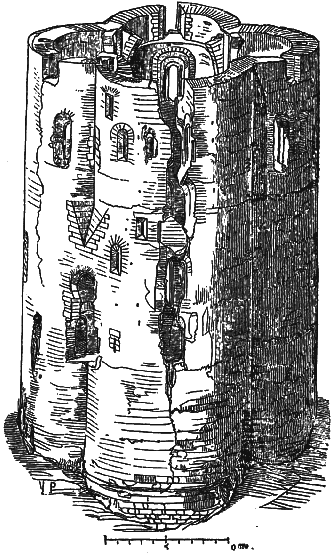
King John Visvaldis was the root, stem, and branch of the Children of Johns. We might say, that the Jersiks, the Children of Johns, were the leaves of the tree trunk that represented the king. Neither leaves could be without the trunk, nor the trunk could be without the leaves. Ideally speaking, if a storm felled a tree, the roots would send forth new shoots, and the kingdom, the stem (or the DonjonDon-Jon, who stands for ‘John of Johns’) would have another go at sprouting and growing into a tree peopled by a society of leaves.

At the same time that not-violent terror created, bonded, and maintained a society, no one who was of it ever forgot that both individuals and society are not immortal. Before immortality immortalized itself upon society with such violence as overcame the Jersiks and has become commonplace in our day, mortality was accepted as a reality of the Great Being itself. This is why a seed was and remains such a wonder. It flies to the winds of fate, and fate finds it another place to root or not. Meanwhile, King John Visvaldis held the community of the Children of Johns together whether the community was in situ or in motion, travelling.


Asterisk & Notes of Interest:

*Jerusalem = Yaroslav. The meaning of this name is hid behind a thick veil, but it becomes easier to decipher if we split the word into yaro + slav. Yaro is somehow related to ‘year’, which may reflect a tradition of an ancient annual sacrifice ritual. In Latvian the word ‘yehrs’ (jērs) means lamb. For ‘slav’ see here and read under Ethnonyms until you come to the theory that the name may once have meant worshippers. In my interpretation the name stands for ‘the lamb of peace’ sacrificed at an ancient ritual invoking peace. Thus, the name ‘Jersika’ in Latvian may once have meant “the land of peace”.

On material depravation material depravation  in Latvia.


On the theme of “more-equal-than-others”, re Animal Farm.
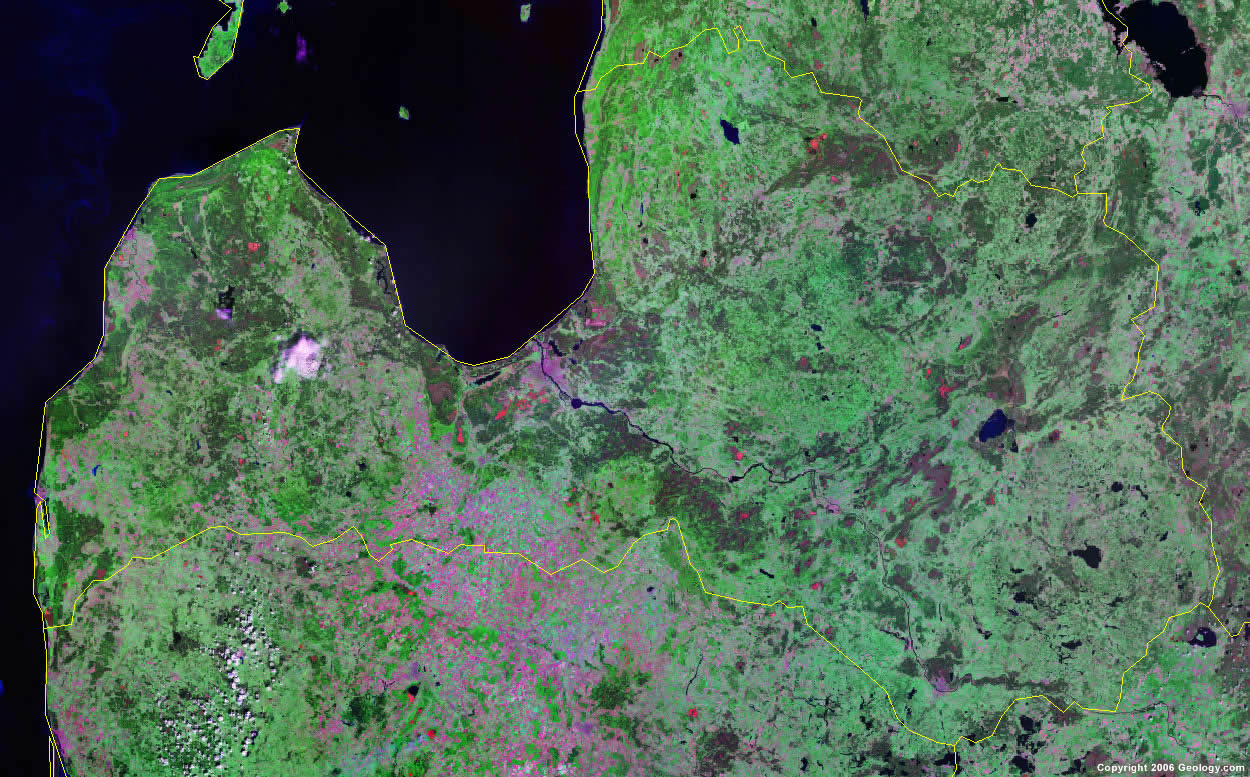
An eyeball view of Latvia (and its forests) company map; satellite map. While some sources claim that Latvia is 47% covered by forests, none of it is old growth forest. The Latvian news media provides little coverage of the rapid pace of deforestation. Anecdotal evidence of deforestation in progress from a neighbor: “There were fewer mushrooms this fall than last year. Forests we used to visit are gone.”

Google software to tell effects of deforestation deforestation

Of great interest to me this and like articles this and like articles. It presents some of my reasons for supporting the growing of Johns Grass in Latvia.

Favored serendipidous click or “chronal mirage” on the internet. I was searching for a relationship between the burning of Jersika and heretics in Lanquedoc, France. You must read the text at near the end of the scroll, re image of “The Burning of St. Joan”, Monday, September 03, 2007, to get the point

My most unappreciated work—so far, re “Tiresias’ Revenge”, my reinterpretation of Sophocles’ “Oedipus Rex”. I believe that Sophocles had to hide the true meaning of his play for political reasons. It is apropos of the political situation in the world today, also in Latvia. The play may be found at Blogs 40 through 47. Start read with Blog 40.

These blogs tend to be a continuum of an idea or thought, which is why—if you are interested in what you read—you are encouraged to consider reading the previous blog and the blog hereafter.

Partial entries of my blogs may be found at LatviansOnline LatviansOnline + Forum Home + Open Forum –ONLATVIANPOPULISM vs LATVIJASLABEJIE. If you copy this blog for your files, or copy to forward, or otherwise mention its content, please credit the author and http://esoschroniclnes.blogspot.com/