Showing posts with label Žižek. Show all posts

Wednesday, January 1, 2014

Eso’s Chronicles 267 / 7
The King & I
© Eso A.B.
All comments appearing within brackets [ ] are editorial in origin. This blog series begins at 264.
 
NEITHER GOD, NOR NOMOS, BUT KING
 
Having begun this series on the ‘King’ with Slavoy Žižek’s mischievous conjoining of the King with bureaucracy (The King and his Bureaucracy, Ch6, ‘Interrogating the Real’), it is only proper to conclude with the no less mischievous comparison that the pop philosopher makes of subjectivity with “dangerous hubris”, insisting that the claim to “authentic essence of humanity” lies “outside the domain of subjectivity”. Žižek posits the subject of authentic essence in Antigone and its human counterpoint in her sister Ismene.
 
I would call the other name of the “subject” that Žižek imagines—a “mask”. However, Žižek quickly becomes inconsistent and contradicts himself, when he decides to dedicate his book to an old Slovene communist, who in 1943 led an uprising of some 2000 starved Yugoslav prisoners against 2200 Italian soldiers who are their guards.
 
The Slovene prisoners succeed in disarming the Italian soldiers. After the war, the Slovene communist is arrested (no reason given why--by the succeeding communist-Stalinist government) and ten years later, he is forced to participate in the building of a monument that celebrates the uprising he led.
 
It is an ironic story, surely.
 
Knowingly or unknowingly, Žižek then tops off the irony by putting Stalin into role of the ‘King’, while the role of the ‘bureaucracy’ passes to Stalinist  communists, those who are enforcing Stalin’s ‘will to power’.
 
This leaves the reader confused as to why Žižek holds an old communist in such high esteem, for obviously the man revolted against the guards of the prison on the basis of his subjective feelings and decisions. The problem resolves itself only if one assumes that Žižek contradicts himself or Stalinists are the new Catholics.
 
I agree that the monument, the ‘subject’ of the ‘’monumental building project, stands for the ‘mask’ of the old communist and his rebellious comrades, who, I assume, are meant to stand for the ‘authentic essence’ of humanity.
 
But why should one believe that the monument stands also for ‘dangerous hubris’? Is that not like a Catholic priest demanding a pagan to renounce his old Gods (who up to the moment are a part of the man’s subjectivity) for the authentic subject of an ‘outside’ God, aka Nomos https://www.google.lv/#q=meaning+of+Nomos ? And is not Nomos synonymous with such repressive organizations of pacification as the Inquisition, the Gestapo, the KGB, and the CIA/NSA? Is not dismissing subjectivity as ‘hubris’ a matter of continued repression and denial of privacy? Therefore, is the monument not a monument to Homo Sacer: http://en.wikipedia.org/wiki/Homo_sacer --the man who cannot be murdered, sacrificed, but only killed, because all he is is naked?
 
This brings us to “god” with a small ‘g’, because Catholicity (and Christianity derived from globalist Catholicism) surely discredited god when written with a capital G, and here Žižek and Schmitt discredit him with a small g. So, why not replace the missing figure of Trust with the long neglected figure of King?
 
Would not a King serve the 900,000 Latvians forced into economic exile as de facto ‘homo sacer’ better than the bureaucratic totalitarian democracy, which with the backing of the totalitarian democracy of the EU takes upon itself the authority to make them de facto homo sacer or, in other words, homeless?
 
There will be those who will claim that I would reinstall subjectivity in place of an objective (rational law) government that a Hegelian http://en.wikipedia.org/wiki/Hegelianism bureaucracy presumes itself to represent. As Schmitt asserted: “all significant concepts of the modern theory of the state are secularized theological concepts”. Here we may remember that Catholic Christianity spent many centuries violently persecuting and inquisitorially repressing an earlier Christianity now identified with Bogomils, Cathars, and Krist-Yans.
 
The repression was necessary because like Žižek (a Hegelist), Catholicism believes human subjectivity to be a hubristic element rather than an inherent element of being human. In short, we have biocentered human beings http://en.wikipedia.org/wiki/Biocentrism_(ethics) opposed by virtual or ‘man-made’ human beings, who are created by words imbued with violent attributes gained through innumerable acts (? 900,000) of de facto (unacknowledged de jure) murders.
 
To discuss the means by which the King may return is a task beyond these blogs, which are meant to argue against the totalitarianism of liberal democracy in an attempt to overturn its dictatorial order that has taken the helm in Latvia. Even so, we may say—in agreement with Carl Schmitt—that the nature of democracy is to behold the rights of the rulers and the ruled as one. In other words, this is what makes democracy a charismatic force, whereas today it has become an alien and an enemy.
 
I have argued for the return of humankind to the wood and leaving urbanism as a minimal element, an element to be determined by none other than the post-urbanist age itself (certainly not by a carbon tax).
 
I am arguing that Latvians make a serious attempt to recapture for their political estate the King. In a preceding State (1918-1939), though not the post-Soviet Latvia, Latvians did indeed experiment with the notion of the ‘king’s’ return, even though the word was seldom used. This experiment was enjoined by one of the founders of the national community, Karlis Ulmanis, who became President of the country as a result of a coup d'état in 1933.
 
Ulmanis was condemned as a dictator, and many hold him such to this day. I argue, however, that Ulmanis was ahead of his time, and that political science had not yet made such strides as it has made by our time. Be that as it may, a great many Latvians praise Ulmanis’ leadership, but suffer not expressing the praise because they find themselves under a totalitarian liberal democratic regime, which in turn is under the umbrella of a liberal totalitarian ‘democratic’ regime in European Union.
 

Sunday, August 11, 2013

Eso’s Chronicles 203/ 3
Shining   Examples (3)
© Eso A.B.

According to outward signs and surveys, the majority of the Latvian people are poor. Among the poor there are yet ‘moar’ poor: the pensioners and young mothers with children. While the pensioners are the storebox of the community’s “somewhat” memories, the young mothers make the future of the country “somewhat” real.

I use the word “somewhat” because one of its synonyms is “sort of”, while the antonym is “not at all”. Both the synonym and antonym just about describes the state of the state of Latvia.

You would not believe this if you read or listened to the statements of the Latvian politicians, bank officials, “well meaning” ministers, or walked under the banner of the Latvian media trumpeting “positive attitude”.
 
The “positive attitude” is to obscure the fact that only 20% of Latvians believe that the state is making adequate progress, while 80% believe that the state is going nowhere or sliding back.

The Minister of Culture says that by the 18th of November (the day in 1918 when Latvia declared itself a sovereign state) the “Shining Castle” across the river Daugava from the “Presidential Castle” recently having caught fire (it was likely deliberately torched to destroy one of the last symbols in Latvia of Latvia as a sovereign state) will be 80% completed.

The Latvian media is upbeat however. According to a post by a foreign held bank (DNB): “Growth [in Latvia] in the Future to accelerate”. A spokesperson for the bank announces that though the predicted growth (GDP) for the year in Latvia by the bank has been only 3.8% of the predicted 4.5%, the bank was right on when it came to the last quarter, re 0.5%. The bank admits that annual growth in construction has declined to 5%, but blames the weather for this.
There is no statement whatsoever with regard to the increasing economic difficulties in Europe as a whole. While the German economy is the strongest and most export oriented in Europe, it grew only 0.1% in the first quarter of 2013. It also blames the weather for the low figure.
The populist retorts (at internet the site) to the spokesman of the bank: “He eats garlic and masturbates”.
As for the people themselves, according to ‘Eurobarometer’ for 2013: 55% were disturbed by unemployment, 38% mentioned the state of the economy, 21% were upset by the income taxes set by government, 5% mentioned the country’s external debt and government corruption and crime.
From the point of view of this observer, while unemployment is high, it is considerably lowered by the self-destruction employed by the natives in order to survive. Such government encouraged self-destruction, if you will, manifests itself through the gradual demolition of the inherent natural wealth, which consists mostly of wood. Self-destruction in Latvia as well as in the rest of the world manifests itself as gradual desertification of the countryside. The greatest amount of damage done by the unemployed to the natural environment is due to the chainsaw and deforestation of privatized land.

Paradoxically, the origin of the chainsaw has almost nothing to do with the countryside as such, but is a consequence of the acceleration of urbanism following WW2. The victor of WW2 was of course the capitalist West. Though the East and the Soviet Union, too, was one of the victors, Stalin was hopelessly confused and unknowing why the East as a whole supported the Revolution of 1917. While Lenin had (by way of Marx) proposed that the Revolution was on behalf of the ‘workers’, a long duree perspective better supports the idea that the Revolution was for the sake of an economy that was  subsistence and a government that was autarchic and reduced taxes to a minimum. No doubt, a great deal of the blame goes to the West, which continuously threatened post-Revolutionary Soviet Union with war and forced on the Soviets a break-neck armaments race. The weaponization of the state absorbed precious resources as well as denied the elites more mindful methods than wholesale slaughter of country people to force them into half-digested ‘revolutionary’ schemes.

The confusion by Western government’s today of what path to the future will enable humankind to survive is greatly encumbered by what these have tought themselves to believe is “democracy--the best of possible governments”. This ‘democracy’, a form of dictatorship, has been proselytized and ‘pushed’ by armchair university level academics, who arguably are the greatest and most unjustified beneficiaries of taxes placed by governments on the ‘laity’, but escape criticism by pointing a limp finger at the armaments industry.

One such beneficiary of liberal dictatorship is the philosopher Slavoy Žižek, presently the director of the Birkbeck Institute in London. The following is a little taste of Žižek’s academic phantasmagoria:

“….democracy is definitely bound up with Geselschaft (society as a mechanical, external aglomeration of atomized individuals), it literally lives on the split between the ‘public’ and the ‘private,’ it is possible within the framework of what was once, when the voice of Marxism was still heard, called ‘alienation’”. Žižek opposes this “Geselschaft” to “Gemeinshaft” (society as a community held together by organic links).

A little further down the page (p164-5, “Looking Away”, October Books, MIT Press), Žižek writes: “The subject of democracy is thus a pure singularity, emptied of all content, freed from all substantial ties….”

Žižek admits that this accommodation to democracy as dictatorship comes with “a little ‘pathological’ stain”, which ‘stain’ is nothing other than the former organic community. Unfortunately, the community metamorphosed first into a ‘nation’, surrenders to Žižek’s capitalist democracy with lots of contortions. When the community-nation twists right, it becomes ‘fascist’, when it twists left, it becomes ‘bolshevik’.

Above such little inconveniences and erasure of resistance by waterboard methodology, the professor sits in the living room on a stuffed leather pig, smiles, and says: Look what a woodsman and revolutionary I am! I even make Money here, here, and here .


Wednesday, May 29, 2013


Eso’s Chronicles 174
Mother of Solutions (V)
© Eso A.B.

While philosophers such as Slavoy Žižek proclaim that there is no alternative to global capitalism: “The true message of the notion of the Third Way is that there is no ‘second way’, no alternative to global capitalism so that, in a kind of mocking pseudo-Hegelian ‘negation of negation’, the Third Way brings us back in the first and only way. Is this not global capitalism with a human face?”*

What escapes Žižek is that unnoticed by the ranks of “…professional and credentialed opinion leaders, particularly journalists and academics”,  http://www.globalresearch.ca/media-disinformation-and-the-conspiracy-panic-phenomenon/5336221 (see 3rd paragraph) the recently arrived ‘new age’ of Internet Populism is challenging the status quoers at their tame song and bringing solutions to problems unimaginable to ‘credentialed opinion leaders’ (Žižek among them).


I have mentioned this war, denied and as if behind the curtains, in previous blogs (167), when I touched on the subject of the Tibetan immolators, a type of warrior not seen in the West since the days of Jan Hus, the Christian heretic unsympathetic to Christian conventionalists (proto-capitalists Catholics). In 1415, nearly 600 years ago**, Hus chose to be burnt at the stake (in Constance), rather than surrender to the dictates of the Habsburg Emperor Sigismund. That the immolator or self-sacrifice is a warrior to be taken seriously is evidenced by the fact that the government of China has threatened to stick anyone who aids or gives succor to self-sacrifice with a charge of aiding and abetting a criminal act.


As if to underscore the issue of the reappearance of self-sacrificial warriors (whether of Tibetan or other origin), a Sri Lankan Budhist monk recently set himself on fire https://www.youtube.com/watch?v=XMtBikwFvyY to protest animal slaughter http://www.bbc.co.uk/news/world-asia-22681763 (a crime perpetrated in the service of the inhabitants of the desert city) and the intrusion into Sri Lankan culture of minority religious faiths (such as neo-Christianity and neo-Islam), both born of and sympathetic to capitalism.


The Sri Lankan government condemns the Sri Lankan media for video taping the event and not forewarning the government about what was about to take place; and may bring charges against the video journalist. One of the reasons for the action of the Sri Lankan government is the claim (of what the BBC reporter Charles Haviland calls ‘ultra-nationalists’) that the “Sinhalese ultra-nationalist ministers in the government have praised the incident as an act of self-sacrifice for the good of the country.”


While I am opposed to immolation by fire due to the extreme pain, suffering, and body mutilation it causes, I am not opposed to waging war against government military type of violence by self-sacrifice.


Military type (gang) violence has long plagued all nations and cultures on our planet. Foremost among the initiators of this violence are governments, which enslave-recruit young men to do their bidding.


The first among overt practitioners of violence are of course they who serve in government led armed forces. These are followed by government opponents who borrow their resistance tactics from government example. Muslim terrorists who arm themselves with strap-on explosive devices, and while sacrificing their own lives in the act, know of no or have no moral qualms about slaughtering innocent people who happen to be nearby as a result of chance. While ostensibly fighting on behalf of Islam and the traditions of Islamic nations, the Islamist terrorists ultimately fight for but an Islamic form of capitalism, which as such will not bring any better solutions for Islamists than Christians.


What is the solution?


The solution stares us practically in the face. Put simply, it is a radical change in methods of fighting war. The method puts an end to violent attack or defense, and is replaced by fighting war by means of self-sacrifice. The war employs no bullets or explosives that are used against others. There are no burials of the dead accompanied by honor guard rifle salvos. Indeed, there are no grave yards, but everyone who sacrificed his-her life has their name and a short bio entered into a permanently available internet scroll accessible through a special ‘spot’ on the menu bar on every computer.


One of the missing links in the Tibetan Budhist self-sacrifice effort is the failure of the Dalai Lama and the Tibetan community to provide for all to see a memorial scroll for its not-violent soldiers. By failing to provide for their own, the Tibetans fail to bring the message of their method of fighting a war to the attention of the world, at the same time as the community fails to significantly change the world for the better and do the missionary work that needs to be done.


The platform for the honor scroll can be provided by any already existing platforms, and such a platform may, beginning with the UN and the support of all ‘AntiWar’ platforms, have an almost an infinite number of sponsors representing many causes of civil society.


The sole bonding mechanism, so to speak, however, should not be the cause, but the not-violent and self-sacrificial method used to fight for the cause. Ending war as we know it, is in itself one of the great causes. However, before this can happen, humans need to change their attitude toward death.


*Slavoy Žižek, “The Universal Exception”, Continuum, p 149.

**Jan Hus was imitated by Jan Palach, who immolated himself in 1968, protesting the Soviet invasion of Chehoslovakia.

Link of interest:

Venner suicide: http://www.bbc.co.uk/news/world-europe-22620143
Women immolate http://www.bbc.co.uk/news/world-middle-east-22697399

Monday, April 15, 2013

Eso’s Chronicles 158
The Perpetual “ ‘In Life’ Politburo” (3)
© Eso A.B.

I sat up and listened, took note, and pulled the siggee at the foot of the video back 3 x (to 4:27) to hear the former Reagan administration budget director David Stockman say: “[The Fed is] the Monetary Politburo of the Western World” http://www.zerohedge.com/contributed/2013-04-13/entire-economy-ponzi-scheme . Unfortunately, the phrase was soon edited out. Still, the censors kept in enough phrases to make it worth listening to, such as “This [the budget] is a Giant Ponzi Scheme (of the Federal Reserve)….(at 2:27)”, and “the Fed is injecting the heroin….” (at 4:37) , and….

So, who am I to say that the Western scheme (they call it ‘civilization’) is imploding and the sound of a major ‘thud’ is but moments away, when I really think that the scheme is imploding; yet, in spite of what I think, I am not sure that I think so?

“Ah…”, you may reply, “I understand your gobbledygook, because, look! …how normal everything appears. Not a leaf or blade of grass is stirring. The air smells as fresh as if a cloud of O3 just went by.”

I, too, understand what you mean. I am, afterall, conversing with myself. Indeed, ‘normality’ reminds me of a German folksong my nanny taught me when I was a small boy, had hurt myself, and was crying.

The nanny sang: “Kommt ein Vogel geflogen, setzt Sich nieder auf mein Fuss, hat ein Zetterl im Schnabel von der Mutter ein Gruss!” http://de.wikipedia.org/wiki/Kommt_ein_Vogel_geflogen (A little bird comes flying and alights on my foot; it has a letter in its beak with greetings from mother.)

After the song, I had a few hiccups and ran on. I knew that by Friday father would be home with a pay check, and he would take me to the toy store and buy me the ball that I had seen in the window when passing by.

Today, however, I hear behind me the footsteps of the Bilderberg Group http://en.wikipedia.org/wiki/Bilderberg_Group , and see them carrying sacks filled with trillions of dollars in off shore money. If the sacks contain money worth real assets, the Bilderbergs will not catch up with me. However, because the trillions are in fiat currency, and within the next few steps is likely to go “Poof!”, they are likely to overtake me.

Since in my youth I lived for a time on a farm, and got to like the idea of being able to harvest my own potatoes, in my fantasy, I was always able to escape the Bilderbergs and run for my potato patch, where the stems and leaves of the plants were thick enough to cover and hide me if I lay between the furrows. However, with the trillions of the Bilderberg money turning into thin air, they may overtake me yet and rush by me with a funerary dirge on their lips.

I am saved from a premature death by the insights of my favourite on-the- cusp-of-centuries philosopher, Slavoy Žižek. Well grounded in the history of philosophy and an enviable memory, Žižek writes of the profound humiliation suffered by post-enlightenment humankind when it was overtaken and humiliated by the cognitive sciences http://www.merriam-webster.com/dictionary/cognitive%20science . Explains Žižek: “Strictly correlative to the humiliation of ‘man’ is the exponential growth of humankind’s technological domination over nature in modernity.”

What Žižek means by ‘humiliation’ is the discovery that the human mind and body conforms to the rules of technology (the body performs much like a machine and thinks much like a digital computer) and we cannot escape as in former days into believing ourselves to be supernatural beings, say, an icon on the walls of a countryside basilica; or as W.B. Yeats said it in his poem “Sailing to Byzantium” http://www.online-literature.com/frost/781/ : “Once out of nature I shall never take / My bodily form from any natural thing, / But such a form as Grecian goldsmiths make / Of hammered gold and gold enamelling….http://www.youtube.com/watch?v=vP9FGGMZpYM

To be ‘in nature’ or ‘out of nature’ is such a common experience in our time that our world comes bifurcated, and it does not appear that we know how to bring the two forks of the one road together again.

Those of us who feel particularly ‘humiliated’ have attached ourselves to the ‘in nature’ or cognitive sciences (led by the Word) as the way of escaping shame and recovering our pride. It is this element of the psyche, which beginning with the steam engine created industrial society and all that comes with it. This development was natural, once the ‘out of nature’ psyche (the irretrievable Act) was not only repressed and humiliated in turn, but was, in fact, ‘successfully’ killed. The ‘success’ of the murder is, however, based on the presumption that being ‘in nature’ means life in nature only—as if only the self-consciousness of the living (in leadership circles) matters. This exclusivity of life ‘in life’ enabled Stalin and Hitler to kill without guilt all those who were of ‘in life’, and were deemed harmful by them. They kept alive only those creatures, which they held necessary as servants.

The iconic God of ‘in life’ leadership and humankind is perfectly illustrated by Stanley Kubric’s http://en.wikipedia.org/wiki/Stanley_Kubrick  movie “2001 Space Odyssey” (1968) http://www.youtube.com/watch?v=ML1OZCHixR0 .

Today’s leaders (Roosevelt, Stalin, Hitler, Nixon, Bush, Obama, Putin, etc.) are very much in the image of the ape smashing the dried bones and skull of a hippopotamus, the latter standing for that part of humankind which may not be of one mind with its gone ape leadership.

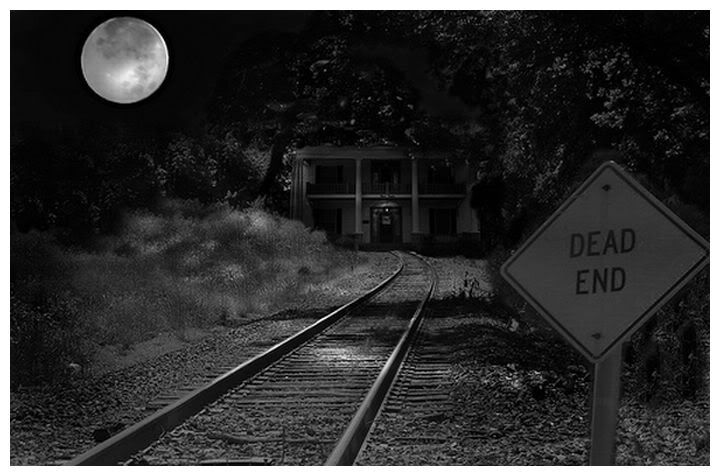
The humans living ‘in life’ claim that the ‘out of life’ God does not exist, even while ‘in life’ philosophers continue to distinguish between an ‘in life’ Real and an ‘out of life’ Another. The difficulty that blocks the road http://i3.photobucket.com/albums/y64/Hands123/deadendtrackedit.jpg  to the rejoining of thought apparently is Death.

Nevertheless, if we can prove for ourselves that there are two realities, an inner and outer, an ‘in’ and an ‘out’, and both are real enough ‘singularities’, then why not an ‘out of life (and body)’ experience for an ‘out of body’ reality, i.e., ? What if phenomenology as fuel for life is only an ‘in life’ phenomenon, but that the ‘out of life’ fuel for life is Mind? Are not atomic and subatomic particles clear evidence that construction of reality continues after death—which is why reality may not yet be fully constructed?

If there is any truth to the above, it remains an open question whether the bifurcation caused by our ‘humiliation’ holds for all time?  At this moment in time however most of those with a ‘higher education’ appear to consider the question as closed and react to their own positivist answer in a sadistic-masochistic manner that causes incalculable harm to nature and the rest of humankind.

To an outside (of ‘in’) observer fantasizing him- or her-self to be less compulsively motivated than Žižek’s ‘man’, the ‘humiliated one’ is charging towards “autistic masturbatory ‘asocial’ joisance”*. The freshmen college anecdote about the monkey pushing the button that causes him an orgasm until he dies from too many convulsions are a social reality, except that for the monkey’s hand levered button, we push the lever just thinking about it http://www.youtube.com/watch?v=BxHxXQPxBTQ .

At the point (in a hypothetical time) where Žižek’s post-modern hyper-man meets with our Great Ancestor (still practicing subsistence economy), there may occur an interesting confrontation.

Our ‘out of nature’ ancestors raise a question which the ‘humiliated’ one may consider yet another humiliation. The question is: “Why are you jerking off so much?”

To which the ‘in nature’ response may go: “Why are you so slow, so unmotivated, and so backward?”

To which the reindeer herders, the Avenks, the travelling Johns reply: “What we took ten billion years to create (yes, we continue to create even when we are so-called dead), you want to do in two centuries. All the living creatures which co-evolved with us, you turn into bones in two decades.”

“Yes, but we can renew our body parts and clone ourselves to live in perpetuity.”

“True, but you have turned our community festivals into Fuck Carnivals, and all the wild animals in the wood are dead because your hunters get an orgasm from each kill.”

 *Slavoy Žižek, “The Universal Conception”, Continuum, pp. 308.

Saturday, April 13, 2013

Eso’s Chronicles 157
I Don’t Know What to Thimk (2)
© Eso A.B.

When ‘WORD’ prevails over ‘ACT’, it always leads to excess. Take sex, for example. When words, which speak of ‘sex’ suggest a sexual act, the ‘word’—as poets well know—always gets a double orgasm (“I would like to touch you all over”) and like a bottle of champagne pops the cork.

The reason this is is because words that mention ‘sex’ arise from unfulfilled desire, which desire is a plain, naked, and shivering thing, like an empty pocket reaching down between our legs, waiting to be used as a handkerchief.

Our shivering desire motivates us to fill our pockets in the shortest possible time and in the easiest possible way. The easiest and least obscene way is to go and BUY something. In short, the ‘word’ motivates us to perform a pseudo act, i.e. not to have SEX, but to have a BUY, on the cheap, at a SALE, as a double orgasm, one for the saleslady, the other for the advertiser, with enough SEX left over to stimulate yet further BUYS, maybe a new bra for Victoria.

If one’s subconscious is untutored and perceives that to BUY means to have something like real SEX, then on the subconscious level the shopping mall becomes a capitalist cathedral, where sex is a non-stop masturbatory orgy. Such an orgy was last had as recently as moments before the 2008 global financial collapse, when, suddenly (though not unexpectedly), all Wall Street money pumps went dry and began ejaculating convulsively. Money, which heretofore had filled the vacuum left by the excess of words talking up capitalism, could no longer perform the function of masking the fact it lacked value. Meaningless existence suddenly became unsustainable and could no longer be perceived as an asset, revealed how already for some time planet Earth had been turned into a desert, and the sand had come, at last, to bury my house as well.

My blogs have been arguing that with the collapse of the ‘Word’, time has come to Act, preferably by abandoning cities—our perfect machines for producing desertification. Though transition to a subsistence economy and getting used to living in the wood again may not come without pain and containment of orgiastic technology, an orderly retreat will surely be succeeded by survival and renewal, rather than a flight from our planet as suggested by astronomer Stephen Hawking http://www.rttnews.com/2093380/stephen-hawking-pushes-for-space-exploration-to-ensure-the-survival-of-humans.aspx?type=gn&utm_source=google&utm_campaign=sitemap .

Of course, this is easier said than done; and as my favorite philosopher Slavoy Žižek explains it: “Don’t Act. Just Think.”

https://www.youtube.com/watch?v=IgR6uaVqWsQ To which I do not quite know how to respond—given that I have been advocating that we think of God as an Act over God as Word. That is, does Žižek not know that the story of Western Christianity is a False Flag, and that the story of Jesus is but a prototype for Baron Munchausen? https://www.youtube.com/watch?v=-we0nkja-DM All who have read “The Adventures of Baron Munchausen” know that it is a story in which words are bricks that turn into canon balls of fantasy, whereas “The Adventures of Jesus” is a staged spectacle sans sex (which any good story would not be without).

Maybe this is what Žižek means when commenting on ‘Occupy Wall Street’ http://en.wikipedia.org/wiki/Occupy_Wall_Street (a major protest movements that followed the many other protest movements that arose after the 2008 financial collapse) he says : “….There is something fundamentally wrong with the system [Capitalism]; and the existing forms of institutionalized democracy are not strong enough to deal with the problems. Beyond this we don’t have an answer…. For me ‘Occupy Wall Street’ is just a signal…. It is time to start thinking….”

Žižek goes on to explain that 20th century opposition to Capitalism (including that of the Soviet Union) ended in brutal repression because “…we tried to interpret the world too quickly, the time is to interpret it again, to start thinking…. We should be careful what we do…. ” Etc., etc. Žižek shifts gears and starts talking about ‘socialism’ within the capitalist system. What Žižek ends up saying is that capitalism is quite alright (even indestructible), but as other capitalist propagandists have already said: capitalism ought to have a ‘heart’ http://www.nytimes.com/2006/09/16/opinion/16tierney.html?_r=0 . Alas, the philosopher sounds like one who likes to chew on frogs already ten times chewed; he not only thinks, but has thought for so long that to think has become to thimk; the Bolshevic has become a Bolshemic.

What Žižek, the opponent of capitalism, misses (he does not miss it in some of his other statements and writings) is that ‘capitalism’ is (what he himself says) a form of joisance  http://en.wikipedia.org/wiki/Jouissance , where the ‘pleasure principle’ (a la Lacan) in an effort to exceed itself causes not only excess, but which excess results in suffering, both of the sadistic and masochistic kind.

Surely Žižek’s problem is that he fails to note that capitalism is the result of repressed Christianity, which repression is the result of living by a False Flag history. In other words, what Western Christianity (Catholicism, the Mother Church) did is reset the self-sacrifice that is the heart of Arch-Christianity* with repressions no less bloody and cruel than Stalin’s. The aim of the repressions was to eliminate self-sacrifice by scaring people to death of death, i.e., by making ‘resurrection’ desirable—consequent to life made miserable by our work ethic.

The answer to Žižek’s problem is simple: a reinvention of death, which will reinvent the charisma of not-violent terror.

The quickest way to put an end to capitalism is to demand that the political elite, in return for its privileges, sacrifice life. I have pointed out in earlier blogs that if such a sacrifice had been forthcoming from Stalin and Hitler, and if they had known that it was required of them, their mode of governing and legacy would have brought about a very different history from the one we have to live with today.

*Ur-Christianity possibly descended from the Siberian Avenks (the name of John(s), the name a likely cognate by way of the Russian Ivan, Vanka, etc., where the ‘v’ is replaced by ‘y’), who in turn may have been heirs to the traditions of the herders who came out of Africa.