Sunday, August 25, 2013

Eso’s Chronicles 208/ 8
WW3 On Pussyfeet (8)
© Eso A.B.

Usually violent harm comes to the body from the outside be it a sword, an axe, a bullet, shrapnel, atomic blast, meteor, or a curse. There are times, however, when the violence from outside enters our inside, and then, somewhat like cancer, causes our body to collapse around it.

One such inside from outside violent matter is gas, nerve gas, specifically Sarin. Because it is odorless and easily mixes with water, it is an ideal invasive agent. Depending on its concentration, the death can be the result of quick asphyxiation or slow convulsive choking.

Just today the U.S. announced that it is taking preparatory steps for a war on Syria , because it blames, without direct proof (except for the word of the big corporation financed “Doctors Without Borders”) , that Syria has used Sarin in retaliation for attacks by so-called SLA or Syrian Liberation Army, which in effect is made up of Islamic ‘crusaders’ against Islamic secular powers. The U.S., which has turned Capitalism into a religion is taking the side of the SLA with the aim of accomplishing a ‘regime change’ against Syria’s Assad government.

If indeed Syria has used Sarin, it apparently is because the SLA was joined and is being led by advance U.S., Israeli, and Jordanian forces since August 15 http://www.zerohedge.com/news/2013-08-23/us-refines-military-options-ahead-syrian-strikes. It is conceivable that these invasive forces within Syria have begun their premeditated ‘false flag’ operations beginning with the Sarin attack (blame Syria for it, of course), now soon likely to be supplemented by cruise missiles.

Be that as it may, the current international tensions present all small and middling state capitals with imminent danger of an attack by a nuclear device.

How so? The question is not difficult to answer.

Consider that you are an empire and an ally of yours (Syria under the wing of Russia and China) is facing an imminent attack. What would you do? Would you attack the immediate threatening powers, who would you strike back?

The answer is you would attack some innocent state with no nuclear devices of its own. You would most likely target some ‘small and middling state capital’. Again, the reason is easy to discern.

Why would a large empire attack its direct enemy first, if an attack on an innocent and unawares bystander would better serve its purpose?

What if, for example, a pre-installed nuclear device  were to be exploded, say in a major Canadian, German, French, Spanish, Italian, or Turkish city? Or you would chose a capital city in the Batics or, for that matter, the Hawaiian Islands, or the Ukraine?

Who could definitively prove where such devices originated from?

And who could prevent the inhabitants of major world cities from panicking and making an attempt to flee their urban environment?

Would this not initiate chaos in many if not all cities of the world?

And what if such pre-installed nuclear devices exist in not only one, but many cities and several are exploded at the same time?

Of course, this writer is nowhere near any nuclear buttons, but at the same time, he hears the war of words and the anxiety implicit in statements by leaders , who fear that an enemy—so far held at arms length—suddenly pushes a button that finds them as unprepared for an attack as, say, in this case, the innocent bystanders. As we well know from WW2, Hitler perhaps hoped that Great Brittain would not enter the fray when he attacked Poland, nevertheless, if England had remained on the sidelines, the victory of WW2 would more than likely have gone to Nazi Germany than Soviet Russia. Indeed, Stalin held to the presumption that his ‘deal’ with Hitler would keep the Nazi leader from attacking him. Had not Hitler made grave mistakes and if England had not entered the war, Stalin would indeed have died in a bunker of his own.

In any event, this writer suspects that if and when WW3 breaks out, the leadership of no country will be found in the capital cities of their respective countries.


Thursday, August 22, 2013


Eso’s Chronicles 207/ 7
Soylent Death (7)
© Eso A.B.

With the arrival of the laboratory grown hamburger tasting of human flesh (if you wish to order such a flavor), the culture of the soylent urbanite is coming to an end. Curiously, no one could have guessed that it is precisely with canibalism introduced by a laboratory that the urban culture will signal its doom. There can be little doubt, that the human flavored hamburger ever so subtly (and grossly) signals the beginning of an age of famine. In other words Nature that bore humankind is no longer sufficient to sustain humankind. That is why there are monsanto seeds, laboratory raised meat, and swimming pool raised tilapia replacing salmon and tunafish.

Though heretofore urbanism has held firm control over the dreams and imagination of humankind (the Dream Time of modern aborigines) as if it still lived in a far away forest and countryside, it has now given the subsistence farmers and shantytown dwellers the advantage. Unlike urban dwellers, the latter are still able to raise their own chickens or, if you will, pigeons. Only upper-class urbanites have something that can compete with such advantages: they will soon be dechlorinating their swimming pools and raising in them a fish called tilapia. The only problem is that: other nutritional content aside, the heart disease potential (of long-chain omega-6 fatty acids) in hamburger and pork bacon is lower than the average serving of farmed tilapia. This shortcoming may, however, be forgiven the prolific fish, because at least its client will be able to die on a full stomach.

When President Obama [America’s peek-a-boo or (take your pick) luri-luri-loo President] takes a train ride with his family, he will not have to draw the curtains across the wagon windows like Stalin did when his armored train chugged Tsaritsyn (now Stalingrad) during the famine. Incidentally, Stalin deliberately caused the famine (in the 1920s) while trying to proto-urbanize the ‘backward’ white country folk by forcing them into collective farms known as kolkhoz and sovkhoz. The confused folk fought this neo-Christian raised self-created Orthodox priest by rushing up the embankment to his train to beg for food and dying of a ‘weak heart’ and malnutrition even as they were climbing the embankment of the railroad line. Today the descendants of the same people may want to climb aboard the train to get out of Washington and find a free spot in the mountains of West Virginia.

When post-capitalism comes to the consumers of death (most of the surviving human population), it will find, as it usually does, a way to make a profit. However, perhaps the one who makes the profit may not be a private entrepreneur, but a small country trying to survive, and the ‘profits of death’ may be invested, both, in survival and instituting a renewed way of life in the wood and countryside.

This is not to say that the post-post-modern age is about to cease, though it is about to radically change from what futurologists some twenty years ago predicted, and what propagandist still predict will be a ‘makeover’ http://www.bbc.co.uk/news/technology-22538561. This is, because, for one, those who follow American economic developments predict an end to traditional full-time employment http://www.oftwominds.com/blogaug13/Social-Security8-13.html , which is one reason to think that future futurologists will, contrary to assertions of the car industry, tell us that there may soon be a rush to breed horses to replace abandoned cars, which may replace traditional wood coffins in the cemetery. With end to full-time employment, urban life itself may only survive as islands in a a sea of a subsistence economies. What are now believed to be illegal drugs may then make some countries rich, as desperate people, seeking to escape difficult ways of dying will seek medicines that will end life quickly and painlessly. Surely such drugs will be taken before the government (if it will still exist) comes to arrest them. Traditional memorial stones and other markers may be replaced by newly planted trees, and a forest may come to stand for a city no more.

When people have to suffer life as a nightmare, they soon begin to dream of a land that has overcome the nightmare. This is the ‘Dream Time’ of the future https://www.youtube.com/watch?v=DnZNEbo-Zzo. Interestingly, the Dream Time of the past had a ruler who was seldom if ever seen.  The Dream King was the fairest King who ever was or will be: He never issued unjust orders. The Dream King made only just decisions. If for any reason his decisions hurt someone, the Just King paid for it with his life either at the end of his rule or his life. Though the King’s death could not undo the pain suffered from an injustice, it greatly diminished the anger that arose as a consequence.

One of the Kings of ‘Dream Time’ was King Arthur. Sir Gawain or Yawein (Jein-Jean-John) represented his executive power, i.e., he was his executioner. One well known story about the role of King Arthur is that of “Sir Gawain and the Green Knight” http://en.wikipedia.org/wiki/Sir_Gawain_and_the_Green_Knight .

One way to unravel the puzzle of the story is to imagine the Green Knight as the forest. In former days, trees were believed to be spirits of ancestors and were, therefore, holy. When Gawain beheads the Green Knight at the Yule Festival, he is actually is guilty of cutting down a Yule tree or trees. The wood revenges itself on Gawain by giving him three gifts of the wood: a deer (meat and pelt), a boar (meat and leather), and a fox (a pelt). The wife of the Green Knight is actually a frog from a fairy tale we all should know well, except instead of a prince, the frog here is a princes, bewitched by the old witch, behind who hides the Sun Goddess, the Creatrix. In Swedish and Latvian the old witch is known as ‘Ragana’, i.e., a woman of wisdom, i.e., Ra=Sun/gana=herder=Yana.

When Gawain (instead of King Arthur) offers (substitutes) his head to the Green Knight, he receives only a symbolic nick or scar on his neck. In this way the wood lets him know that as long as it is left to be large enough to house the gifts given, the forest will revenge itself ‘kindly’ though the potential of decapitation will always remain.

Sunday, August 18, 2013


Eso’s Chronicles 206/ 6
Of Soylent Man (6)

I use the word ‘soylent’ in the sense that the superstructure of the modern world has become stuck in a labyrinth of its own making. Part of the reason for being stuck in a labyrinth is the computer, which can be programmed to repeat a senseless ideology ad infinitum, i.e., the mind of an idiot as well.

This point--the dead center of the mind of an idiot--was reached when Deadalus, the ‘scientist’, started believing that he could make the computer think in an organic manner. Therefore, when Deadalus arrives at the exit of the labyrinth of his making, the computer has a program that will turn him back into the labyrinth.

When such ‘turnings back’ into one’s self reaches a certain critical number, organic flesh turns into virtual or soylent flesh of the ideal man, which man is best described by the philosopher and psychologist Žižek as a democrat with “a certain ‘pathological stain’”.*

While I believe that Žižek has contributed ideas that move us closer to better perceiving certain riddles of our times, he--through being or pretending to be so much of our times—has made his own It (the ‘who’ of earlier times) into a ‘stain’ of soylent flesh within his own formulation of a ‘democratic’ nation, Such soylent flesh though alive finds itself to be in a state of rigor mortis.

Lacking grounding in organic nature, man becomes a soylent, a creature which attempts to establish for Itself a beachhead by hooking a steel ring into the nose of an organic democratic community. The not yet repressed community of individuals is then told in suitably academic terms: “This leftover [democracy in the wild] to which formal democracy clings, that which renders possible the subtraction of all positive contents [i.e., the tongue does it after kissing the ring—auth.], is of course the ethnic moment conceived as ‘nation’ [the nation as an identifiable leftover of the organic community—auth.]”*

I concur with Žižek in how our time perceives the condition of government. Bought off by capitalism turned into religion, governments of the West have had great success in murdering and destroying organic life and environment on our planet, and replacing it with two cars in a garage and the like. Such a replacements have satiated all need for the human mind to think creatively, as ‘art’ today illustrates. In other words, ‘art’, too, is an instant soylent, an It, a product of an inhuman human and can bypass the human dwelling and go directly into a museum or morgue. What is the difference?.

One of the insruments that facilitates and turns the organic community into a community of soylents is the law. We can observe this every time a Parliament (composed of pseudo immortals) meets and passes laws for the mortals; that is to say, law-makers die of the law only during a Revolution, but the public suffers and dies of it all the time. The ‘dying’ are all ‘ordinary’ men and women, soldiers, and prisoners sentenced to death, and include self-immolating Tibetans in the role of Indians trying to resist the invasion of their country by a soylent cavalry of the  Chinese.

It is interesting that upon entering the ritual of becoming soylent leads to becoming an ‘ethnic’ at the half-way house called ‘a nation’.

This prompts the question: What is the difference (if any) between an ‘ethnic’ and an ‘organic’?

The obvious answer is that the ‘ethnic’ is of a ‘nation’ (preferably an urban one), while an ‘organic’ is of a community in the wild. Such a link leads us to a ‘community’ that several blogs ago Žižek defined by the German word Gesellshaft, basically an organization of strangers, card carying members of a political party or labor union. Be these as ‘ethnic’ as they wish, the Geselshaften of capitalist democracies remain for ever a conglomerate of strangers with love in a state of rigor mortis between them.

Another definition of a community speaks of it as people living in the same locale and sharing the same social and historical experience.

Yet, a third definition of ‘community’ is the Latvian definition: it locates the home (the place) of Latvians in Latvia (a certain geographic location), but defines a Latvian by law, re: it is not necessary for a Latvian to have a direct experience of ‘the place’, but it suffices that he-she comes from parents of the place.

Such a definition of a community, nullifies the community of place—especially if the place is a small one, and those living at the place are a small number. When ‘the place’ has many tens of millions of inhabitants, then the physical impossibility of a quick and total replacement of the remnant of the organic community preserves the ‘ethnic’ inhabitants of a nation until the language changes beyond easy recognition. However, this does not hold true in all cases. In the instance of the Latvians, their (and not only) organic community became soylent with the replacement of the oral and idiomatic culture by that of the written word and legal terminology.

Thus, even within one nation there may come to be two communities: one being of the soylents, the other of the organics. The soylents, generally practice capitalism, while the soylents practice subsistence economy. --With the arrival of the Industrial Age, the soylents generally repress the organics—until the soylents become an overwhelming majority and their ‘nation’ experiences exponential growth ‘in place’, which, because the growth cannot be sustained, quickly implodes (crashes) ‘in place’ and reverts to the ‘wild’ state. Needless to say, the implosion is denied, as is the case today, because soylents cannot imagine that ‘democracy’ must return to its organic, i.e., autarchic and subsistence economic stage.

*Slavoy Žižek, “Looking Away”, An October Book, MIT Press, p 104-105. All text placed withing brackets [ ] are by the author.


Thursday, August 15, 2013

Eso’s Chronicles 205/ 5
Eating Soylent Greens (5)
© Eso A.B.
 
It is likely that most everyone believes (except soylent Monsanto and related folk) that the world is grossly overpopulated and human intelligence is in need of discovering ways to adapt to a situation of not only permanent crisis, but permanent and ongoing catastrophe.

Among the causes of this a state is overpopulation and substitution ipso facto of nature with ‘soylent’ nature. Not least among the catastrophic events, is the ‘individual rights’ issue pushed forward by the ‘democracy’ practiced by capitalist nations, which creates a decentered individual with no roots in any organic community. The ‘democratic’ individual is ideologically bonded by Money, which—besides all the other ‘rights’ creates “the right to enjoyment”, the one “human right” demanded be Marquis de Sade during the French Revolution, which right the Revolution denied him.

The Marquis, nevertheless, insisted on ‘enjoyment’, by insisting that he could do what we know as ‘sadistic’ things with everybody who came his way. This is not to say that being a sadist is to inflict sexual cruelty and degradation on others, but only that this is the result when you or I consider every body as subject of our will. It does not take long to perceive that the post-Revolution substitution for this freedom is the presumptions granted to Money.

When the philosophers (Voltaire among them) began to argue for the separation of religion and state, they effectively succeed in overthrowing God by making Him (or Her) an object of pietism, rather than a force integral to community making and maintaining. With the arrival of the French Revolution and the separation of Church and State becoming a reality, God ceased to be the benevolent Creator of all, Who according to old community myths, out of his benevolence was willing to Sacrifice Him-Herself for the sake of the community. The result was a bonding of the community in a common dream of peace and friendship. But when God was replaced by Money, society enabled the rise of the God of Wealth as a substitute for humankind’s Primal God.

Unfortunately, the God of Wealth or Money depended on accumulation. Buying candy for a penny does not make one wealthy. However, accumulation could not be done without the word being turned into a paradox: causing creators to become killers. First the killing was of animals for the sake of their skin, which were used either as clothing, sandals or leggings, then carpets and wall hangings; but it did not take long before it was realized that moths like pelts even more than humans, and the killing of animals was made compulsory. This is how those with the authority to issue orders were soon discovered to have the advantages that those with no authority also desired. The latter quickly transformed authority into power. Whereas formerly people had submitted to power willingly because they respected the authority behind it, henceforth power lost its power of persuasion unless it increased the pain that came with it.

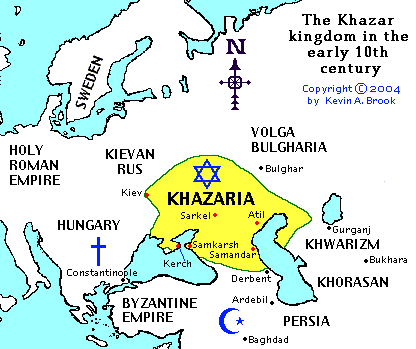
The system of taxation may have begun in the Kingdom of Khazaria , when the Vikings began to force the slav kings to pay bounty for the subjects the Vikings took hostage. The slav kings then, in turn, began to demand from their subjects, mostly herders of reindeer, a certain number of pelts, which evolved into taxation.

Whereas in early sacred communities authority had been acquired by imitating God and becoming a martyr for the sake of the community, the rise of power exchanged martyrdom for the illusion of immortality. Whereas the earlier King held authority by taking an oath to self-sacrifice himself at a predetermined time, he later came to use this authority to empower an executive to do ‘the dirty work’. The executive, originally a herder of the animals, necessarily became the butcher and skinner.

In the early days, when the community was still sacred, no one ever  killed an animal without asking it forgiveness. No doubt, the transition from being a wholesale butcher of deer to becoming a killer of the herdsman Abel was no an easy step, because even the butcher is likely to have objected to serial butchery of his brother’s flock and then his noncompliant brother. The sacred community, too, likely objected. This is how the first laws came to be written: Thou shall not revenge your animals on Cain, because if you do, vengeance will be taken on you sevenfold (Gn 4:15). Here the word ‘sevenfold’ is used in the sense that the King of Power will kill the cousins of the sacred villagers to the seventh remove. This will result in slaughter and war. We live in such days today.

When religion was separated from the state, it was Cain who became ‘the red man’ (also Cadmus, etc.), who broke lose from the authority of the sacred King and replaced him. Henceforth, the King became the Banker, aka Cashier-In-Chief (in recent Western history his name is closely associated with that of Rothchilds, who may be distant descendants of Kazar tax collectors working for Vikings collecting bounty for hostages from early Slav kings. Unfortunately, the powerlessness of the sacred community was such that this system was soon adopted by every Mideastern King and then by every state in the world.)

To escape the curses of organic man, the tax collectors eventually declared themselves to be ‘different’ (or ‘chosen’), that is, immortal, but unable to separate their origin from that human beings (the brahmans tried), and knowing the vengeful nature of humans, they declared all humans immortal. Still, the priviledge of holding on to most of the Money they kept for themselves, which enabled them to declare themselves Gods of Money. Idealistic as the tax collectors were, they could not like God The Wondermaker, create Money without end and for all humans in equal amounts (until the creation of the Federal Reserve—a private bank—which did so through the mechanism of so-called QE or Quantitative Easing). Even so, they could create enough Money for a select few by desertifying the planet, and persuading the naïve descendants of the dumbed down sacred community that they would be compensated by a free trip to a colony on the moon.

Following such maneuvers in word and deed, they now wait for the day the religious call ‘Judgment Day’, by arming themselves to the teeth and accustoming themselves to eating laboratory grown meat, aka soylent (ahem ‘cultured’) meat, because all the farm workers who grew greens were soon be dead for lack of Money.

From here on soylent meat will not only be seen in our accustomed McD, but will come in as many flavors as you can think of: lamb, steak, pork, chicken, rabbit, fish, and not least, human.


Monday, August 12, 2013

Eso’s Chronicles 204/ 4
47 Pensioners (5)
© Eso A.B.

Many years ago (~1973), while protesting the building of the Seabrook Nuclear Power Plant in New Hampshire, a number of protesters, myself including, undertook a fast that lasted for two weeks. If I remember right,  the Boston Globe gave us passing notice. Today, I have passed that small self-disciplinary act by several days and am now on day 17. So far so good, except that the store bought juices which I have been drinking are sickeningly sweet and tasteless. Since the apples in my orchard are coming ripe, I am now gathering a few sacks full of them, and a neighbor of mine has promised to press them into apple juice.

A person who is well acquainted with Latvian politics and to whom I have sent blogs 200 & 201 of my Chronicle series, inquired what it was that I was asking of the government. I responded by mentioning several demands (I have written of them in my blogs and in these posts): a quick restoration of the Riga Castle as a symbol of Latvia’s sovereignty. Among a number of other requests, are included a request for a quick passage of the necessary changes to Amendment 68., which will enable Latvia to maintain its sovereignty in the face of expected changes in the Lisbon Treaty moving Europe to become a Federation; and the resignation of the Minister of Justice Bordans who through his actions and words has given strong indications of his indifference to Latvia as a sovereign nation and hints of his tacit agreement to Latvia’s inclusion in Federated Europe.

Way back then—forty years ago—I eventually left the Clamshell Alliance when a small group of people felt that “direct action non-violent protest” included cutting fences at the Seabrook worksite. I felt that such actions nullified non-violent protests such as marching with signs, fasting, or sitting in a tree for a few weeks, which is how one resident of  New Hampshire got the protest movement going. I got back something of a sneer from the more aggressive group, because my reaction to its breaking the consensus vow was verbally explosive, and perhaps because the group felt its tactics were more likely to stop the construction project. It did not.

Because today I am repeating my fasting ‘act’, I am better prepared to explain it than I was then. First, another brief remembrance of the times back in Boston. At the time, I was working as a typesetter for a small newspaper publishing company out of Brookline that published a weekly newspaper called The Boston Ledger and Brookline Chronicle. The editor of the papers, John Van Scoyoc, gave me the opportunity to write a short weekly column. This may have had something to do with the fact that even then, I was much complaining about the state of politics. However, when the opportunity arose to actually write about it, I discovered that I could not bring myself to say anything relevant, and thus my column quickly turned into a rather ordinary kind of ‘chronicle’. The reason for clamming up was a very simple one: American politics was rather like the politics of Latvia are today—positivist, non-controversial, in a rut, and to say anything contradictory would turn anyone into an ogre, he-she was not prepared to be or play.

In the context of the current economic and financial crisis, politics has become potentially more controversial. This is borne out in that a recovery from the economic and financial crisis is not only in doubt, but the very fact that it is in doubt, allows one to think of the consequences of failure. Not just any failure, but a failure with catastrophic consequences.

The presumption of the current Latvian government of PM Valdis Dombrovskis, the Unity Party, and coalition of Nationalist partners to navigate toward a Federal Europe without consulting the nation by holding a referendum (allowed for by the Constitution) violates in a traitorous manner the Latvian Constitution (an understanding between the citizens of the nation and its government). Latvia gained sovereignty (1918) after a hard and bloody fight and paid the price in tens of thousands of lives. Moreover several hundred thousand Latvians escaped from death by fleeing to Russia and other war related events by the skin of their teeth. Later during the Bolshevik times, many were deported to the Gulags. Those who found new homes in the West did not remain loyal to Latvia in their memories or ‘fantasize’ about a free Latvia in the expectation that it would be surrendered to and take orders from an unelected government in Brussels.

While acceding with the arguments of some sociologists that the politics of ‘democratic’ Europe today supersede (by means of methods of a dictatorship) the communities established by nations in earlier times, it is clear that the modern individual will not stand up for the community he-she arise from. Nevertheless, an individual of a differing mind may hope to awaken an asleep community that has forgot its roots or is so attached to fiat currency that it is all that he-she is capable of being loyal to. That individual has the help of current crisis, possibly bringing a new reserve currency within a very short span of time and the inevitable chaos and war this may lead to.

In times when the community was not yet subject to the hegemonic choke of old killer empires that have survived to the present day, situations like those facing Latvia and other nations, met with determined resistance. One telling example comes from Japan, an actual event that involved 47 ronin , i.e. samurai. The story of how they saved Japan from loss of honor (actually as a nation) remains as an inspiration to this day.

I suggest that the story is as applicable to not-violent actions today as it was in the 18th century. To understand what I am about to suggest next the reader should read the story at the above link.

It is possible that--but for the hypnotist’s snap of his fingers to awaken his subjects--such 47 individuals are still to be found today and are awaiting the signal. I am not proposing that these 47 indispensible ones are samurai or soldiers, or subscribe to some Japanese code of honor, but are individuals with a spirit not unlike that residing within any organic community that yet remains. Indeed, given the decentered individual of our time, the untested culture of the cult of youth, the candidate for one of the 47 may, more likely, be found in a nursing home or among pensioners.

The mode of protest on behalf of a nation’s sovereignty was best known in the West before neo-Christianity repressed those Christians who had existed long before the arrival of Catholicism and its state serving offshoots. These early Christians were known as Cathars. While the Cathars were murdered by fire, and though no record remains that they escaped their fate by taking resort to their well known ritual known as the  endura  (after taking consolamentum  from their own priests or by divine inspiration, one begins a fast that ends in death), the precedent is there (was practiced for many centuries if not longer) and its potential remains an option.

I am convinced that in spite of the falsehoods and contempt filled propaganda still surrounding the kind of Christianity practiced by the Cathars, the reawakening of such a spirit is not only a necessity, but remains the only way that will put the arrogance of today’s ‘democratic’ dictatorships back were it and they belongs—in the resort town for the living dead.


Paul Craig Roberts on Role Reversal: http://www.youtube.com/watch?v=buqJP7y115s

Sunday, August 11, 2013

Eso’s Chronicles 203/ 3
Shining   Examples (3)
© Eso A.B.

According to outward signs and surveys, the majority of the Latvian people are poor. Among the poor there are yet ‘moar’ poor: the pensioners and young mothers with children. While the pensioners are the storebox of the community’s “somewhat” memories, the young mothers make the future of the country “somewhat” real.

I use the word “somewhat” because one of its synonyms is “sort of”, while the antonym is “not at all”. Both the synonym and antonym just about describes the state of the state of Latvia.

You would not believe this if you read or listened to the statements of the Latvian politicians, bank officials, “well meaning” ministers, or walked under the banner of the Latvian media trumpeting “positive attitude”.
 
The “positive attitude” is to obscure the fact that only 20% of Latvians believe that the state is making adequate progress, while 80% believe that the state is going nowhere or sliding back.

The Minister of Culture says that by the 18th of November (the day in 1918 when Latvia declared itself a sovereign state) the “Shining Castle” across the river Daugava from the “Presidential Castle” recently having caught fire (it was likely deliberately torched to destroy one of the last symbols in Latvia of Latvia as a sovereign state) will be 80% completed.

The Latvian media is upbeat however. According to a post by a foreign held bank (DNB): “Growth [in Latvia] in the Future to accelerate”. A spokesperson for the bank announces that though the predicted growth (GDP) for the year in Latvia by the bank has been only 3.8% of the predicted 4.5%, the bank was right on when it came to the last quarter, re 0.5%. The bank admits that annual growth in construction has declined to 5%, but blames the weather for this.
There is no statement whatsoever with regard to the increasing economic difficulties in Europe as a whole. While the German economy is the strongest and most export oriented in Europe, it grew only 0.1% in the first quarter of 2013. It also blames the weather for the low figure.
The populist retorts (at internet the site) to the spokesman of the bank: “He eats garlic and masturbates”.
As for the people themselves, according to ‘Eurobarometer’ for 2013: 55% were disturbed by unemployment, 38% mentioned the state of the economy, 21% were upset by the income taxes set by government, 5% mentioned the country’s external debt and government corruption and crime.
From the point of view of this observer, while unemployment is high, it is considerably lowered by the self-destruction employed by the natives in order to survive. Such government encouraged self-destruction, if you will, manifests itself through the gradual demolition of the inherent natural wealth, which consists mostly of wood. Self-destruction in Latvia as well as in the rest of the world manifests itself as gradual desertification of the countryside. The greatest amount of damage done by the unemployed to the natural environment is due to the chainsaw and deforestation of privatized land.

Paradoxically, the origin of the chainsaw has almost nothing to do with the countryside as such, but is a consequence of the acceleration of urbanism following WW2. The victor of WW2 was of course the capitalist West. Though the East and the Soviet Union, too, was one of the victors, Stalin was hopelessly confused and unknowing why the East as a whole supported the Revolution of 1917. While Lenin had (by way of Marx) proposed that the Revolution was on behalf of the ‘workers’, a long duree perspective better supports the idea that the Revolution was for the sake of an economy that was  subsistence and a government that was autarchic and reduced taxes to a minimum. No doubt, a great deal of the blame goes to the West, which continuously threatened post-Revolutionary Soviet Union with war and forced on the Soviets a break-neck armaments race. The weaponization of the state absorbed precious resources as well as denied the elites more mindful methods than wholesale slaughter of country people to force them into half-digested ‘revolutionary’ schemes.

The confusion by Western government’s today of what path to the future will enable humankind to survive is greatly encumbered by what these have tought themselves to believe is “democracy--the best of possible governments”. This ‘democracy’, a form of dictatorship, has been proselytized and ‘pushed’ by armchair university level academics, who arguably are the greatest and most unjustified beneficiaries of taxes placed by governments on the ‘laity’, but escape criticism by pointing a limp finger at the armaments industry.

One such beneficiary of liberal dictatorship is the philosopher Slavoy Žižek, presently the director of the Birkbeck Institute in London. The following is a little taste of Žižek’s academic phantasmagoria:

“….democracy is definitely bound up with Geselschaft (society as a mechanical, external aglomeration of atomized individuals), it literally lives on the split between the ‘public’ and the ‘private,’ it is possible within the framework of what was once, when the voice of Marxism was still heard, called ‘alienation’”. Žižek opposes this “Geselschaft” to “Gemeinshaft” (society as a community held together by organic links).

A little further down the page (p164-5, “Looking Away”, October Books, MIT Press), Žižek writes: “The subject of democracy is thus a pure singularity, emptied of all content, freed from all substantial ties….”

Žižek admits that this accommodation to democracy as dictatorship comes with “a little ‘pathological’ stain”, which ‘stain’ is nothing other than the former organic community. Unfortunately, the community metamorphosed first into a ‘nation’, surrenders to Žižek’s capitalist democracy with lots of contortions. When the community-nation twists right, it becomes ‘fascist’, when it twists left, it becomes ‘bolshevik’.

Above such little inconveniences and erasure of resistance by waterboard methodology, the professor sits in the living room on a stuffed leather pig, smiles, and says: Look what a woodsman and revolutionary I am! I even make Money here, here, and here .


Friday, August 9, 2013

Eso’s Chronicles 202/2
How to Destroy a Nation (2)
© Eso A.B.
 

Grandfather had enough of playing second fiddle to the Latvian state (though he had bought the state a number of military biplanes (I saw them during a fly-by over his vacation home in the summer of 1938), and my father had replaced him as editor-in-chief for some time). A few years before his death, he went to consult my godfather, Mintauts, and asked his opinion about a divorce from Emiliya. The legal mind advised him to forget it, as it meant that his heirs, the children of his first marriage, might be left with little legal rights to the money he had made or properties he had bought. The heir to the Habsburg Empire, Emiliya’s adopted son George (his father was an Austrian), would most likely get to keep it.

Meanwhile, the small sovereign state of Latvia enjoyed a small economic boom. Its agricultural products: butter, bacon, wood were in demand. The country had relatively few motor engines polluting its air, because the horse still prevailed in the countryside. The car owned by my father, a Chrysler, spewed gasoline fumes so badly that I became car sick every time the family took a trip to grandfather’s estate in the region of Kurzeme. I much rather enjoyed the family motorboat, the engine exhaust being quickly dissipated by the winds of the sea.

By the time the Soviet Union crossed Latvia’s borders, I was seven years old. The Soviets quickly put a stun grenade on the family’s dining table. At the beginning of WW2 (as I was turning eight) the granade went “Boom!” and eight members of the family disappeared in the Gulags, while two (my father and maternal grandfather, a former ambassador to Moscow) were likely tortured and shot.

The country as a whole split into two halves: the survivors of Soviet carnage turned pro-German, while the former have-nots fled the country with the retreating Soviet Army, which after WW2 was to occupy the country for nearly fifty years. I, my two siblings, and mother survived, by hiding in the countryside among the relatives of my paternal grandmother. It was there that I grew to love the countryside and its direct ways: if you wished to travel, you had to yoke a horse or two to the carriage, and the eye could not avoid watching the horse raise its tail when needing to make a fart.

After surviving a string of refugee camps and forty-six years in America, I was happy by the opportunity to return to Latvia. It turned out to be an unhappy experience as political disunity heightened by extreme poverty, consequent to shock economic policies forced on the country by capitalist America gave early indications that the country would not survive as a sovereign community.

Pressures that forced the dissolution of what traditions had survived the Soviets came as quickly as the first years of so-called ‘independence’. One man (a man in early middle age) was perceptive enough to publicly sacrifice his life in front of the Freedom Monument, but his act was dismissed by the state as imbecilic and his complaints were not investigated.

Interestingly, the blade of the axe came from the ‘nationalist’ influence out of exile. In the forty-six (rough estimate) years in exile, the nationalists—most coming from Latvian urban society or, for that matter, having been born to exiles living in an urban environment—were easy converts to capitalism. Irrational denial of all notions of egalitarianism, natural to agriculturalists, forest dwellers, and fishermen coupled with easy and accustomed access to consumer goods produced at the expense of the environment and countryside, became a convenient ‘capitalist tool’. The coup de grace was delivered by the argument that Latvia was ‘unnaturally’ countryside oriented, and had a disproportionate number of people living ‘unproductively’ in the countryside.

A number of descendants of Latvian exiles, who had no familiarity with the country other than participating in folkdance groups in Western urban ‘democracies’ were let loose with their capitalist ways (their own capital or with the capital of the corporations they were employed by) on a country that had not yet had any opportunity to accumulate capital of its own. The results were pure joy to those exiles who returned to Latvia as tourists once a year for two weeks, and pure disaster for Latvians who were not prepared for such quick changes, and, worse, had no support from their own government, which for all practical purposes had turned out to be a traitor to its country as a sovereign entity.

While the traitorous nature of the government was camouflaged behind numerous legalistic excuses, the fact remains that it denied its citizens the right to hold a referendum—ostensibly over whether to forgo the local currency (lats) for the euro, but actually to deny the citizenry the right to sovereign expression and set a precedent for further such denial.

As I wrote in a post to another internet platform, it is not that Latvia will cease to exist because of this. It surely will remain as a name for a place for some time to come; there will also remain a number of indigenous people who are lucky enough to escape the squeeze to have them flee the country as economic refugees. However, as a sovereign community, as a community that yet had the opportunity to discipline itself for survival through the practice of an economy that fully or partially accords with the principles of autarky has become fodder to foreign interests and badmouthing of planetary hegemony dominated by the West.

While the following link to a description of autarky https://www.youtube.com/watch?v=4-8eaW3C-XY ends with a nearly full endorsement for globalization, Latvians would be wise to remember that globalization today is the result of the liberal application of violence as a facilitator to urbanist ends. On the other hand, autarky is successfully practiced by the Latvian Senate (Saeima), where autarky as in-house ‘democratic’ fascism (or do you prefer leeches to feces) rules supreme.