Showing posts with label Scotland. Show all posts

Tuesday, April 15, 2014

Eso’s Chronicles 329 / 5
Odds and Ends  
© Eso A.B.
 All comments appearing within brackets [ ] are editorial in origin.
THE SUPERNATURAL AND SUBJECTIVE (5 of 6)

We have read about the Resurrection, but have given little thought that in order for it to take place we need to return to superstition, a term, which was invented by the superstition of science that the mind dies with the body.

I will attempt to answer the question about the origins of ‘superstition’ in a later blog. On this occasion, I will try to stick with the Easter theme, which for the absence in our time of self-sacrifice is no longer accompanied by Resurrection—except as a meaningless word.

Easter is a time in which—so superstition tells us—Jesus rose from the dead. The creators of Easter hastened to celebrate their new Holyday before (the end of April or early May), when the Beltaines began their night and day orgy dedicated to the green fire.

While critics of literature shy away from making the connection, the Greek playwright Euripides wrote a reasonably accurate description of what went on during  “The Bacchae”. What we miss when we read the play is that King Pentheus did not lose his head due to the ‘madness’ of  his mother Agaue having eaten a basket full of fly agaric, but because the king had instituted a gender change for the Sun, which up to that particular festival had been known by her name in the feminine gender–Sonne (German and Old English), or Saule (Latvians).

For reasons of his own, that is to say, for subjective reasons, Euripedes likely believed that the old superstition of the Sun being the mother of all life on Earth (Zemele*) was so ingrained in the minds of the people of the wood that it could never be erased.

The clue of what the superstition about Saule/Sonne was is revealed in a Latvian folk poem, which tells that at Her rising and setting the rays of Sun (Saule, f.g.) shear the tree tops. We may remember here that King Pentheus had climbed to the top of a pine to better see the orgies below. When the Sun rose, her rays blinded the autistic and sex starved King, and when climbing out of the tree, for lack of sight, he lost his footing and grip and tumbled to the Earth below to be ‘devoured’ by his mother (Agaue or Zemele, take your pick).

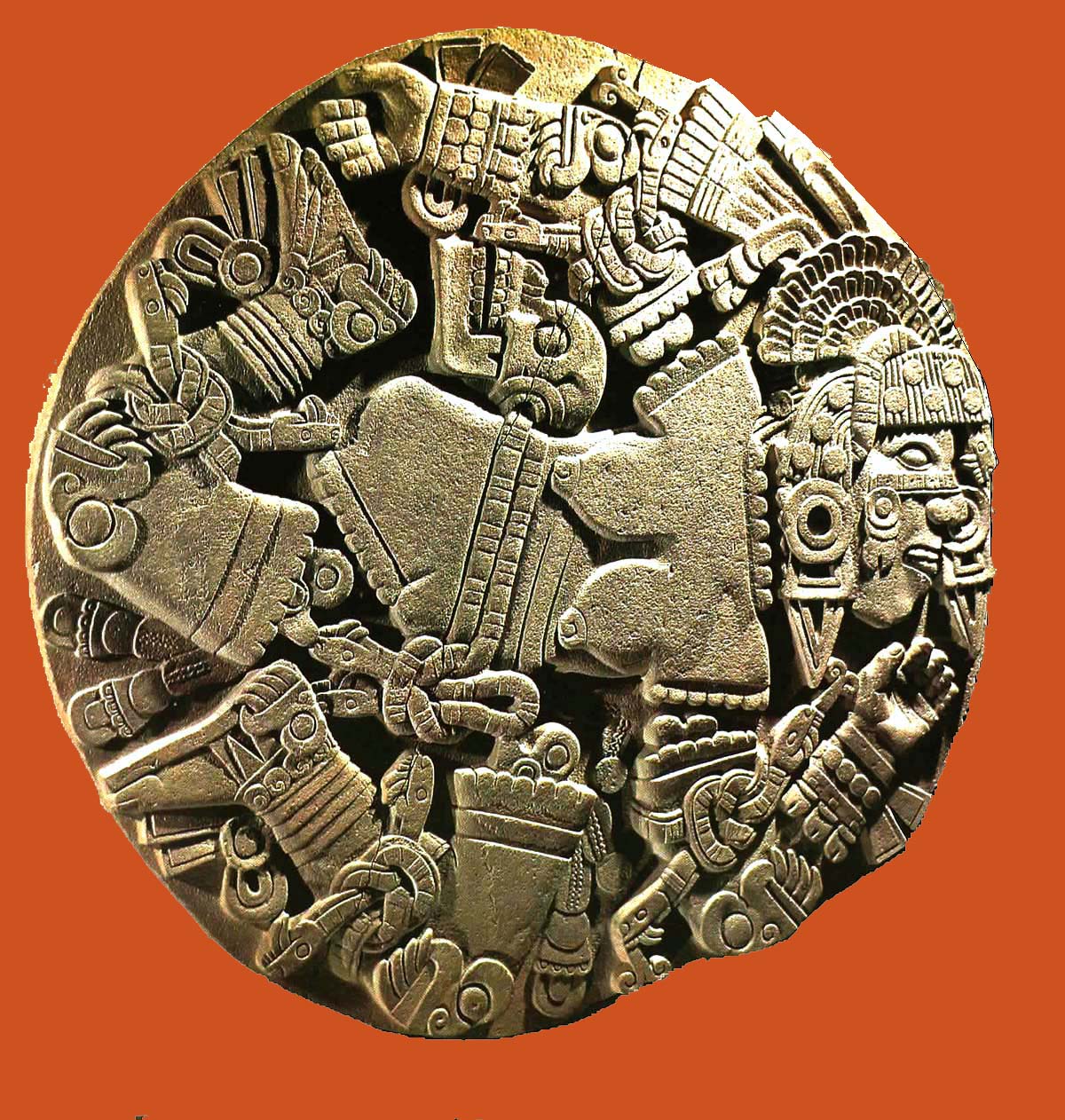
I believe that the same “Bacchae” event was reflected in the Aztec rites of human sacrifice at the top of Templo Major in what is now Mexico City. When the corpses of the sacrificed (at the top tier of the temple) were thrown down the steep steps, these were awaited below by a two dimensional sculpture of a dismembered Earth Mother— Tlaltecuhtli http://www.famsi.org/research/pohl/images/aztec3figure1.jpg . By a curious and paradoxical twist in the story, Coatlicue (aka ‘the serpent skirt’, the Mother of the Gods and all heavenly bodies, including the Sun) had given birth to the Sun as a male. As if to make up for the error, female sacrifices were also made at the temple (probably to give the Sun feminine aspects). The difference in the story of the Aztecs and Greek Dyonysians is that the Aztecs had the Sun give birth to the male gender as if to replace Her real feminine self. Realizing her mistake, She sacrifice herself to correct herself.

There are so many versions of who the Sun is among the Aztecs http://www.aztec-history.com/aztec-sun-god.html that all those who cared were very confused. To decide whose version is right without going to war over it, the Aztec Gods called for a big get together to see which one of them was able to sacrifice him or herself in lieu of a war by jumping in a pit of fire. None of the Gods proved brave enough. As among government officials today, none of the elite wished to lose life, when there was a surplus of peons available to die in their stead.

At last a God covered by open sores of a venereal disease (to indicate that he was both a God and a human) called Nanauatzin, later renamed Tonatuih, jumped into the fire. By being consumed in a fire (almost identical to the death of John Basil in old Byzantium), Nanauatzin connects to  the fires of the Dyonisian Bacchae Festival, the People of Johns Festival among the Latvians, the Beltaine Festival of Ireland and Scotland, and not least, the death of Jesus Christ (the traitorously renamed John Basil).

Being of pure fire, the Sun demands that in times of peace she is remembered by a display of fire, but in times of war, when the continuance of life appears in doubt, she must be remembered with a self-sacrifice. As the link below tells it, if ordinary sins were confessed by the Slavs in an ordinary hole in earth, sins against life demand a hole deep enough to reach fire.

*Zemele=Semele=Mat Zemlya http://en.wikipedia.org/wiki/Mat_Zemlya

Monday, April 14, 2014

Eso’s Chronicles 328 / 4
Odds and Ends
© Eso A.B.
All comments appearing within brackets [ ] are editorial in origin.

THE TRAGEDY OF JOHN AND IESU (3 of 4)

In some ways John the Baptist or Christener and Jesus Christ may be one and the same person, and their basic message of love may be the same.

Still, there are some important differences between the two.

Even while the New Testament admits that John precedes Jesus and that he Baptized or Christened Jesus, there are some substantial differences. A careful reader will have noted that my two previous blogs, 326 & 327, dwell on how deliberate and politically motivated changes in the meaning of names set the stage for the Big Lie.

We discovered that the word pagan, really means pa-Yan, a word that stands for a ‘belittled’ reindeer (or other forest animals) herder in the Eurasian woods. A neighbor of mine, who was born in Siberia, reminded me that the word ‘pa-gan’ also rhymes with the Russian word for the fly-agaric (aka amanita muscaria), the famous red mushroom capped by white dots, frequently used by native shamans of the wood https://www.google.lv/#q=images+of+fly+agaric . Its Russian name spells ‘pa-gan-ka’.

It is easy to imagine how a townie alienated from nature, would in later years condescendingly call a dweller of the wood a Paganka. This name calling does not differ much from today’s city or government elite calling a marihuana smoker a ‘pothead’.

Nevertheless, John Allegro wrote a controversial book, which he called “The Sacred Mushroom and the Cross”, in which there are a number of images from ancient art showing the use of the mushroom for visionary purposes http://psypressuk.files.wordpress.com/2011/03/mushroom-in-christian-art.jpg . Since we live in a cultural atmosphere that accepts that the thinking process is a matter of digitization, the chemical process as a facilitator of visions has been viciously denied and repressed by do-gooder political organizations and religious organizations lobbied by secular governments. The “yes-no” process of “yes-no”, “yes-no” ad infinitum has unfortunately brought our urban desert civilization to the state of near idiocy.

The fact that both John and Jesus were men of the wood and not from Nazareth or the river Jordan, is hid by contrary statements, such as Matthew 3:4, calls the wood ‘wilderness’ and describes John wearing “a garment of camel's hair and a leather belt around his waist””; while Jesus is popularly believed to have been either a carpenter or the son of a carpenter, a belief derived from Matthew 13:55: “"Is not this the carpenter's son?”

Who but men living in the wild of nature (if not the wood) wear a garment of camel’s hair and are expert handlers of wood, that is to say, are  carpenters? While most hominids of the times of John and Jesus were not urbanites as today’s popular prejudice of churchmen encourages us to believe, they all surely knew that the wolf could imagine having eaten Little Red Ridinghood only if he had eaten a fly agaric.

And why would a wolf eat a fly agaric? Probably because he mistook it for menstrual blood. As the color red is associated with the color of blood and hence is a sacred color, and the muscaria amanita is known to lower blood pressure, it may have been used by women during their menstrual periods. Whether it was used externally, I do not know, but Red Ridinghood is not a name of an ‘innocent’ little girl wearing a red hat in the days when color red could be afforded only by royalty.

Yet, while John and Jesus both stood for enduring suffering and pain in the name of love as a human condition, there was also a distinct difference between them.

John was clearly a man of the wood. His color was green, that of vegetation coming back to life in the spring. In northern climes his month was April-May, the Beltaine Festival of Ireland (remember the clover leaf as its symbol) and Scotland come to mind http://www.britannica.com/EBchecked/topic/60147/Beltane . It was a fire festival, because it is in these months that leaf and grass as if catches fire and bursts from sleepy earth. Beltaine is also a word that consists of two words: Belt + aine. While the meaning of ‘belt’ may derive from ‘vert’, green or ‘velt’ to swell, ‘aine’ clearly rhymes with yaine or ian. In other parts of Europe this festival is celebrated in June on the Summer solstice and is known as Johns Festival. It, too, is associated with the color green and fire; it is a day when everyone in Latvia of old and of the wood wore a green-leafed wreath http://www.kasjauns.lv/Otkrito_Foto/22.06.2010/1_Glavnaja-big.jpg  or when it comes to today, wears a green spray attached to his-her garments.

As the summer solstice is the day of the Goddess Sun, the celebrants in Latvia are called “children of Johns”, however, the word ‘children’ may be a religio-political substitute for the word ‘llaudis’ (Jāņu ļaudis), People. As I pointed out in blog 326, “…the acronym INRI (Latin: Iēsus Nazarēnus, Rēx Iūdaeōrum) should be substituted with the letter L [in place of I], in which case the acronym reads ‘Lūdaeōrum’, which means ‘King of the People’ not of Jews.” Indeed, in Latvian folk belief the Kings of the People are all named John.

Still, when Catholic Christianity arrived to substitute the Christianity that arose of itself in the wood and of ‘Lūdaeōrum’, the word was substituted by “Iūdaeōrum” or Jews (a people compelled to become tax collectors), not only was there begun a tradition of prejudice by the elite against human beings living in nature, but the nature of Christianity itself was changed for a faith imposed on the People by princes and barons. In short, the name of John was changed to Iesu, and this Iesu had no objections to either tax collectors or tax collecting.