Showing posts with label Aztec. Show all posts

Tuesday, April 15, 2014

Eso’s Chronicles 329 / 5
Odds and Ends  
© Eso A.B.
 All comments appearing within brackets [ ] are editorial in origin.
THE SUPERNATURAL AND SUBJECTIVE (5 of 6)

We have read about the Resurrection, but have given little thought that in order for it to take place we need to return to superstition, a term, which was invented by the superstition of science that the mind dies with the body.

I will attempt to answer the question about the origins of ‘superstition’ in a later blog. On this occasion, I will try to stick with the Easter theme, which for the absence in our time of self-sacrifice is no longer accompanied by Resurrection—except as a meaningless word.

Easter is a time in which—so superstition tells us—Jesus rose from the dead. The creators of Easter hastened to celebrate their new Holyday before (the end of April or early May), when the Beltaines began their night and day orgy dedicated to the green fire.

While critics of literature shy away from making the connection, the Greek playwright Euripides wrote a reasonably accurate description of what went on during  “The Bacchae”. What we miss when we read the play is that King Pentheus did not lose his head due to the ‘madness’ of  his mother Agaue having eaten a basket full of fly agaric, but because the king had instituted a gender change for the Sun, which up to that particular festival had been known by her name in the feminine gender–Sonne (German and Old English), or Saule (Latvians).

For reasons of his own, that is to say, for subjective reasons, Euripedes likely believed that the old superstition of the Sun being the mother of all life on Earth (Zemele*) was so ingrained in the minds of the people of the wood that it could never be erased.

The clue of what the superstition about Saule/Sonne was is revealed in a Latvian folk poem, which tells that at Her rising and setting the rays of Sun (Saule, f.g.) shear the tree tops. We may remember here that King Pentheus had climbed to the top of a pine to better see the orgies below. When the Sun rose, her rays blinded the autistic and sex starved King, and when climbing out of the tree, for lack of sight, he lost his footing and grip and tumbled to the Earth below to be ‘devoured’ by his mother (Agaue or Zemele, take your pick).

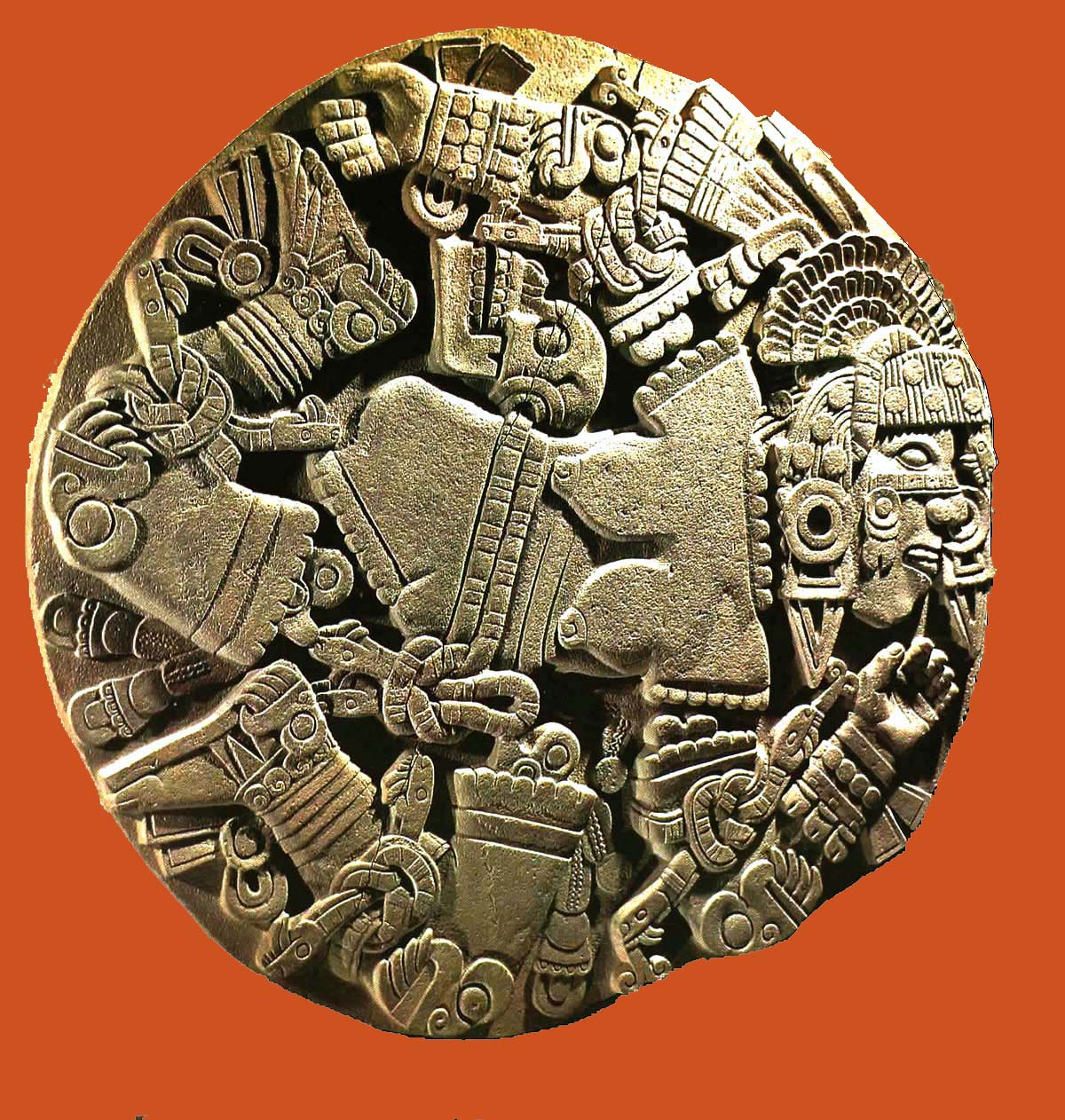
I believe that the same “Bacchae” event was reflected in the Aztec rites of human sacrifice at the top of Templo Major in what is now Mexico City. When the corpses of the sacrificed (at the top tier of the temple) were thrown down the steep steps, these were awaited below by a two dimensional sculpture of a dismembered Earth Mother— Tlaltecuhtli http://www.famsi.org/research/pohl/images/aztec3figure1.jpg . By a curious and paradoxical twist in the story, Coatlicue (aka ‘the serpent skirt’, the Mother of the Gods and all heavenly bodies, including the Sun) had given birth to the Sun as a male. As if to make up for the error, female sacrifices were also made at the temple (probably to give the Sun feminine aspects). The difference in the story of the Aztecs and Greek Dyonysians is that the Aztecs had the Sun give birth to the male gender as if to replace Her real feminine self. Realizing her mistake, She sacrifice herself to correct herself.

There are so many versions of who the Sun is among the Aztecs http://www.aztec-history.com/aztec-sun-god.html that all those who cared were very confused. To decide whose version is right without going to war over it, the Aztec Gods called for a big get together to see which one of them was able to sacrifice him or herself in lieu of a war by jumping in a pit of fire. None of the Gods proved brave enough. As among government officials today, none of the elite wished to lose life, when there was a surplus of peons available to die in their stead.

At last a God covered by open sores of a venereal disease (to indicate that he was both a God and a human) called Nanauatzin, later renamed Tonatuih, jumped into the fire. By being consumed in a fire (almost identical to the death of John Basil in old Byzantium), Nanauatzin connects to  the fires of the Dyonisian Bacchae Festival, the People of Johns Festival among the Latvians, the Beltaine Festival of Ireland and Scotland, and not least, the death of Jesus Christ (the traitorously renamed John Basil).

Being of pure fire, the Sun demands that in times of peace she is remembered by a display of fire, but in times of war, when the continuance of life appears in doubt, she must be remembered with a self-sacrifice. As the link below tells it, if ordinary sins were confessed by the Slavs in an ordinary hole in earth, sins against life demand a hole deep enough to reach fire.

*Zemele=Semele=Mat Zemlya http://en.wikipedia.org/wiki/Mat_Zemlya

Tuesday, June 18, 2013

Eso’s Chronicles 180/ 2
The Sun Over Temixtetlan
© Eso A.B.

If myth is to be real, it tells the story of a religion, and not just an ‘ideology’ as some anthropologists, reflecting secular prejudices, now have come to call it. Myth and religion are synonymous and are to be respected in the same way as so-called bona fide pseudo ‘religion’ is.

For the Mexican people of the 15th-16th centuries, their sacred stories were no less interpretable than the Bible or Koran texts are for Jews, Christians, and Muslims. Reinterpretation can move forward and backward. Either way, there were many omens that did not bode well for the capital of the Aztecs, Tenochtitlan. One of the omens was that the Aztecs were not universally admired and had enemies among the other nations in the area that we know today as Mexico.

While the following link tells an interesting story of the siege of Tenochtitlan http://en.wikipedia.org/wiki/Fall_of_Tenochtitlan and represents an academic consensus of sorts, I have taken an oppositional point of view. The divide in the point of views occurs that the victor tells a story grossly distorted from the original, and has little to do with what actually happened. Nevertheless, the ‘victor’s’ viewpoint becomes ingrained. After the passing of some years, a different version becomes difficult to reconstruct because the evidence has been removed to conform with and validate the victor’s story.

One major factor that contributed to the fall of Tenochtitlan, but one that became known only many years after the city had fallen into Spanish hands, was the role of an outbreak of a plague of small pox. Another as yet unnamed factor may be the probability that the populace had reached the state of imminent revolt. Here and there appear signs that if a revolt had broken out, it could have turned into a Revolution. Why?

I broadly cover the subject of a potential Revolution against the Aztecs in a blog (EsosChronicles 178) outside of this series. I based my argument on the thesis that teomiqui, self-sacrifice, the way of death by the Gods practiced during the Toltec civilization, was compromised by the conquering Aztecs, who replaced it with human sacrifice, to which end they made wars against surrounding nations, took prisoners its warriors, then sacrificed them on the temple platforms at Tenochtitlan. This was done because the Aztecs themselves were too cowardly to rule through the charisma of self-sacrifice.

I realize that for most anthropologists teomiqui simply means human sacrifice. One may ascertain this by searching the internet. However, such an interpretation is profoundly influenced by neo-Christian prejudice against self-sacrifice, which—one may argue—is the very reason why neo-Christianity was created. Though neo-Christian Catholicism insists that in the early years neo-Christians did sacrifice their lives in order to establish Catholicism, the sacrifice was sooner of Christian ‘heretics’ by the Catholic Inquisition financed by secular kings and prices. Thus, neo-Christianity did all it could to deny the credibility of self-sacrifice, which it did by proposing resurrection as a solution to a purported fear of death.

My early contact with the word teomiqui came through “City of Sacrifice” (p73) by David Carrasco: “it was believed that the human body was the vulnerable nexus of vital cosmic forces and was filled with divine essences that needed periodic regeneration. One means to this regeneration was called teomiqui, to die divinely or ‘dying like a god dies’, which meant human sacrifice.”

In our time other perspectives have taken hold: “Without resurrection, there can never be any final reconciliation. But in the absence of reconciliation, or of hope for that, neither can there be any morality;” so claims Professor John Milbank http://www.firstthings.com/article/2009/02/004-the-ethics-of-self-sacrifice-20 speaking on behalf of neo-Christianity and therewith as if closing the book on further discussions about the meaning of death and morality. As I understand it, to the professor a ‘final reconciliation’ means reconciliation with both death and life.

But what if the arrival of ‘life’ in a material universe does not ask for such ‘reconciliation’? What if for life its emergence from matter is both natural and organic? What if for life the achievement of consciousness is implicit in its being? If so, then surely consciousness and death are preordained, and resistance to life as organic phenomenon (and an insistence that it be converted to a supernatural event), means a replacement of organic reality with a questionable virtualism or para-reality. The ‘reconciled’ neo-Christian realizes ‘reconciliation’ by agreeing to replace an organic Paradise with an urban environment.

For the ‘old world’ of Christianity, however, the reconciliation with reality of death occurred when its leaders enabled and maintained a community by self-sacrificing their lives to free the Sun from the arrest of death. The ‘reconciliation’ occurred through self-sacrificial death, which enabled a) the Sun to rise; b) the community under the Sun to share in a fearlessness of death like that of its leaders; and c) for the community to reconcile to the idea that its individuals share in a sufficiently like nature to constitute as a singularity the community, not the individual.

Before the Aztecs seized power over the territory formerly governed by the Great Tolan, the Holy of Holies of the Toltec civilization was located at Teotihuacan (‘The abode of the Gods’).

It was at Teotihuacan that the era of the Toltecs was created, that is to say, the Sun also of the Aztec era also came into being. The deed by which the proto-Toltecs energized the Sun began with the self-sacrifice of two of its Gods: Nanautzin and Tecuciztecatl. Both Gods gathered up the courage not only to sacrifice themselves, but sacrifice themselves by jumping into a pit of fire. It was the light of this fire that constituted the only light that existed before the rising of the Sun.

Since Mexico and Central America is a land of many volcanoes, we may image the pit of fire as having been the caldera of a volcano. While the Sun gave no light, it was the volcanic fire, reflected against the thighs of the Sun that gave evidence that there was indeed such a thing as the Sun.

The Sun was not however impressed with just two self-sacrifices. She merely acknowledged them. The ‘sign’ of acknowledgement has been lost by Mexican story tellers, but is still known by the Japanese, who tell that the Sun, Amaterasu, was coaxed out of the cave in which she had hid by a mirror, who the Gods claimed embodied the Sun’s replacement. When the Sun came to look, She indeed thought that her reflection belonged to another sun, then grew suspicious, and to prove that the reflection was but of herself, lifted her skirt to prove that the reflection was but of her own thighs and pubic triangle.

When the Sun was about to reenter the cave, the Gods realized that all had to take courage similar to that of Nanautzin and Tecuciztecatl. “Let us all die,” the Gods took courage and agreed. And they all took their lives by turning into hummingbirds, and then let the Wind Ecatl blow them into the fire.

Then Ecatl, the only one of the Gods to remain alive, emptied his lungs completely of breath by blowing on the Sun as hard as he could. This is how, at last, the Sun was set into motion, daylight came into being again, and human beings gathered themselves to live in a community.