© Eso Antons Benjamins, aka Jaņdžs
POSTSCRIPT 2 / Epilogue
99 Let Us Have Alterity or
Come The Alternative —….
These blogs tend to be a continuum of an idea or thought, which is why—if you are interested in what you read—you are encouraged to consider reading the previous blog and the blog hereafter. http://esoschronicles.blogspot.com/
First, as to the word "alterity" in the title. According to the dictionary “alterity” means: otherness; specifically the quality or state of being radically alien to the conscious self or a particular cultural orientation
Second, I have mentioned in my blogs in the past Michael Taussig, the anthropologist. I acknowledge my debt to Taussig here by citing him and his analysis of Walter Benjamin’s thought from his own thought provoking book, “Mimesis and Alterity”, Routledge, 1993. I am referring specifically to Chapter 3, ‘Spacing Out’ (Latvians would probably use the word “iedomāties”, to think into).
Taussing quotes Walter Benjamin: “The gift of seeing resemblances is nothing other than a rudiment of the powerful compulsion in former times to become and behave like something else.” I cite this passage, because I do not believe that for Latvia today those “former times” are past, but are of profound relevance and need to be exercised today.
This is because as things are in Latvia now, it is a state with a failed government. While there are many mundane administrative functions that can be fixed without a change of government, the chief problem is that the state’s would-be orthodox reformers et al, are insufficiently alive in their imaginations and articulations to probe and try alterity. Indeed, at a time when it is clear that the “West” (capitalism) is as failed an affair as the recent “East” (communism), and yet the ossified model of the former inspires the Latvian reformers in the midst of ongoing social turmoil—even death (suicides) and pain (look at the teeth)—one has to wonder whether the inarticulateness of the ‘picture’ of the state of Latvian society (such mimesis of the community’s self as there exists) is not in fact a process realizing the intolerability of the situation by acting out a communal dying.
Of course, the “good” reformers will not admit that the old Latvia is dead or shout with me “Long live the other Latvia!” They will ask: “What other Latvia?”
This bloggers proposal of how to achieve the “other” Latvia is suggested in Blog 98. I suggest that the only hope of projecting Latvia into alterity that is other than a dying present is to wage a successful “not-vote” campaign. It is possible for 700,000 not-voters to do so. I do not mean that being “successful” must necessarily end in a victory (though it is desirable), but that a “not-vote” campaign draws sufficient attention to itself to become the kick-start (the electric shock to a stopped heart) necessary to assemble a Constitutional Revision Assembly, a Referendum Committee, empower an Interim Government to do all that is possible to do to stop Latvia from bleeding empty of its people by out-migration and demographic death-spiral put into motion by a series of failed governments, and of course many more issues.
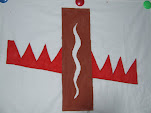
In order to survive, Latvia needs to imagine itself a survivor. This survival must include the possibility of seizing on radical direct not-violent actions as means to survival. The Latvia of tomorrow must shed its dead orthodox skin. This skin—a distorted history of pagans, peasants, and neo-Christian preachers—has been let overwrite a people who were in their proto-Latvian stage artisans (weavers, carpenters, potters, smiths, cobblers, gardeners, etc.) and were better known as Johns Children (Jāņu bērni). These were hobbled in the recovery of their identity, when in 1888 the figure of the itinerant teacher John (still visible on the Lihgo flag of 1874) was replaced by one Bear-Slayer, a figure lifted out of Luther’s Illustrated Bible (where he appears as Samson the Lion-Slayer).
The switch away from John in favour of Bear-Slayer happened not only because in 1881 Tsar Alexander III came to power and provoked pogroms against the Jews, but because he threatened many of the people living in the tsardom by attempting to have their language replaced with Russian. Among these people were Latvian speaking people. The tensions exploded under Tsar Nicholas II with what we know as the “1905 Revolution”. While dissatisfaction with economic development was one of its motivating forces, there were other motivations not tied to economics. This is the reason why the image (and the alterity) of Bear-Slayer, a macho character, found fertile soil in what had formerly been a kingdom held together by itinerant story tellers, who served equally well as saints. By making Bear-Slayer the hero and then leaving him to replaced John was a fatal mistake.
Indeed the institutions that diminish the proto-Latvian people (the populist substrate always at odds with a government presenting itself as neo-Christian) have a long history. And this is why the life of the Latvian community’s subjective self was permanently at odds (and often not for the better, though the why-fores are understandable) with democracy under the direction of a parliamentary government. Today direct participatory democracy is still spoken of only in the context of a President directly elected by the public rather than the Parliament. The Parliament remains a club of and for “political” parties.
At the same time, the death rattle may be just what the doctor ordered if we understand the anxieties of the subjective self of Latvians as they enter the death spiral caused by out-migration, an increasingly low birth rate, and not least by a parliamentary government believing itself to know better, though responsible for the time of troubles. This may be an opportune moment for Latvians to recapture the moment of self-identification lost in the last half of the 19th century and—with the help of alterity—re-identify themselves.
To cite Walter Benjamin (by way of Taussig) again: “If the theory is correct that feeling is not located in the head, that we sentiently experience a window, a cloud, a tree not in our brains but, rather, in the place where we see it, then we are, in looking at our beloved, too, outside ourselves. But in a torment of tension and ravishment.”
If the people who once knew themselves as Johns Children still retain in themselves something of the power of “mimesis”, that curious desire to be someone, something or somewhere else, an alterity remains a possibility. Though one cannot accomplish this directly of course, one can feel one’s self into it, and there are many ways of doing it. The copy machine is as much a mimesis machine as a wreath of grasses and flowers on one’s head. The latter was how the Latvian Children of Johns felt themselves into the role of being the children of John, their hero, the maternal male storyteller come on Johns Eve to keep them awake and make sure the Sun rises on Midsummer morning. Today, however, we have for alterity the young Latvian woman, who imagines she comes from impoverished peasants (perhaps kolhozniks), who conceives a child in England with the seed of an irresponsible Latvian boy also imagining he has endless generations of impoverished peasants in his background. Such is the result of the alterity that the parliamentary government of Latvia presents its people with.
Walter Benjamin is writing about his “ravishment” (his feeling his way into an alterity) while thinking of a young Latvian woman, a theatre director, (“a Russian revolutionary from Riga”—circa 1920s) with whom he is infatuated. Asja Lācis is an object out there in Walter Benjamin’s field of vision, that—to paraphrase Benjamin in first person singular—…cuts a one-way street through me, and by that cut stimulates my commitment to Marxism…. Walter and Asja live together for two years in Berlin (no doubt this is the time when Asja cut through Walter Benjamin with arguments that she makes ever so much more profound than words on paper). An intellect bound together by love (be it infatuation) is able to make the quantum jump from singer to linden tree in blossom time, to the song of bees in the blooms, and to the Revolution. So can’t government acting as if it has the rights of state and can go riding piggy-back on the wagon of history pushed onto the steel rails of a neo-liberal capitalist economy.
An important point raised by Michael Taussig is Benjamin’s perception of history. Writes Taussig: “The radical displacement of self in sentience—taking one outside of oneself—accounts for one of the most curious features of Benjamin’s entire philosophy of history, the flash wherein ‘the past can be seized only as an image which flashes up at an instant when it can be recognized and is never seen again.’ Repeatedly this mystical flash illuminates his anxiety for reappraisal of past in present, this understanding that ‘to articulate the past historically does not mean to recognize it ‘the way it really was’ (Ranke). It means to seize hold of a memory as it flashes up at a moment of danger.’”
Taussig continues: “This flash marks that leap ‘in the open air of history’ which establishes history as ‘Marx understood revolution’ as ‘the subject of a structure whose site is not homogenous, empty time, but time filled by the presence of the ‘now’.’”
The government of Latvia, the one in office for the last twenty years, perceives the history of Latvia as a homogenous empty time. By so doing, the government causes the Latvian people to perceive their history as an “empty time” as well. The Latvian government of today empties the people of their “now” as a community and replaces it with visions of conspicuous consumption. In the end, conspicuous consumption is a form of cannibalism performed by the government on the people so that when everything else has been consumed, they consume themselves. The subjection of and then the limitation of the peoples’ subjectivity to Pop globalizes the world for freedom to be a Conspicuous Consumer, but it fails to impress the community of proto-Latvians, 200,000 of who have voted with their feet and left Latvia.
The Latvian people describe the consumption of their state with the phrase “the stolen state”, a word combo that is one of the top ten in Latvia. It is "the stolen state", the nicely crisped body with green garnishes on the long dining room table, that is the centre piece of attention of the guests.
I trust this explains what alterity has to do with vision, with tomorrow, with a people at peace and a purpose. The “not-vote” campaign continues. To not-vote must be done to ensure humankind an alterity beyond that of the Conspicuous Consumer. It is worth as a consciousness raiser. My 99 blogs lead toward it.
Copy leaflet at 98 and pass it on.
Showing posts with label Walter Benjamin. Show all posts
Saturday, April 17, 2010
Tuesday, December 15, 2009
© Eso Antons Benjamins, a.k.a. Jaņdžs
NOT-VIOLENT TERROR
64 The Future of The Wuerzeltod (II)
A friendrecently asked: “Why do we always end up in a two-tiered society?”
My answer is simple and straight forward.
We have destroyed and disappeared the wood.
The wood—ever since the creation of humankind—has been humankind’s first line of defense with regard to human freedom and liberty.
The wood is the home of democracy. So-called democracy of the urban environment, the city, is nothing but utopian thinking in retrospect. Human beings did not become democrats in the process of social evolution, but they were born democrats, and democracy is because it began in the wood.
The wood and the individual tree stand as a shield against exploitation. Both the wood and the individual tree in the wood is the physical object that enables man and woman to defend themselves against any attackers of their democratic privilege.
Both now and in the long ago, many men became rich, wealthy, and ‘important’ by cutting down the wood. It was not always thought as an act of terrorists. To the contrary, it was often believed to be a creative act by pioneers (http://www.fiddleheadsbarandgrill.com/pdf/darlingtour.pdf ) and ‘smart generals’, as, for example, when the Roman General Varus lost three legions to the freedom loving Germanic tribes. The strategy of the men of the wood was a simple one, they attacked the Romans from out of the Teutoburg wood http://en.wikipedia.org/wiki/Teutoburg_Forest and then ran back into the wood to hide in the marshes and swamps there. After their defeat, the Romans always cut the wood about them when encamping or building a fort; and no number of brave and heroic wood dwellers could then dislodge or defeat the disciplined ranks of the Roman urbanites.
The tragedy for democracy and the wood began with the arrival of agriculture. Up to that time, human beings made their dwellings by clearing out a piece of land in the forest. The cleared land was used to grow various edible roots, berry bushes, and fruit trees, while the wood and its marshes were used as hunting and fishing grounds.
With the arrival of agriculture, which brought with it taxation (of grain) and hording by the boyars (originally probably ‘bully boys’). who built fortifications for their hoard. The fortifications used a large amount of lumber. In turn, this resulted in the clearance of sizeable areas of the forest. When some people of the wood found it convenient to build their dwellings along the outer edge of the wall of the boyars’ castles-forts, there arose the first towns and cities. Worse, there arose conceit among the “city” dwellers against the people of the wood and farmers. The conceit was most likely based on the ‘superiority’ of violence that the city people could bring to bear against the dwellers of the wood.
The cutting of forests continues to our day, We now call this cutting of trees “desertification”, because we can clearly see that we are not only destroying trees, but have created a whole culture of extreme resource exploitation along with it.
This brings us back to the question that opens this blog: “Why do we have a two-tiered society?”
Answer: Because we no longer have people dwelling in the wood. We no longer are protected by the wood. We can no longer ambush the Roman legions from behind trees. Our wood huts along the wall of the fort have become numbered cubicles in an “urban environment”. A modern American folk song called “Little Boxes” http://www.youtube.com/watch?v=2_2lGkEU4Xs&feature=related describes the situation well.
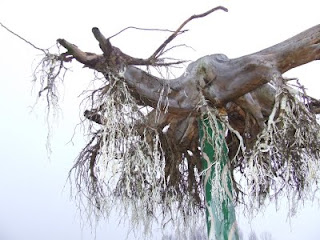
Speaking only for myself, I consider myself “terrorized” by all those who have terrorized the wood to extinction. In order to protect my interest in freedom and democracy, I have purchased a few hectares for myself in Latvia and have built there a “temple” dedicated to the wood. The centerpiece of the temple is not a God or Goddess, but the trunk of an oak tree with sawn off limbs. The “tree” stands on a concrete platform that has been built over the foundations of what used to be an old cowbarn and a hayloft.
This brings me to the literary critic, philosopher, and essayist Walter Benjamin. I am particularly interested in Walter Benjamin’s thought, because very possibly he helps to explain the thought processes of our forebears (and of course my own).
Writes Benjamin: “If the theory is correct that feeling is not located in the head …but, rather, in the place where we see it, then we are, in looking at our beloved, too [in this instance the wood and trees], outside ourselves.”
In other words, we experience our experience of the object in a sentient manner, as it beings outside ourselves. When we see a tree that commands our attention, we do not look at it as an actor may, with our head and conscious selves studying the tree in every detail, but as if the tree were that instant become a part of us. Such an entry of our self into the wood’s or tree’s self allows us to see he tree as copy of our selves. [I owe this latter insight to Michael Taussig’s book, re “Mimesis and Alterity”.] This is why sometimes the sawing down of a tree affects us with emotions that make us want to scream murder!

It is thus that we sacralize, make holy, a place, where the oak tree grows (or grew), and, in turn, the tree and its place sacralizes us. NOT-VIOLENT TERROR
64 The Future of The Wuerzeltod (II)
A friendrecently asked: “Why do we always end up in a two-tiered society?”
My answer is simple and straight forward.
We have destroyed and disappeared the wood.
The wood—ever since the creation of humankind—has been humankind’s first line of defense with regard to human freedom and liberty.
The wood is the home of democracy. So-called democracy of the urban environment, the city, is nothing but utopian thinking in retrospect. Human beings did not become democrats in the process of social evolution, but they were born democrats, and democracy is because it began in the wood.
The wood and the individual tree stand as a shield against exploitation. Both the wood and the individual tree in the wood is the physical object that enables man and woman to defend themselves against any attackers of their democratic privilege.
Both now and in the long ago, many men became rich, wealthy, and ‘important’ by cutting down the wood. It was not always thought as an act of terrorists. To the contrary, it was often believed to be a creative act by pioneers (http://www.fiddleheadsbarandgrill.com/pdf/darlingtour.pdf ) and ‘smart generals’, as, for example, when the Roman General Varus lost three legions to the freedom loving Germanic tribes. The strategy of the men of the wood was a simple one, they attacked the Romans from out of the Teutoburg wood http://en.wikipedia.org/wiki/Teutoburg_Forest and then ran back into the wood to hide in the marshes and swamps there. After their defeat, the Romans always cut the wood about them when encamping or building a fort; and no number of brave and heroic wood dwellers could then dislodge or defeat the disciplined ranks of the Roman urbanites.
The tragedy for democracy and the wood began with the arrival of agriculture. Up to that time, human beings made their dwellings by clearing out a piece of land in the forest. The cleared land was used to grow various edible roots, berry bushes, and fruit trees, while the wood and its marshes were used as hunting and fishing grounds.
With the arrival of agriculture, which brought with it taxation (of grain) and hording by the boyars (originally probably ‘bully boys’). who built fortifications for their hoard. The fortifications used a large amount of lumber. In turn, this resulted in the clearance of sizeable areas of the forest. When some people of the wood found it convenient to build their dwellings along the outer edge of the wall of the boyars’ castles-forts, there arose the first towns and cities. Worse, there arose conceit among the “city” dwellers against the people of the wood and farmers. The conceit was most likely based on the ‘superiority’ of violence that the city people could bring to bear against the dwellers of the wood.
The cutting of forests continues to our day, We now call this cutting of trees “desertification”, because we can clearly see that we are not only destroying trees, but have created a whole culture of extreme resource exploitation along with it.
This brings us back to the question that opens this blog: “Why do we have a two-tiered society?”
Answer: Because we no longer have people dwelling in the wood. We no longer are protected by the wood. We can no longer ambush the Roman legions from behind trees. Our wood huts along the wall of the fort have become numbered cubicles in an “urban environment”. A modern American folk song called “Little Boxes” http://www.youtube.com/watch?v=2_2lGkEU4Xs&feature=related describes the situation well.
Speaking only for myself, I consider myself “terrorized” by all those who have terrorized the wood to extinction. In order to protect my interest in freedom and democracy, I have purchased a few hectares for myself in Latvia and have built there a “temple” dedicated to the wood. The centerpiece of the temple is not a God or Goddess, but the trunk of an oak tree with sawn off limbs. The “tree” stands on a concrete platform that has been built over the foundations of what used to be an old cowbarn and a hayloft.
This brings me to the literary critic, philosopher, and essayist Walter Benjamin. I am particularly interested in Walter Benjamin’s thought, because very possibly he helps to explain the thought processes of our forebears (and of course my own).
Writes Benjamin: “If the theory is correct that feeling is not located in the head …but, rather, in the place where we see it, then we are, in looking at our beloved, too [in this instance the wood and trees], outside ourselves.”
In other words, we experience our experience of the object in a sentient manner, as it beings outside ourselves. When we see a tree that commands our attention, we do not look at it as an actor may, with our head and conscious selves studying the tree in every detail, but as if the tree were that instant become a part of us. Such an entry of our self into the wood’s or tree’s self allows us to see he tree as copy of our selves. [I owe this latter insight to Michael Taussig’s book, re “Mimesis and Alterity”.] This is why sometimes the sawing down of a tree affects us with emotions that make us want to scream murder!

While a mutual blessing may occur every time that I (we) and the tree meet (as when it grows in my yard), the communal ritual of sacralization (with the whole community participating) generally occurs on the basis of a local tradition, among Latvians, specifically, on Johns Eve.
In Latvia, Johns’ Eve is the time when a man presents himself to himself and the community with an oak leaf wreath on his head, a symbol of strength, endurance, greening, and life giving. In the instance of the oak tree, its fruit are the acorns that feed bird and beast. The woman appears with an oak leaf crown on her head as well (flowers are for medicinal tea and fulfill the sentiments of modern city dwellers), and both man and woman wear loafers (pastalas) made of linden tree bark made pliable after having been soaked in water.
To break meaning down further, the oak speaks for mindfulness as if it were a hat, while the linden speaks for being in touch with Earth. When the linden is in bloom, she is visited by thousands of bees; and if the bees think not with their heads, but are sentient in their being, then the linden tree, bees, and humans together create an aura within a special sound space. Latvians call this sound “sann-eht”. This ‘sann’ sound may only be heard properly when we are standing under a blooming linden filled with bees and with you and me present. So, if one wishes to hear how the linden, its flowers, the bees, and we sann together, you and I have to go there, where we will meet in the here and now.
We can rebuild this planet and recreate an un-tiered (egalitarian) society when and if we start using our brain to create ways to live in the wood again. Presently, it is still a movement toward the city, yet the computer makes the city unnecessary--at least as far as communication and education is concerned. Factories need not be so large as to consume a landscape. We dont need cars. We do need a good monorail http://en.wikipedia.org/wiki/Monorail system , bycycle paths, and a way to quickly attach a bicycle to the rail.
We also have to reinterpret history. That is why I have turned to Anatoly Fomenko as my orienter and guide in history. The current and popular version of history destroys our (my) sense of sentience regarding events by removing the events further into the background than they really are.

As recently as the 17th century, daily life was still enveloped by the wood. The machine, the great distancer of reality (television and the chainsaw being best examples), was not yet. Jesus on the cross (replacing Jesus thrown into a fire pit on the Hippodrome (11th or 12th centuries) in Constantinople did not yet fill the imaginary space with a phantasm better fit for the consumption of an urban dweller. Death by burning was a more sentient experience, the last victim of the Inquisition being Giordano Bruno in 1600, but the imaginary suffering of Jesus is made to appear more immediate.
In short, the current version of history (re: 2012 years since the birth of Jesus) denies, certainly handicaps Walter Benjamin’s theorizing and relevance. Propaganda takes precedence over sentience. The linden tree may as well be a linden in Unter den Linden http://www.ww2incolor.com/d/483493-4/1__007 c. Berlin, WW2.
Asterisks; Notes of Interest:
On material depravation in Latvia.
On the theme of “more-equal-than-others” Animal Farm.
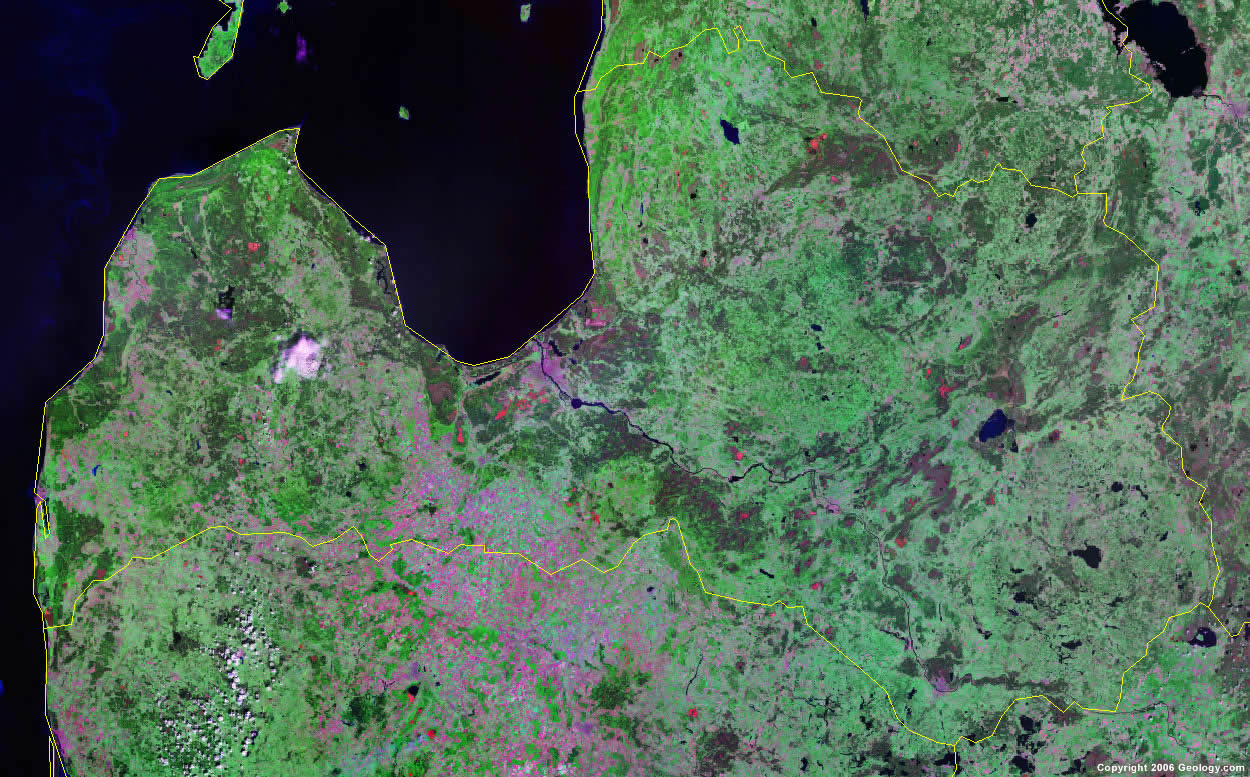
An eyeball view of Latvia (and its forests) company map; satellite. While some sources claim that Latvia is 47% covered by forests, none of it is old growth forest. The Latvian news media provides little coverage of the rapid pace of deforestation. Anecdotal evidence of deforestation in progress from a neighbor: “There were fewer mushrooms this fall than last year. Forests we used to visit are gone.”
Google software to tell effects of deforestation.
Of great interest to me this and like articles like articles. It presents some of my reasons for supporting the cultivation of Johns Grass in Latvia.
Favored serendipitous click or “chronal mirage” on the internet. I was searching for a relationship between the burning of Jersika and heretics in Lanquedoc, France. You must read the text at near the end of the scroll, re image of “The Burning of St. Joan”, Monday, September 03, 2007, to get the point.
My most unappreciated work—so far, re “Tiresias’ Revenge”, my reinterpretation of Sophocles’ “Oedipus Rex”. I believe that Sophocles had to hide the true meaning of his play for political reasons. It is apropos of the political situation in the world today, also in Latvia. The play may be found at blogs 40 through 47. Start from Blog 40.
These blogs tend to be a continuum of an idea or thought, which is why—if you are interested in what you read—you are encouraged to consider reading the previous blog and the blog hereafter.
Partial entries of my blogs may be found at LatviansOnline + Forum Home + Open Forum –ONLATVIANPOPULISM vs LATVIJASLABEJIE. If you copy this blog for your files, or copy to forward, or otherwise mention its content, please credit the author and http://esoschroniclnes.blogspot.com/
Subscribe to:
Posts (Atom)