Showing posts with label fascism. Show all posts

Sunday, March 9, 2014

Eso’s Chronicles 302 / 1  
A Suicidal Civilization
© Eso A.B.
All comments appearing within brackets [ ] are editorial in origin.

IS FASCISM RECOVERABLE?

A lady who I have known for many years recently surprised me by being endorsed on a network by one who works for a ‘suicide prevention’ group. Since the lady is a practicing Buddhist, one may say that from a conventional point of view this is a match made in heaven. Both work for ‘healing from within.’

My objection to the mutual endorsements is because whenever I hear talk of suicide prevention without hearing an explanation that extreme dedication to suicide prevention denies a would-be ‘suicide’ the right to argue on behalf of self-sacrifice of life, I hear an argument on behalf of an  of evasion of life. Indeed, I hear in the advocate of suicide prevention a voice denying self-sacrifice of life and arguing that self-sacrifice (and Revolution) is not necessary whatever the circumstances may be that makes one think of them. Indeed, a radical, i.e., violent defense of a right to be sovereign when it comes to a decision about one’s life is summarily dismissed on behalf of an ‘inner’ and presumably ‘spiritual’ decision of a religious nature and conviction.

My readers know that I have long endorsed and argued on behalf of self-sacrifice as essential to the existence and maintenance of the human community. If it were not so, we would not be walking upright and would be still be squatting high in a tree chattering rather than talking. When all is said, self-sacrifice is an act that, though it may begin as a small favor, may end up with the ultimate sacrifice of giving one’s life. Yet ever since before the Age of ‘Enlightenment’ and the arrival of Catholic Christianity (God is only of the Plus side) there have been people who have argued that suicide is an act of violence and a major transgression against one’s self and, therefore, needs to be preached against and condemned.

Or is it that the argument in support of fear (and avoidance) of Death comes from those who raised themselves to material wealth by repressing and killing those who stood in the way of such self-improvement? The medieval poet Dante expressed this fear (revealed in official forgiveness of sins) in his poetry http://www.stpeterslist.com/8214/forest-of-suicides-6-comments-on-dantes-punishment-for-the-self-violent/  and, like it or not, condemned the creator of Death to the lower ring of Hell, which he imagined to be like Antarctica. Who is this Creator of Death—

Satan or God?  

I argue that Death is the creation of God; while, for all I know, you may say it is a creation of Satan.  Yet if Satan is a separate creation from God, he is not necessarily either more or less than God.

A way around this is to argue that both God and Satan are only middling Creator gods, and that there is yet a Higher God who created them both. This is easily illustrated by successive digital divisions, re < into < <, and so on. The Engish poet Robert Blake called this God Urizen http://en.wikipedia.org/wiki/Urizen , God of Reason and Logic

To simplify my argument, I will stay with the idea that whether there is a God (call him the Big Other or Urizen) or not, matter brought to life was created by God to die for his own good reasons. If this is only a half a truth or in no way true, my presumption, nevertheless, justifies the argument that death is/was either created (or evolved) for a purpose. What purpose?

Here we need to look back to the old tradition of repentance and fasting—despite the fact that there are many writers who believe that “…we no longer have the luxury of tradition” (either repentance or fasting). What was the reasoning that brought fasting about?

Does it mean that fasting or lent needs a ‘tradition’ for us to give it a try? I do not quite understand, why I need ‘a tradition’ to put up with a tradition of never hearing Bill Gates, whoever he is, reprimanding himself for hanging tooth and claw to an acquisitive character, from which our culture mines the deserts of its cities.

Needless to say, I have no idea of who this Bill Gates is, except that the press keeps touting such a name as the world’s wealthiest man or oligarch, and he has been seen on a number of ‘platforms’ advocating fascism as he sees it http://au.ibtimes.com/articles/535577/20140123/bill-gates-melinda-foundation-jimmy-fallon-show.htm . When it all gets boiled to syrup, the brew differs only slightly from Mussolini’s famed definition, which I will quote following Gates three definitions:

1. Everything in the oligarchy;
2. Nothing outside the oligarchy;
3. Nothing against the oligarchy.


These definitions (of course, Gates may not even know the word ‘fascist’) do indeed deny the ‘traditional’ definition of ‘fascism’ by Mussolini, who proposed it on behalf of the ‘State’ rather than ‘oligarchy’ as in the following http://www.urbandictionary.com/define.php?term=fascism :

“1.’Everything in the state’. The Government is supreme and the country is all-encompasing, and all within it must conform to the ruling body, often a dictator.

2.’Nothing outside the state’. The country must grow and the implied goal of any fascist nation is to rule the world, and have every human submit to the government.

3.’Nothing against the state’. Any type of questioning the government is not to be tolerated. If you do not see things our way, you are wrong. If you do not agree with the government, you cannot be allowed to live and taint the minds of the rest of the good citizens.

The use of militarism was implied only as a means to accomplish one of the three above principles, mainly to keep the people and rest of the world in line. Fascist countries are known for their harmony and lack of internal strife. There are no conflicting parties or elections in fascist countries.”
].

Still, if we think of it, ‘fascism’ speaks not only on behalf of oligarchy’, but also of monarchy. And as in the last words of 3., it also speaks of ‘good citizens’. So, what gives?

We may begin to start unraveling the riddle by, first, identifying appropriate synonyms for 1., 2, and 3.

A: is dictator as well as pope, president, or King.
B: is government not as in A. but as in Bureaucracy.
C: good citizens constitute the community, the city, the society.
D: militarism is outwardly turned armament. The needles of a porcupine are an excellent example.
E: fascism is a State with an outwardly violent face.
F: sometimes a nation is called a fascist State.

G: Is it possible that a fascist nation does not always project violence outwardly, but replaces it with atonement, lent, and self-sacrifice?

Thursday, October 24, 2013

Eso’s Chronicles 226/ 12
Blood to Go
© Eso A.B.

America’s misfortune is that it inherited ‘democracy’ in the form of an unsolved European crime, but was fooled into believing that the crime was a divine gift through the Magna Carta http://en.wikipedia.org/wiki/Magna_Carta , Pilgrims-Calvinists http://wiki.answers.com/Q/What_religion_were_the_pilgrims , and the Age of Enlightenment and Reason http://en.wikipedia.org/wiki/Age_of_Enlightenment.

What America has not understood to this day is that urban ‘democracy’ http://en.wikipedia.org/wiki/History_of_democracy is a delusion that finds for itself a delusionary act to translate into. It is like you have just come on the street after seeing a fantastic movie and are asking yourself: “Where can I find myself a lover or heroic role similar to the one in the movie?” You find the answer by going into a pizza parlor and ordering a pizza with anchovies. In short, you slap yourself in the face with the tail of a fish.

True democracy exists only in the wood, where every tree offers an opportunity to either hide or climb if whoever comes towards you appears stronger than you and you have not made your greeting friendly, or—if you are more courageous—you make him-her your dinner and no human rights organization will make an issue of it. In our post-wood civilization, where the ‘natural’ environment has been turned into an urban setting, ‘democracy’ is but a longue durée memory of the liberties in the wood, now best expressed through liberal capitalism, libertarianism, and libertinism. As stated in the previous blog in a slightly different context, ‘democracy’ is the death of death itself, which in every day language translates itself as “this is all there is” , “enjoy it while you can”, “the strong rule”, “the rich chose the music”.

I have also written that the event that set the modern era into motion was the substitution of the Christianity of the Wood with a Christianity of urbanites, which Christianities do not much differ from ‘democracy’ in the wood and ‘democracy’ in the city respectively. Because these bipolar versions of democracy and Christianity are not well understood and even less discussed, the original versions have fought the latter version with bloody and tragic fury, while the latter (in possession of nuclear bombs, and night vision goggles) claim the former belong in a oo.                                                               

I have no particular wish to pick on America, because—as stated in the first sentence—Europe is where the alternate or neo- versions of ‘Christianity’ and ‘Democracy’ took root and were the gospel stories were ghost written and ancient literature was rewritten. In so far as other governments (Russia, China, et al) have evolved influenced by European and American versions of Christianity and democracy, these, too, face a bloody comeuppance. As much as a comeuppance spells disaster, it cannot be avoided, because there is no other solution to the never faced problems of governments and the economy other than through a reintroduction of death in a manner never to be forgotten. I dare say, I see Robespierre, Stalin, and Pol Pot as comic book characters to the Saturn whom many artists have been prophesying as being on the way, but never quite succeeding in portraying the horror, because their works, always based on experiences of their times have never reached the crescendo that is yet ahead. Were we to create an artistic series, we would likely begin with the tapestries once covering piles of potatoes on a French http://i.dailymail.co.uk/i/pix/2011/04/20/article-1378818-0BA5552900000578-103_634x399.jpg potato field, take a look at the Goya’s Saturn http://en.wikipedia.org/wiki/Saturn_Devouring_His_Son , and end with Picasso’s ‘Guernica’ http://www.jkrweb.com/art/images/guernica.jpg , which in 2003 the U.S. had removed from the hall of United Nations http://www.wsws.org/en/articles/2003/02/guer-f08.html  because Collin Powell had war on Iraq and execution of Saddam Hussein in mind.

It is worth noting that the false flag of urban ‘democracy’ has been propping itself up by selecting fascism and communism as the bugaboos which will seize power if ‘democracy’ is turned out of its blood smeared offices. America and its cronies in Europe have ‘outlawed’ fascism by pointing to the atrocities of Hitler against the Jews. Russia, too, through Lavrov, its foreign minister, states: “Sure enough, the Russian-Belgian contacts had to string along with the twists and turns of the European history, but we can say with full confidence that mutual affection between our peoples has been the constant of our relationship. Now that ideological contradictions are a thing of the past…” In other words, now that bloody ‘democracy’ has a clear field as a result of the collapse of fascism and communism and there appears to be no chance of a re-analysis, ‘democracy’ may resume ruining the planet.

                                                               As we ought to know, both Belgium and Russia have their own bloody histories. Belgium’s King Leopold II (1835-1909) exceeded Hitler’s and Stalin’s murders, perhaps more than the two put together http://www.historytoday.com/tim-stanley/belgiums-heart-darkness . Yet Lavrov’s statement clears the field for a Europe and Russia--‘knocked for a loop’ by their recent histories--to make recovery of their former ways and with renewed underhanded methods compete over the colonization of Eastern Europe through cooperative federalization greased by compliant politicians of impoverished nations. Sadly, the people of the formerly occupied nations are unable to gather their wits because their minds are massaged and whitewashed by urban democratic ideals and their forests are turned into tree stumps by banks.

Yet as a number of  founding fathers of American ‘democracy’ pointed out, especially Jefferson http://www.ushistory.org/us/20.asp , America was not a federalist nation. In short, at least some of the founding fathers of America implicitly argued that the future of democracy ought to evolve along the lines of an autarky. To be sure, some have suggested that an autarky is a de facto fascist state, while forgetting that an autarkic government was the nature of government when humankind subsisted on the goods of nature and these had not been exhausted by being turned into ‘resources’ by proto-capitalist and capitalist governments, which decimated forests to plant grains, which are more quickly turned into money than animal furs.

Unfortunately, Jefferson’s ideas did not prevail, and America, its territory at that time (1743-1826) yet in a natural state, was wide open to invasion by technology, which began its assault by building railroads and killing off the native population. Technology, no doubt, facilitated the development of capitalism, which exploited and continues to exploit the planet: http://www.bbc.co.uk/news/world-europe-24222392

The dangerous momentum that built America, turned catastrophic after the U.S. claimed to have ‘won’ WW2 (1945) and brought the Soviet Union to its knees (1991). Its wealthy, bloated, and simplistic minded elite began to overreach when they presumed to export ‘democracy’ with increasingly bloody methods to countries not yet directly under the control of their Federal Reserve Bank. As evidence of spying by the NSA shows https://www.reviewjournal.com/news/france-newest-ally-angry-over-nsa-spying , ‘democratic’ proto-invasions began as early as 1960s, though not yet on such a scale as in the present computerized era. Due to the financial and economic crisis, instigated by dysfunctional ‘democratic’ governments, now striking all Western-born nations simultaneously, Europe has become increasingly frantic in its attempt to become a Federalized Union. Brussels power plays have brought alarm to at least one European country—England.

Friday, August 9, 2013

Eso’s Chronicles 202/2
How to Destroy a Nation (2)
© Eso A.B.
 

Grandfather had enough of playing second fiddle to the Latvian state (though he had bought the state a number of military biplanes (I saw them during a fly-by over his vacation home in the summer of 1938), and my father had replaced him as editor-in-chief for some time). A few years before his death, he went to consult my godfather, Mintauts, and asked his opinion about a divorce from Emiliya. The legal mind advised him to forget it, as it meant that his heirs, the children of his first marriage, might be left with little legal rights to the money he had made or properties he had bought. The heir to the Habsburg Empire, Emiliya’s adopted son George (his father was an Austrian), would most likely get to keep it.

Meanwhile, the small sovereign state of Latvia enjoyed a small economic boom. Its agricultural products: butter, bacon, wood were in demand. The country had relatively few motor engines polluting its air, because the horse still prevailed in the countryside. The car owned by my father, a Chrysler, spewed gasoline fumes so badly that I became car sick every time the family took a trip to grandfather’s estate in the region of Kurzeme. I much rather enjoyed the family motorboat, the engine exhaust being quickly dissipated by the winds of the sea.

By the time the Soviet Union crossed Latvia’s borders, I was seven years old. The Soviets quickly put a stun grenade on the family’s dining table. At the beginning of WW2 (as I was turning eight) the granade went “Boom!” and eight members of the family disappeared in the Gulags, while two (my father and maternal grandfather, a former ambassador to Moscow) were likely tortured and shot.

The country as a whole split into two halves: the survivors of Soviet carnage turned pro-German, while the former have-nots fled the country with the retreating Soviet Army, which after WW2 was to occupy the country for nearly fifty years. I, my two siblings, and mother survived, by hiding in the countryside among the relatives of my paternal grandmother. It was there that I grew to love the countryside and its direct ways: if you wished to travel, you had to yoke a horse or two to the carriage, and the eye could not avoid watching the horse raise its tail when needing to make a fart.

After surviving a string of refugee camps and forty-six years in America, I was happy by the opportunity to return to Latvia. It turned out to be an unhappy experience as political disunity heightened by extreme poverty, consequent to shock economic policies forced on the country by capitalist America gave early indications that the country would not survive as a sovereign community.

Pressures that forced the dissolution of what traditions had survived the Soviets came as quickly as the first years of so-called ‘independence’. One man (a man in early middle age) was perceptive enough to publicly sacrifice his life in front of the Freedom Monument, but his act was dismissed by the state as imbecilic and his complaints were not investigated.

Interestingly, the blade of the axe came from the ‘nationalist’ influence out of exile. In the forty-six (rough estimate) years in exile, the nationalists—most coming from Latvian urban society or, for that matter, having been born to exiles living in an urban environment—were easy converts to capitalism. Irrational denial of all notions of egalitarianism, natural to agriculturalists, forest dwellers, and fishermen coupled with easy and accustomed access to consumer goods produced at the expense of the environment and countryside, became a convenient ‘capitalist tool’. The coup de grace was delivered by the argument that Latvia was ‘unnaturally’ countryside oriented, and had a disproportionate number of people living ‘unproductively’ in the countryside.

A number of descendants of Latvian exiles, who had no familiarity with the country other than participating in folkdance groups in Western urban ‘democracies’ were let loose with their capitalist ways (their own capital or with the capital of the corporations they were employed by) on a country that had not yet had any opportunity to accumulate capital of its own. The results were pure joy to those exiles who returned to Latvia as tourists once a year for two weeks, and pure disaster for Latvians who were not prepared for such quick changes, and, worse, had no support from their own government, which for all practical purposes had turned out to be a traitor to its country as a sovereign entity.

While the traitorous nature of the government was camouflaged behind numerous legalistic excuses, the fact remains that it denied its citizens the right to hold a referendum—ostensibly over whether to forgo the local currency (lats) for the euro, but actually to deny the citizenry the right to sovereign expression and set a precedent for further such denial.

As I wrote in a post to another internet platform, it is not that Latvia will cease to exist because of this. It surely will remain as a name for a place for some time to come; there will also remain a number of indigenous people who are lucky enough to escape the squeeze to have them flee the country as economic refugees. However, as a sovereign community, as a community that yet had the opportunity to discipline itself for survival through the practice of an economy that fully or partially accords with the principles of autarky has become fodder to foreign interests and badmouthing of planetary hegemony dominated by the West.

While the following link to a description of autarky https://www.youtube.com/watch?v=4-8eaW3C-XY ends with a nearly full endorsement for globalization, Latvians would be wise to remember that globalization today is the result of the liberal application of violence as a facilitator to urbanist ends. On the other hand, autarky is successfully practiced by the Latvian Senate (Saeima), where autarky as in-house ‘democratic’ fascism (or do you prefer leeches to feces) rules supreme.

Friday, May 24, 2013

Eso’s Chronicles 171
Fascism as Deconstruction of Community (III)
© Eso A.B.

Thus (see blog 170), if proto-fascism has its beginning in a disintegrating community desiring to heal itself, for those who have the desire to heal, finding themselves being labeled ‘fascists’, further facilitates the disintegration of their community, and places the naming agent in the position of the enemy or his agent. The enemy/ agent works as a:


1) saboteur, a role enhanced by deliberate idiocy;

2) the sabotage occurs for the agent’s own good reasons; and


3) the reason for the sabotage is to access Money, because when there is enough Money, it substitutes for community; i.e., one may do without community, because one can buy an illusion of it.


4) The agent or enemy of community, therefore, is Money; because Money buys ‘freedom’ and ‘liberates’ one of the community and responsibilities toward it.


5) Money opens a new world, a wholly virtual world. As opposed to the Superego of the organic world, who projects in our dreams as a ‘medicine man’, the Superego of the wholly virtual world is a consumer item. For example, a Barbie doll https://www.youtube.com/watch?v=w7P_0_HfTp8. Incidentally, a Barbie doll may be had only through the agency of Money, which is God for real in our time and space. Nevertheless, this money is seldom in the hands of the community, but remains in the possession of the anti-community forces: the billionaires, the millionaires, and the military forces the oligarchs support.


Items 4) and 5) provide the reasons why capitalists sabotage a community’s effort to reestablish itself. The sabotage is accomplished by diverting the healing effort toward self-destructive ends and then call the result ‘fascism’, a word of such evil potency that the victor ‘democratic’ State forbids it to be ever mentioned again.


Among the negative consequences of communities efforts to recover are two gigantic icebergs: Hitler’s fascism and Stalin’s communism.


At their beginning stages, both fascists and communists had enormous popular support. If they had not had such support, they could hardly have succeeded in rising to their eventual dominant positions.

There were, however, forces embedded among communalists, which sabotaged their good cause and earned them ridicule and a bad name for a long time thereafter. In short, in so far as now bygone communism and fascism represented forces of the community that rose against its destroyers, the community in the end became a worse loser than when it had begun its recovery effort. The community was further diluted than it had been at the beginning of the uprisings. By our day, the community no longer exists as a tangible entity.


What has replaced the community is a wholly artificial megalopolis, a centre for the creation of virtualism, which is held together (zusammen) not through personal relationships, but through everyone’s dependency on Money. Money itself is ‘democratic’, in so far as it can be divided among community members more or less equally, but which ‘equality’ fails to become a reality, because the enemies of the community desire to keep the Money, most of it, for themselves.


It is at this stage of political developments that the leaders of the community (not having been forewarned) succumb to the temptation of either 1. Money or 2. Power (a Money substitute). The only way to then continue forward is to divert the attention of the members of the community from the ‘real’ enemy on to a scapegoat.


In the event of Hitler’s community organization, it discovered the enemy in the “Jews” (or gypsies, polaks, russen, homosexuals, avant garde artists, etc.). Because among all the above were certain anti-community factors and phenomena, the untutored have-nots were readily persuaded to turn on one or all of them. The persuasion was given roots when it was conjoined with permissive and officially overlooked killing.


Of the enemies, the community of Jews, the most cohesive community among the above, turned out to be the one which communitarians could be caused to hate and kill most readily. The reasons for why are many, but the most apparent one is that anti-Semitism was not a new phenomenon, but was grounded in an antagonism many centuries old. This ‘old’ antagonism was, in turn, grounded in the unresolved Great Schism that went back to the Civil War among Eastern and Western Christianity, its high point being the so-called Fourth Crusade of 1202-1204.


The Crusade was nominally won by the West when it sacked and plundered Constantinople, and transferred the centre of Christianity from the Byzantine Empire to Rome, Italy. The physical address change was accompanied by a power shift from an autonomous Eastern priesthood, which was rooted among a people familiar with prehistoric shamanism (hence autonomous), to a priesthood rooted as a bureaucracy under the wing of a Western secular king, turned Christianity on its head.


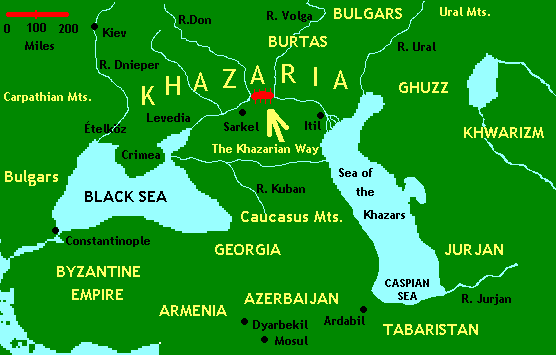
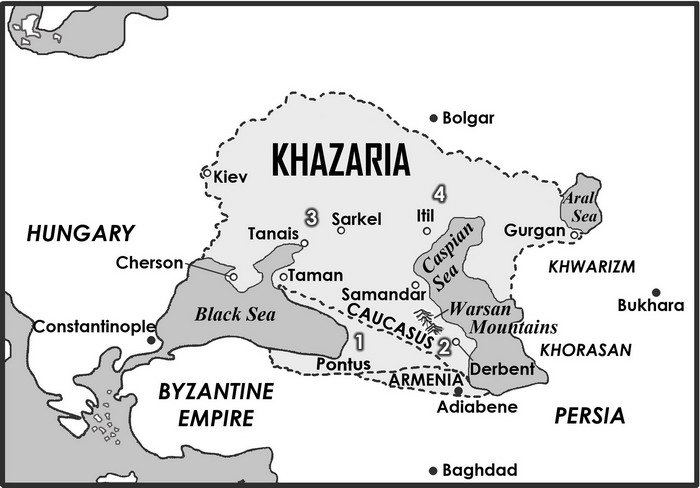
Eastern Christianity, known as Orthodox Christianity, was forced to adopt a Western or Catholic Christian story of the nature of the Son of God. The Orthodox or Eastern version of the story was associated with the Kabalah and the Old Testament, which texts likely had their origins in Jewish of Khazaria http://www.oocities.org/tmajlath/khazaria.gif . Needless to say, the Eastern Christian story of the Son of God differed considerably from that of the Western story. In the Eastern story, the king of Eastern Christianity is burnt by the traitorous Byzantine Emperor Alexius I at the Hippodrome in Constantinople about 1118, whereas the Western story was pure theatre and spectacle.


The community movement led by Hitler took advantage of Western Catholic bureaucracy’s (The Habsburg Empire was Catholic and centered in Vienna, Austria) antagonism toward the Jews, and subsequently identified the movement with Italian fascism, which took its name from a bundle of fascio (hazel) sticks as disciplinary tools.


Community building by Lenin and Stalin took an opposite tac, when it found its enemy not in the Orthodox priesthood (though it killed thousands of priests), but in the tsarist oligarchy, its sympathizers among the Russian bourgeois, and a peasantry (Kristi-yan) that had risen to a ‘kulak’ http://www.britam.org/pics/KhazarEmpire.jpg  status.


What was missed by Lenin, Stalin, and Hitler was that neither the ‘community’ of the Germans nor Slavs identified with industrialized workers community. What the proto-Revolutionary and disintegrating community wished for was an organic community, the one they and their forebears had had for centuries, except it had become demoralized by those seeking wealth and progress as the only way to overcome the repressive princes, boyars, and barons.


As everyone knows, Stalin’s Soviet Union and Hitler’s Reich did not fulfill the dreams of the community movement, but the community movements in Europe and Russia (aided by American capital) met with a catastrophic defeat instead.


The answer for the causes of this defeat is indeed to be sought in Western capitalism, which built itself on the idea of a ruthless exploitation of our planet’s natural resources and made a huge investment in advertising and evangelizing militant capitalism. Additionally, defeat of the community was facilitated by the fact that none of the community leaders and no one in their bureaucracies or churches came to think that the rebuilding of a community requires of the leadership an ultimate self-sacrifice and that its goal is a subsistence, not capitalist, economy. The leadership of the community then and now remains all too attached to its own well being.

Wednesday, May 22, 2013

Eso’s Chronicles 170
No Room For Me at Home (II)
© Eso A.B.

The Merriam-Webster dictionary defines fascism as: http://www.merriam-webster.com/dictionary/fascism (please read link) :

“1: often capitalized: a political philosophy, movement, or regime (as that of the Fascisti) that exalts nation and often race above the individual and that stands for a centralized autocratic government headed by a dictatorial leader, severe economic and social regimentation, and forcible suppression of opposition

2: a tendency toward or actual exercise of strong autocratic or dictatorial control “early instances of army fascism and brutality — J. W. Aldridge”; etc.

Anyone with some analytical ability will note that both 1 & 2 definitions are not definitions, but transparent  pejoratives and a priori denouncements dressed in a language tuned to imitate a definition.

Let us take a closer look at the 1st ‘definition’: “….a political philosophy, movement, or regime (as that of the Fascisti) that exalts nation and often race above the individual and that stands for a centralized autocratic government headed by a dictatorial leader, severe economic and social regimentation, and forcible suppression of opposition…”

The second (2) ‘definition’ is no less propagandistic and serving those  (Merriam?) in whose interests it is to weaken and ultimately destroy COMMUNITY as a legitimate social phenomenon.

Let us look at the items separately and in the context that sees said ‘definitions’ as politically deliberate and pejorative redefinitions of a community of human beings:

1. A political philosoph:
Is ‘community’ a political philosophy or a necessity of the human condition? http://dictionary.reference.com/browse/community The reader should read the text at link to see that the enemies of the COMMUNITY are those who stand against it: “1. a social group of any size whose members reside in a specific locality, share government, and often have a common cultural and historical heritage.”

2. regime:
http://dictionary.reference.com/browse/regime?s=t Items 1. (above) + 2. should suffice for us to get the anti-community gist: “1. a mode or system of rule or government: a dictatorial regime. 2. a ruling or prevailing system.”

3. exalts nation and often race above the individual:
synonyms: extol,  glorify, elevate, praise, raise. In and of themselves the synonyms are harmless, but put in combination with words such as “nation” or “race above the individual”, it instantly acquires a negative coloration in reference to the ‘known unknown’ COMMUNITY that inevitably stands just behind the curtain.

4. centralized autocratic government headed by a dictatorial leader:
a definition of ‘autocracy’: http://en.wikipedia.org/wiki/Autocracy : “An autocracy is a system of government in which a supreme power is concentrated in the hands of one person, whose decisions are subject to neither external legal restraints nor regularized mechanisms of popular control (except perhaps for the implicit threat of coup d'état or mass insurrection).”

5. economic and social regimentation:
if this is the prevailing mode of communal existence, then COMMUNITY again appears in a negative light.

6. forcible suppression of opposition:

here we return to the Merriam Dictionary: “fascism noun: Philosophy of government that stresses the primacy and glory of the state, unquestioning obedience to its leader, subordination of the individual will to the state's authority, and harsh suppression of dissent. Martial virtues are celebrated, while liberal and democratic values are disparaged. Fascism arose during the 1920s and '30s partly out of fear of the rising power of the working classes; it differed from contemporary communism (as practiced under Joseph Stalin) by its protection of business and landowning elites and its preservation of class systems. The leaders of the fascist governments of Italy (1922–43), Germany (1933–45), and Spain (1939–75)—Benito Mussolini, Adolf Hitler, and Francisco Franco—were portrayed to their publics as embodiments of the strength and resolve necessary to rescue their nations from political and economic chaos. Japanese fascists (1936–45) fostered belief in the uniqueness of the Japanese spirit and taught subordination to the state and personal sacrifice. See also totalitarianism; neofascism.

While it is true that the above mentioned states and regimes did use the stated methods for gaining and staying in power, it is just as clear that said governments had no or little understanding of the place of a community in the scheme of human society or the state as a mechanism for the facilitation of communal values. On the other hand, it cannot be said that the impulses that lead to the creation of a fascist state did not originate with a desire by a disintegrating community to preserve the community.

The question over what forces create a community necessarily lead us to consider the nature of human being, consciousness, the Superego, the subjective mind, primal times, and more.


Any attempt to look at the community leads one to look at the nature of human being. We begin as children, and as children our natures are as needful of parental protection and love as we as remain barbarous, anarchistic, and largely untutored in our behavior. As babes, we all insist that we are born billionaires, and the first billion that we own is attached to the nipple of our mother’s breast.


Because parents have gone through the experience of learning that the physical habitat we are born into does not offer us a cornucopia of everything we want, they must wean the child not only off the mother’s breast, but that instead of getting two pieces of candy, we may have to be satisfied with one, and sometimes none at all. This is when the cornucopia appears in heaven and the figure of God. However, ‘God’ and ‘heaven’ (or Paradise) are meaningless words until these are supplemented with images and stories that create the illusion that these promises are real. By the time the child discovers that a storyteller tells lies, he-she has reached puberty and discovers the pleasures of sex, which discovery may have been caused by parental sex education. Instead of being truly educational, it more likely lead to self-education through masturbation. Because for a man the desire of his penis tends to be stronger than the man himself, the penis provokes fantasies of women as cornucopias. Since a boy knows that the women of his own family are no cornucopias, his fantasies project to women of other families and/or tribes, and results in stealing for himself a ‘wife’.


It may be that the first communities began through the act of rape, which deed was resolved by the myth that women ‘enjoyed’ being raped. While today we seem to ‘unknowingly know’ that rape is an unmentionable, this was not necessarily so for our forebears. While the reason for rape for a man was sexual pleasure, its consequences were assured pregnancy culminating in the birth of a child. Another inevitable consequence was social turmoil: one small social unit, one family (in prehistoric days headed by a woman) had intruded into the space of another family. Conflict was always just short of being imminent, even though it was not always inevitable.


Imminent conflict could be avoided by following a number of simple tactics. One of these was rape, an immediate (asap) deflowering of the stolen-kidnapped maid. This fait accompli act defused the conflict, because the brothers of the maid, who gave chase (the father always was no one knew where) knew enough about ‘facts of life’ that a child could be the consequence. If a child was indeed the consequence, it was better for the families of the two women (one of the groom, the other of the bride) to live in peace. In other words, the custom that prevails to this day in pre-borgeois ‘organic’ communal life, which encourages the raped woman’s family to blame her rape on the woman, is not because it favors rape or wishes to besmirch one of their own, but to avoid mortal conflict between the brothers of the two families.


Another tactic employed was to carry the stolen ‘bride’ beyond easy reach of her pursuing brothers, such as carrying the maid across a natural barrier, say, a river. The barrier means that the pursuers will be delayed, during which time the sexual act will be consummated.

Yet another tactic is to take advantage of everyone’s desire to avoid death. Thus, both sides invented numerous excuses for avoiding conflict. In a Latvian folk song, after the maid is carried across the river, her brothers, still on the other shore, call their sister and urge her to come back, but the maid (no doubt already sexually compromised) shouts back: “Dear brother, I will not come back, your wife treats me harshly….”


Still, while direct conflict between the families has been avoided, a sense of humiliation may linger. Sometimes this results in brawls among the men-brothers at the next community festival, where inebriating drink may loosen tongues and resolve to control one’s self. If grudges result in conflict long after the original provocation, other tactics need to be exercised to avoid violence. It is these tactics that call for the involvement of elderly men, commonly known as community elders; and it is at this point that the Superego invents another story. The story may come by way of a dream (ever respected because its source is not one’s personal and wilfull consciousness) or may be consciously inspired and meet with communal approval. One may call the story, “Piece of Coal in the Cake”.


The elders of the various families who participate in the Festival, come together for a Salmagundi (a meal of peace*) at which they confirm that together they form one community, and all, do or die, stand as one. To confirm this resolve, the men divide among themselves a cake, into which has been baked a piece of black coal. Whoever gets the piece of cake with the coal in it will self-sacrifice himself on behalf of all, i.e., the community. In this way, he will overcome death and violence on behalf of all.


Incidentally, such an extended community avoids becoming centralized, but consists of autonomous communities. The bond among the communities is expressed and reasserted at festivals, which come together on the basis of habit and tradition. They often occurred on astronomically significan days: summer and winter solstices. The man who ‘wins’ the peace of coal, pays for the ‘win’ with his life, though in times of conflict, he may become the King or leader of the community and goes to repel the ‘outsiders’ or ‘unfriendlies’. By becoming the leader of armed men, the King is in no way forgiven death, but becomes the leader, because death is already his fate. If he survives the battle, he will fulfill his pledge perhaps at the next festival


The need to select a King in wartime may create Kingship as a centralized office for the entire community. The office does not lead to fascism or the dissolution of communal bonds in preference of a hunta or junda. The organic nature of the community continues to be confirmed through self-sacrifice.


*Salmagundi—while the dictionary informs us that it is a salad, the word ‘salma’ (like salam) probably stands for ‘peace’, while the word ‘gundi’ likely stands for a ‘gathering’.

Monday, May 20, 2013


Eso’s Chronicles 169
The Misnaming of My Community (I)
© Eso A.B.

Fascism and not democracy is the ‘star’ issue of the 20th and 21st century’s politics. Nevertheless, the U.S. government and its European allies (NATO) in the East are sold on ‘democracy’ as the story that dominates the myth of now and the future. With the name of ‘democracy’ on its lips, government claims the right to attack and destroy my community by forcing on it the rule of banks and extinction by globalized fascism.

As long as Money was ubiquitous or could create the illusion that it was ubiquitous, it could and did sell the populations at large on “human rights”. As one well-known popular academic philosopher* of the West tells it: “….the decisive cut in the relation of domination … occurs with the passage from pre-bourgeois to bourgeois society. In the pre-bourgeois society civil society is not yet liberated from organic ties…. With the advent of bourgeois society this rich and ‘affective’ and ‘organic’ relations between master and his subjects lies in tatters.”

Yes, but…. What lies in ‘tatters’ today is less the ‘organic’ being than Money, which the inorganic or virtual world of the bourgeois rests on. Moreover, Money stood for the superego of the bourgeois striving to bring into organic reality its black-and-white dream of ‘human rights’.

Along with the disappearing worth of Money, we see disappear the post-pre-bourgeois ‘democratic’ civil society, which is replaced by Mr. Bernank’s (see reference at blog 165) black-and-white nightmare. I adapt it from one of my own dreams:

Into the room of the rejected ‘organic’ world intrudes a black shadow and rapes my beloved. I feel ‘murder’ in my heart, but cannot bring myself to become the rapist’s killer. Suddenly, almost miraculously, in the room appears a doctor. I recognize him as my ‘organic’ master, yet rejected superego. He stands next to a transporter bed, and looks at me with a condescending smile on his face. It is as if the doctor-master is saying: ‘You cannot act? Will you perhaps recognize me—if not before—now, and ask for my help?’ I swallow hard, and feel almost completely paralyzed by anxiety; then I point to the black shadow standing in the window and say: ‘Please, do something!’ The doctor goes up to the shadow, grabs it by its shoulders, then drags and puts it on the transporter. He then puts both of his thumbs on the shadow’s jugular veins, presses hard on them https://www.youtube.com/watch?v=YNVgp0KthtY , and puts the intruder to sleep.

I then grab the body by its feet and ask the doctor to help me carry it out of the house. The doctor makes no objections, and we take the body of the shadow into my backyard. We put it by the bushes that grow along the fence, then go back into the house and lock the door behind us.

At this moment Mr. Bernank awakens with a feeling of guilt and cold sweat on his brow. He gets out of bed, goes to the kitchen and the refrigerator and takes from the freezer a small stash of marihuana, which he takes to the bathroom and flushes it down the toilet. By finding himself in his kitchen awake, Mr. Bernank realizes that his nightmare was not ‘virtual’ but ‘real’. He takes a deep breath, goes back to the bedroom, and crawls back into his bed, where his wife unwinds from a fetal position and snuggles up to Bernank reassuringly.

In real life, however, the nightmare is not over, but only beginning. The shadow moves on, and while not coming back into my house, it now wants to seize the day.

It is not the people of the West who wish to bring an eclipsed ‘democracy’ to Europe, Euro-Asia, and Asia, but the ‘cradle of liberty’ run out of all sense of responsibility toward life on our planet. The death denying West (with the help of its military forces burning up trillions of dollars in armaments and wars) is imposing ‘democracy’ on behalf of capitalism under the control of the propagators of ‘free markets’, the banks https://www.youtube.com/watch?v=rszNYFOF2g4, which care not if ‘democracy’ is bankrupt and an empty shell.

At the heart of most everyone is a demoralized subjectivity become subjected to the superego of ‘Democracy’—the banks. The banks believe that they have inherited the immortality of God, which expresses itself through the triumph of fiat Money. The banks no longer believe in the power of organic life or death, before which the people continue to stand in awe, nevertheless. Money cares not a whit if the ‘organics’ scramble to survive on top of rubbish heaps or live in NYC’s subway tunnels while others pay multi-millions for high-rise apartments http://www.zerohedge.com/news/2013-05-19/new-new-york-housing-bubble-park-avenue-maids-quarters-studio-39-million .

So, is it any surprise that the community, today identified with fascism and so-called ‘far right’, is raising its head and is being put down by capitalist lackeys https://www.youtube.com/watch?v=CtjENQpdcSw such as Slavoy Žižek, who makes his living changing his tune according to multi-cultural standards? https://www.youtube.com/watch?v=f7oD24MWRT0 ? The anti-imigrant populists of who Mr. Žižek speaks of in the link are for him unmentionable fascists rather than people who think that ‘my room’ remains ‘my room’ and while everyone (if I so choose) may on occasion be my guests, guests are not to take over ‘my room’ https://www.youtube.com/watch?v=J3KePdi2ObM as if it were their own even under the name of Žižek. Nor am I friendlier to immigrants if they happen to be the police breaking into my house https://www.youtube.com/watch?v=u4K1BD8hXBE .

*Slavoy Žižek, “The Universal Exception”, Continuum, p. 84-85.

Sunday, May 19, 2013


Eso’s  Chronicles 168
Forbidden Death (11/2)
© Eso A.B.

The Superego!—at first a harmless product of the human brain to enable one to connect with more people than in one’s family and create a community that includes one’s neighbor.

Probably the first creation of the superego was language. It must have happened a long time ago, because it is difficult not to imagine that it has something to do with mating calls http://www.academia.edu/2343976/The_seductive_voice . Without mating or love-making we would not be here. Also, though incest is not as uncommon as idealization would like us to believe, familiarity within a family circle does not encourage sexual relations with other family members. No doubt, the evolution of complex language had contributing sources to development other than sexuality.

If language was first constructed by our superego (or perhaps the superego is sourced in language), it did not come by way of chimpanzees (they do not make humanlike sounds), but by way of Campbell’s monkeys http://news.bbc.co.uk/2/hi/science/nature/8405806.stm who carried a speech making gene (FOXP2), which when exposed to changes in amino acid composition contributes to increased fine-tuning of motor control necessary for articulation, i.e., the unique human capacity to learn and coordinate the muscle movements in lungs, larynx, tongue and lips that are necessary for speech  http://www.sciencedaily.com/releases/2009/05/090528120643.htm .

In short, the function of the superego at the beginning of the human species was simple and practical. However, by the time of the arrival of our era, it had been seized by governments, which turned the superego into a straight jacket by using it to control what is or is not said in the process of communication. What is or is not said are today called “talking points” https://www.youtube.com/watch?v=d1Vn9UH7KYo . These ‘points’ also affect the people who are part of government. The nature of reality itself is erased by “talking points”, which are controlled from a ‘deep state’ or a shadow government within an intelligence agency.

While humans domiciled in the wood and savannah (today more than 50% live in cities http://www.bbc.com/future/story/20130516-how-city-life-is-changing-us), their superego conflated with the subjective state of mind. This is something that contemporary humanity, having imprisoned itself in the desert of the city, and having surrounded itself with a fence of ‘human rights’, no longer understands. Thus, in our time the ‘ideal’ of the superego is never anything else, but a lie propagated by philosophers, all of who were born after the wood was cut down and humanity transited from a ‘safe’ environment in the wood to living in the desert wrought with exposure to endless dangers on the plain.

This is where https://www.youtube.com/watch?v=IGV3GjnUCk8 the reality at the time of human origins became subject to verbal ideation, which, paradoxically, meant a ‘dumbing down’ of our species. According to some anthropologists, the size of the human brain has been shrinking ever since the Stone Age http://discovermagazine.com/2010/sep/25-modern-humans-smart-why-brain-shrinking and the Idiocracy Empire is not done growing.

Why was humanity relatively safe living in the wood, when compared to an environment where the wood is absent or patchy?

There is no easy answer, but it may be tied to a change in the climate of our planet from warm to cold and/or the movement of human beings from a warm climate to a climate where winters brought severe cold and hunger. If the placing of human origin in Africa is correct, then our species originated not only in a warm climate, but one relatively abundant in food. Thus, when humans had to adapt to rapid changes in temperature and frequent spells of hunger, the subjective self and superego went their separate ways. The superego sought through language excuses for its earlier more benign view of life. It found it in dreaming of ‘better times’ in ‘a golden past’ and immortality in a present so obsessed with itself that death almost never comes up as a subject.

The ‘golden past’ and ‘deathless present’ may have been golden and deathless in, both, a figurative and literal sense.

The figurative (or proto-literal) past is associated with lack of want, which, may coincide with the period during which humans lost their animal fur. While some scientists argue that human nakedness is the result of our origin in water http://www.eridu.co.uk/Author/human_origins/aquatic_ape.html , as a consequence of which our original hair cover may have become insufficient to keep us warm when the water retreated, and keeping warm became a problem. It was then that warmth was restored by our forebears learning to cover themselves with the fur of other animals. We may see evidence of this in stories of natives covering themselves with the skins of lions http://www.energyenhancement.org/Hercules-wearing-lion-skin.jpg and other furred animals. In other words, the once upon a time proto-literal reality became symbolic, figurative, an unremembered memory, and a story of when humans sacrificed their children to placate death, their superego.

When it comes to a literal sense of reality, a golden past rings true for times when gold was a valuable in the sense of being a freely accessible to a wood and savannah dwelling people, and was valued for being a shiny and reflective metal, which could be used to accentuate the sacred. The change from figurative-symbolic to a literal value is illustrated by the Biblical story of The Worship of the Golden Calf http://en.wikipedia.org/wiki/Golden_calf replaced by our present ever inflating deathless fiat currency.

The latter has created a situation where the superego is no longer controlled by governments, but by banks http://www.eurotopics.net/en/home/autorenindex/autor-liakos-antonis/ .

While the attention by the media to the dramatic change in who determines the future of society is superficial, the potential consequences are only hinted at by the fact that none of the officials of the large banks, including the Federal Reserve of the U.S. have received punishment for their part in the financial and economic catastrophe now blowing across our planet. Das kapitalistische Über-Ich henceforth speaks https://www.youtube.com/watch?v=Jjq0VaMewA0 as only a dictatorship of banks can speak.

If today we are cought up in a coup d'etat de facto and therefore invisible to us, the future holds in store a coup d'etat de jure. We will begin to see the transition when banks begin to dismiss governments.

This is when we may see yet another paradox. The stage will be set not only for a die-off, but also for humanity’s return to the wood.

Some of the opposition to the banks may arise from within some of the governments involved, to which cause these governments will want to solicit the support of what we know as a nation’s citizens. The opposition to deathless fiat currency is not, however, to become real before death is reintroduced as a social reality.

Like it or not, this brings us to the subject of nationalism, fascism, community, blanked out culture, and the failure of governments that propose globalization as the inevitable outcome of present trends.

https://www.youtube.com/watch?v=y_2r2rZow00&list=PL5310B3619D37A964. Incidentally, the so-called (as advertised by the globalist controlled media, in the instance of above link, re Cross Talk, Peter Lavelle) ‘far right’ or ‘fascism’ is sourced in the people’s wish to have a ‘safe’ community. To make the wish a reality, the community has to negate the globalist and multi-culturalist accusation of entertaining a false resolution of its organizational difficulties by turning to fascism that culminates in anti-Semitism. This necessity is likely to realize itself only by causing the superego to return to self-sacrificial death as a reality of self-government.


Wednesday, March 13, 2013

Eso’s Chronicles 146
The False Flag Is Raised by Fascists (5)
© Eso A.B.
A Self-portrait at 79, 2012
What is fascism?

I have to begin my answer by revealing something of my family’s background. Though as a child, I was at the age of eight years, a witness to Hitler’s war efforts and occupation of Latvia (1941), my home country, I was also under a constant exposure to two opinions and evaluations of what was taking place.
 
On the one hand, there was the Soviet propaganda machine drumming the message that the Germans were all fascists and the German-Latvian Administrative Government drumming that Stalin was a monster killer. I could personally confirm both messages as true. Coming from a family that made its living from publishing a newspaper, I was an avid reader of newspapers and a listener to radio news from about the age of five. I, thus, had an elementary sense of what the political stance of the two opposing sides were about at a young age. Of course, I had no knowledge of history, which, along with later reflections on some of the events I had personally witnessed, began to play a role only years later.

The Soviets arrested and deported many members of my extended family. Among the deported were my father (1941), maternal grandfather (1940), grandmother, and aunt (1941). On my father’s side, besides my father, among the deported were one of his sisters, her husband, and my niece (1941). Among the victims were also family friends and acquaintances.

After the Germans arrived (1941) and ‘saved’ us from deportation (my mother and her three children, were also on the ‘to be deported’ list as we later discovered), and our joy over being ‘saved’ by outbreak of war was a paradox that did not pass unnoticed. It also soon became clear that the property nationalized by the Soviets would remain, fait accompli, nationalized and would not be returned by the Germans. After the fortunes of war began to turn against the Germans, the brother of my godfather was arrested for his activities to have the Germans recognize and restore independence to Latvia. He was sent to a concentration camp in Germany where he died (1945).

On my father’s side, I had always assumed my family ethnicity to originate in Latvia, even though it was well known in the family that my great-great-great-grandfather had been a Herrnhuter. The Herrnhuters were brought into Latvia through the offices of the German Graf Zinzendorf after the Great Northern War (between Russia and Sweden, in which war Russia was the winner). The war, which had devastated large areas of Latvia’s northern region, ended in 1710. The German barons, who ruled over Latvians under contract to Russians, were fearful that the countryside may remain an economically depressed area. This would, of course, affect the fortunes of the German barons as well.

I was greatly surprised that after I took the opportunity to have my DNA analyzed, I was to discover that the greatest number of genes that matched mine were centered in the region of the northern Balkans, in and about Croatia. After making some rough approximations, I accepted the results of the analysis as proof that my forebears in Latvia had come from this region about the year 1740, which is one of the first years that Herrnhuters began to enter Latvia. Of course, this does not mean, that these Herrnhuters, necessarily came directly from the northern Balkans. They may well have for reasons known only to them, domiciled in Bohemia, or Moravia, or Germany. It was in German Saxony that Graf Zinzendorf established a Herrnhut community http://missionaries.griffith.edu.au/missionary-training/herrnhut-moravians-1722-1869 . What I find even more interesting about these origins is that the northern Balkans played a significant role in offering the Bogomils a safe haven during the time of their persecution in the 13th and 14th centuries http://en.wikipedia.org/wiki/Bogomilism . For me an associacion of the Bogomils with the Herrnhuters is as obvious as inevitable—even if significant theological changes had taken place between the demise of the one and rise of the other.

One of the unique elements of the Herrnhuter Christian brotherhood, Unitas Fratrum, is that its origins reach back to the times and movement of Jan Hus (burnt at the stake in 1415) in Moravia. Jan Hus opposed the interposition of Catholic priests between humankind and God. He regarded himself and his followers as a remnant people of an earlier form of Christianity. The Catholic persecution of the Hussites in Bohemia and Moravia (the Catholic Franciscans had persecuted the Bogomils in the northern Balcans), made these proto-Protestant Christians think of themselves as living in permanent exile. The latter fact made them perfect missionaries, because they came to their new homes not as ordained preachers, but as laymen and craftsmen, who embedded themselves in the local population http://www.tarzier.org/memoirs/part_two/seeds_spirit.html .

In Latvia, the call for Herrnhuter help came from German circles, specifically General and Countess Hallert of Wolmar (Valmiera, about 30 km from my present countryside home), the Countess happened to be a good friend of Graf Zinzendorf’s wife, and she traveled to Dresden to make a personal solicitation. On the other hand, the German barons, fearing a successful spiritual recovery of the demoralized countryside, were not necessary either helpful or friendly. They were anxious, not only because the successors of Hans Hus were known as ‘trouble makers’. Indeed, my Third step Great Grandfather was married to a woman (first name unrecorded) who was known as “the daughter of Liberts (Free = a free man)”.

Then “a funny thing happened on the way to the forum”: my great grandfather’s second wife (I am a descendant of this second marriage) is said to have accidentally burnt down his inn while making tallow candles over a hot stove. Before the death of my great grandfather’s first wife, my grandmother helped take care of the children of great grandfather’s first marriage. She also cleaned the hall in the inn where the Herrnhuters met on Sundays. Be that as it may, I have always been suspicious that the story was a False Flag deliberately spun by grandfather to cover up some fact not convenient to his career.

For one, Herrnhuters (my forebears including) often worked in Latvia not only as managers or bookkeepers for German barons, but as was the wont of Herrnhuters, they built (with the barrons’ permission) themselves inns. These inns served not only as meeting places for the Brethren on Sundays, but earned enough money to keep the movement going and perhaps even pay the baron something in taxes. In short, I credit the notion that the inn was burnt down by none other than the Latvians, whom the Herrnhuters had helped get back on their feet.

After the Herrnhuters had revived the Latvian countryside population and it began to reassert itself with a spirit of its own, the German dominated Lutheran Church became concerned about losing its dominant position. In order to advance its fortunes, the largely German barons and clergy became open to compromise; i.e., the Germans were ready to replace the German clergy with a Latvian one, provided it agitated for its position by pointing out to the locals the close connection of the Herrnhuters with the Germans and their culture. This association was undeniable. As it happened, the agitation against Herrnhuters coincided with the rising nationalist movement among Latvians, which fact created a conflict within the Herrnhuter movement itself, perhaps even a kind of minor civil war within its ranks. As best as I can figure it, the Germanic element among the Herrnhuters, after suffering some minor violence from their Latvian brethren (burning down an inn), swallowed hard, made peace with the Lutherans [I was even baptized by a Latvian Lutheran bishop (Terins)] and let the movement lapse. Sadly, my great grandfather’s death (1868) coincided with the end of Herrnhuter movement in Latvia.
 
My grandfather went on to become a choir director and school teacher with ambitions to compensate for his father’s humiliation and loss of status by becoming wealthy. The latter ambition caused him to go bankrupt after the failure of two hardware stores, which financial condition at that time did not protect him from his creditors, which prevented him from starting new commercial ventures on his own. Thus, while he is known to have become one of Latvia’s first millionaires, this was true in a technical sense only, because the legal rights of ownership, in order to escape the wrath of his creditors, necessarily went to his second wife, and the newspaper he nursed to great prominence the current crop of Latvian media folk no longer associate with him. Unfortunately, the current political forces in Latvia favor the neglect of history across a broad spectrum in order to better misrepresent it.

The above ought to suffice in identifying the Germanic influences from the paternal side of my life. My maternal background is no less interesting, but has had a lesser influence on my intellectual development for the simple reason that I never learned to speak the Russian language.

Briefly, when a young man, my maternal grandfather, an ambitious farm boy, from an activist and intellectually aware Latvian region (Vecpiebalga), worked as a surveyor for the Transsiberian railroad near Ufa in Russia; this is where he met my maternal grandmother, who upon finishing her education in Petrograd, had returned to the region to help administer the estate of her maternal uncle, Knyaz Kugushev. She herself was born Ral, another Russian Knyaz, whose daughter married into the  Kugushev clan. Knyaz is the Russian approximation of the English name for a Prince. Because it was unheard of—in those days--that a woman of nobility marries a commoner (and no Russian Orthodox Priest would dare do so), the young lovers eloped to Riga, where in Juhrmala, a suburb of Riga, a priest too old to care about sanctions, married the couple.

Not that this is the end of wonders.

Another provocative ethnic admixture (as yet untested by DNA analysis) comes from my paternal grandmother’s side. When a child, I had always been fascinated by the curly black hair at her temples and a similar attraction at the hairline of at least one of her daughters. Subsequently, I discovered that such curls were a characteristic of people from the Middle East region, often from Iran. By chance, I then discovered that at the southern end of the Caspian Sea there is a city named Gurgan. Since the G sound may in another language be pronounced as a J or a Y, such a name change coincided perfectly with my grandmother’s maiden name, re Jurjans. It comes to mind that one of my family lines arrived in proto-Latvia by towing (as slaves?) a boat up the Volga River and by portaging the boat to the Duna (Yuna or Juna) River, and after drifting downriver a considerable distance, hence oared upriver of Ogre and arrived at Ērgļi (Eagle Town) at the foothills of Latvia’s highest mountain Gaiziņkalns (Gaze or View Mountain).

The rest of my maternal past is wrapped in a colorful braid of legends, which have left their influence on my interests in the sense that they have encouraged me not to neglect these areas in intellectual terms, even though my personal circumstances never gave me the opportunity to develop any of them to the degree that they would contribute to a career. Thus, while one Kugushev was said to have conquered Bashkiria for the Russian Tsar, another became a survivor in Bolshevik Russia; and because my maternal grandmother’s best childhood friend was the wife of Bolshevik Russia’s first Finance Minister Tsurupa (who had served imprisonment in Siberia with knyaz Kugushev (he did not lift his hat to the Tsar), this connection helped my maternal grandfather, to become Latvia’s first ambassador to Soviet Russia. It is said that this friendship also cost him an appointment as Latvia’s Foreign Minister, or maybe it was because Stalin expelled him from the Soviet Union and accused him of stealing Russian antiques, said to include Faberge eggs.

In any event, these rather colorful strands of family history helped prevent my joining what I consider an obscene form of nationalism cultivated by latter-day (today’s) Latvian Parliament. This is despite of considering myself a Latvian nationalist also, but on the other side of a nationalist government as a self-help welfare group making a fascist government enclosure its home.

So, to return to the topic of fascism; what is fascism?

I think it depends on how one defines it. And, alas, the definitions are more than one.

Online Wikepedia has an extensive list of definitions and descriptions for fascism: http://en.wikipedia.org/wiki/Definitions_of_fascism . It is interesting that Wikepedia ends its list by reminding that ‘fascist’ is often used as an epithet. Indeed, this is how most Russian media sources use it and why Israeli political leaders sneer when so described.

One of my favorite authors (though I do not always agree with him), Slavoy Žižek, describes fascism as “…the longing for authentic community and social solidarity….” What to Žižek’s mind destroys this longing for community, is the “ideological dream-work” (I describe the dream-work as a matter of using women in advertising as images and symbols that stimulate a society to become a consumer of masturbatory sex) of obscene capitalism re-represented with an ever anew orgasm in every advertising image containing sexual innuendo.

Strange as it may be, the False Flag is not only the Flag (the Curtain) that was rent at the death of Basil in Constantinople, but the red Flag waved by toreadors before a bull. While the bull is the victim and the obvious symbol of a justly enraged humankind, the passive spectators of this cruel show of dominance are not only the victims of it, but also its fools https://www.youtube.com/watch?v=fNW48fT4CAg .