Showing posts with label Stalin. Show all posts

Friday, February 21, 2014

Eso’s Chronicles 299 / 12  
A Civilization of Persecution
© Eso A.B.
All comments appearing within brackets [ ] are editorial in origin. This series begins with 288.

LETHAL CONSEQUENCES

I have long argued that Western or Catholic (Jesus centered) Christianity has wrought havoc on our planet. Over the years (over which I have written my blogs), I have listed quite a few reasons for this.

One of the main reasons for the Christian (and Muslim) wrought disaster is the destruction of an all encompassing sphere of thought and its replacement with a uni-polar thought system.

In the Western sphere, the onset of war against an all encompassing mind began when the Crusaders attacked an earlier form of Christianity which held that thought possessed, both, the positive and negative realms, i.e., the good, the bad, the moral, and immoral. At the same time, these early Christians, led by Basil (a Slavic name for King), recognized that on our planet the negative order had to be contained and restrained by a transcending or sacrificial principle, which could be achieved only through a will to self-sacrifice.

Unfortunately, the will to self-sacrifice, introduced an illusionary split in the sphere of the all encompassing Mind, and this split was utilized by secularist oriented men, and the positivist half was violently severed from the negative or evil half. History knows this event as the ‘Crusades for Christ’, which began in 1208(?) against the Cathars in Languedoc (now part of France) and against King All Mighty (Vissvaldis-?Basil) in Livonia, now Latvia, ruler of the kingdom of Jersika (?Jerusalem).

Calling its predecessors “worshippers of ‘dualism’”, uni-polarism sharpened the distinctions by defining the negative realm as ‘evil’ and belonging to Satan (God of the minus end of the numerical scale), while simultaneously identifying itself and its God with the positive end of the numerical scale.

Catholic Christians soon attacked the Sovereign Christians and gained the upper hand through the fact that they accepted the guidance of a system of bureaucrats, which was established by the ‘Church’ leaders, most of who were the unemployed siblings of secular leaders seeking power and wealth for themselves.

In practical terms, secular leadership meant the replacement of a system of government led by a Priest-King with a system of middlemen, who early on were priests serving a runagate King. Early or Sovereign Christianity had no middlemen, but were led in their orientation by what then seemed a realm of an all encompassing sphere of mind. Furthermore, their orientation was conditioned by the fact that our planet at that time was covered by wood, and their habitat was that wood.

To live in a wood means clearing a small ground of trees and build in the clearing a house, often a communal house http://www.youtube.com/watch?v=QvyBSu1zqvM , or in some cases, moving the house up into the trees http://www.youtube.com/watch?v=vhF7wYpBBqE . While the Catholic missionaries may claim that these people of the jungle live in a ‘bubble’ (a world outside of our time), the argument is easily reversible by arguing that the real and unsustainable bubble is our urban centered desert http://www.youtube.com/watch?v=nZKqzoDMuz8 .

Of course, to listen to the advertisements of the ‘glories’ of our urban desert, we hear stress on ‘creativity’, which if analyzed reveals that such creativity is little more than an effort to escape the boredom http://www.youtube.com/user/MoMAvideos of the urban scene.

A similar paradox that Jesus centered Christianity brings us is wonderfully put by the French philosopher Paul Virilio: “…the Total Peace of deterrence is Total War pursued by other means.”*

A yet even greater paradox is why the Christianity of Jesus, obviously a creation of Capitalism (which was quite literally created of flayed skins of forest animals), which—before the invention of ‘money’—constituted the first tax, is claimed and believed to be a ‘Savior’, when by dismissing Dualism as Evil, it has no other means of deterring violence than through an ever more lethal technology of War. If implemented, this technology would result in a suicide of the implementer, the very phenomenon it seeks to escape and declares to be an act against its positivist God.

Here is where we must look back to the all encompassing mind concept. If the uni-polar and positivist mindset of the West is mistaken, then the time when deterrence of violence will no longer function and will be circumvented by ‘other means’ will surely come.

It is this ‘other means’ that has held my focus on the political alternative of the King or—as I wrote in blog 297—the ’47 Ronin’ standing in for him in a charismatic sense. It is not only because I read so many fairytales that focused on a King when a child, but because war first came into my life in 1939, at the age of six.

I remember seeing a photo of a Stuka airplane shown dive-bombing http://www.talismancoins.com/catalog/Junkers_Ju_87_Stuka_Postage_Stamp.jpg  over Warsaw and no less clearly my maternal grandfather, Kahrlis Ozols (formerly Latvia’s ambassador in Moscow) walking with my father, Jahnis Benyaminsh (Jānis Benjamiņš), editor in chief of Latvia’s then largest newspaper “Jaunākās Ziņas” (Latest News), in our garden and discussing how to react to a possible Soviet incursion into Latvia. As I recall, the tone of the discussion centered the fact that both were citizens of Latvia in ‘good’ standing, and as such had nothing to be ashamed of or fear.

A few years later the Soviets shot them both, Karlis possibly with Stalin’s knowledge in Moscow, my father in Astrahan.

I often think back to those days and mull over in my mind what—all things considered—my ‘ideal’ and ‘true’ reaction ought to be (both men were oriented toward capitalism). It is this ‘mulling’ that continues in my mind that maintains the concentration of my thoughts on the King, and leads me to conclude that if Stalin had acted as a self-declared homo sacer (he had the necessary absolute authority) and sacrificed his life for the Bolshevik cause as a ‘naked’ and ‘sacred’ man, I would hold that the sacrifices of my family had not been in vain.

However, as it stands, if Stalin, the man, would rise from the dead and come before me, I would, in my old age, wish him eternal life, find me a few worthy witnesses, and take my life before his eyes to revenge mine.

*Paul Virilio http://www.egs.edu/faculty/paul-virilio/biography/, Pure War, p. 39, The MIT Press.
Save the wood. http://melnaysjanis.blogspot.com/ .
Saw Cross https://blogger.googleusercontent.com/img/b/R29vZ2xl/AVvXsEjPI4FceVgDDSuUxIJcVFT6TfjBf6IQwE5T0nZB9xmrUUFmPppkD7WJte8Z2M4Hr6pCOlMRAGQ34oPcCr8n3WQK-j-acV7Yrd0kWyLS6qNQrRzzKrt2dsS-iDrr3GVqgtgSkpeSzXxbAc0i/s220-h/DSCF7743.JPG
 

Saturday, January 4, 2014

Eso’s Chronicles 270 / 10
30—Decharismatized...
© Eso A.B.

Sometimes I have difficulty concluding a series, because once the ‘last’ blog gets written, there come yet another idea that needs saying. In this case it is my objection to Slavoy Žižek’s attempts to destroy human subjectivity by making it synonymous with irrationality. While I find Žižek quotable, I also discover him often enough an opportunist, who will not hesitate to in-verse his own arguments to further his ‘pop’ fame, as he does when he defends the anarchistic Pussy Riot (…”They are conceptual artists in the noblest sense of the word: artists who embody an Idea.”) with a government he calls Prick Riot simply because he likes to kiss with the West for pursuing the war against the East. Here is a quote (at length) from the ‘pop star’ in which, when all is said, he ends up supporting the Prick Rioters:

“Constitutional monarchy is a rational Whole, at whose head is a strictly ‘irrational’ moment: the person of the monarch. The essential thing, here, is the irreducible abyss between the organically articulated rational Whole of the rational State, at whose head is a strictly ‘irrational’ moment: the person of he monarch. The essential thing here, is the irrationality of the person who incarnates supreme Power, by which the Power receives the form of subjectivity….” Žižek concludes: “The essential thing… is the irreducible abyss between the organically articulated rational Whole of the constitution of the State, and the irrationality of the person who incarnates supreme Power, by which the Power receives the form of subjectivity….” Žižek ends his argument by quoting Hegel: “….in a well ordered monarchy, the objective aspect is solely the concern of the law, to which the monarchy merely has to add its subjective ‘I will’.” In short, let monarchy be dictated by a ‘democracy’ or, to put it another way: “Chaos, Thy will be done!”

Since Žižek is retained by the Birkbeck Institute in London, I presume that the closest example he has in mind with regard to the ‘irrational’ is the British monarchyas represented by Queen Elizabeth and her son Charles. This writer is more interested in Charles than his mother, because Charles, in an establishmentarian way (the same as Al Gore), is interested (subjectively no doubt) in protecting the environment, which includes forests, such as the Amazon, England’s own, and perhaps in an indirect way also that of Latvia. My trouble with Prince Charles subjective interests is that I do not sense him projecting the kind of charisma and attention, which I feel the subject requires and that his office accords him. In other words, being King within a ‘democratic’ establishment means nothing today.

I assume that Prince Charles is merely implementing his passive “I will” that Hegel and Žižek say he is good for. Nevertheless, the constraints put on a monarch’s subjectivity by Hegel and Žižek and the bureaucratic totalitarianism they both support acts as a constraints on all who would just as soon be rid of all three, which takes me back to the idea expressed by Carl Schmitt that the nature of democracy posits the identity of the ruler and the ruled as one—even if in practical terms the unity may be blurred in favor of the elite (the bureaucracy in this case). This is why in the event of an emergency or exceptional case, the bureaucracy can only deliver Chaos, while the King’s ‘exceptional’ and decisive word, is dismissed by the ‘mechanics’ (the lawgivers) of democracy.

Our time has quite forgot that a King’s decision was called ‘divinely inspired’ because at the end of his life the King nullified his  transgressions (incurring of ‘wrong’ decisions) through a no lesser sovereign and charismatic act--self-sacrifice of his life.

This course of action chrism (charismatic action) was followed by the ‘damned and vilified’ German Reich’s Chancellor Hitler in 1945, but was not followed by the ‘damned and vilified’ Stalin (1953) who may have been assassinated (1953) by someone of his inner court, likely the head of the secret services Beria http://www.marxists.org/archive/dunayevskaya/works/1953/beria-purge.htm . The possibility that Stalin was assassinated, just as the fact that Lenin requested poison to end his life, despite their failure to execute a clear-cut self-sacrifice, saves their reputation from clear-cut condemnation as murderers (which slur is typical of  the political elite of our times).

Protest as much as we may against the acts perpetrated by either of the mentioned dictators, their death as a self-sacrifice in one case, and a self-sacrifice denied in the other, cannot be judged any individual’s personal and ‘obscene’ judgment (a word Žižek uses often). The act of self-sacrifice straddles the word ‘sacer’, in the sense that it encompasses the meaning ‘sacred’ and ‘accursed’, and denies anyone the authority to judge either Stalin or Hitler, even when placing them at the edge of ‘obscenity’, the mass graves that evidence the results of their wills.

As in the last paragraph of the following link http://en.wikipedia.org/wiki/Carl_Schmitt  its anonymous writer states: “The direction all this leads, and the reason why Schmitt has been taken so seriously by political theory, is to the theorization of the crisis and state of emergency not as exceptional moments in political life, opposed to some stable normality, but as themselves the predominant form of the life of modern nations.”

This writer agrees that ‘political life’ in our times projects a state of ‘crisis and state of emergency’ and predominates in the life of nations. The desertification of the biosphere and elimination of ‘naked life’ by technology continues at an ever greater pace http://www.bbc.co.uk/news/uk-25599249 .

Political life today—as evidenced by the Soviet Union, the German Reich, the United States of America, and China--is too much for any bureaucracy to handle. While the U.S. emerges as the last of the crisis obsessed and state of emergency torn super states, it has been able to survive only as a result of taking part and being an obscene ‘victor’ in the annihilation of the German Reich and Soviet Union. By making an attempt to ‘globalize’ (the better word would be to ‘catholicize’) the planet under its one ‘democratic’ political system, which is little more than finding another name for slogans synonymous with: “workers of the world unite” and “Lebensraum”, the U.S. confirms itself as ‘Chaos in Charge’. If Žižek’s argument on behalf of repressing subjectivity has discovered some instrument that makes appear that ‘democraacy’ can prevail for a while longer, we may be sure that death will number in the  billions.


Monday, December 2, 2013

Eso’s Chronicles 244/ 30
Addendum 5—Ecce Russia  IV?
© Eso A.B.

Though at this time Russia appears to have chosen the capitalist road to recovery and President Putin appears to be opposing the U.S. and NATO incursions into the territories of Russia’s former Empire as a reactionary and face-saving measure, perhaps for that very reason it carries little weight with anyone who looks at the future of capitalism with a critical and skeptical eye.

Likewise, the current demonstrations in Kiev, Ukraine http://rt.com/news/ukraine-protests-court-ban-538/ , in opposition to Ukraine President Yanukovich’s decision not to integrate into the EU economy fails to carry conviction for an outside observer opposed to globalization. There are several reasons for skepticism:

1)    on a superficial level centralization seems to have its advantages in the sense of being able to impose its authority over a wide area and, therefore, has wider support at least among the elite groups who share benefits with the center. However, its authority is weak, and appears to be choking on a fish bone stuck in its throat, because all the economic measures governments appear to be able to take involve diminishing returns for the public at large;

2)    while the EU and the West as a whole appear to be putting their bets on a future that continues to reflect an urbanized ‘Pop’ culture, there are good reasons to believe that this era of our ‘future’ has spent itself and is about ready to drop dead;

3)    from the geopolitical point of view, it is hard to deny that it appears that the West is expending an enormous amount of its resources in an attempt to surround Russia and China with military bases, and that it behooves the self-interest Russia and China to push back, even if at the expense of the nations along their borders, which, for reasons of their own, may prefer to be in the Western camp.

It is for reasons like the above why this writer, whose family roots are deeply set and identified with the spiritual, cultural, and economic recovery of one of these ‘border’ countries –Latvia—looks with expectant eyes more to the East than the West. At the same time, I see the call of some Ukranians for a “Revolution” http://rt.com/news/ukraine-protests-court-ban-538/ as nihilism of the nondeveloped (Paul Virillio’s term; see previous blog) readily subcumbing to capitalisms advertisement for itself as a result of overexposure to an urban lifestyle.

The fact that the city has replaced the nation (see blog 243) has set the stage for a Civil War, except that the war cannot be waged in terms of defense (because that war has already been lost), but must be waged to win. To win this civil war means for one of the sides to wait for the circumstances when the present victor falls to his knees through a lucky stroke delivered by an existential circumstance that is fortuitous for the health of our planet and decisively persuasive of the failure of liberal capitalism as an incontrovertible economic necessity. Of course, if one is able to analyze the existential weakness of the opponent with sufficient perspicacity http://www.zerohedge.com/news/2013-11-30/russell-napier-we-are-eve-deflationary-shock  for it to be persuasive, then the stroke against the back of the opponents’ knees may be delivered before the ‘act of God’ happens.

My readers know that for a long time now I have put the city and the wood at opposite poles. This is because I perceive the wood as a cross of animal and human characteristics, while I see the city as an artifice, where the latter is escaped (to some degree) only by the ruling elites, because these can indulge their animal instincts, whereas the majority of the city’s inhabitants are either slaves-castrates, soldiers, priests-astrologers, or concubines. It is in the artifice of the latter elite that politics has its beginnings as a dream-remembrance of life in the wood. Unfortunately, in the city the dream of democracy, unlike democracy in the wood, must always remain an ideal and beyond anyone’s ability to actually achieve.

Interestingly, life in the city imposes itself and imitates reality so persuasively that—even if the individual has spent his-her early years in the wood or the countryside—the community presumes its self-absorbtion to be natural and to always have been so. It is for this reason why the difference between life in the wood and the city does not become immediately apparent to those who live in one or the other sphere exclusively.

The above was dramatically illustrated by the Bolsheviks vs the peasants in the Russian Revolution, and is ever so briefly mentioned in the movie “Stalin” http://www.youtube.com/watch?v=jxP7FNX2nqk (57-1:2.30), starring Robert Duvall. We note that as far as Stalin is concerned, it is the city people who have the priority over the people of the countryside and the wood. Though one can argue, with justification, that the reason the city had priority was because it was in the city that the factories were located and factory workers lived, and these had priority, because unless the Soviet Union industrialized quickly the West would soon take the opportunity to destroy it, yet an opposite perception was never advertised or allowed to surface either in the Soviet Union or in the West. The only ‘revolutionary’ deed enforced by the Bolshevik Party is that it never permitted consumerism (a capitalist priority) to ever take hold in the Soviet Union. Nevertheless, the prioritization of the city over the countryside and the wood became so ingrained in the Soviet mentality that as soon as the Soviet Union fell in 1991, the consumer mentality of its city people by way of Khrushchev seized the day, and party apparatchiks became the billionaires of ‘renewed’ Russia.

Even today, the Russian Times (RT), an internet news service, assumes that post-Soviet Russia is essentially in the capitalist camp, re: http://rt.com/op-edge/globalization-us-china-rivalry-478/ “…both Russia and China understand(ood) that as an economic, political and social program, Western Marxist ideology does not work, and both did well to rid themselves of it, even if in different ways.”

Which raises the question: Is an economy distinguished by whether it is East, West, North, or South, or whether it is between those who live in the wood or the city?

Sunday, August 25, 2013

Eso’s Chronicles 208/ 8
WW3 On Pussyfeet (8)
© Eso A.B.

Usually violent harm comes to the body from the outside be it a sword, an axe, a bullet, shrapnel, atomic blast, meteor, or a curse. There are times, however, when the violence from outside enters our inside, and then, somewhat like cancer, causes our body to collapse around it.

One such inside from outside violent matter is gas, nerve gas, specifically Sarin. Because it is odorless and easily mixes with water, it is an ideal invasive agent. Depending on its concentration, the death can be the result of quick asphyxiation or slow convulsive choking.

Just today the U.S. announced that it is taking preparatory steps for a war on Syria , because it blames, without direct proof (except for the word of the big corporation financed “Doctors Without Borders”) , that Syria has used Sarin in retaliation for attacks by so-called SLA or Syrian Liberation Army, which in effect is made up of Islamic ‘crusaders’ against Islamic secular powers. The U.S., which has turned Capitalism into a religion is taking the side of the SLA with the aim of accomplishing a ‘regime change’ against Syria’s Assad government.

If indeed Syria has used Sarin, it apparently is because the SLA was joined and is being led by advance U.S., Israeli, and Jordanian forces since August 15 http://www.zerohedge.com/news/2013-08-23/us-refines-military-options-ahead-syrian-strikes. It is conceivable that these invasive forces within Syria have begun their premeditated ‘false flag’ operations beginning with the Sarin attack (blame Syria for it, of course), now soon likely to be supplemented by cruise missiles.

Be that as it may, the current international tensions present all small and middling state capitals with imminent danger of an attack by a nuclear device.

How so? The question is not difficult to answer.

Consider that you are an empire and an ally of yours (Syria under the wing of Russia and China) is facing an imminent attack. What would you do? Would you attack the immediate threatening powers, who would you strike back?

The answer is you would attack some innocent state with no nuclear devices of its own. You would most likely target some ‘small and middling state capital’. Again, the reason is easy to discern.

Why would a large empire attack its direct enemy first, if an attack on an innocent and unawares bystander would better serve its purpose?

What if, for example, a pre-installed nuclear device  were to be exploded, say in a major Canadian, German, French, Spanish, Italian, or Turkish city? Or you would chose a capital city in the Batics or, for that matter, the Hawaiian Islands, or the Ukraine?

Who could definitively prove where such devices originated from?

And who could prevent the inhabitants of major world cities from panicking and making an attempt to flee their urban environment?

Would this not initiate chaos in many if not all cities of the world?

And what if such pre-installed nuclear devices exist in not only one, but many cities and several are exploded at the same time?

Of course, this writer is nowhere near any nuclear buttons, but at the same time, he hears the war of words and the anxiety implicit in statements by leaders , who fear that an enemy—so far held at arms length—suddenly pushes a button that finds them as unprepared for an attack as, say, in this case, the innocent bystanders. As we well know from WW2, Hitler perhaps hoped that Great Brittain would not enter the fray when he attacked Poland, nevertheless, if England had remained on the sidelines, the victory of WW2 would more than likely have gone to Nazi Germany than Soviet Russia. Indeed, Stalin held to the presumption that his ‘deal’ with Hitler would keep the Nazi leader from attacking him. Had not Hitler made grave mistakes and if England had not entered the war, Stalin would indeed have died in a bunker of his own.

In any event, this writer suspects that if and when WW3 breaks out, the leadership of no country will be found in the capital cities of their respective countries.


Friday, May 24, 2013

Eso’s Chronicles 171
Fascism as Deconstruction of Community (III)
© Eso A.B.

Thus (see blog 170), if proto-fascism has its beginning in a disintegrating community desiring to heal itself, for those who have the desire to heal, finding themselves being labeled ‘fascists’, further facilitates the disintegration of their community, and places the naming agent in the position of the enemy or his agent. The enemy/ agent works as a:


1) saboteur, a role enhanced by deliberate idiocy;

2) the sabotage occurs for the agent’s own good reasons; and


3) the reason for the sabotage is to access Money, because when there is enough Money, it substitutes for community; i.e., one may do without community, because one can buy an illusion of it.


4) The agent or enemy of community, therefore, is Money; because Money buys ‘freedom’ and ‘liberates’ one of the community and responsibilities toward it.


5) Money opens a new world, a wholly virtual world. As opposed to the Superego of the organic world, who projects in our dreams as a ‘medicine man’, the Superego of the wholly virtual world is a consumer item. For example, a Barbie doll https://www.youtube.com/watch?v=w7P_0_HfTp8. Incidentally, a Barbie doll may be had only through the agency of Money, which is God for real in our time and space. Nevertheless, this money is seldom in the hands of the community, but remains in the possession of the anti-community forces: the billionaires, the millionaires, and the military forces the oligarchs support.


Items 4) and 5) provide the reasons why capitalists sabotage a community’s effort to reestablish itself. The sabotage is accomplished by diverting the healing effort toward self-destructive ends and then call the result ‘fascism’, a word of such evil potency that the victor ‘democratic’ State forbids it to be ever mentioned again.


Among the negative consequences of communities efforts to recover are two gigantic icebergs: Hitler’s fascism and Stalin’s communism.


At their beginning stages, both fascists and communists had enormous popular support. If they had not had such support, they could hardly have succeeded in rising to their eventual dominant positions.

There were, however, forces embedded among communalists, which sabotaged their good cause and earned them ridicule and a bad name for a long time thereafter. In short, in so far as now bygone communism and fascism represented forces of the community that rose against its destroyers, the community in the end became a worse loser than when it had begun its recovery effort. The community was further diluted than it had been at the beginning of the uprisings. By our day, the community no longer exists as a tangible entity.


What has replaced the community is a wholly artificial megalopolis, a centre for the creation of virtualism, which is held together (zusammen) not through personal relationships, but through everyone’s dependency on Money. Money itself is ‘democratic’, in so far as it can be divided among community members more or less equally, but which ‘equality’ fails to become a reality, because the enemies of the community desire to keep the Money, most of it, for themselves.


It is at this stage of political developments that the leaders of the community (not having been forewarned) succumb to the temptation of either 1. Money or 2. Power (a Money substitute). The only way to then continue forward is to divert the attention of the members of the community from the ‘real’ enemy on to a scapegoat.


In the event of Hitler’s community organization, it discovered the enemy in the “Jews” (or gypsies, polaks, russen, homosexuals, avant garde artists, etc.). Because among all the above were certain anti-community factors and phenomena, the untutored have-nots were readily persuaded to turn on one or all of them. The persuasion was given roots when it was conjoined with permissive and officially overlooked killing.


Of the enemies, the community of Jews, the most cohesive community among the above, turned out to be the one which communitarians could be caused to hate and kill most readily. The reasons for why are many, but the most apparent one is that anti-Semitism was not a new phenomenon, but was grounded in an antagonism many centuries old. This ‘old’ antagonism was, in turn, grounded in the unresolved Great Schism that went back to the Civil War among Eastern and Western Christianity, its high point being the so-called Fourth Crusade of 1202-1204.


The Crusade was nominally won by the West when it sacked and plundered Constantinople, and transferred the centre of Christianity from the Byzantine Empire to Rome, Italy. The physical address change was accompanied by a power shift from an autonomous Eastern priesthood, which was rooted among a people familiar with prehistoric shamanism (hence autonomous), to a priesthood rooted as a bureaucracy under the wing of a Western secular king, turned Christianity on its head.


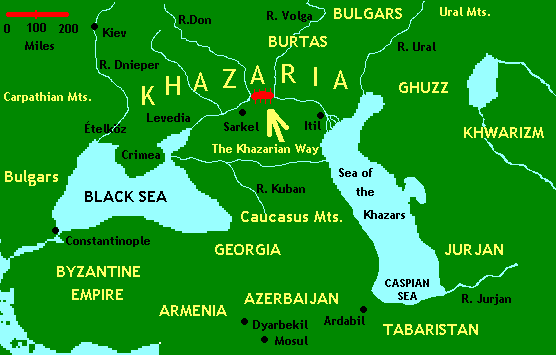
Eastern Christianity, known as Orthodox Christianity, was forced to adopt a Western or Catholic Christian story of the nature of the Son of God. The Orthodox or Eastern version of the story was associated with the Kabalah and the Old Testament, which texts likely had their origins in Jewish of Khazaria http://www.oocities.org/tmajlath/khazaria.gif . Needless to say, the Eastern Christian story of the Son of God differed considerably from that of the Western story. In the Eastern story, the king of Eastern Christianity is burnt by the traitorous Byzantine Emperor Alexius I at the Hippodrome in Constantinople about 1118, whereas the Western story was pure theatre and spectacle.


The community movement led by Hitler took advantage of Western Catholic bureaucracy’s (The Habsburg Empire was Catholic and centered in Vienna, Austria) antagonism toward the Jews, and subsequently identified the movement with Italian fascism, which took its name from a bundle of fascio (hazel) sticks as disciplinary tools.


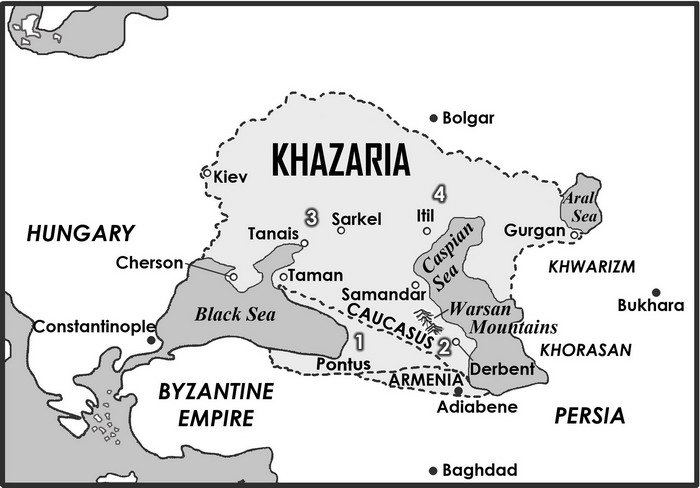
Community building by Lenin and Stalin took an opposite tac, when it found its enemy not in the Orthodox priesthood (though it killed thousands of priests), but in the tsarist oligarchy, its sympathizers among the Russian bourgeois, and a peasantry (Kristi-yan) that had risen to a ‘kulak’ http://www.britam.org/pics/KhazarEmpire.jpg  status.


What was missed by Lenin, Stalin, and Hitler was that neither the ‘community’ of the Germans nor Slavs identified with industrialized workers community. What the proto-Revolutionary and disintegrating community wished for was an organic community, the one they and their forebears had had for centuries, except it had become demoralized by those seeking wealth and progress as the only way to overcome the repressive princes, boyars, and barons.


As everyone knows, Stalin’s Soviet Union and Hitler’s Reich did not fulfill the dreams of the community movement, but the community movements in Europe and Russia (aided by American capital) met with a catastrophic defeat instead.


The answer for the causes of this defeat is indeed to be sought in Western capitalism, which built itself on the idea of a ruthless exploitation of our planet’s natural resources and made a huge investment in advertising and evangelizing militant capitalism. Additionally, defeat of the community was facilitated by the fact that none of the community leaders and no one in their bureaucracies or churches came to think that the rebuilding of a community requires of the leadership an ultimate self-sacrifice and that its goal is a subsistence, not capitalist, economy. The leadership of the community then and now remains all too attached to its own well being.

Wednesday, May 15, 2013

Eso’s Chronicles 166
History As Parabox (9)
© Eso A.B.

The West—and by now the East as well—are constructing our civilization from the glaze of a superego. This process has a life of over a thousand years. The Superego is a creature that is not alive, but is an icon of icons, a negative “artifice of eternity” (W.B. Yeats) created by governments during our historical period best described as a parabox https://www.youtube.com/watch?v=evmonek8_bw.

The icon of icons, the monster which the populations of Earth sees when waking in the morning and going to bed in the evening are not images ordinary artists dare to portray. The only ones - who successfully portray the superego are untutored and naïve teenagers https://www.youtube.com/watch?v=q3I7Et9lG2g .

We may wish to ask ourselves why the Western Superego echoes back to the West as a Japanese monster or Godzilla?

The answer is surprisingly simple: the Western Superego is a monster because the wise men of the Western world project it by means of an ineffective word. The wise men of the West speak of love, of love thy neighbor, of love thy neighbor as thyself. While such love may happen in the secrecy of private life, it never happens in public life. Why does love not project itself in the public light?

Here the answer becomes complex. The Japanese child when born, comes into the world and is immediately put into a Zen Budhist straightjacket http://www.youtube.com/watch?v=sKHvPkGqfuU . A child born in the West is, to the contrary, put in a straightjacket inside a babel of words https://www.youtube.com/watch?v=__AhDt9TA_Q , and the result is about the same as that of Zen: a blank mind before mind came into existence, but once in existence, it immediately goes into overdrive.

For example: Because ‘loving my neighbor as myself’ may also mean that I love myself to such a degree that when I see my neighbor suffer and endure a life that I am sure that I would not want to endure, I express my love by killing myself in protest over his-her suffering. That is to say, by my death I hope to cause the creator of the cause of my neighbor’s suffering to desist from causing him-her and me further pain. Nothing could be more direct and plainer.

Of course, the creator of pain may (and usually does) ignore me and simply shrugs shoulders. At which point another person may intercede, both, on mine and my neighbor’s behalf. However, if such an intercession has no results, then there begins a game of chess grounded on the premise that my neighbors, who see my sacrifice as ineffective, form an attitude of rejection of the individual who causes the pain and orders (in the name of sanity) such an individual expelled from the community. If the expulsion of the violent one is rejected, and to the contrary initiates further aggressive behavior from him-her, then physical punishment (up to capital punishment) may be in order.

It is at this juncture of self-sacrifice unto death and capital punishment for daring to disregard the dictates of the superego that the battle over the kind of civilizations we live in ensues. Will humankind decide that civilization henceforth will proceed according to law, which is backed by capital punishment, even the outbreak of war, or will capital punishment continue to be exercised—until the enforcer of the ‘love thy neighbor’ civilization declares him- herself willing to sacrifice his-her life to put an end to that civilizations nonsense?

The last is best illustrated by imagining Stalin, the heir of the Soviet Revolution, announce that he will leave his post of “General Secretary of the Central Committee of the Communist Party” by dying a sacrificial death. Had it occurred to Stalin to do so, he would most likely have had a chance to continue the Revolution by popular demand no less. In this instance, none who had suffered as a consequence of his leadership could argue that he had endured less sacrifice than the public.

The survivors of the Revolutionary ordeal would be proud over having been privileged to be part of the Revolution; provided, of course, that Stalin was followed by a leader equally dedicated to leadership through self-sacrifice. Several post Stalin names come to mind: Khrushchev, Gorbachev, Yeltsin, Putin; also the Pope, Dalai Lama, Billy Graham, Jerry Falwell, Xi Jinping, etc.

Unfortunately, self-sacrifice has fallen out of favor. Elsewhere, I have suggested that its disregard is traceable not only to personal fears of death or cowardice, but to the imposition on the mind of a meme of fear https://www.youtube.com/watch?v=pO70ZjZ0wrw , which for obvious reasons holds self-sacrifice in low esteem. One such fear is the fear of death itself.

When and how the fear of death began is now beyond tracing. However, it is not difficult to imagine that it may be the result of fear of torture and death by slow torture.

Some will protest that fear of death is natural to consciousness itself. This raises the question of whether a fearful consciousness is not a consequence of deliberate emotional unbalancing and a deliberate creation of schizophrenia http://www.mayoclinic.com/health/schizophrenia/DS00196 . Such a fear may result when a safe environment is destroyed and causes one to discover one’s self unprotected. An illustration of this exists in Genesis 3:7, where Adam and Eve not only discover themselves naked, but where their condition is aggravated by a description of nakedness as sinful. Instead of nakedness causing Adam to get an erection and fondling Eve and Eve tempted to pet the erection and her fondler, they try hide from each other, because both are a priori enlightened that too much ‘multiplying’ will lead to overpopulation and murder. Because the implanted sense of guilt becomes so great, neither Adam nor Eve dare imagine themselves playing games in which ‘penetration’ is avoided as a matter of a radically different perspective on sexual enjoyment.

Perhaps sometime in the future when the fear of death is overcome, we will be able to engage our minds in discovering how it came about. At this time, however, it will suffice to point out that not all human beings have been fearful of death at all times. For example, at the Hindu festival of Juggernaut http://en.wikipedia.org/wiki/Juggernaut , pilgrims are known to have sacrificed themselves to this God of relentless forward movement of their own will and without anyone urging them to do so.

At the same time, there should be no doubt that the neo-Christian-led cult of fear of death was in the early days of the cult enforced by the execution of the practitioners of self-sacrificial death. True, the neo-Christians justified their actions by claiming they were stopping child sacrifice, for which I agree there is no justification. However, there are no studies of whether the sacrifice of children, animals, and prisoners was perhaps not begun at a time when an older civilization had come under attack of an age cynical about the nature and purpose of death, and sacrifice of others than one’s self was a consequence of a later and secondary cause.

Such an attack on death is traceable to an age that preceded neo-Christianity or was somehow conflated with it. Re: “The pre-Christian religions of the Germans and Celts conflated capital punishment with human sacrifice. Criminals condemned for different classes of offenses were sacrificed to different gods by different methods, among which were drowning, hanging, buried alive and the sword (Ward 1953). A similar differentiation is visible among the executions that are such a prominent feature of British and European history: hanging for commoners, beheading for nobles executed for treason, and burning alive for heretics and witches.”*

Still, death as a key personal freedom is vociferously denied by governments addicted to life in the post natural urban desert. This is illustrated by an article by Sally Quinn in the Washington Post of May 11, 2013 http://www.washingtonpost.com/national/on-faith/the-dalai-lamas-compassion-disconnect/2013/05/10/076bc91a-b8d5-11e2-b94c-b684dda07add_story.html?wpisrc=nl_headlines .

Ms Quinns question: “Isn’t self-immolation the very antithesis of what Buddhism is about?” speaks volumes on behalf of fundamentalist neo-Christian conceits. It comes with the ID tags of a superego trapped and dead in an inverted parabox.

*Felix Padel, The Sacrifice of Human Being, Oxford, p 368.

(To be continued.)