Showing posts with label populism. Show all posts

Thursday, January 8, 2015

EC 471 Hiermalgamated History
© Eso A. B.
Brusels Sprouts Me in the Head

Hieros Gamos means Holy Marriage, and ‘hiermalgamy’ means a forced or unholy marriage by secular authorities of people to governments through the act of taxation or other violent and unnatural jointings or divorces.

Globalization brings with it a New Age of Slavery. We can see this in all areas where we see an encroachment of the Superstate (the USA, Russia, China, India, and all their hangers on). As Guy Verhofstadt in the interview (click name) wisely insists, he does not wish for a Europe that is a Superstate. Nevertheless, that is what the former Belgian Prime Minister, turned federalist, expects Europeans to accept. He understands that seizing office (sometimes any office) is but a first step in an endless number of steps to ever more offices and greater power. This is the modus Vivendi of our liberal civilization that seldom if ever prosecutes crimes of politicians, government, or bankers.

In recent days the former Prime Minister of Belgium and now leader of the transnational Alliance of Liberals and Democrats for Europe, along with Mario Draghi, head of the European Central Bank, have spoken out with unmistakable deviousness that transnationalizing Europe is not the same thing as federalizing Europe.

If I were the Pope, I would make both men archbishops of The Hiermalgamic Church of Europe (THCE), where every marriage ceremony marries two t r a n s entities until all of Europe sings a love song a la Mario Draghi, and the wedding guests are entertained by ECB cartel hawks raping the doves of European national communities —just as the Federal Reserve in the U.S. is raping the American people. Needless to say, JanetYellen of the Federal reserve makes sure that the college of EU archbishops does not become a sexist institution by pretending she is a Tochter aus Elysium.

In effect, unelected EU officials are so fully immersed in their self-made dystopias that they happily shoot their people’s identity dead (more in next blog) and desecrate past generations all the way back to Adam and Eve, who they leave alive, but chop down the apple tree instead.

As I have argued before, the Industrial Civilization, brought into being by a process of govRmnt centralization, significantly accelerated by science, is due to an illness that I call ‘anaptyxic dystopia’. This growing black hole can only come to an end by inverting itself—not through a physical but a mental process.

The scaffolding that supports our maniacally growing civilization (Russia, China, et al are on its bandwagon) has not yet collapsed. Nevertheless, such a collapse can be extrapolated by anyone who has not yet sworn total loyalty to the Superstate and has not permitted him- or herself to be violently (in this case willfully) hiermalgamated to some Democracy that denies Populism. Today ‘democracy’ is like a cabbage caterpillar eaten inside out by the Paraside Rex larvae of wasps committed to creating ever greater devastation of nature, because unlike the wood and jungle, it cannot offer its own ‘gifts of nature’, except these have become tax debts. Without slaves paying off such debts, the elites would find themselves up sht creek without a paddle. Unfortunately the reality is, that it is the People who today have their heads shoved up a dead end.

If we were to imagine that in fact People are cabbage caterpillars and the elites are wasps (as the American elite have correctly named themselves), then the inventors of taxation have also discovered how the caterpillars will not only feed them, but protect them in a cocoon of their own ignorance, which happens when ‘democracy’ turns in on itself through the simple device of ‘voting’ when to vote has become an act of absurdity and ‘not voting’ should be the rule.

Saturday, April 10, 2010

98 POSTSCRIP (1)

These blogs tend to be a continuum of an idea or thought, which is why—if you are interested in what you read—you are encouraged to consider reading the previous blog and the blog hereafter. Photos: The juices are flowing.Tapping the birch.

The NOT-VOTE as Debt Nullification.

Thomas Jefferson proposed that the states have the right to “nullify” unconstitutional federal laws. Virginia supporters of the Constitution (1788) insisted that the Constitution possess only the powers “expressly delegated” to it. Jefferson included the world “nullification” in his draft of the Kentucky Resolutions of 1798.

The “NOT-VOTE”, an action proposed by this blogger for the upcoming elections in Latvia (October 2, 2010), is a form of citizen opposition to the seizure of the government by a consortium of corporate populists. The seizure is made possible (not only in Latvia of course) by having the courts of law recognize corporations as individuals, giving them the rights of individuals. The corporate “individuals” then create a form of corporate populism, sometimes known as partidocratic democracy. Of course, the corporate populists condemn citizen populism. Indeed, in Latvia the word “populism” has been forced to become a synonym of “chaos”. This is how corporations manage to shift the blame for the chaos caused in Latvian society from themselves to the people.

There is an urgent need for the citizens of Latvia to act on the NOT-VOTE if the destruction of the community of Latvia is to be avoided. The community of Latvia must insure—among many other things—a Constitutional Revision Assembly, which hopefully will fence in the heretofore Conspicuous Consumption free-for-all endorsed by corporate interests, which has brought economic ruin to the country. One hopes it will be replaced with community oriented long-term economic policies.

Not least, a NOT-VOTE by the citizenry of Latvia may nullify the IMF''s and their own government's imposed debt slavery, because a NOT-VOTE constitutes an act by a sovereign people against the ills brought their community by a “foreign body” (be it one of their own or other).

The term “nullification” has a long history. One may argue that a not-voter acts as a member of a jury. Here * is a link to one interesting discussion of the topic.

Below is material for a popular flyer. You are encouraged to forward it to your contacts.


AN INVITATION TO NOT-VOTE
(a translation in Latvian below.)

Not-Voting In Latvia

What Does “Not-Voting” mean? A not-vote means that you vote with your feet and do not visitt the poling station.

Who is organizing the “Not-Voting” campaign? The not-vote is being organized by UPNoVo, United Populist Not-Voters. Everyone who has ever not-voted or thinks so doing in the future is a potential member.

What is the purpose of “Not Voting”? The purpose of a not-vote is to free the people of a corrupt government that has imposed itself on a society and nation by a number of pseudo-legal schemes. “Pseudo-legal” means clever lawyers and politicians twisting the spirit of the law in such a manner as to achieve the opposite of the law’s intent. In the instance of the State of Latvia “pseudo-legal” acts by partidocrats have “stolen the nation” in order to exploit it to their own ends.

How was Latvia stolen from its people? Latvia reemerged from occupation under the Soviet Union in 1991 under the aegis of a movement known as The People’s Front. However, as soon as The People’s Front passed its populist authority to the reconstituted government, government adapted a policy of Conspicuous Consumption as its near- and long-term goal. The new “vision” (never explicitly stated) by government not only fragmented the aforementioned populist movement, but became an occupation force in its own right. The government hid its “vision” of the future behind academic jargon. Conspicuous Consumption became known as “shock capitalism”.

Where is it written that Latvia’s politics is devoted to “conspicuous consumption”? There is no  “written” law, but it functions de facto, that is,

a) it has made many politicians and ex-politicians rich;
b) government has supported MACRO (big) businesses over MICRO (small) businesses;
c) government has sold the people of Latvia into debt-slavery, because it knew beforehand that if it had to be bailed out by the International Monetary Fund (IMF), this would be the result;
d) all the bail out money went to cover the losses of mostly Swedish and Danish banks; nothing went to Latvian business; not only the debtors, but the entire citizenry of Latvia must now pay off the debt to the banks;
e) the government has no real “vision” of Latvia’s future. In fact, it refuses to envision a future, because “conspicuous consumption” suits those in command positions.

What happens if I “not-vote”? In spite of the to be expected arguments by the government to the contrary, the members of UPNoVo (United Populist Not-Voters) may set up assemblies to rewrite the Constitution, discuss and debate the development and long-term goal of Latvia, discuss future public referendums, organize interim government, all this and more aware of the economic difficulties the world is in and is likely remain in for a long time. A different mind-set is necessary if the government of a sovereign people is to enter the future with confidence. Act by “not-voting!” The whole world will be watching.

Because the economic crisis was invited to happen not only by Latvian neo-liberals, but also the International Monetary Fund (IMF), there exists the possibility that upon the establishing of a majority not-vote, it may be possible to nullify the loan (repudiate the debt) accepted by a corrupt government.

UPNoVo, United Populist Not-Voters

* P.S. The following a quote from above link is most relevant to the NOT-VOTER: “Those whose interests lie in maintaining government control of social behavior may argue that the Constitution provides the necessary protection of liberties. But legislative bodies will always confirm the constitutionality of their own acts. And the oaths sworn to uphold the Constitution by judges and public servants have historically been only as good as the power to enforce such oaths. Nor are free elections adequate to prevent tyranny without jury veto power, because elections come only periodically and give no guarantee of repealing the damage done. Additionally, the second body of legislators are likely to be as bad as the first, since they are exposed to the same temptations and use the same tactics to gain office.”


AICINĀJUMS NE-BALSOT


Ne-balsošana Latvijā

Ko nozīmē “Ne-Balsot”? Ne-balsot nozīmē, ka jūs balsojat ar kājām un nepiestājat pie balsošanas iecirkņa. Jūs ne-balsojat.

Kas organizē “Ne-Balsot”? Ne-balsošanu organizē VPB vai ViPoBa, Vienota Populistiska Balss. ViPoBā iederās ikviens pilsonis, kurš kādreiz ir ne-balsojis. Ne-balsotāji ir žūrija, kas vērtē valdības nedarbu.

Kāds ir iemesls “Ne-Balsot”? Dotā brīdī ne-balsošanas mērķis ir atteikties no korumpētas valdības, kura ir iesēdusies valdības krēslā izstumjot no tā sabiedrību. Šī “okupācija” ir panākta ar dažādu instrumentu palīdzību, ieskaitot pseido-juridiku. “Pseido juridika” nozīmē, ka advokātiem un politiķiem tiek dota iespēja izbēgt no likuma gara un izveidot tam kaut ko pretēju. Šī aicinājuma gadījienā “pseido juridisks” akts nozīmē “nolaupīt valsti”, lai to izmantotu savtīgām interesēm par labu.

Kā nozaga Latviju no tās iedzīvotājiem? Latvija atbrīvojās no Padomju okupācijas 1991. g. To vadīja populistiska kustība Tautas fronte. Diemžēl, tikko Tautas fronte atdeva savu populisma mandātu officiālai valdībai, valdība noteica populismu šķēlošu mērķi: Pār-tērēt; tulk. angļu valodā: Conspicuous Consumption. Akadēmiskais žargons pār-tērēšanu slēpa ar vārdu frāzi “šoka terāpija”.

Kur ir rakstīts kā Latvijā valda “pār-tērēšanas” princips? Nav tāds rakstīts likums, bet tas darbojās de facto:

a) tas ir padarījis dažu labu esošu vai bijušu politiķi bagātu;
b) valdība galveno kārt atbalsta MAKRO (lielos) uzņēmējus;
c) valdība ieveda Latvijas iedzīvotājus parādu verdzībā, jo zināja, ka ja būs jāprasa Starptautiskais Valūtas Fonda (SVF) aizdevums, rezultāts būs tāds kāds viņš ir;
d) visa SVF aizdotā nauda tika dota, lai glābtu zviedru bankas, kuras veicināja valsts parādus. Parādi tagad jāatmaksā ne tikai parādniekiem, bet visiem Latvijas iedzīvotājiem;
e) valsts vīzija par Latvijas nākotni kā nav tā nav; fakts ir, valdība ir izvēlējusies “pār-tērēšanu” kā valsts mērķi, un šis mērķis pilnībā saskan ar pie varas esošo partidokrātiju interesēm;

Kas notiks ja es “ne-balsoju”? Neskatoties uz dažādiem valdības pret argumentiem, VPB biedri pārrunās tālāku Tautas Frontei līdzīgu iedzīvotāju organizēšanos, ka piemēram, sasaukt Satversmes pārrakstīšanas konferenci, diskutēt un debatēt par Latvijas attīstību īslaicīga un ilglaicīga laika ietvaros, organizēs pagaidus valdību, un atcerēsies, ka ekonomiskā krīze notiek kā Latvijas, tā pasaules mērogā. Citiem vārdiem, sekmīga ne-balsotāju akcija iespaidos visas pasaules politisko nākotni. Pasaule vēro!

Tā kā ekonomisko krīzi veicināja ne tikai “pašu bālēliņi”, bet arī arzemju bankas (SVF ieskaitot), pastāv iespēja, ka ja ne-balsotāji ir pārliecinošā vairākumā, pastāv iespēja SVF “aizdevumu” apstrīdēt un nullificēt.

Latvijas iedzīvotājiem laiks atcerēties “dziesmoto revolūciju” un izmantot tās garu “ne-balsojot”. Domāsim par pagātni, tagadni un nākotni ar drosmi un pašapzinību. Ziedosim savu drosmi “ne-balsojot” par stagnāciju vai pār-tērēšanas principa turpināšanos.

ViPoBa, Vienota Populistiska Balss
P.S. Sekojošais links šeit  [http://www.isil.org/resources/lit/history-jury-null.html]  (angļu valodā) sniedz saīsinātu vēsturi par žūriju spēju nullificēt likumu. Datora tulkojums ne visai precīzs, tāpēc blogotājs pats mēģina tulkot raksta priekšpēdējo paragrāfu. Nepārprotami, te ir nepieciešams pieredzējis tulks, tomēr jēga ir pietiekami skaidra, lai lasītājs saprastu, ka tikai vara, kura pieķērusies pie likuma radīšanas kā tikai savu tiesību, noliedz žūrijas principu latviešiem. Tā tad, NE-BALSOTĀJI ievērojiet:
“Tiem, kuru interesēs ir uzturēt valdības kontroli pār sabiedrības uzvedību argumentēs, ka Konstitūcija satur [visu], kas ir nepieciešams, lai aizsargātu cilvēka tiesības. Tomēr, leģistratūras vienmēr apstiprina pašas savu aktu likumību [konstitutionalitāti]. Vēsture [pierāda], ka tiesnešu un valsts darbinieku zvērasti ir vienmēr uzticāmi tikai tik, cik likuma garantētājs ir spējīgs zvērastu īstenot. Brīvas vēlēšanas nav pietiekamas, lai novērstu tirāniju, [tādu] kura atsakās no [absolūtas] veto varas, jo vēlēšanas notiek tikai laiku pa laikam un nedod nekādu arantiju, ka tās atcels iepriekš pielaistās kļūmes. Toties, jaunie ievēlētie [varas locekļi] iespējams būs tik pat slikti kā iepriekšējie, jo viņi būs padoti tiem pašiem kārdinājumiem un lietos tās pašas [izvairīšanās] taktikas [kā iepriekšējā vara].
Datora tulkojums: Tiem, kuru intereses atrodas saglabāt valdības kontroli pār sociālās uzvedības, var apgalvot, ka Konstitūcija sniedz nepieciešamo aizsardzību brīvību. Bet likumdošanas iestādes vienmēr apstiprina konstitūcijai savu rīcību. Un zvērestus zvērējuši ievērot Konstitūciju, tiesneši un valsts ierēdņi ir vēsturiski ir tikai tik labi, kā pilnvaras īstenot šo zvērestu. Tāpat arī ir brīvas vēlēšanas pietiekamas, lai novērstu tirāniju bez zvērinātajiem veto tiesības, jo vēlēšanas nāk tikai periodiski un dot nekādas garantijas atcelšanu darīt bojājumus. Bez tam, otrā ķermeņa likumdevēju, iespējams, ir tik slikti, kā pirmajā, jo tie ir pakļauti tiem pašiem kārdinājumiem un izmanto to pašu taktiku, lai iegūtu biroju.

Sunday, April 4, 2010

© Eso Antons Benjamins, aka Jaņdžs

AN INTERMISSION  
97 To Be Continued at Another Time (2)

I     Mythology, when understood to be more than about ghosts, vampires, and dragons is a set of images whose complexity give evidence of having once been a well thought out and well told. The story of Oedipus, re-presented in my blog series “Tiresias’ Revenge” (see blogs 68-81), and my re-construction of “The Story of Clever John and Crazy Jane” (blogs 92-95) give support to the belief that these stories are profoundly spiritual in content. Unfortunately, in both cases, the world dwells on fragments and easily and often misinterprets them as a convenience to forgetfulness.


No doubt, my interpretation of the story of King Oedipus (“Tiresias’ Revenge”) puts emphasis on something passed over by Sigmund Freud’s interpretation. At the same time, the knowledge of how a story can be constructed and deconstructed and constructed yet again—rather than one example being the only example for all times—tells us that many examples may be tried and not always the best model is chosen. The story of King Oedipus clearly bends the plot of the play more to my reconstruction than that of Freud. Sophocles’ version of the play masks some disturbing events in the background that Freud and most everyone pass over.

Both of the aforementioned stories (“Tiresias’ Revenge” and “The Story of Clever John and Crazy Jane”) give an interpretation of The Real that we are not accustomed in perceiving. Most of us know the Real as a Western positivist projection. While the positivist advertisement best points its finger at the Barbie Doll, the Real of Oedipus and Clever John gives evidence that their creators knew how to chop wood. For a king to discover that it is not for having slept with his mother that ten of his family die, but for him not having suffered the risk of sacrifice is devastating. It is devastating for all who trusted the king’s (or government’s) authority. Clever John (clever in the sense of the unhesitatingly using his wit in an invidious manner when opportunity allows) gets taught the priorities of the Sun in no uncertain terms.

It is through the story of Clever John (a story very likely from before the written word) that we discover that proto-Latvians knew what the price of a wagon load of gold was. It was the “Clever Johns”, the  kaupos, who came to replace the itinerant Johns of arch-Christianity. Crazy Jane became crazy because Clever John could not be trusted though it cost him the spectacle of the lights going on just in time to discover that in return for a wagon full of gold, he has the pleasure of making love to a straw doll.

The people who formed the Latvian governmentwhich followed the “singing revolution” and exposed Latvia to the shock treatment of neo-liberal economic policies, betrayed the people and the state of Latvia by seizing it for conspicuous consumerism. One may argue that they neither knew nor understood better, and were mere kaupos on behalf of neo-liberalism. Ought they to not know now? There is no evidence that they do. The recent appearance of a group that calls itself “The Meierovic Group for Progressive Changes” (whose initial members count 43 prominent names) proves that the fault is not only with the government, but the intelligentsia of Latvia. Perhaps it is mute; perhaps it does not exist, though it is mentioned frequently as if asserting it makes it so.

Describing itself as “non-political”, the Meirovic Group has announced that its members are “…ready to give their time and energy to make of Latvia a dynamic, self-aware and honorable 21st century Western nation” (re Press Release of 21-3-2010). Are they joking? Does not the word “Western” represent—implicitly and explicitly—a political orientation?

If before the disintegration of the Soviet Union and with it the orthodox Left in the West, one could argue that “West” (or Western) was a word that contained both the Left and the Right political wings, today this is no longer true. Anyone who follows politics today knows that politics has been captured by money that favors a neo-liberal orientation. True, the latter pretends to be an all embracing “Western” political ideology. But it is unlikely that the members of the “non-political” Meirovic Group do not understand that “Western” has come to stand for the creation and maintenance of weak citizenship. What else is the Latvian government, but a bought off conspicuous consumer partidocracy making a gross spectacle of itself with the “positive” political support of its corrupt self? The Latvian people stand outside this glass bowl with but one orange fish in it and watch the fishy wiggle its tail as a form of reform.

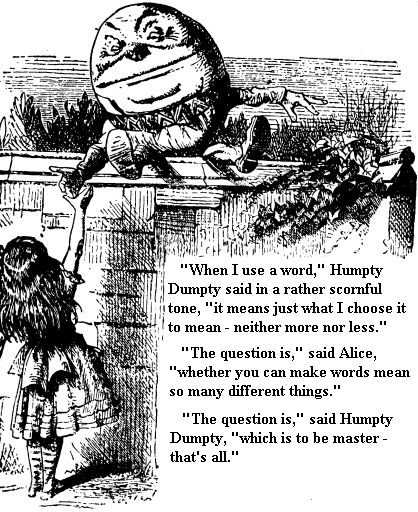
The Maeirovic Group asks citizens to be “demanding” and suggests that this demandingness will metamorphose into a demand for schools and health care. Have the Latvian people not been demanding this all along, but have been yoked by their government to debt and tax slavery and banks instead? The political winds of today blow people not toward benign globalization, but toward more neo-liberal exploitation of the politically weak and uninformed populations said to believe in something the government and its cronies call “populism”. The “growth” of the consumerist Humpty Dumpty goes on uninterrupted even in a crisis that is as permanent as the war on terrorism by “democratic” and “freedom (loving)” consumer nations. Even Alice (in Wonderland) knows that Humpty Dumpty falls off the wall; not so, it seems, the said Meirovic group.

II    It would have been politically more neutral for the Meierovic Group to say that it stood for an East-West neutral 21st century nation. This evidently did not occur to the group. Why not?

The answer is only a guess, but the ones who should have questioned the politics of a “non-political” group should have been those with links to the “old left”. The Maeirovic Group does have members with such links. However, apparently these members stand for that particular “left” which has no ideas of its own and finds primitive accumulation an apolitical act. In short, the Meierovic Group sees the war currently being waged on the behalf of and to further the cause of Conspicuous Consumption as an end in itself, and of course as destined to win. Therefore, so the logic goes, why oppose “Western” political ideology which is a Winner from the word go? Did not the so-called Cold War happen between the Soviet Union and the West? Did not the “West” win and provide proof of a successful depolarization of politics?

What the Meirovic Group does not say is that the “West” unambiguously supports Conspicuous Consumption with the military forces of NATO. Only a decade after the fall of the Soviet Union, the symptom of Conspicuous Consumption broke out in an acute event, which we know as “9/11”. A group of young people, saturated by, with, for, yet unaware that they had been poisoned by the bacillus of Conspicuous Consumption, motivated by jealousy (and angered by delay in the instant gratification promised in televised soap opera ads), they attacked one of the financial centers of the West. For all its paradoxes, it was a chronal moment. The events ocultated (sorry; a new meaning to the word ‘occultation’), occultated in such a way that paradoxes met, shorted, and something humongous happened: the sick unknowingly retaliated on those who made them sick more profoundly than they had dared imagine. [For backup of this hypothesis of the new polarization see “Afflicted Powers”, Verso, 2005, by Retort, a group of San Francisco Bay area that describes itself as “antagonists to capital and empire”. An interesting read; see Ch 5 & 6 to be sure.]

The crisis of Latvia is that of a community without a purpose, dreaming of conspicuous consumption, financially poor, psychologically adrift. The present Latvian government (a partidocracy controlled by businesses wholly committed to conspicuous consumption) sells conspicuous consumerism to the people without reservations, because the government emerged from under the Soviet yoke as a political a tabula rasa. A moment after this reconstituted entity rid itself of the inspired romanticism of “liberty” explicit in the “singing revolution”, it instantly morphed into a failed imagination. The imagination fails the Meierovic Group. This does not mean that its surreal presentation of itself as “not a political party” does not continue the romantic notions of the “3rd Awakening” of Latvia. Indeed, it does continue it. However, this suggests that the crisis which the group perceives and of which it is born is more serious than the group knows. This will present the group or whatever may emerge from it with either a strategic failure, i.e., a continued preoccupation with a fake present, or the emergence of the only alternative—a revolutionary act.

As this writer has suggested many times, one such revolutionary act (or, if you will, not-violent terror—see blogs 1-81) is a “not-vote” in the upcoming elections in Latvia in October. Unlike the pean of peacemakers: “They declared war, and no one came”, which is far too soon to predict to be soon doable, ‘not-voting’ is doable. The members of the Meierovic Group have not only the potential talent and influence to carry off the act, but to prepare for its success (of which there is a good chance) by preparing forums for the necessary debates, conferences (to rewrite the Latvian Constitution for one), and install a temporary government while the house of Latvia is debated over and put in order. This kind of effort will surely be worth joining and its growth will send chronal echoes through all political spectrums of the world.

P.S. Spring is icumen in. I write this on the 30th of March, 2010. The cranes, storks, geese, and starlings returned a day or two after the spring solstice. The first butterfly was seen at a local cemetery—as one rose, but the other went from being a point to becoming a wave as the holographic model of the universe suggests. Immersed in an affliction known as ‘lack of time’, I take an intermission to do other necessary things. From time to time I may return with yet another Postscript. I hope the readers found the above essay interesting enough to back up to the early blogs, even back to the beginnings. The build-up through all that boring stuff was necessary to erase the orthodox and calcified image of both “ancient” and more “recent” (proto-)Latvians and create the beginnings of an alternative.

P.P.S. For all those of you who did not care a wit for any of my blogs, I send you herewith the greetings and “apologies” of Clever John and Crazy Jane. See here. I have a feeling that you will want to see this twice.

Last but not least: a link to a workshop of “How to start a populist NOT-VOTE movement” or
any-other-such and to “"Eso's Chronicles" for a philosophical trump over the usual “a Not-Vote is Sin” sweats (see blogs 96 & 97 to get the idea): It is the only way for people to recover the State.

Asterisk & Notes of Interest
On material deprivation in Latvia.
On the theme of “more-equal-than-others” see George Orwell's "Animal Farm".  
A recommended read: “The Theory and Practice of Oligarchical Collectivism” by Emmanuel Goldstein (A book within a book from George Orwell's "1984".)  
Of interest to me is this  (news on the California elections to legalize Johns Grass) and this article (coca politics in Bolivia). The articles express some of my reasons for supporting the growing of Johns Grass in Latvia.
Interesting material  relating to Johns.
A provocative and stimulating news-analysis-opinion site (from someone very American): http://emsnews.wordpress.com/  
……………………………………………………..
These blogs tend to be a continuum of an idea or thought, which is why—if you are interested in what you read you are encouraged to consider reading the previous blog and the blog hereafter.

Partial entries of my blogs may be found at LatviansOnline + Forum Home + Open Forum –ONLATVIANPOPULISM vs LATVIJASLABEJIE. If you copy this blog for your files, or copy to forward, or otherwise mention its content, please credit the author and http://esoschronicles.blogspot.com/ 

Friday, December 4, 2009

© Eso Antons Benjamins


NOT-VIOLENT TERROR
61 The People of Johns (V)

In his book “On Populist Reason”, Ernesto Laclau analyzes the role and connectedness of populism and the “people”, and comes to a conclusion that ought to be of interest to Latvians today. Laclau writes: “…the political operation par excellence is always going to be the construction of a ‘people’.” Later in the same paragraph, the professor gives his conclusion as to what gives populism its important role. He writes: “Firstly, there is the widening of the discursive-strategic operations that the construction of the ‘people’ requires…. [Secondly,] any new ‘people’ would require the reconstitution of the space of representation through the construction of a new frontier.”

It may be difficult language for the uninitiated, but the message to the Latvian ‘people’—whose heterogeneous equivalences (whatever at that time) were shattered by the Soviet occupation and imposition of hegemonic workers paradise—is to make an effort to emerge from the October, 2010 elections with a new sense of itself as a ‘people’. At this writing, there does not however exist any “widening of the discursive-strategic operations” required for heterogeneous interests to emerge. On the other hand, the yeast of pent up anger among the post-Soviet Latvian people is rising, hopefully will energize, and certainly gives hope for an emergence of a post-Latvian Latvian people.

Coining the term ‘post-Latvian Latvian’ may not be a concept that many post-Soviet Latvians will find agreeable. But to consider it and its implications they must, because the political system that has imposed itself on Latvia is not of the ‘people’. That is why we hear the drumbeat of unwavering condemnation of ‘populism’ by government and from the patriots who are patriots of government rather than of the people. Apparently, the sense among the political elite is that it is on firm ground, and the traditional media and “politologues” are obedient and in tow behind it. I think that it remains to be seen if this is true or make-believe.

I mentioned in preceding blogs that following the destruction of the kingdom of Jersika (?-1209), there have been three-four different political eras during which the Latvian people were real, but which reality was never to manifest itself in a politically homogenous social entity commonly known as ‘people’. If the replacement of the totem of Johns (sons of the Sun) with Bear-Jaw-Breaker (in the 1888-1905 period) was perhaps indicative of a subjective consensus among the ‘people’—[potentially another Zionist style state in the making (?)]—the consensus broke apart after the heavy losses (9000 Latvian, 45,000 Russian soldiers) on the front during and after the Christmas battles of 1916 (old calendar) near Riga. The aftermath contributed to the fall of tsarist Russia in 1917 and significantly changed the political landscape in Latvia. For one, the Russian Revolution and bloody civil war made it easier for many patriotic Latvians to turn nationalist (i.e., Zionist; rather than envision greater independence within a Greater Russia) and turn its eyes toward the West.

It was for this reason that the liberal democratic Latvian state that emerged after WW1 was too polarized between liberal and socialist forces to provide the rainbow of equivalences from which a new democratic homogeny of the Latvian people could emerge. The Constitution of the state was written in haste with no provisions for a review in the years following. Instead, the parties that became part of the Saeima soon began to metamorphose into parties with business interests at their core—as is the case with the Saeima today. In short, the Constitution failed to protect the people of Latvia from a partidocracy that favored an oligarchy oriented lumpenproletariat twice.

The failure of the Latvian Constitution to protect Latvians from exploitation by the post-Soviet oligarchs is distressing, because almost all business interests today are MACRO business interests with a degree of access to money that makes it believe it can overwhelm society at large not only in the economic arena, but in the political as well. That the lumpenproletariat of business managers and board members feels confident that it can continue to overwhelm the people is evidenced by the recent reemergence of the former Prime Minister Shkhehle (Šķēle)   whose [pseudo-]Peoples Party (Tautas partija) under the leadership of another Prime Minister, Kalvītis, was at the wheel of government at the time of Latvia’s economic collapse.

Though the People’s Party (Tautas partija) only a month ago had only 2% of support from the public in opinion polls, Šķēle apparently now feels confident that he can overcome his party’s unpopularity with money of his own, from the pockets of allied interests, and a vote from a dumbed-down impoverished population. Since his reemergence, TP’s approval rating has risen to 5.6%. Šķēle clearly expects to make his points by using the carrot and stick approach, i.e., I promise to improve the economy, but only if you vote for me. Else? If you do not vote for me, there will be no development of the economy along the lines of MACRO business, which will bring hundreds of jobs. As for MICRO business, it creates jobs only one or two at a time, and takes time and devotion to develop. Besides, there is no longer such work available as the Children of Johns once engaged in: weaving, inn keeping, harness and rope making, spoon carving, tailoring, acting as healers, and the like. So, vote for “Maximum Goodtime” and the party that rocks to MACRO music—even if it is more than a little stale.


Asterisk & Notes of Interest:

Information on emigration figures.

On the theme of “more-equal-than-others” see Orwell.

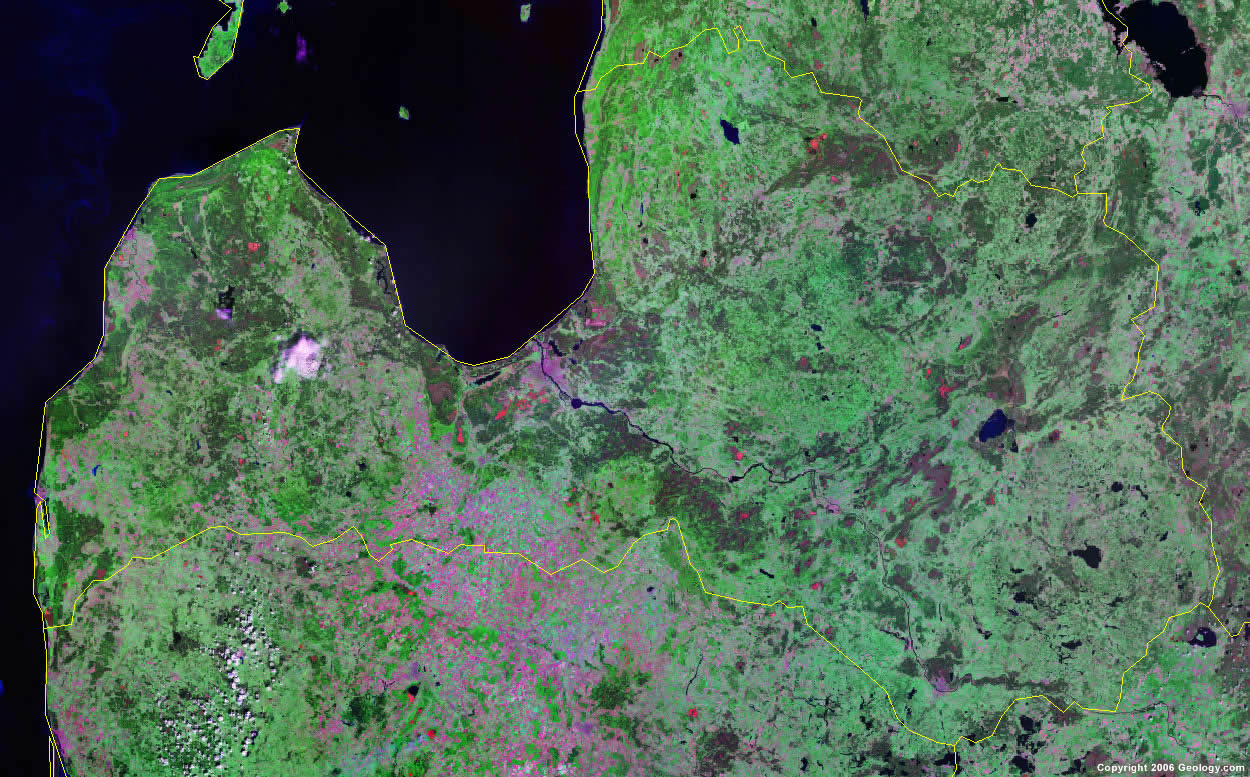
An eyeball view of Latvia (and its forests) company mapsatellite. While some sources claim that Latvia is 47% covered by forests, none of it is old growth forest. The Latvian news media provides little coverage of the rapid pace of deforestation. Anecdotal evidence of deforestation in progress from a neighbor: “There were fewer mushrooms this fall than last year. Forests we used to visit are gone.”

If we substitute the word “trees” for “gold” and make the words synonymous, then “trees” come to stand for the “gold” of Latvia. If we then read Ayn Rand’s words from her book “Atlas Shrugged”, but substitute “gold” with “tree”, Rand takes us to a very interesting conclusion: “Whenever destroyers appear among men, they start by destroying money, for money is men's protection and the base of a moral existence. Destroyers seize gold and leave to its owners a counterfeit pile of paper. This kills all objective standards and delivers men into the arbitrary power of an arbitrary setter of values. Gold was an objective value, an equivalent of wealth produced. Paper is a mortgage on wealth that does not exist, backed by a gun aimed at those who are expected to produce it. Paper is a check drawn by legal looters upon an account which is not theirs: upon the virtue of the victims. Watch for the day when it bounces, marked, ‘Account overdrawn.’” My thanks to site and author here.

Of great interest to me this and like articles. It presents some of my reasons for supporting the growing of Johns Grass in Latvia. The Teutonic Knights of yesteryears and the neo-Christian politicians of today have all conspired to destroy native Latvian sacred traditions. The micro farmers of yesteryears’ countryside have been removed from the land in favor of macro farmers, thereby destroying the main function of the countryside—a good place for subsistence businesses and raising children, the latter the native culture’s nature tested self-replenishing human stock. Without Johns Grass to attract tourists to the Latvian countryside to substitute for the income lost due to deforestation, the human stock will continue its precipitous decline. Radical steps need to be taken to make all of Latvia (not only a few of its cities) a place where households make their home.

These blogs tend to be a continuum of an idea or thought, which is why—if you are interested in what you read—you are encouraged to consider reading the previous blog and the blog hereafter.

Partial entries of my blogs may be found at LatviansOnline + Forum Home + Open Forum – ONLATVIANPOPULISM vs LATVIJASLABEJIE. If you copy this blog for your files, or copy to forward, or otherwise mention its content, please credit the author and http://esoschroniclnes.blogspot.com/

Monday, November 16, 2009

© Eso Antons Benjamins


NOT-VIOLENT TERROR
55 The Ides of Marx (III)

“November 11, 1918, Germany was compelled to sign the Compiègne armistice http://tiny.cc/7MJVo  with the allies and this gave the opportunity for declaration of an independent Republic of Latvia. Initially, LNDP [Provisional* Latvian National Board, i.e., Latviešu pagaidu nacionālā padome] and the Democratic Bloc [anti-socialist or so-called “citizens” circles] could not agree on the political system to be chosen for the new country - the Social democrats insisted on forming a socialist regime, which was not acceptable to other parties. However, after long debate, on November 17, 1918, LNDP and the Democratic Bloc agreed to jointly form a provisional parliament, the Latvian People's Council (LPC), which resolved to establish an independent and democratic republic. On the following day, on November 18, 1918, based on the previous day's resolutions, the independent Republic of Latvia was proclaimed.” http://tiny.cc/Qg8nD **

However, this is not the whole story. Indeed, it passes over much that is relevant. For one, it completely bypasses the populist point of view—“populism” meaning “the people”***—which is not taken into consideration (in spite of the word “people” being so prominent a part of the council’s name), and by numerous legalistic oversights is excluded from having a say in the Latvian Constitution (Satversme). Note from the quote above: “…Social democrats insisted on forming a socialist regime, which was not acceptable to other parties. However, after long debate, on November 17, 1918, LNDP and the Democratic Bloc agreed to jointly form a provisional parliament….” What happened to the Social Democrats? Did they disappear, capitulate, or accept the point of view of “other parties”?


The Social Democrats refused to join the LNDP when it was founded on 1st of October, 1917. Only ten months after the Latvian troops (strēlnieki) had lost 8000-9000 men during the “Christmas battles” of 1916, the feelings against the tsar’s regime ran high. The loss occurred because Russian troops failed to come to the aid of the Latvian troops, when on December 23rd, 1916, they created a breach in the German lines. The Russian troops (possibly due to demoralization in the ranks and fear among officers to order an attack under such circumstances) failed to take advantage and enter the breach. The Latvian troops then had to retreat and stabilize the lines to prevent the Germans from seizing Riga during a counterattack. Because of the huge losses during these battles, the mood of the troops and most Latvians in the territories unoccupied by the Germans was against the tsar, indeed, many spoke of overthrowing him.

The “Christmas battles” ended in the middle of January, 1917. The situation in tsar’s Russia continued to deteriorate. Due to the failure of the Russian government to assure adequate supplies for civilians and the military in the capital city of Petrograd (St. Petersburg), the city’s population revolted. On the 27th of February the revolt was joined by Russian soldiers. The tsar abdicated his throne on March 2nd. On the 12th of March, the Latvians of Vidzeme held a meeting in Valmiera (with the regions of Riga, Cesis, and Valka participating) and demanded the new Provisional Government of Russia to dismiss the German Landrat, which heretofore had acted as the local government for the Russians. The Social Democrats played a leading role at these meetings. By the 17th of May the party’s resolution expressing lack of confidence in the Provisional Russian government was seconded by the 2nd Strelski Congress.


By the end of March, 1917, four more Latvian political parties, defining themselves as “un-socialist” (anti-socialist) and “citizen led” (in this instance ‘citizen’ defined as a member of the bourgeois) were formed, but had difficulties defining their working principles and attracting membership. The Farmer’s party was founded in late April, and under the leadership of Kārlis Ulmanis, attracted a membership of 20,000, thus, becoming one of the largest political parties in Latvia.

It must be noted at this point that in Latvia today (2009), the word “socialist” is often perceived—as the following quote shows—as a word wholly negative. “…A person who has not lived through the socialist order and seen its consequences cannot understand it.”***.—Ilga Kreituse, Associate Professor at Riga Stradinu University. http://tiny.cc/DFIpC  (My translation). One must remember, however, that in 1916-1917 socialism was perceived by most people not only in terms of a force willing to overthrow a shopworn tsarist regime, but as hope for the future. Of the terror of violence—which was later coupled with deliberate under education (especially of the Latvian people) under Lenin and Stalin—no one had any inkling.

The answer, biased toward the interests of the bourgeois parties, may be found at this link http://tiny.cc/BCjvX . To quote: “...the efforts of the LPNP [Provisional Latvian National Board--Latviešu pagaidu nacionālā padome] to keep [the big powers] from forgetting Latvian interests had gained recognition [through England’s de facto recognition of Latvia], but at this very moment there appeared disagreements between the LPNP and the Democratic block over the principles of unity. Refusing to participate in any further discussions, the representatives of the Democratic block called a meeting for the 16th of November and on the following day proclaimed itself as the Sovereign Council of the People.... On the 18th of Novermber, 1918, the Sovereign Council of the People proclaimed itself to be a sovereign authority and founded the Latvian nation. (My translation. The test in Latvian at ****)


What the quote still does refuses to spell out (a little of the history here http://tiny.cc/IUnNk  and http://tiny.cc/e6KW9 )  is that the bourgeois parties dismissed the Social Democrats, and ignored the interests of the people in favor of the liberal circles. Under the cover of a renewed German attack and Russian retreat, “The liberal circles among Latvians hurriedly began looking for permanent solutions with regard to the political future [of Latvia], which meant that it was necessary to review all earlier political goals….” (My translation; see quote in Latvian at *****).


One should read the Latvian text (from which the above quote) of Dr. hist. Uldis Krēsliņš with care. The historian’s text is as carefully worded as it is misleading. It should be especially noted that the large vote (67%) received by the Social Democrats and their allies is counterbalanced by by the historian with the world “plašāko” (broadest). How does “largest vote” for one square with “broadest representation” for the other? Quite clearly, the history of Latvia or what passes as Latvia’s history has been smudged by the politics of a government where partidocracy has become a tradition. This is how a legalistic dance of words rather accurate presentation is able to replace a recorded majority with opinionated “breadth”. The practice of disinformation in 1918 is still a practice in 2009. (To be continued in blog 56)

Asterisk & Notes of Interest:

* I am translating “provisional” as “pagaidu”, literal meaning “temporary”. The word could also be translated as “ad hoc”, Latin for “for this purpose”.
** “LPNP centieni lielvaru cīņās neļaut aizmirst latviešu intereses bija guvuši atzīšanu, bet šajā brīdī Rīgā pēkšņi atklājās pretrunas starp LPNP un Demokrātiskā bloka aprindām par apvienošanās principiem. Atsakoties no tālākām sarunām, Demokrātiskajā blokā apvienojušos partiju pārstāvji 16.novembrī sanāca uz sēdi un nākamajā dienā konstituējās par Tautas padomi.” http://tiny.cc/BCjvX
***Populism and “the people”. “Populism is the discussion of the political which constructs and gives meaning to ‘the people’.” –Oscar Rayes, Skinhead Conservativism: A Failed Populist Project. http://tiny.cc/ZPbaHc  
**** Atsakoties no tālākām sarunām, Demokrātiskajā blokā apvienojušos partiju pārstāvji 16.novembrī sanāca uz sēdi un nākamajā dienā konstituējās par Tautas padomi.... 1918.gada 18.novembrī pilsētas 2. teātrī Latvijas Tautas padome, pasludinot sevi par suverenās varas nesēju, proklamēja Latvijas valsti.
***** “…liberālajām latviešu aprindām lika steigšus ķerties pie Latvijas politiskās nākotnes jautājuma patstāvīgas risināšanas, kas, savukārt, nozīmēja nepieciešamību pārskatīt līdzšinējo nacionāli politisko centienu mērķus… ” http://tiny.cc/BCjvX
................................................
On the theme of “more-equal-than-others” http://tiny.cc/RRviK  ; http://tiny.cc/1NFQJ
An eyeball view of Latvia (and its forests) http://tiny.cc/7mSpk  http://tiny.cc/TSghu  The two maps match, but you should look at both to get a realistic sense of the meaning of the “47%” forest cover. The Latvian news media provides little coverage of the rapid pace of deforestation. At this moment, only “lousy” weather and water filled swamps keep the chainsaws at bay. Anecdotal evidence of deforestation in progress from a neighbor: “This fall there were far less mushrooms than last year, because the forests we used to go to are gone.”
These blogs tend to be a continuum of an idea or thought, which is why—if you are interested in what you have read—you are encouraged to consider reading the previous blog and the blog hereafter.
If you copy this blog for your own files, or to forward, or otherwise mention its content, please credit the author and http://esoschronicles.blogspot.com/

Tuesday, November 10, 2009

© Eso Antons Benjamins


NOT-VIOLENT TERROR
53 The Ides of Marx (I)

I had to look twice when I saw the TimesOnline headline: “Vatican thumbs up for Karl Marx ….” I was even more surprised to learn that the headline was telling the truth. The Vatican is engaged in historical reappraisal and making changes in its stance with regard to its former positions on a number of issues. According to TimesOnline:

“L’Osservatore Romano, the Vatican newspaper, said yesterday [10/22/09] that Marx’s early critiques of capitalism had highlighted the ‘social alienation’ felt by the ‘large part of humanity’ that remained excluded, even now, from economic and political decision-making.

“Georg Sans, a German-born professor of the history of contemporary philosophy at the pontifical Gregorian University, wrote in an article that Marx’s work remained especially relevant today as mankind was seeking ‘a new harmony’ between its needs and the natural environment. He also said that Marx’s theories may help to explain the enduring issue of income inequality within capitalist societies.” http://tiny.cc/6jOOf


It is significant that the leader of a major institution with populist tendencies, the “Church”, is changing its mind and has tilted the institution it controls—the Catholic Church in this instance—closer to those who are critical of neo-liberal leadership. The latter has clearly presumed itself to be the Captain of the Universe as it leads the charge towards globalization. Going into opposition is a radical step for the Vatican, because Catholic leadership (ever since its beginnings at Avignon) is responsible for the betrayal of the arch-Christian autocephalic democracy in order to serve the interests of secular princes. It is through the help of the Catholic Church that the princes, the forerunners of the capitalist system, were able to infiltrate into the social fabric of society and weaken its resistance to outsider exploitation. Indeed, the Catholic Church’s dependency on secular leadership for support created the “more-equal-than-others” economic order that rules today.


Nevertheless, if the Catholic Church has the will to turn from rhetorical doubt to seeing in it a major spiritual revelation, it must yet take another step into the populist camp. Such a step must help return “religion” to the days when all Christian Churches were autocephalic organizations, and all Churches knew only of “Johns” of whom Jesus was but one. It was the Catholic Church, whose early popes were the brothers or brothers-in-law of secular princes, who remade the remnant of the Constantinopolitan autocephalate at Avignon into a spiritual organization serving the interests of the princes ruling in the West. [This is why the first crusade to follow the one on the Bogomils of Constantinople (sometimes known also as the Fourth Crusade) was against the Cathars, a holdout autocephalate Church in Lacquedoc, southern France.]


Whether the Catholic Church will take such a radical step, we do not know. Most likely, it will not. However, the events and trends now abroad—specifically the obvious lack of charismatic authority by governments and secular institutions—must necessarily take “religion” in an autocephalos direction with or without the old and shopworn orthodoxies of neo-Christendom joining. The Latvian “Children of Johns”—a religious society once arguably part of the proto-autocephalic churches of central Europe—will necessarily play a role in the return of self-sacrifice in politics. Given the state of ineffectiveness the predominant spiritual condition of neo-Christendom, a return to arch-Christianity cannot be stopped. Neo-Christians can no longer hide that they have been cultivating leadership by rhetoric instead of leadership by example. To put it another way, the return of Jesus as John is inevitable—and that should be the happy news that President of Latvia, Zatlers, brings to the next secretive neo-Christian prayer breakfast when it meets in Riga next year. http://tiny.cc/ZQKeq
In Latvia—the last location of the name of Johns as a populist name and celebration—the “Children of Johns” present the world with an empty signifier ready to receive not only equivalences found among neo-Christians at large, but welcomes equivalences that now operate without self-sacrifice from among all religions.

Elsewhere, I have suggested how the Johns’ Eve Festival on Midsummer Eve in Latvia could remind a community in the throes of dying to its ethnicity to transform the loss into trans-ethnicity, and through such a process become the founder of a homogenous society that is as new as it is old. Jahnis or John will then be free to travel to Germany as Johann and/or Hans, to France as Jean and Joan, to Italy as Digiovanni (Dionysius), to Russia as Ivan and Zhena, to the Spanish-speaking countries as Huan, and may end up in Peru dancing a Huanka. In other words, Johns, pronounced Yahnyi in Latvian, is amenable to imitation and has room to spare for further spiritual evolutions. If Latvians were to choose this path, it could result in the long prayed for “return of Jesus”, not as a supernatural event, but a singular happening, a return of John to the college of Johns.

As Schopenhauer said to the unbelievers: “All truth passes through three stages. First, it is ridiculed. Second, it is violently opposed. Third, it is accepted as being self-evident.”

On Old Europe, Marija Gimbutas http://tiny.cc/Zz07V  ; http://tiny.cc/K6pJj   


On “New Chronology” [of History.] Anatoly Fomenko http://tiny.cc/JJnHw

On the theme of “more-equal-than-others” http://tiny.cc/RRviK  ; http://tiny.cc/1NFQJ

An eyeball of Latvia (and its forests) http://tiny.cc/7mSpk  ; http://tiny.cc/TSghu  The two maps match in showing the forested areas, but you should look at both to get a realistic sense of the meaning of “47% forest cover”. The Latvian news media does not provide coverage of the rapid pace of deforestation on a routine basis. At this moment, only the “lousy” weather and water filled swamps keep the chainsaws at bay—somewhat.

These blogs tend to be a continuum of an idea or thought, which is why—if you are interested in what you have read—you are encouraged to consider reading the previous blog and the blog hereafter. This is the 55th blog of a continuum, more or less.

Like all authors, I would like to be paid for what I do, however, the machine that would charge you a quarter for clicking all day or a dime for a one-time click has not yet been invented. Therefore, if you copy this blog for your files, or to forward, or otherwise mention its content, please credit the author and http://esoschronicles.blogspot.com/  

Friday, November 6, 2009

© Eso Antons Benjamins

NOT-VIOLENT TERROR
52 A Floating Dead Fish (IV)

(Continued from blog 51)

The fear of Latvia losing brainpower and labor to emigration is nothing new. http://tiny.cc/P29Sg  Social disintegration in Latvia, especially the countryside, is happening partly because of the many people looking for greener pastures abroad. The demoralization of the country speaks for itself through daily news. As for personal safety, everyone hopes for the best, some may install alarms to be heard a kilometer or more away, and some are discussing how best go to each other’s aid when such an alarm goes off or the neighbor calls for help by mobile telephone. Were such an emergency to arise, the neighbors will have agreed beforehand to come see if everything is as it should be.


Just recently, television news spoke of armed gangs of youths robbing, beating, even killing elderly farm people. Last year, not far from where I live, a man who had sold his cows (the dairy industry in Latvia is collapsing) and was suspected to have the money from the sale at home was killed. Police in the countryside is a legal matter, not a practical factor. The police highway patrols make highly visible raids especially at the end of the month to beef up the budget, but not much more. People who live in a village nearby express fear of unruly gangs of village youths congregating at night hours at a local bus stop. The youth have no nothing to do during the weekends especially. I have seen many walking around drunk. The lights on the street of the village go out at 10 p.m.


Meanwhile, everyone knows this is not the bottom of the bust. While most people realize that the economic crisis is world wide, the Latvian government receives the lion’s share of the blame. It should. Whatever the happy talk on television news that village choirs will continue to receive government support, and that the nationwide Song Festival every five years, a tradition since 1864, will go on, fact is that over the last twenty years, countryside culture of Latvia has collapsed from the “minimum” during the Soviet rule, to a “deficit” under Latvia’s own government. With the absence of communally known songs, which incidentally first made Latvians conscious of themselves, homogeneity disappears. Sure, the Latvian media has been telling its audience how the Suits (Suitu) http://tiny.cc/EOEGm  received support from the EU as a culturally unique community. Only in the event this were true for every “novads”, i.e., municipal jurisdiction would could this be considered good news. [One person to consistently note the demise of Latvia is Alvis Hermanis, the Latvian theatre director: Latvija līdz ar Latvijas laukiem šobrīt aiziet nebūtībā. KF 10/16-23/09, p. 5] Few people I suppose the following link http://tiny.cc/DgxQ9  may inspire some and they will see in it future possibilities—if only more folk songs were to be so recast, the effort consistent, and people took to it. However, from another point of view, it is a goodbye to songs with roots reaching back centuries on a most jarring note.


So, here is the question of the day: Might not a reevaluation by Latvians of themselves and their situation be worth the pain that comes from looking at one’s self and community honestly? If the “soft” death sentence of a slow but certain demographic extinction is to be accepted by the people, their populist sense demands—at the very least—that the sacrifice of the people bear fruits that are worthy of transmission. Such a people’s transmission to a Latvia without Latvians must include the Latvian imaginary abroad. Does anyone know what such a Latvian sourced abroad looks like? For me, it is the world of Johns and the “Children of Johns” who once upon a time were part of everywhere on the European landscape, and who still belong there. This is why, in spite of the discomfort that self-examination may bring, the Latvian populists may discover the ghosts of the whole world joining them, because not only Latvians, but everyone who is in his-her right mind knows how necessary it is to reevaluate the premises on which our civilization operates. Moreover, the “Children of Johns” may be the ones who put religion back in the populist movement with a paradigm that is a demand’s demand: Get neo-Christendom to release Jesus from the “heavenly” prison it has made for him, and let him come back to live among the Johns again.


The resurrection of Populism from rhetorically induced sleep—sand blown in the eye by way of advertisements announcing another ‘Sale’ in yet another Consumer Heaven—is occurring as I write. Today consumerism once projected and sold as “good news, no longer projects convincingly and the “good news” of advertising falls flat. A naked reality is seeping into the consumer voluptuary and disturbing its dreams with the homeless sleeping on sidewalks.


Latvians outside the circle of the partidocratic democracy ensconced in Saeima know with what devastating effect a morally irresponsible “leadership by example” can affect a people’s psyche. The leadership by example, no doubt, is still taking its example from the “historical victor’s” point of view, which according to Dr. Martin Grahl, minister of the German community in Latvia, has mutated and become a “voracious capitalism united by a sense that the system cannot be changed”. (My translation from another blogger’s translation into Latvian.) http://tiny.cc/t3uaN  Those who know German, may read the original here: http://tiny.cc/OEBHw

Recently some men dug a crater in Mazsalaca, LV intending it to look like the crater of a meteor. I do not know who told about it to the media, but for a day or so, everyone was wondering whether this was a hoax http://tiny.cc/A4jk7  or for real. Perhaps there was also a reason for the hesitation. If the meteor was for real, then it would be one more piece of evidence, it was a brick off the gate of Heaven. http://tiny.cc/HgEYZ  [Everyone here is waiting for the year 2012 to arrive and see if the Incas were right and a major cycle of some kind will end, the end of the world perhaps.] However, because there was no meteor, but a mobile telephone company seeking to bring attention, we may be forced to reconsider. The thought may come that the End Of The World will not come with a Zoom and a Bang, but finds us with a government of our making that is indifferent to whether we go naked as a wolf child.

These blogs tend to be a continuum of an idea or thought, which is why—if you are interested in what you have read—you are encouraged to consider reading my blogs before and blogs hereafter. The following links reflect a little to how I see matters stand. http://tiny.cc/TEqkH  ; http://tiny.cc/eanvb  ; http://tiny.cc/CJMtG

If you copy this blog for your own files, or to be forwarded, or its content is otherwise mentioned, please credit the author and http://esoschronicles.blogspot.com/

Tuesday, November 3, 2009

© Eso Antons Benjamins


NOT-VIOLENT TERROR
51 A Floating Dead Fish (III)

On the 31st of October, the newly founded "novads" of Aloja, now a constituency of several former "pagasts", came together for a "Citizens Forum" and listed what in their opinion were some of the most important issues for the new jurisdiction. The photos are of the Citizens Forums event in Vilzehni. About fourteen people were in attendance. Those attending split into small work groups. After listing the issues they believed to be important, the participants viewed what issues had been listed by other work groups.  Foto's by Agnese Sietinsone.

(Continued from blog 50)

It would be a mistake to see populism as some kind of a political party. It is not a political party, because it is much more. Unfortunately, in Europe, where parliamentary rather than direct democracy is the norm, dismissal of populism as a notion of cranks is common. However, there are times when populism becomes the enemy of all political parties, and parties become irrelevant to the steps people are struggling to make to break loose from the embrace of status quo, such as is currently holding the reigns of power in Latvia. http://tiny.cc/2zeWw 

Populism is a genetically charged creature within a social body forever struggling for economic equality. This is because populism is rooted in human nature, while society other than the family is always an artificial construct and therefore virtual. Populism is of course also struggling for other things, too, but economic equality is the one desire all humans share in from the moment they seek their mother’s breast.


This is why food riots usually are the first signs of populism stirring. Van Gogh’s painting “The Potatoe Eaters” comes to mind. The second most common populist stirrings used to come from oppressed landless peasants. If in the first instance the cause of a peasant revolt was oppression by their local barons, the second most common cause is the distant city. The city dwellers directly or through the policies of government become “more-equal-than-others” over today’s farmers. With the unemployment rate of such cities as New York reaching 10% (with unofficial guesstimates reaching as high as 17%), one can see why food prices in cities matter a great deal. On the other hand, for how long will government keep to policies that encourage people to leave the countryside for the city? In an age where home computer may establish links with just about anyplace in the world, is not the city—as manifest by New York—outdated and kept afloat by government policies robbing the world of resources, the farmers of a living, and our civilization of a future?


A legitimate government is tied to its ability to persuade the people that such economic inequalities as have been accepted to make life more comfortable for larger-than-life communities are not for anyone’s personal benefit. The people are always interested to know if potentially parasitic elements are successfully checked before they become parasitic. However, when a parasitic element takes over the government—as it has in Latvia—the people lose their trust in government and feel that their sovereign being—which they have attached to their larger-than-life-community, Latvia—is threatened. It is then that the ground beneath the soles of everyone’s shoes goes soft and becomes slippery.


Given today’s political and economic situation in Latvia, the country has an opportunity to return to the most natural constituency—the smallest social unit—that nature provides humankind with, i.e., mother and child. Or is it the abandoned child? Can there be any other cause for Latvia’s precipitous fall (anyway you turn it) than an absence of moral intelligence in government? Moreover, what is the cause of this corruption? Is it partidocratic permissiveness (visatļautība) become a tradition? Is the partidocratic democracy of Latvia, controlled by business, taking advantage of being “more equal-than-others” by means of “holes” in the laws that allow the government to dumb down the country more than it already has?


By accepting an economic imbalance among members of the community (the nation if you will), with such differences as may arise (whether the result of administration expenses, programs that educate people up rather than down, and others), the community assures itself a future worthy of study and remembrance even after millennia. It is in the interests of a community that originates in the people to encourage and provide the people with an education that teaches how to sustain the community’s gains by exercising not-violent means. Not least, only a not-violent community can justify the trust intelligence has put in human behavior.

Today, many factors that govern the life of a more-than casually created community have broken down in Latvia. It is not uncommon for mothers in Latvia to abandon their children, sometimes fortunately only temporarily, while they seek a job in some other country. This is especially happens when children are born to a single mother when she is or was in her teens. A year or two after the birth of her children, the young woman finds the horizon receding from her dreamscape (usually made-by-advertising), and she becomes aware of a larger social landscape. It is then that the young woman may realize that in an urban society fortune can still be sought by means of sexual attraction. In one such case known to this writer, a young woman with three children has married a man in England, who is there from a Muslim nation. Of the three children that she left behind in Latvia, one is with his father, another child (father said to be unknown) has been adopted, while the third (father also unknown) is growing up at a state run orphanage. If by some lucky circumstance such families sometimes reconstitute themselves, the damage done to the children is incalculable. Indeed, such children become natural enemies of the state, at best indifferent to it. Were populism to recover its voice and influence, all these children could be joining those wishing to unseat the monopoly government serving the “more-equal-than-others” partidocratic democracy in power in Latvia.

The political situation in Latvia is in the danger zone. If there is little danger of violence [one does not see a social body of sufficient mass (remember that Latvia is in a demographic death spiral)], danger comes, nevertheless, to social instability, safety, and what increasingly looks like an irreversible collapse of the credibility of the post-Soviet “reconstituted” government of Latvia. The top five levels in the illustration that I provided by the top, re ttp://tiny.cc/2zeWw   are in the process of collapsing. If the reader will take a closer look at the picture, the “we eat for you” layer (5th down) layer is the first to go, thus taking all of those above it with it. The dead fish that W.C. Fields mentioned, re blog 49, still floats down river. Where are the fish that will swim upriver?

These blogs tend to be a continuum of an idea or thought, which is why—if you are interested in what you have read—you are encouraged to consider reading my blogs before and blogs hereafter. The following links reflect how I see matters a little more subjectively. http://tiny.cc/TEqkH ; http://tiny.cc/eanvb ; http://tiny.cc/CJMtG

If you copy this blog for your own files, or to be forwarded, or its content is otherwise mentioned, please credit the author and http://esoschronicles.blogspot.com/