© Eso Antons Benjamins
NOT-VIOLENT TERROR
61 The People of Johns (V)
In his book “On Populist Reason”, Ernesto Laclau analyzes the role and connectedness of populism and the “people”, and comes to a conclusion that ought to be of interest to Latvians today. Laclau writes: “…the political operation par excellence is always going to be the construction of a ‘people’.” Later in the same paragraph, the professor gives his conclusion as to what gives populism its important role. He writes: “Firstly, there is the widening of the discursive-strategic operations that the construction of the ‘people’ requires…. [Secondly,] any new ‘people’ would require the reconstitution of the space of representation through the construction of a new frontier.”
It may be difficult language for the uninitiated, but the message to the Latvian ‘people’—whose heterogeneous equivalences (whatever at that time) were shattered by the Soviet occupation and imposition of hegemonic workers paradise—is to make an effort to emerge from the October, 2010 elections with a new sense of itself as a ‘people’. At this writing, there does not however exist any “widening of the discursive-strategic operations” required for heterogeneous interests to emerge. On the other hand, the yeast of pent up anger among the post-Soviet Latvian people is rising, hopefully will energize, and certainly gives hope for an emergence of a post-Latvian Latvian people.
Coining the term ‘post-Latvian Latvian’ may not be a concept that many post-Soviet Latvians will find agreeable. But to consider it and its implications they must, because the political system that has imposed itself on Latvia is not of the ‘people’. That is why we hear the drumbeat of unwavering condemnation of ‘populism’ by government and from the patriots who are patriots of government rather than of the people. Apparently, the sense among the political elite is that it is on firm ground, and the traditional media and “politologues” are obedient and in tow behind it. I think that it remains to be seen if this is true or make-believe.
I mentioned in preceding blogs that following the destruction of the kingdom of Jersika (?-1209), there have been three-four different political eras during which the Latvian people were real, but which reality was never to manifest itself in a politically homogenous social entity commonly known as ‘people’. If the replacement of the totem of Johns (sons of the Sun) with Bear-Jaw-Breaker (in the 1888-1905 period) was perhaps indicative of a subjective consensus among the ‘people’—[potentially another Zionist style state in the making (?)]—the consensus broke apart after the heavy losses (9000 Latvian, 45,000 Russian soldiers) on the front during and after the Christmas battles of 1916 (old calendar) near Riga. The aftermath contributed to the fall of tsarist Russia in 1917 and significantly changed the political landscape in Latvia. For one, the Russian Revolution and bloody civil war made it easier for many patriotic Latvians to turn nationalist (i.e., Zionist; rather than envision greater independence within a Greater Russia) and turn its eyes toward the West.
It was for this reason that the liberal democratic Latvian state that emerged after WW1 was too polarized between liberal and socialist forces to provide the rainbow of equivalences from which a new democratic homogeny of the Latvian people could emerge. The Constitution of the state was written in haste with no provisions for a review in the years following. Instead, the parties that became part of the Saeima soon began to metamorphose into parties with business interests at their core—as is the case with the Saeima today. In short, the Constitution failed to protect the people of Latvia from a partidocracy that favored an oligarchy oriented lumpenproletariat twice.
The failure of the Latvian Constitution to protect Latvians from exploitation by the post-Soviet oligarchs is distressing, because almost all business interests today are MACRO business interests with a degree of access to money that makes it believe it can overwhelm society at large not only in the economic arena, but in the political as well. That the lumpenproletariat of business managers and board members feels confident that it can continue to overwhelm the people is evidenced by the recent reemergence of the former Prime Minister Shkhehle (Šķēle) whose [pseudo-]Peoples Party (Tautas partija) under the leadership of another Prime Minister, Kalvītis, was at the wheel of government at the time of Latvia’s economic collapse.
Though the People’s Party (Tautas partija) only a month ago had only 2% of support from the public in opinion polls, Šķēle apparently now feels confident that he can overcome his party’s unpopularity with money of his own, from the pockets of allied interests, and a vote from a dumbed-down impoverished population. Since his reemergence, TP’s approval rating has risen to 5.6%. Šķēle clearly expects to make his points by using the carrot and stick approach, i.e., I promise to improve the economy, but only if you vote for me. Else? If you do not vote for me, there will be no development of the economy along the lines of MACRO business, which will bring hundreds of jobs. As for MICRO business, it creates jobs only one or two at a time, and takes time and devotion to develop. Besides, there is no longer such work available as the Children of Johns once engaged in: weaving, inn keeping, harness and rope making, spoon carving, tailoring, acting as healers, and the like. So, vote for “Maximum Goodtime” and the party that rocks to MACRO music—even if it is more than a little stale.
Asterisk & Notes of Interest:
Information on emigration figures.
On the theme of “more-equal-than-others” see Orwell.
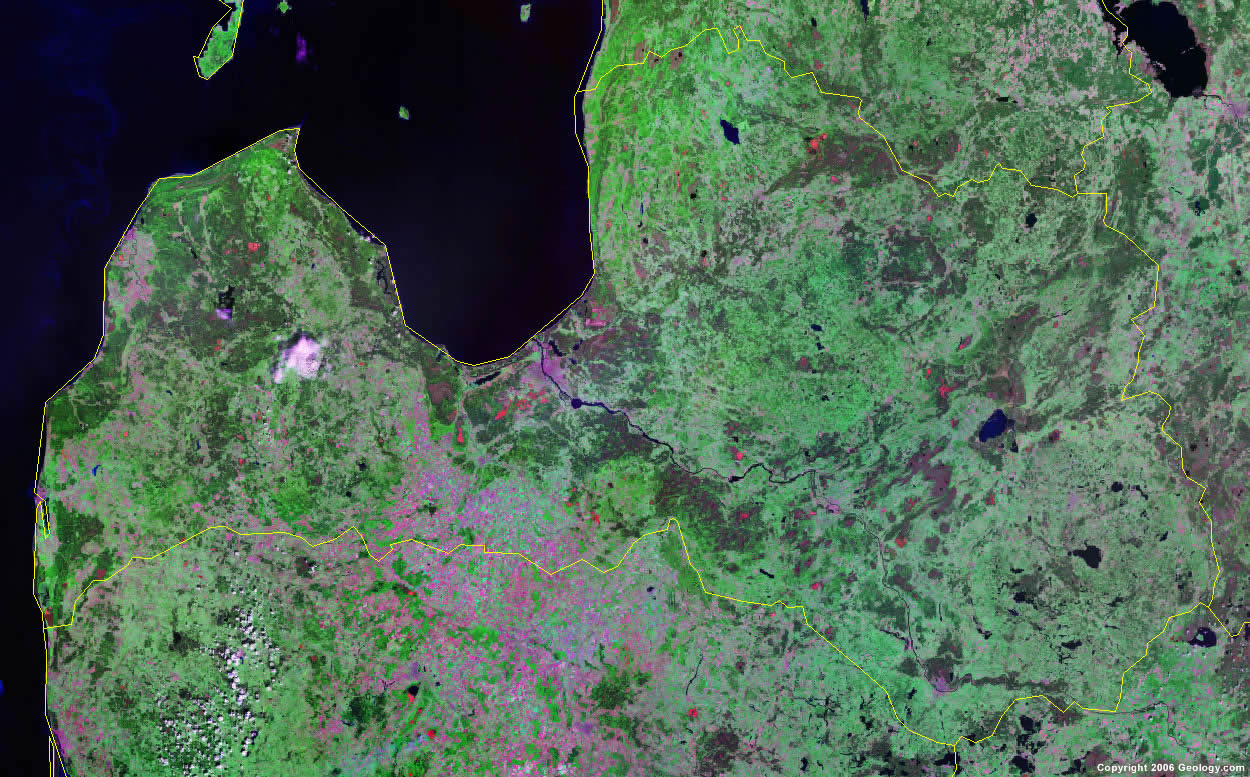
An eyeball view of Latvia (and its forests) company map; satellite. While some sources claim that Latvia is 47% covered by forests, none of it is old growth forest. The Latvian news media provides little coverage of the rapid pace of deforestation. Anecdotal evidence of deforestation in progress from a neighbor: “There were fewer mushrooms this fall than last year. Forests we used to visit are gone.”
If we substitute the word “trees” for “gold” and make the words synonymous, then “trees” come to stand for the “gold” of Latvia. If we then read Ayn Rand’s words from her book “Atlas Shrugged”, but substitute “gold” with “tree”, Rand takes us to a very interesting conclusion: “Whenever destroyers appear among men, they start by destroying money, for money is men's protection and the base of a moral existence. Destroyers seize gold and leave to its owners a counterfeit pile of paper. This kills all objective standards and delivers men into the arbitrary power of an arbitrary setter of values. Gold was an objective value, an equivalent of wealth produced. Paper is a mortgage on wealth that does not exist, backed by a gun aimed at those who are expected to produce it. Paper is a check drawn by legal looters upon an account which is not theirs: upon the virtue of the victims. Watch for the day when it bounces, marked, ‘Account overdrawn.’” My thanks to site and author here.
Of great interest to me this and like articles. It presents some of my reasons for supporting the growing of Johns Grass in Latvia. The Teutonic Knights of yesteryears and the neo-Christian politicians of today have all conspired to destroy native Latvian sacred traditions. The micro farmers of yesteryears’ countryside have been removed from the land in favor of macro farmers, thereby destroying the main function of the countryside—a good place for subsistence businesses and raising children, the latter the native culture’s nature tested self-replenishing human stock. Without Johns Grass to attract tourists to the Latvian countryside to substitute for the income lost due to deforestation, the human stock will continue its precipitous decline. Radical steps need to be taken to make all of Latvia (not only a few of its cities) a place where households make their home.
These blogs tend to be a continuum of an idea or thought, which is why—if you are interested in what you read—you are encouraged to consider reading the previous blog and the blog hereafter.
Partial entries of my blogs may be found at LatviansOnline + Forum Home + Open Forum – ONLATVIANPOPULISM vs LATVIJASLABEJIE. If you copy this blog for your files, or copy to forward, or otherwise mention its content, please credit the author and http://esoschroniclnes.blogspot.com/
Showing posts with label Ernesto Laclau. Show all posts
Friday, December 4, 2009
Saturday, October 24, 2009
© Eso Antons Benjamins
NOT-VIOLENT TERROR
48 Latvians demand
As we see from “Tiresias’ Revenge” (blogs 40-47), Oedipus is the main personage in a play-story about the whence of political authority. The mother and son relationship that is featured so prominently in the West because the relationship includes a sexual relationship as well, is but to illustrate that in a spectrum of relationships this is also possible. More important, however, is the fact that when Anyone (in this instance Oedipus) is born into a cultural space that allows anyone to become President, the consequences will be catastrophic unless the President in return for his privilege to office, sacrifices his-her life to secure for the next President the trust necessary to govern the country (Thebes-Latvia).
Oedipus’ failure to understand the reasons for the plague that is haunting Thebes brings on the plague with increasing intensity, particularly in his own extended family relationships. Because of Oedipus failure to risk sacrifice and as a result of ignoring arguments that claim the indispensability of self-sacrifice, twelve deaths take place. The deaths are of
1. the baby who is left in place of Oedipus on Mt. Citheron;
2. King Laius, unknowingly killed by Oedipus, but the clash most likely arranged by Iocaste, wife and mother;
3. King Laius’ bodyguard who witnessed the King’s killing—murdered arranged by Iocaste;
4. the king of Corinth, probably poisoned by Merope, his wife, upon her concurrence with Iocaste’s suggestion;
5. Tiresias, the seer, probably killed by Iocaste’s hirelings;
6-7. Otus and Ephialtes, the sons of Iocasta and Oedipus, twins, dead by each other’s hand;
8-9. Antigone, Oedipus’ daughter, and Haemon, son of Creon, poisoned by Creon;
10. Creon’s wife and Haemon’s mother, Eridike;
11. Iocaste, Oedipus’ mother and wife;
12. Oedipus.
The story can be further restructured after these deaths, by having the new king, Creon, marry the surviving queen of Corinth, Merope. The reemergence of Ismene, the one survivor of the clan, can only occur after Creon and Merope are dead, too. Ismene, of course, symbolizes the ‘people’—whatever it is they emerge as after their continued exploitation (think of the sacrifice of children) by the Sphinx who contrary to impression never went away.
In blog 39, I wrote on the failure of the “more equal than others” group to lead society successfully, because though our civilization originated in an assumption that all human beings are economically equal, the group would remain more equal among the members of its club than outsiders would want it to become. Since perfect economic equality is an assumption that cannot be realized in society (outside the family circle) without self-sacrifice, that is to say, without a maturing of the individual into one who takes charge of his life including his death, society cannot be created except through violence. This is to explain why the “more-equal-than-others” group rules through violence.
Just a few days ago, I saw the following statement appear on a site on the internet: “We have to tolerate the inequality as a way to achieve greater prosperity and opportunity for all,” said Brian Griffiths of Goldman Sachs. http://tiny.cc/RRviK As tolerated as this truism may be when the balance is guaranteed by a self-sacrificial Sacred King, the Latvian government has sent the majority of the people of Latvia into poverty by having put the leadership of the country into the hands of corporations. Thus, we arrive at a unique period for Latvia: a time when the people may again experience themselves as a “people”. Of course, there is no guarantee that this will happen, but in a way this experience is overdue, because the Latvians sacrificed themselves last during the “freedom fights” (brīvības cīņas) at its foundation in the last days of WW1. (Alas, the sacrifices by Latvian legionnaires in WW2 are tainted because of an possible association with the Waffen SS of Hitler’s Germany.)
The post-Soviet “reconstituted” Latvia arrived for the Latvians on a silver platter in what we know as “the singing revolution”. The sentimentality of this positivist slogan is but one propaganda tool that the “more-equal-than-others” economic group holds over the public. With all due respect to the several people who were killed by Omon and all those who participated in the “days of the barricades” (1991), theirs was an affirmative ritual, but in retrospect of insufficient awesomeness to assure that Latvia become a heterogeneous society except by way of government advertisement.
The corruption of government is so extensive and destructive of Latvia as a place that is more than a geographical location, flags warning of cultural disintegration are appearing everywhere. While the government keeps talking of Latvia as a place for and of a people, the people hear the rhetoric, but feel a lack of commitment on the part of government (no lack of evidence of this), which, in turn, creates the feeling of a lack of “something”, a lack of fullness, a lack of an identity. Because the government is not able to find for itself another definition than a surrogate of business corporations (very understandable given who controls the government) and business is now suffering from financial shock (lack of business and money), the possibility of the population discovering or rediscovering or redefining its identity may be in the offing.
As professor of political theory Ernesto Laclau writes in his book “On Populist Reason”: “…the notion of the non-fulfillment of the demand [for ‘fulness’], which confronts it [Latvia] with an existing status-quo [as corporate control]… makes possible the triggering of equivalential logics leading to the emergence of a ‘people’.” [Everything within brackets is of this author.]
These blogs tend to be a continuum of an idea or thought, which is why—if you are interested in what you have read—you are encouraged to consider reading the previous blog and the blog hereafter.
f you copy this blog for your own files, or to be forwarded, or its content is otherwise mentioned, please credit the author and ttp://esoschronicles.blogspot.com/
NOT-VIOLENT TERROR
48 Latvians demand
As we see from “Tiresias’ Revenge” (blogs 40-47), Oedipus is the main personage in a play-story about the whence of political authority. The mother and son relationship that is featured so prominently in the West because the relationship includes a sexual relationship as well, is but to illustrate that in a spectrum of relationships this is also possible. More important, however, is the fact that when Anyone (in this instance Oedipus) is born into a cultural space that allows anyone to become President, the consequences will be catastrophic unless the President in return for his privilege to office, sacrifices his-her life to secure for the next President the trust necessary to govern the country (Thebes-Latvia).
Oedipus’ failure to understand the reasons for the plague that is haunting Thebes brings on the plague with increasing intensity, particularly in his own extended family relationships. Because of Oedipus failure to risk sacrifice and as a result of ignoring arguments that claim the indispensability of self-sacrifice, twelve deaths take place. The deaths are of
1. the baby who is left in place of Oedipus on Mt. Citheron;
2. King Laius, unknowingly killed by Oedipus, but the clash most likely arranged by Iocaste, wife and mother;
3. King Laius’ bodyguard who witnessed the King’s killing—murdered arranged by Iocaste;
4. the king of Corinth, probably poisoned by Merope, his wife, upon her concurrence with Iocaste’s suggestion;
5. Tiresias, the seer, probably killed by Iocaste’s hirelings;
6-7. Otus and Ephialtes, the sons of Iocasta and Oedipus, twins, dead by each other’s hand;
8-9. Antigone, Oedipus’ daughter, and Haemon, son of Creon, poisoned by Creon;
10. Creon’s wife and Haemon’s mother, Eridike;
11. Iocaste, Oedipus’ mother and wife;
12. Oedipus.
The story can be further restructured after these deaths, by having the new king, Creon, marry the surviving queen of Corinth, Merope. The reemergence of Ismene, the one survivor of the clan, can only occur after Creon and Merope are dead, too. Ismene, of course, symbolizes the ‘people’—whatever it is they emerge as after their continued exploitation (think of the sacrifice of children) by the Sphinx who contrary to impression never went away.
In blog 39, I wrote on the failure of the “more equal than others” group to lead society successfully, because though our civilization originated in an assumption that all human beings are economically equal, the group would remain more equal among the members of its club than outsiders would want it to become. Since perfect economic equality is an assumption that cannot be realized in society (outside the family circle) without self-sacrifice, that is to say, without a maturing of the individual into one who takes charge of his life including his death, society cannot be created except through violence. This is to explain why the “more-equal-than-others” group rules through violence.
Just a few days ago, I saw the following statement appear on a site on the internet: “We have to tolerate the inequality as a way to achieve greater prosperity and opportunity for all,” said Brian Griffiths of Goldman Sachs. http://tiny.cc/RRviK As tolerated as this truism may be when the balance is guaranteed by a self-sacrificial Sacred King, the Latvian government has sent the majority of the people of Latvia into poverty by having put the leadership of the country into the hands of corporations. Thus, we arrive at a unique period for Latvia: a time when the people may again experience themselves as a “people”. Of course, there is no guarantee that this will happen, but in a way this experience is overdue, because the Latvians sacrificed themselves last during the “freedom fights” (brīvības cīņas) at its foundation in the last days of WW1. (Alas, the sacrifices by Latvian legionnaires in WW2 are tainted because of an possible association with the Waffen SS of Hitler’s Germany.)
The post-Soviet “reconstituted” Latvia arrived for the Latvians on a silver platter in what we know as “the singing revolution”. The sentimentality of this positivist slogan is but one propaganda tool that the “more-equal-than-others” economic group holds over the public. With all due respect to the several people who were killed by Omon and all those who participated in the “days of the barricades” (1991), theirs was an affirmative ritual, but in retrospect of insufficient awesomeness to assure that Latvia become a heterogeneous society except by way of government advertisement.
The corruption of government is so extensive and destructive of Latvia as a place that is more than a geographical location, flags warning of cultural disintegration are appearing everywhere. While the government keeps talking of Latvia as a place for and of a people, the people hear the rhetoric, but feel a lack of commitment on the part of government (no lack of evidence of this), which, in turn, creates the feeling of a lack of “something”, a lack of fullness, a lack of an identity. Because the government is not able to find for itself another definition than a surrogate of business corporations (very understandable given who controls the government) and business is now suffering from financial shock (lack of business and money), the possibility of the population discovering or rediscovering or redefining its identity may be in the offing.
As professor of political theory Ernesto Laclau writes in his book “On Populist Reason”: “…the notion of the non-fulfillment of the demand [for ‘fulness’], which confronts it [Latvia] with an existing status-quo [as corporate control]… makes possible the triggering of equivalential logics leading to the emergence of a ‘people’.” [Everything within brackets is of this author.]
These blogs tend to be a continuum of an idea or thought, which is why—if you are interested in what you have read—you are encouraged to consider reading the previous blog and the blog hereafter.
f you copy this blog for your own files, or to be forwarded, or its content is otherwise mentioned, please credit the author and ttp://esoschronicles.blogspot.com/
Labels:
Ernesto Laclau,
Kaunas,
King Oedipus,
Latvia,
Lithuania,
Mt. Citheron,
Riga
Subscribe to:
Posts (Atom)