Showing posts with label Riga. Show all posts

Tuesday, January 14, 2014

Eso’s Chronicles 279 / 5
The ‘Knellen’ of EU Nations
© Eso A.B.
All comments appearing within brackets [ ] are editorial in origin.
 
THE LAW AS AGENCY OF LIQUIDATION
 
If in the beginning of what we call ‘civilization’, humankind lived in the wood and was ruled by a dream-King who was never seen except as a fantasy figure in a story, then the King was told about by story-tellers who, more than likely, were travelling herders who travelled for the most part with the seasons, south to north (in the spring), and north to south (in the fall).
 
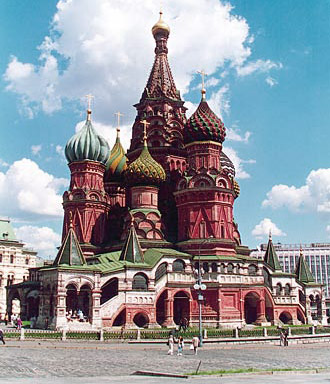
It was the story-tellers who built the first temples, sites where stories were told to such people as had decided to become sedentary and make a living off the wood and its free gifts: animal pelts for dress, meat cured by smoking, and dried berries, mushrooms, and roots, which were later soaked and boiled into a soup in home-made clay pots. One of these early fairy-tale temples, Saint Basil’s (Sacred King) Cathedral http://www.moscow.info/images/red-square/St-Basils-Cathedral.jpg , still stands in Moscow though built at a later date (as a Memorial) and on a much grander scale than early temples in the wood.
 
The early herders of nomadic tribes were called Gens, from which have derived such names as genes, gendarmes and at least a hundred more words. Gens probably meant ‘herder’; in the Latvian language it is pronounced ‘gans’, but gans is still a herder. The many derivatives and cognates of the name are a fact hidden and deliberately overlooked by linguists, who will argue that they cannot see how the same letter G can over time change into other letters J, Ch, Y, H, Gh, V to name a few, and be pronounced differently: Jean, John, j(y)anniseries, Charon, Huan, Ghengis, Vanna (Vanesa), and so on. For this reason, St. Basil’s Cathedral in Moscow, which in direct translation means ‘Sacred King’ Basil, and Basil’s early name was likely John (Ivan, Jesus) the King, ought still be recognized as a symbol for ‘green’ (wood, field, and nature).
 
In any case, these early travelling priests or medicine men were also the first teachers. One ought not to be surprised that it was from these same ‘herders’ that there emerged the first teachers and, indirectly, law makers. These were the ‘wise men’, aka sons of the Sun; traces of this still remain with the Jewish rabbis, if we remember that many centuries ago, many people could not say the letter R and pronounced it as L, thus Rabbi=Labbis, the latter meaning ‘good men’ in Baltic languages to this day, hence “Laba diena” in Lithuanian means “Good day!” In the Baltics themselves, the word ‘labs’ changed to ‘raibs’, which means ‘changeling’ (of colors, many spotted, interesting); the Latvian capital city Riga, was anciently known as Līga, which is a word that stands for alliance and agreement (līgums).
 
In the early days, rabbis were men of the wood and also animal herders who came from many communities. When the days of the dream-King were coming to an end [at about the end-times of the Byzantine Empire (according to Anatoly Fomenko) aka Israel], these same men formed a community of their own ‘good men’. It ought not be surprising that in due course the ‘good men’ came to serve the King as lawmakers and tax collectors.
 
It was at this time that the early stages of later calamitous times were set into place. Though it may confuse some people why this should be so, it makes sense if we remember that the early people of the wood, who governed themselves, kept social order through localized decisions, whereas with the appearance of the King (as an actual rather than a dream entity), there appeared the first steps toward ‘globalization’. This globalization (then known as Catholization) of ‘human rights laws’ had nothing to do with ‘human rights’, but enabled a mechanism that made laws on behalf of kings, princes, barons, and EC commissioners. The post-wood or urban laws were imposed on many communities, which destroyed the earlier local (subjective) decision making mechanisms and unleashed governmental entities that are monstrous when compared to what our forebears believed to be necessary for self-rule.
 
Early opposition to globalized law came from the rabbis or ‘good men’ of the Israelite (formerly Byzantine) community. Almost everyone knows what the globalizers or Reichmahers of Germany did to the rabbis and their communities. The lies told by the Reichmahers remain in force through anti-Semitism in many East European countries, who do not remember—unfortunately—that their own communities of gani, the gens, were repressed and ‘knelled’ by the descendants of Vikings, who settled in Western Europe and now wish to Federalize Europe under a new legal barbarism. http://en.wikipedia.org/wiki/Law
 

Friday, November 8, 2013

Eso’s Chronicles 230/ 1
New Kursk 01
© Eso A.B.
 
The following link by “Battlefields” on the battle of Kursk http://www.youtube.com/watch?v=22xpNBJCS4U  in 1943 is lengthy and leaves something to be desired, nevertheless, it shows how the battle took a long time being prepared by both Germany and Russia. The preparations and their length by both sides are most impressive, not least, because they show that both sides had their apprehensions about coming out on the winners’ side. In this writer’s opinion, another such battle (not necessarily of tanks, which may have become an outmoded weapon) is being prepared for in the Middle East and in the Baltic; in other words, a battle across a very wide front indeed.
 
While I cannot give any actual outlines of the battle to come, I will present its rough outlines and raisons d'être in the next few blogs.
 
Just yesterday there was a news item in the Reuters News Service, that U.S. Secretary of State John Kerry has warned Israel http://www.reuters.com/article/2013/11/07/us-palestinians-israel-kerry-idUSBRE9A60P220131107  that if it does not join the American-brokered peace negotiations in the Middle East, it was likely to be soon facing a Third Palestinian Intifada and other geopolitical problems in the not too distant future.
 
The Secretary of State’s warning comes in the context of a reassessment of recent American and NATO strategies, which likely caused all the Great Powers who form on what was once Pangaea http://geology.csupomona.edu/drjessey/class/Gsc101/Plate.html , the original land mass of our planet, to tickle their nuclear buttons. In other words, Europe, Asia and all the abutting lands, have for approximately a thousand years been facing a concerted Western strategy to occupy the land whence they themselves originally came from. Wishing to shed the spiritual discipline of their forebears, the Westerners decided that they would create a history of their own, albeit a history of fiction, which would allow them to attack the descendants of the powers that remained in charge of their own ancient homelands.
 
In the thousand years or so since the Carolingian kings the divisions and regroupings occurred among the various powers in the Western lands have been many. The original attacks by the West on the East can be identified with the early Crusades, starting about the 11th and 12th centuries of the 2nd millennium. In these attacks only the peripheral borderlands of the East were chiseled from it, and some beachheads captured, notably at the eastern end of the Mediterranean Sea and northeastern Europe.
 
My own country, Latvia, is part of the chiseled part of the East. Originally, the Germans, part of the great migration of the Goths (first as Vikings to the Black Sea region, then as various tribes of Goths backing away toward the northeast of Europe (the so-called Benelux countries), under the pressure of the advancing Turkic tribes or, as some prefer to call them—Huns. In the Benelux area, the Goths split up in three four main branches: the Germans, French, English, and Scandinavians. Latvia, then part of a geographical area known as Livonia, has its origins in the German desire to be independent of French Rule and the burden of French Paris as their capital city. Thus, early German warriors, known as Teutonic Knights, ventured into the relatively sparsely settled wooded lands of the European northeast, and established a city we now know as Riga. Originally, Riga was slated to become the future capital of Germany.
 
Riga was founded in 1201 by cannon Albert of Bremen http://en.wikipedia.org/wiki/Albert_of_Riga, who was elevated to the rank of bishop by his uncle Hartwig archbishop of Bremen and Hamburg. Bishop Albert also founded the Teutonic Knights with whom he subjugated most of the Baltic tribes native to the area.
 
Though seldom mentioned and for political reasons never pressed, one of the reasons for the founding of Riga was to found a future capital city for the Germanic people.  One of the subtitles that Bishop Albert gave to Riga was Jerusalem, which indicates, at the very least, that in his mind’s eye Riga in the future was ‘up there’ with Constantinople and other major cities of the West and East. Again for political reasons, this high status for Riga remains unrealized and is reason why the subject is deliberately muted. Nevertheless, those powers, which have an eye on the future, of Europe as a federated state, retain an interest in Riga as a city founded by Germans. Not least among these are Latvians come under the Anglo-Saxon influence and are linking their future with NATO, which in one way or another is replacing the Teutonic Brotherhood.
 
Russia, too, has a no less greater interest in Riga than the West. To understand this better, we have to remember the trading history of Russia, which begins above the polar circle in Murmansk, moved south to Novgorod the Great, and later--with the building of St. Petersburg—moved even further south. By the beginning of the 20th century, Riga, then still part of tsarist Russia, had become the third largest city in Russia. While today Riga has lost its glory, the recent military maneuvers by Russia and NATO http://www.independent.ie/world-news/europe/tensions-rise-with-russia-as-nato-to-stage-biggest-war-games-in-seven-years-29733358.html  suggest that its geopolitical importance is not being overlooked in the centers of power and is the cause of considerable hubris in government circles of Latvia itself.
 

Friday, December 11, 2009

© Eso Antons Benjamins, a.k.a. Jaņdžs


NOT-VIOLENT TERROR
63 The Future of The Wuerzeltod (I)

When Bishop Albert sent his knights to burn and destroys Jersika, he was hoping not only to destroy a kingdom, but to disembody proto-Latvians who were its inhabitants by burning their idols. If he were to succeed in his endeavor, the exercise would not kill so many people as make those not killed “Wuerzeltod”. Wuerzeltod means, in this setting, a people become spiritually-psychologically dead to their roots, an uprooted people in their own garden. That is how a people can keep their language, but the language loses much of its spirit, which is replaced by, let us say, a foreign object.

Without their idols (cultural objects instilled over the centuries with memories of traditions, which had the power to heal the soul every time some defeat, including illness, visited the people) the Jersiks would be unable to re-embody their bodies with their former spiritual selves. In effect, Bishop Albert hoped to make the Jersiks obedient to him and other lords in Riga. Under Riga’s tutelage [Riga, the new para-normal Jerusalem] the defeated and humiliated Jersiks would be denied the right to repossess their former and own spirits. They would be remade as neo-Christians, i.e., post-Jersika Jersiks become Wuerzeltod to their old spirit as well as spirits.

The burnt idols of Jersika were replaced by various neo-Christian saints, all of who implicitly and explicitly denied their predecessors, the itinerant Johns, existence. Denied, too, were the shamans-healers (dziednieki, literally sing-healers), priests, and all that was sacred to those who—through struggles of many millennia—had created their own vision of Jerusalem*. The Jersiks and all people about were caused to pray to a chronal mirage sent by Rome. The mirage was of the head of a man enveloped by a circle, a halo laid down by goldleaf, which gave it a para-normal appearance. But whereas the Jersiks would have called the icon the head of John (Jānis), Son of the Sun, the man from Rome, the Pope, called it Jesus Christ, Son of God. No doubt, the Wuerzeltod, that is to say, the body with little or no memory of its past, transferred its need for a spirit to Jesus. The process of transference was made easier through many para-psychological tricks, violence being its primary tool. Because Jesus himself had been one of the Johns and was killed by the Brotherbund of Rome, John was reembodied in Jesus by violent conversion, which was then glued to the communal memory through the demand of continuous confession and a written history that never was. Since the art of writing and the art of printing belonged to the powers that be, the Brotherbund was able to force the graft to grow roots.

Given such a background, we now must move forward in our reconstruction of the Latvian myth as it might have moved forward had the making of myth not been forbidden to proto-Latvians. We must return to John Visvaldis, King of Jersika, and ask: Why had the Jersiks followed this leader? What was his magic attraction?

If the Children of Johns in King John Visvaldis’ keep had followed their “John Awesome” [Visvaldis = (literally) Ruler Over Allness, an Allness that is an equivalence not of ‘all’ (viss), but Visums (Allness)], they most likely did so in deference to the not-violent terror the King inspired. Such an inspiration from the King came by way of the King’s forebears, all of who had ended their life at a ripe old age, but which age was ended by way of what the Cathars called the endura. When the Cathar perfecti or priests felt that their hour had come, they called for their descendant-to-be to offer them consolamentum (literally to consol them), after which they no longer took food. The offering of consolamentum was also a form of oath-taking by the one who offered it, that is, he-she swore to uphold not-violent rule in the same manner than the one who was taking the consolance and was departing. When a perfecti died, he transferred to his-her descendant(s) great charismatic authority. Similar practices were in existence among most of the heredici—including (we surmise) the Children of Johns of Jersika.

The neo-Christian brethren were able to destroy the old bonds of loyalty among the Children of Johns because they were in effect aliens. They were not of the culture of Johns, but belonged to what in our own day is known as capitalist culture, a culture that enriches its adherents and not the temple. In due course, the para-normal sheen of gold on the halo of the icon is scraped off and converted to coin.

To be awesome is to inspire no ordinary respect, but to be inspired by terror, not-violent terror. Even if appearing fearless before death may not be all that it seems (all are apprehensive before it), it, nevertheless, has enough traction-terror to prevent a community of which John(s) are the leaders from dissolving into Wuerzeltodness—rootlesness.

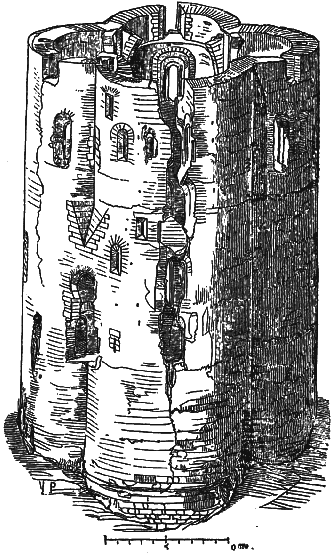
King John Visvaldis was the root, stem, and branch of the Children of Johns. We might say, that the Jersiks, the Children of Johns, were the leaves of the tree trunk that represented the king. Neither leaves could be without the trunk, nor the trunk could be without the leaves. Ideally speaking, if a storm felled a tree, the roots would send forth new shoots, and the kingdom, the stem (or the DonjonDon-Jon, who stands for ‘John of Johns’) would have another go at sprouting and growing into a tree peopled by a society of leaves.

At the same time that not-violent terror created, bonded, and maintained a society, no one who was of it ever forgot that both individuals and society are not immortal. Before immortality immortalized itself upon society with such violence as overcame the Jersiks and has become commonplace in our day, mortality was accepted as a reality of the Great Being itself. This is why a seed was and remains such a wonder. It flies to the winds of fate, and fate finds it another place to root or not. Meanwhile, King John Visvaldis held the community of the Children of Johns together whether the community was in situ or in motion, travelling.


Asterisk & Notes of Interest:

*Jerusalem = Yaroslav. The meaning of this name is hid behind a thick veil, but it becomes easier to decipher if we split the word into yaro + slav. Yaro is somehow related to ‘year’, which may reflect a tradition of an ancient annual sacrifice ritual. In Latvian the word ‘yehrs’ (jērs) means lamb. For ‘slav’ see here and read under Ethnonyms until you come to the theory that the name may once have meant worshippers. In my interpretation the name stands for ‘the lamb of peace’ sacrificed at an ancient ritual invoking peace. Thus, the name ‘Jersika’ in Latvian may once have meant “the land of peace”.

On material depravation material depravation  in Latvia.


On the theme of “more-equal-than-others”, re Animal Farm.
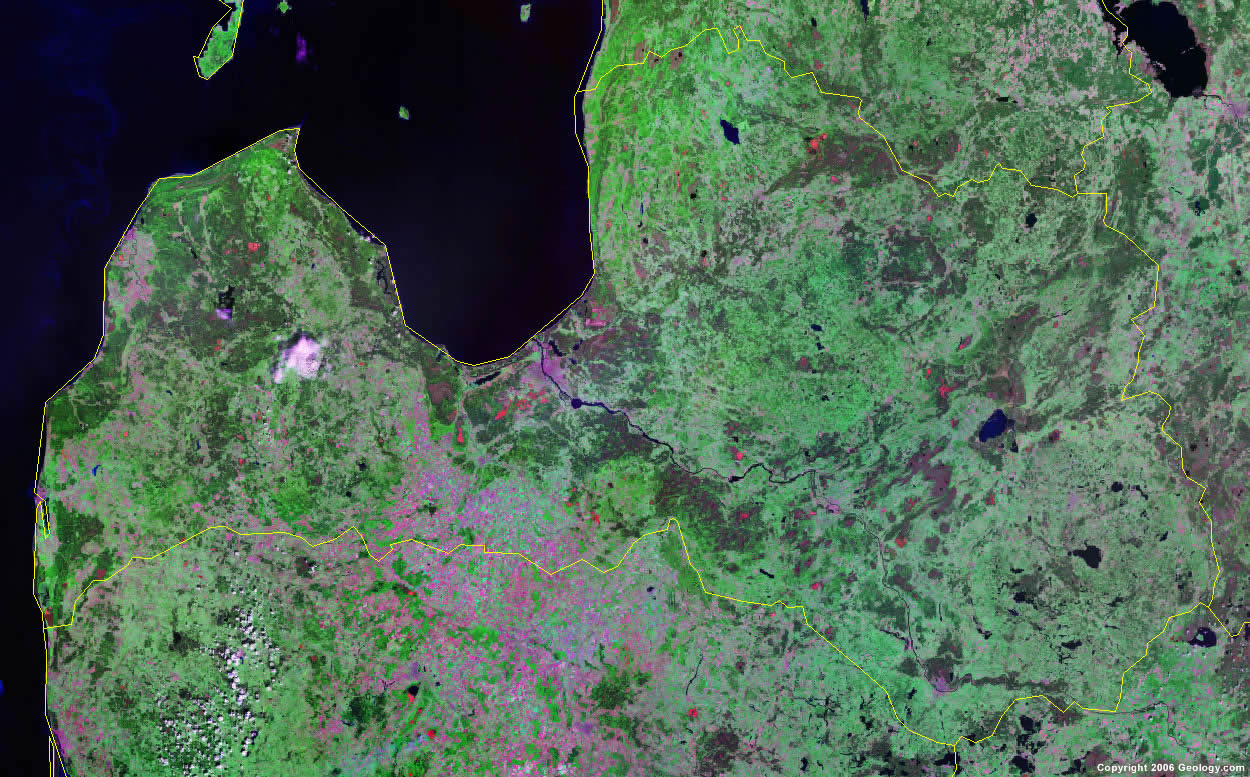
An eyeball view of Latvia (and its forests) company map; satellite map. While some sources claim that Latvia is 47% covered by forests, none of it is old growth forest. The Latvian news media provides little coverage of the rapid pace of deforestation. Anecdotal evidence of deforestation in progress from a neighbor: “There were fewer mushrooms this fall than last year. Forests we used to visit are gone.”

Google software to tell effects of deforestation deforestation

Of great interest to me this and like articles this and like articles. It presents some of my reasons for supporting the growing of Johns Grass in Latvia.

Favored serendipidous click or “chronal mirage” on the internet. I was searching for a relationship between the burning of Jersika and heretics in Lanquedoc, France. You must read the text at near the end of the scroll, re image of “The Burning of St. Joan”, Monday, September 03, 2007, to get the point

My most unappreciated work—so far, re “Tiresias’ Revenge”, my reinterpretation of Sophocles’ “Oedipus Rex”. I believe that Sophocles had to hide the true meaning of his play for political reasons. It is apropos of the political situation in the world today, also in Latvia. The play may be found at Blogs 40 through 47. Start read with Blog 40.

These blogs tend to be a continuum of an idea or thought, which is why—if you are interested in what you read—you are encouraged to consider reading the previous blog and the blog hereafter.

Partial entries of my blogs may be found at LatviansOnline LatviansOnline + Forum Home + Open Forum –ONLATVIANPOPULISM vs LATVIJASLABEJIE. If you copy this blog for your files, or copy to forward, or otherwise mention its content, please credit the author and http://esoschroniclnes.blogspot.com/  

Wednesday, November 25, 2009

© Eso Antons Benjamins


NOT-VIOLENT TERROR
58 The People of Johns (II)

Due to its geography, the territory that is now Latvia has always been in a state of greater or lesser demographic crisis. No doubt, various conflicts and wars have played their horrific role. However, an undeniable role in the shaping of the culture of the Baltics has been played by the land itself. As I remember from a news report a while ago, the current Premier of Russia, Vladimir Putin, is said to have referred to Latvia as a country where one can find only sand and mushrooms. Of course, in a derogatory sense, Putin is absolutely correct, because the third resource, forests, are now fast disappearing. According to some of my neighbors, the mushrooms, too, may be going due to the fast pace of deforestation.

There is some richly fertile land in Latvia, of course. However, most of it lies in the south of the country, and, from what I read, it has been bought up by foreign companies. Where I live, the northern part of Limbazhu region (not far from the Estonian border), the land has only about a foot of rock-thrown topsoil with clay appearing immediately underneath. This condition is due to the scraping and leaching of the land by the retreating ice age and its plentiful water runoffs not all that many thousand years ago. While farmers are exploiting this topsoil to the maximum and claim that the soil has plenty to give yet (“as long as you keep tilling and fertilizing it”), my own sense is that the land is better served if it were left to the forests and humans adapt to a forest environment.

The geography of Latvia pleads that the land be reforested, that the people learn how to build their homes in forests again as of yore, and that the population continue to be sparse—as it always has been.

Such an readaptation to geography, unfortunately, runs against the grain of the privatist mentality that prevails in the wake of 19th and 20th century philosophies that hold that those in power are “more-equal-than-others” and to simplistic Darwinisms such as “survival of the fittest”. Such theology-philosophy was well represented by the current President of Latvia, Zatlers, when on Latvia’s Independence day, he emphasized three things as being of primary importance: “land, people, freedom”. Why the president omitted sacrifice makes sense in the context of the neo-religion that prevails in Latvia today and is enabled by Latvia’s Constitution, the same that was unable to prevent two savagings of Latvian culture and the country’s economy. The first savaging occurred through the offices of the Saeima and the Cabinet of Ministers of the original Republic, the second is officiating today. Within both time periods the prevailing philosophy of government and, if you will, the theology of those in government, did not encourage “freedom” with responsibility, which of course cannot occur without sacrifice.


The final death knell of Latvian culture of old was sounded by the Latvian poet Pumpurs, who in 1888 published a pseudo epic called “Lāčplēsis” or Bear-jaw-breaker. While it has become a convention to call the poem’s pseudo-hero “Bear-slayer”, he is often portrayed as tearing apart the jaws of a bear. Such an image occurs in Luther’s Illustrated Bible (1543), though the figure is ripping the jaws of a lion and his name is Samson. http://www.suite101.com/view_image.cfm/1049463

I do not believe that most Latvians know that the death of their forebears occurred (I am still hoping that it did not occur) in 1209. The year should be famous among Latvians for two reasons.

One. In 1209 (the date may be of questionable accuracy for those who are critical of Scaligeri’s chronology) Pope Innocent III began a Crusade against the Albigensian Cathars in what is now the south of France. It is my opinion that the Cathars were equivalencies or co-existing arch-Christians cells. The auto cephalic ecclesia of Eastern orthodox neo-Christian churches follows this organizational pattern to this day. The Crusade ended in a victory for the Pope. Many of the Cathar perfecti (teachers and leaders) were burned. The significance of burning, incidentally, is that it was believed to wipe from memory the times and ways defended by those burnt.


Two. In 1209 the neo-Christian bishop of Riga, Albert, sent forces at his command against the kingdom of Jersika, which was located in what is now the southeastern region (most of today’s Latgale). Jersika (pronounce Yersika; sometimes written Gercik, Gereike) was a kingdom ruled by a king named Visvaldis. In literal translation, the king’s name means Ruler of All. The king was not prepared for the surprise attack and Jersika was burned to the ground. In 1842, the thirty-six year old Polish poet Michal Borch, possibly of Latgalian extraction, wrote a poem, in which he imagines the defeated king witness Jersika burning. The poetic image is based on Heinrici Chronican Livoniae (“Indrikha hronika”) written in the 13th century.

After Visvaldis is taken across Daugava and sees his burning city on the other side of the river, the king “…took a deep breath and began to weep. He screamed, and he said: Ai, Jersika, my dear city! Ai, the inheritance of my fathers! Ai, the unexpected destruction of my people!...” (My translation.) Visvaldis is taken prisoner, brought to Riga, and publicly humiliated there.*


For an encore, let me offer a variation on the text. “John screamed, and he said: ‘O, Jerusalem, my dear city! Ai, the inheritance of my fathers! Ai, the unexpected destruction of my people!’” Perhaps it is time to think that Jersika may be a colloquialism for Jerusalem. Bishop Albert tried to capture the name and bring it to Riga. It was not uncommon to compare Riga to Jerusalem in the bishop’s days. However, as we know, in our times Riga remains the seat of secular power. If in Albert’s days Riga’s mission was conversion of arch-Christian proto-Latvians to neo-Christianity, today the government is doing all it can to turn neo-Christianity to Pop culture, which is successfully leading Latvians to a post-Latvian future.

I owe the quote and help in making the above One./Two./1209 c.e. association to Kaspars Klavins and his book “apStāvēšana”, Mansards, 2009, p. 80. I find the title of Klavins book almost untranslatable, but perhaps “Defense Of…” will approximate. Klavins speaks, among other things, of the defense of Latvian culture even as it may be disappearing from the stage of history. The book’s author criticizes the cultural ethos prevailing in Latvia today and rings praise in defense of the values proto-Latvian culture in Jersika. Klavins is Assistant Professor at the Daugavpils University and Adjunct Research Associate at Monash University in Australia. I would add that Jersika’s defeat is taken political advantage of by various interests to this day, which is why information of the culture that most likely prevailed in Jersika is repressed to this day. (More to follow in my next blog.)


Asterisk & Notes of Interest:

*“Tāpēc, nododami pēcnieku zināšanai to, kas noticis mūsu laikos, darām zināmu visiem nākamiem un tagadējiem Kristus ticīgiem, ka Dieva lielā žēlastība, joprojām jauno Livonijas baznīcas dēstījumu atbalstīdama un atbalstot uz priekšu virzīdama, pakļāva mums Visvaldi, Jersikas karali. Proti, ieradies Rīgā, klāt esot jo daudziem dižciltīgiem garīdzniekiem, bruņiniekiem, tirgotājiem, vāciešiem, krieviem un lībiešiem Jersikas pilsētu, kas viņam pieder par dzimtu līdz ar novadu un visiem pie šīs pilsētas piederīgiem labumiem viņš nodeva kā likumīgu dāvinājumu svētās Dievmātes un jaunavas Marijas baznīcai, bet tos savus meslu devējus, kas saņēmuši ticību no mums, viņš atbrīvoja un nodeva mums līdz ar viņu mesliem un novadu, proti Autīnas pilsētu, Cesvaini un citas ticībai piegrieztās. Pēc tam, zvērējis mums vasala uzticību, viņš svinīgi saņēma no mūsu rokas minēto Jersikas pilsētu ar piederīgo novadu un labumiem kā lēnu ar trim karogiem.” http://tiny.cc/pYqiX  


On the theme of “more-equal-than-others” http://tiny.cc/RRviK  ; http://tiny.cc/1NFQJ


An eyeball view of Latvia (and its forests) http://tiny.cc/TSghu  While some sources claim that Latvia is 47% covered by forests, none of it is old growth forest. The Latvian news media provides little coverage of the rapid pace of deforestation. Anecdotal evidence of deforestation in progress from a neighbor of mine: “This fall there were far less mushrooms than last year. The forests we used to go to are gone.”


Of great interest to me: http://tiny.cc/HorIT  The article pretty well presents my reasons for supporting the growing of Johns Grass to facilitate the tourist industry in the Latvian countryside.


These blogs tend to be a continuum of an idea or thought, which is why—if you are interested in what you have read—you are encouraged to consider reading the previous blog and the blog hereafter.


If you copy this blog for your files, or copy to forward, or otherwise mention its content, please credit the author and http://esoschroniclnes.blogspot.com/  

Saturday, October 24, 2009

© Eso Antons Benjamins


NOT-VIOLENT TERROR
48 Latvians demand

As we see from “Tiresias’ Revenge” (blogs 40-47), Oedipus is the main personage in a play-story about the whence of political authority. The mother and son relationship that is featured so prominently in the West because the relationship includes a sexual relationship as well, is but to illustrate that in a spectrum of relationships this is also possible. More important, however, is the fact that when Anyone (in this instance Oedipus) is born into a cultural space that allows anyone to become President, the consequences will be catastrophic unless the President in return for his privilege to office, sacrifices his-her life to secure for the next President the trust necessary to govern the country (Thebes-Latvia).

Oedipus’ failure to understand the reasons for the plague that is haunting Thebes brings on the plague with increasing intensity, particularly in his own extended family relationships. Because of Oedipus failure to risk sacrifice and as a result of ignoring arguments that claim the indispensability of self-sacrifice, twelve deaths take place. The deaths are of

1. the baby who is left in place of Oedipus on Mt. Citheron;
2. King Laius, unknowingly killed by Oedipus, but the clash most likely arranged by Iocaste, wife and mother;
3. King Laius’ bodyguard who witnessed the King’s killing—murdered arranged by Iocaste;
4. the king of Corinth, probably poisoned by Merope, his wife, upon her concurrence with Iocaste’s suggestion;
5. Tiresias, the seer, probably killed by Iocaste’s hirelings;
6-7. Otus and Ephialtes, the sons of Iocasta and Oedipus, twins, dead by each other’s hand;
8-9. Antigone, Oedipus’ daughter, and Haemon, son of Creon, poisoned by Creon;
10. Creon’s wife and Haemon’s mother, Eridike;
11. Iocaste, Oedipus’ mother and wife;
12. Oedipus.

The story can be further restructured after these deaths, by having the new king, Creon, marry the surviving queen of Corinth, Merope. The reemergence of Ismene, the one survivor of the clan, can only occur after Creon and Merope are dead, too. Ismene, of course, symbolizes the ‘people’—whatever it is they emerge as after their continued exploitation (think of the sacrifice of children) by the Sphinx who contrary to impression never went away.

In blog 39, I wrote on the failure of the “more equal than others” group to lead society successfully, because though our civilization originated in an assumption that all human beings are economically equal, the group would remain more equal among the members of its club than outsiders would want it to become. Since perfect economic equality is an assumption that cannot be realized in society (outside the family circle) without self-sacrifice, that is to say, without a maturing of the individual into one who takes charge of his life including his death, society cannot be created except through violence. This is to explain why the “more-equal-than-others” group rules through violence.

Just a few days ago, I saw the following statement appear on a site on the internet: “We have to tolerate the inequality as a way to achieve greater prosperity and opportunity for all,” said Brian Griffiths of Goldman Sachs. http://tiny.cc/RRviK As tolerated as this truism may be when the balance is guaranteed by a self-sacrificial Sacred King, the Latvian government has sent the majority of the people of Latvia into poverty by having put the leadership of the country into the hands of corporations. Thus, we arrive at a unique period for Latvia: a time when the people may again experience themselves as a “people”. Of course, there is no guarantee that this will happen, but in a way this experience is overdue, because the Latvians sacrificed themselves last during the “freedom fights” (brīvības cīņas) at its foundation in the last days of WW1. (Alas, the sacrifices by Latvian legionnaires in WW2 are tainted because of an possible association with the Waffen SS of Hitler’s Germany.)

The post-Soviet “reconstituted” Latvia arrived for the Latvians on a silver platter in what we know as “the singing revolution”. The sentimentality of this positivist slogan is but one propaganda tool that the “more-equal-than-others” economic group holds over the public. With all due respect to the several people who were killed by Omon and all those who participated in the “days of the barricades” (1991), theirs was an affirmative ritual, but in retrospect of insufficient awesomeness to assure that Latvia become a heterogeneous society except by way of government advertisement.

The corruption of government is so extensive and destructive of Latvia as a place that is more than a geographical location, flags warning of cultural disintegration are appearing everywhere. While the government keeps talking of Latvia as a place for and of a people, the people hear the rhetoric, but feel a lack of commitment on the part of government (no lack of evidence of this), which, in turn, creates the feeling of a lack of “something”, a lack of fullness, a lack of an identity. Because the government is not able to find for itself another definition than a surrogate of business corporations (very understandable given who controls the government) and business is now suffering from financial shock (lack of business and money), the possibility of the population discovering or rediscovering or redefining its identity may be in the offing.

As professor of political theory Ernesto Laclau writes in his book “On Populist Reason”: “…the notion of the non-fulfillment of the demand [for ‘fulness’], which confronts it [Latvia] with an existing status-quo [as corporate control]… makes possible the triggering of equivalential logics leading to the emergence of a ‘people’.” [Everything within brackets is of this author.]

These blogs tend to be a continuum of an idea or thought, which is why—if you are interested in what you have read—you are encouraged to consider reading the previous blog and the blog hereafter.

f you copy this blog for your own files, or to be forwarded, or its content is otherwise mentioned, please credit the author and ttp://esoschronicles.blogspot.com/    
© Eso Antons Benjamins


NOT-VIOLENT TERROR
47 Tiresias Revenge (VII)

This blog continues a play called “Tiresias Revenge”.

The play runs from blog 40 through 47. I wrote it many years ago using various sources for the text of King Oedipus, all scholarly books as I remember. Who would read this stuff? Yech! Nevertheless, I hope you read it. The people of Latvia and their descendants abroad should find it interesting and pertaining to them. For blogs discussing populism, go to blog 40 or before and following 47.

Scene Five (Continued)

(Tiresias crawls forward.)

Tiresias: Do you, King Oedipus,
really believe that a man untested by fate
has an eye for truth and is worthy to be King?
You may pretend,
but unless you offer
yourself in self-sacrifice,
Latvia will lose respect for truth
and live in a world out of touch.
A plague plagues Latvia,
because of you, King Oedipus.
You killed not only our Gods,
but King Laius, your father, to top it.
To cleanse the world of your crime,
you must offer your life in payment.
You have not done so.

King Oedipus: I rescued Latvia’s children from the Sphinx.
All Latvians are grateful to me.
What do you mean, I killed my father?

Tiresias: You were born,
King Oedipus, son to a king
to be his heir if you had accepted
the sacrificial role of a God.
This is how cities are made and people bonded.
We, even I whose eyes you destroyed—
welcomed and welcome still
your rescue of our children.
But you refused further responsibility.
You have not kept your promises
to keep Latvia a country
that serves its people.
You have no authority over us,
but such as you may coerce from us.
You are no living memorial to your forebears.
I am come to call you
unworthy of such great glory.

King Oedipus: Monster theologian!

Tiresias: Had you survived on the mountaintop,
you would have had claim
to become King Laius’ heir.
Instead, your mother feared for you.
When I carried you to the mountain,
she screamed as one who had near lost her mind.

King Oedipus: You took me to be sacrificed?

Tiresias: As tradition required and
as your father asked me to do.
Your mother insisted I let her watch over you.
I agreed—if she sat naked
and offered herself to the Sphinx
if the Sphinx came and found her pleasing.

King Oedipus: What else?

Tiresias: Queen Iocasta agreed.
There was a storm.
While I dozed, your mother caught you up
and ran to hide in the goatherd’s shack.
She let that buck, then ten bucks strong,
dance his cock over her
not to waken me.
Then they left a dead babe,
whether stillborn or not, I do not know,
in your place.

King Oedipus: What fantasy the blind possess!

Tiresias: The goatherd agreed to pass you on
to this man, the messenger from Lithuania.
He took you to your aunt and her husband,
the King and Queen of Lithuania.

King Oedipus: What is Creon paying you
to invent this story?

Tiresias: When you were twenty,
your mother visited you disguised as a witch.
She had a plan that would
regain for you the throne of Latvia.
You were still young and innocent.
You could not imagine killing your father
and taking your mother to bed.
That is why you fled Kaunas.
Your mother, in Riga,
was overjoyed when she heard.
The two sisters-whores would have
your kingdom for among themselves.

King Oedipus: I do not believe any of this.

Tiresias: After you destroyed the Sphinx’s temple,
you were welcomed to Riga as a hero.

King Oedipus: I killed no man.

Tiresias: You met your father at the crossroad
before you met the Sphinx. Remember?

King Oedipus: Was that King Laius?
That was not my father.
That man had come to trade children.
My trusty guards, not I killed him.

Tiresias: How little you know,
King Oedipus. Listen!
Your mother when young was a courtesan
at an inn in Kaunas.
She knew of many babes whose bodies
were buried under the floors of the whorehouse.
When her sister, Merope, a courtesan, too,
had luck and married King Polybus,
she introduced Iocasta to King Laius.
Merope was infertile—the result of her trade.
But Iocasta bore King Laius a son.
When King Laius wanted to honor Oedipus
and open the way for him to become his heir
by exposing him to the will of our Gods,
Iocasta was horrified.
Perhaps she had babes of her own
under the whorehouse floor.

King Oedipus: You mean to tell me
that failing to take the test cursed me
to kill my father
and marry my mother?

Tiresias: You want to know
what became of the golden wire?
Your mother gave it to you
on the day you married her.
She had it reworked into the very necklace
you wear around your neck this moment.

King Oedipus: Oh horror! Dear Gods!

Tiresias: Before I go to sleep,
I often exclaim:
‘Oh Gods, oh Gods, oh Gods.’

(Tiresias dies. Enter Princess Ismene’s nurse, Iananna. We met the latter when she came screaming for help to prevent Polynices and Eteokles from killing each other. She did not succeed.)

Iananna: The Queen is dead.

King Oedipus: No!

Strophe: Polynices and Eteokles are dead, too.
Creon turned them against each other.
Neither of the twins was tested
on Mt. Cytheron.

Antistrophe: After Queen Iocasta died,
Prince Creon, seized the throne,
declared himself King of Latvia
and married Merope, Queen of Lithuania!
Messengers ran through both kingdoms and
announced King Oedipus mad.
King Creon threw Polynices’ body to the dogs.
This very moment, Antigone, his sister,
is burying what remains of him.

Strophe: I fear for Antigone’s life.

Antistrophe: Fear no longer.
Antigone and Haemon, Creon’s son,
both imprisoned as examples of the sacrifice
Creon was capable of
have taken poison.

Strophe: Eridike, Creon’s wife, is dead.
She took her life to hasten the wrath
of the Gods against her long ago lover.

Chorus: King Oedipus has put out his eyes.
But nothing will bring back those
who died because of him.

(Enter Princess Ismene, the youngest daughter of King Oedipus and Queen Iocasta, with her nurse, Iananna. Princess Ismene is still a child at this point.)

Iananna: You are responsible
for the death of twelve.
Start with the babe to replace you on the mountain.
Your stepfather in Kaunas, too.
He agreed to die (or someone poisoned him),
because he understood
that you had no other exit,
no other way to escape from Riga—
unless you went to attend a funeral.
Will you also sacrifice Gans and Ismene
and make it number fourteen?

King Oedipus: Do not be afraid
of such talk, dearest Ismene.
I am not now nor ever was a monster.
You know the path, Ismene dear,
to the peak of Mt. Citheron.
Let us go there.

Princess Ismene: Yes, father.

King Oedipus: I want you to lead me up that mountain.
We will wait out the night under the stars there.
They say you can see
all of All from there.

(Exit everyone but the chorus and Queen Ismene. The latter—hidden behind a pillar—has been standing stage right from the beginning of Scene 1.)

Strophe: Only life comes easy;
death takes much to do.

Antistrophe: So many dead!
How could it happen?
A mother promised her son more. He got less.
No mother wants her children to call her a liar.
What went amiss?

Strophe: Before Queen Iocasta returned from Lithuania
and threw her witch’s mask in the ditch,
she persuaded her sister, Queen Merope of Kaunas,
to let Prince Oedipus visit Latvia.
The sisters hired armed men for Oedipus’ escorts.
The captain of the guard was in both sisters’ hire.
Iocasta did not tell King Laius of her plans,
but arranged for him to meet her son at the crossroads.
Then the queen told the king (as if an aside):
‘King Laius, I forgot to mention,
I bought some whorehouse children
as sacrifices for state occasions.
A caravan of them is due tomorrow.
Be so good, take ten sacks of grain,
and go to the crossroad to receive them.’

Strophe: King Laius was killed
when he asked for the delivery.

Queen Ismene: I remember the King
covering me with a blanket.
It was a cold night on Mt. Citheron.
In the morning, when I saw my father dead,
I ran terrified to nanny Iananna.
She—as true as the Sun’s warm shadow—
hid me until Creon and Merope died.
I have not visited Mt. Citheron since.
But now the story is told,
you must know—lest plagues come again—
I go there this very hour.
Yahn will keep me company,
come there and come back.


–End of Play—
Finis! Amen!
May the Dearest Goddess be with us.

These blogs tend to be a continuum of an idea or thought, which is why—if you are interested in what you have read—you are encouraged to consider reading the previous blog and the blog hereafter.

If you copy this blog for your own files, or to be forwarded, or its content is otherwise mentioned, please credit the author and http://esoschronicles.blogspot.com/

Friday, October 23, 2009

© Eso Antons Benjamins


NOT-VIOLENT TERROR
46 Tiresias Revenge (VI)

This blog continues a play called “Tiresias Revenge”.

The play runs from blog 40 through 47. I wrote it many years ago using various sources for the text of King Oedipus, all scholarly books as I remember. Who would read this stuff? Nevertheless, I hope you read it. The people of Latvia and their descendants abroad should find it interesting and pertaining to them. For blogs discussing populism, go to blog 40 or before, then return read from #40 on up.

Scene Five

(The stage as before. Enter guards with goatherd.)

Guard: King Oedipus, here is your man.

King Oedipus: An old bony goat, is he not?
No matter. All I need is pluck his memory.

Strophe: We sacrificed our children,
then built Riga to their memory.
The city was sacred to us.
But sacrifice has ended now.
The Gods are offered a goat instead.
Poor goat! Betrayed Gods!

Antistrophe: Death comes when it will.
We die unknowing into unknowing.
We leave behind yet more unknowing.

King Oedipus: You, messenger from Lithuania!
Is this the man you spoke of?

Messenger: It is.

King Oedipus: Old man, what is your name?
Were you a goatherd working for King Laius?

Goatherd: My name is Gans.
Some call me Yahn. I was.

King Oedipus: Where did you herd the goats?

Gans: It was some distance from here,
near Latvia’s border with Lithuania,
in the dales of Mt. Citheron.

King Oedipus: Yahn, did you ever meet the man
standing next to me?

Yahn: I don’t know.
I don’t remember.

Messenger: King, it happened a long time ago.
The man is old. But he knows the mountains well.
He had two herds of goats. I had one.
We herded in adjacent valleys for three years
from summer until autumn.
When winter came,
he drove his herd to King Laius’ barns.
Was that not so, old friend?

Yahn: Yes, now that you remind me of it.

Messenger: Do you remember the time, Yahn,
when you handed me a child
and asked me to bring it to Kaunas?

Yahn (the other name of John, the herder):
What makes you ask?

Messenger: Old friend, here he is.
Here is the king who was that child.

Yahn: Death take you!
As John is my undertaker,
I do not believe it.

King Oedipus: Do you fault me for being your king?

Yahn: Best of kings, it was but an expression.

King Oedipus: It evaded an answer.

Yahn: King, what do you expect?
My friend knows nothing.
When he was a boy,
I was fifty or more.

King Oedipus: Do you know pain, Yahn?

Yahn: King, don’t do me ill.
I am a faithful citizen of Latvia.
Why else would King Laius have
trusted me with his herds?

King Oedipus: Guards!
Bend the man’s arm.

Yahn: All, help me!

King Oedipus: You handed this man a child,
who was a boy, me, is that not so?

Yahn: Gods! Riga! Would I have died that day.

King Oedipus: I can arrange for it yet.

Yahn: If kings refuse to die,
I refuse to do better.

King Oedipus: This bag of skin is a stubborn Billy.

Yahn: I am a citizen of Latvia
born in my own house.
I gave you my answer:
I was already in years,
when he was but getting to nine.

King Oedipus: Where did you find the child?
Who gave the child to you?
Did a twig or a wire of gold bind my ankles?

Yahn: There was a gold wire.
I sold it double its price.

King Oedipus: Whose child was I?

Yahn: You were not mine.
I only passed you to another.

King Oedipus: Who was it?
Was it someone standing here?

Yahn: The way you ask questions,
upsets me, King.

King Oedipus: If you delay answering,
consider yourself dead.

Yahn: If you kill me,
will your authority over yourself
continue to be as great as now?

King Oedipus: You are suicidal.

Yahn: Once you were a king’s son.
I am not sure who you are now.

King Oedipus: How come you know so much?

Yahn: I know it from her, King Oedipus.

King Oedipus: Her? Who is ‘her’?

(Tiresias appears at the back of the stage. He crawls on all fours, obviously mortally wounded. His face and dress are splotched with blood. The Chorus makes a half turn as if to wait for the goatherd’s answer, but sees Tiresias instead. The Chorus gasps. Even so, the goatherd drowns out the chorus.)

Yahn: Your mother and wife!

King Oedipus: What?! How dare you!

Yahn: I dare you to threaten me more.
In your first years of life,
your mother often visited you.
Perhaps you have not been told,
but the Queen of Lithuania, Merope, is your aunt.
She and your stepfather, King Polybus, were
a man and a woman without children of their own.
They needed a gift from the Gods.
They took you in and raised you as their own.

King Oedipus: How muddled can old age get!
The mind grows hairy. How awful!

Yahn: King Laius put you up for sacrifice to the Gods
as was the custom for princes since King Cadmus.
Had you survived the night,
you would have proven yourself
a worthy heir. But your mother feared
you might die.
She did not believe death was a thing
her son should risk.
There was snow in the mountains.
She begged King Laius to leave
a straw doll in your place.

King Oedipus (pointing at Tiresias, but not reacting to the fact the old priest is bleeding):
Look! There crawls your twin in fate.

Chorus: Dear Gods!

Scene Five continues on next blog.

These blogs tend to be a continuum of an idea or thought, which is why—if you are interested in what you read—you are encouraged to consider reading the previous blog and the blog hereafter.

If you copy this blog for your own files, or to be forwarded, or its content is otherwise mentioned, please credit the author and http://esoschronicles.blogspot.com/

Thursday, October 22, 2009

© Eso Antons Benjamins


NOT-VIOLENT TERROR
45 Tiresias Revenge (V)

This blog continues a play called “Tiresias Revenge”.

The play runs from blog 40 through 47. I wrote it many years ago using various sources for the text of King Oedipus, all scholarly books as I remember. Who would read this stuff? Nevertheless, I hope you read it. The people of Latvia and their descendants abroad should find it interesting and pertaining to them. For blogs discussing populism, go to blog 40 or before and following 47.

Scene Four

(The stage remains unchanged. Enter messenger from Corinth.)

Messenger: Good day, dear people.
Is this Latvia?
Is this where King Oedipus lives?

Chorus: Welcome to Latvia stranger.
The king is with us.

Messenger: Will someone ask him to receive me?
I have important news concerning his father.

Chorus (obviously surprised): Already! Gods!
We have been waiting for you.
Who are you? Where are you from?

Messenger: I’m from Lithuania.

Chorus: Guards! Call King Oedipus!
There is important news from Lithuania.

(Enter King Oedipus.)

King Oedipus: News from Kaunas is always welcome.
How are its King and Queen?

Messenger: King Oedipus!
May children love you to the end of time.
Humankind will not forget your deeds.
May forget-me-nots bloom in your remembrance.
I beg your forgiveness.
I bring news of sorrow.

King Oedipus: I already have plenty of sorrows.
Do you not have something better?

Messenger: Yes, of course.
When the Sun shines behind the clouds,
it rings its fleece with gold.

King Oedipus: It is a fair sight.
But is it more than speech?

Messenger: Yes, King Oedipus!
The citizens of Lithuania want
you to be their king.
I’ve been sent in the hope
I will return with news you accept.

King Oedipus: What has happened to the king?

Messenger: King Oedipus, this part of the message
will bring you sadness:
The King of Lithuania, your father, is dead.

King Oedipus: Gods! What did he die of?

Messenger: When one is old,
even a small matter may cause death.

Chorus (interrupting): King Oedipus, excuse me!
If the news is painful, it is also good.
Your kingdom is doubled!
Latvia will be twice the size it is presently.
This is the answer to our prayers from the Gods.

King Oedipus: Guards, go call the Queen!
Messenger, your news is good indeed.
No disrespect, I love my father,
but the cloud is indeed gold edged.
You will surely get your share of it.

(Enter Queen Iocasta.)

Queen Iocasta, the King of Lithuania,
my father, has died.

Queen Iocasta: I sorrow for him and you.

King Oedipus: The citizens of Lithuania
want me to be their king.

Queen Iocasta: Did I not say all will be well?

King Oedipus (suddenly crestfallen):
I almost forgot.
How could I forget!
I mean, the other half of the witch’s story.
Messenger! Go back where you came from.
Thank your people for their trust in me,
but I cannot accept their offer.

Queen Iocasta: Oedipus, forget stories told by witches.
The witches are gone with the Sphinx.

King Oedipus: It is well only
if my mother were dead, too.

Chorus: King, think what you say.

Queen Iocasta: I thought you called me to hear good news.

King Oedipus: I had forgotten the curse.

Messenger: King Oedipus,
I do not understand.
Did you mention your mother?
What curse?

King Oedipus: Yes, my mother.
Yes, a curse.

Messenger: What makes you fear your mother?
She always speaks kindly of you.

King Oedipus: I fear an old curse.
Your visit brings it to mind.

Messenger: I beg a thousand forgivenesses.
But if it is not a secret,
what is the curse?

King Oedipus: A long time ago a witch came
with a prophecy
that I would bed my mother
and spill my father’s blood.

Queen Iocasta: The message from Kaunas
proves the curse has no weight.
You are soon king of two kingdoms.
As for sleeping with your mother,
many sons taken from their mother’s breast too soon,
dream bedding with her as grown men.

Messenger: Is that what you fear?

King Oedipus: I did not want to kill my father.
I did not want to bed my mother.
That is why I sought my fortune
elsewhere than Lithuania.

Messenger: Great King, let me ease your mind.

King Oedipus: Do if you can.
Else I will never come near Kaunas.

Messenger: King, you have been told lies.
Your fears have no basis.

King Oedipus: How can that be?
Dare you contradict me?

Messenger: The King and Queen of Lithuania
were not your real parents.
Though you are their heir,
you are their stepson by a mother unknown.

King Oedipus: I just promised you gold
and you are already betting your neck.

Messenger: I swear this is true.
The King and Queen of Lithuania
had no children of their own.
Then the Gods put you in my arms.
And I put you in theirs.

King Oedipus: What is this?
You put me in their arms?
Who put me in yours?

Messenger: A friend of mine,
a goatherd.
He found you on the mountain ridge
of Mt. Citheron,
between Riga and Shauliai.
I took you and carried you to our city.

King Oedipus: How did I, how did you
happen on the mountain?

Messenger: When I was young, I was a goatherd, too.
You were left in the mountains
as an offering to the Sphinx.
My friend found you and withdrew the loop
that bound your ankles.

King Oedipus: Who did such a thing?

Messenger: Child sacrifice was not uncommon then.
Such offerings were made by many
to summon favor from the Gods.
People in despair did it.
So did kings—to test the favor of their Gods
and so the people would know.

King Oedipus: Is your friend still alive?

Messenger: He was a goatherd working for King Laius.
The people of Riga can better tell where he lives.
There must be people who remember him.

King Oedipus: Iocasta, do you remember?
Did you know of such a goatherd?

Queen Iocasta: Since when, King Oedipus,
do you have messengers tell you what to do?
Leave be.
You know how rumor undermines our city.

King Oedipus: But if the goatherd is alive,
I will learn the truth.
He may still have the loop
that bound my ankles.

Queen Iocasta: Oedipus, be serious.
Leave be.

King Oedipus: I must learn
whether I am the son of a whore or a king.

Queen Iocasta: Oedipus, do not continue this.

King Oedipus: Messenger, was the loop made of gold
or was it a twig of a willow branch?

Messenger: I did not see or think to ask.

Queen Iocasta: King Oedipus,
I wish only the best.
Leave this matter be.

King Oedipus: I have not asked
for your advice on this.

Queen Iocasta: A king in too much of a hurry
may leave the Gods behind
and discover himself beset by doubt.

King Oedipus: You, guards,
go find the goatherd.
If he lives, bring him to me.

Queen Iocasta: Oedipus, why don’t you listen?
Why do you stick your head
in the maw of the Sphinx?

Chorus (aside): Did I not save you from it once already?

King Oedipus (in mock tones recites a childrens’ ditty):
When a goatherd dies,
the billy climbs up,
up into the clouds
to asks the Gods, please
return me my master—
else I, too, must die.
The Gods tell the billy:
Away! Away! Billy,
you have no beard of gold .
You’re but a goat.

(Exit Queen Iocasta in obvious distress.)

Chorus: Something unpleasant will come of this.

King Oedipus: I will learn of my past.
The children of whores were bought for sacrifice.
But perhaps I wore a golden wire.
Perhaps I was of royal blood.

Strophe: Who bore you, child?

Antistrophe: Who was your mother?
Was she a virgin surprised by a goatherd?
Was it the night?
Was the goatherd seduced by a whore?
Was your mother taken by a king?

Chorus: Why did the king not take the queen’s advice?
It was she who made him king.
She was a queen before he was a king.
It was she who agreed to marry him
and make him king.

[Enter Iananna, the nurse of Princess Ismene (see Prologue)].
She runs, screams.]

Iananna: O Gods! O Gods!
How terrible! The horror!
Polynices and Eteokles stalk each other
with spears in hand.
Where is the King?
Oedipus, your sons, your twins!
Where is the Queen?
Iocasta, your twins!
Hurry! Help!

Scene Five next.

These blogs tend to be a continuum of an idea or thought, which is why—if you are interested in what you have read—you are encouraged to consider reading the previous blog and the blog hereafter.

If you copy this blog for your own files, or to be forwarded, or its content is otherwise mentioned, please credit the author and http://esoschronicles.blogspot.com/

Wednesday, October 21, 2009

© Eso Antons Benjamins


NOT-VIOLENT TERROR
42 Tiresias Revenge (II)

This blog continues a play called Tiresias Revenge.

The play commences with blog 40 and has a few blogs (through 47) to run. I wrote the play some years ago using various sources for the text of King Oedipus, all scholarly books as I remember. Who would read this stuff except a student of literature? Yech! Nevertheless, I hope you read it. It actually is one of the best stories ever.

Chorus (as it turns the palms of its hands up in a gesture of receiving):

(cont.)

We want to be healed.
Every year at the summer solstice we gather
to hear you tell why the sun sets
and why tomorrow it may rise again.
As we wait for the sun,
hearing the story may bring us hope.

Queen Ismene: The story speaks.
It speaks again and again. It tells itself.
It tells us what we must do to be Latvians.
It’s not an easy story to hear.
Indeed, as it comes to mind,
tears come to my eyes—for us all,
myself and you also.

Chorus: On the landscape of time,
Latvia unfolded like a fern in spring.
It moved us all to sing in jubilation.
Then the scroll stopped unfurling
as if the sap was cut.
Queen Ismene, tell us what happened.
You were there.

Queen Ismene (points to a young man among the listeners):
I will tell the story.
But we must not look to the past only.
Look, here is Prince Yahn.
Tomorrow my son begins his turn
as guardian of the story and Thebes.
After tomorrow it is he
whose blood will turn into the balm
that heals our city.

Chorus: Prince Yahn, we are most grateful.
May you tell the story
as your mother now does
when your turn comes.

Queen Ismene: Let the story begin.
It begins with my mother’s
love for her son, my father, Oedipus.
Let us witness our forebears’ bitter learning
and the wisdom that this moment
brought them.
I was too young to understand the story
when it caught me up.
I was not born when it began.
But my nanny, Iananna, witnessed it.
Through your parents, you know it, too.
It is in our bones.
The story tells us what we must do
to become and ever be Thebans.

Scene One

King Oedipus enters center stage through the castle gate. He approaches the altar, the priest, his daughter Ismene, and those gathered around her.

King Oedipus: Children, my sons and daughters,
citizens of Thebes, why have you come
to listen to a priest mumble words
that only darken and bring dissention?
What’s depressing you?
I come to hear what’s wrong.

(The king turns to the priest.)

You—I don’t know your name—
You’ve aired air long enough.
Speak to me, your king.
Speak for those not used to addressing a king.
What do they fear? What do they need?

Priest: King of Thebes, King Oedipus!
You see us all, young and old,
all proud Thebans, bent around this altar,
looking at our bread, cheese, and fruit offerings,
waiting for one or all Gods to come,
waiting to see them reach for butter, for honey.
But neither God nor Gods come,
and we cannot wait longer.
There are murmurings, King Oedipus,
that God wants blood, perhaps
from one of our children—as of old.
Thus, we are immobilized and sit and wait.
Incense rises, but curls not
as when a spirit is present in it.
Despair is getting the better of us.
King Oedipus, do not belittle our prayers.
Our prayers reflect the reality of Thebes
overcome by a mysterious plague.
King Oedipus, king Yahnis, call the Gods,
call on our ancestor Cadmus,
raise your hands to the Sun who makes the day.
Long ago you came promising Latvia better days.
You freed us from the Sphinx and its temple
where we took our babes and prayed
for the Gods to accept them as our offerings.
Our children no longer swing their arms
and wing across the abyss
to acknowledge the Sphinx’s promise.
The vultures no longer pick their bones below.
King Yahn, though you saved our children,
we have not recovered our will.
This is why we pray for you to speak
and use the powers that saved us once before.
Do not hold back your healing power.
Do not allow anyone to say
you promised us light,
but we continue to be under a shadow.

King Oedipus (Yahn): Children, I delight in your hope.
No one feels as badly as I over all this.
I know every one of you is suffering,
but surely I suffer more.
I suffer my own misfortunes
and the misfortunes of all Thebes and Thebans.
Even so, I’ve given the matter thought.
And I’ve discovered a place
where the answer may be found.
I’ve sent Prince Creon, the brother of Queen Iocasta,
to visit the holy sites of Thebes and consult with
the daughters of the Sun, the priestesses there.
Let them throw acorns struck from the tree by lightning
and read what we must do to save Latvia.

Priest: We thank you, King Oedipus, for your words.
Yes, look! Look there! The guard tower is signaling
that Creon has returned.

King Oedipus: May the Sun send us good news.

Priest: The news is good. Else Creon
would not carry a green wreath in hia hand.

King Oedipus: We will soon know. Here he is.
Greetings, Prince Creon!

(Enter Prince Creon.)

Prince Creon: Hail, King Oedipus.
I am back and have a message.
Let us go into the castle.
(It is not for everyone’s ears.)

King Oedipus: What do you mean?
Why speak out of the public’s ear?
Is there something in the news we should fear?

Prince Creon: The Sun asks for deeds not words.
The revelation may move some
to rash conclusions and rash deeds.

King Oedipus: What revelations, what deeds?

Prince Creon: Do you want me to tell before all?

King Oedipus: Tell what you know to all.
All of Latvia suffers the same pain.

Prince Creon: Very well. Remember though
that what you hear is not of my making,
but told by the daughters of the Sun
on behalf of the Sun.
With their ears cleaned by tongues of holy snakes,
the maids speak what they are told.
So, this is what the Sun said. It said:
Go weed the weed before it sinks its root
to depths beyond undigging.

King Oedipus: What weeds are you talking about?
Harvest time is almost upon us.
The time to weed is past.

Prince Creon: The weed, King Yahn, is a man.
We must find and remove from our midst a man.
The Sun declined to reveal his name.
The name is for us to discover.
The man must be discovered and removed,
else Thebes will be in debt to a murderer.

King Oedipus: A murderer? Of whom?

Prince Creon: King Oedipus, before you
picked up the reins of Thebes,
we were under the reign of King Laius.
He was son of King Cadmus, Thebes’ founder.

King Oedipus: I never met King Laius.
Prince Creon: The Sun’s daughters say that
Laius’ murderer must be found.

King Oedipus: Where are we to look for him?
Where are his footprints?

Prince Creon: We must look in our own land.
We must look behind mere words, at deeds.

King Oedipus: Did King Laius die in the castle?
I remember hearing that he died
abroad while traveling.

Prince Creon: The king had an appointment with certain men
bringing him secrets from a neighboring kingdom.
The king never returned.
All his bodyguards but one were killed.

King Oedipus: Secret meetings carry risks.
But what said the survivor?
Did he say who did it?

Creon Prince: The man gave us no clear answer.
He did say he buried our king
and could lead us to his grave.
Unfortunately, the guard was poisoned
before he could lead us there.

King Oedipus: Surely that means
the murderers have a friend among us.
Did the poisoned man have a wife?
We need some clue.

Prince Creon: The man had no wife.
He left no descendants.
He worked as a hand at the king’s stable.

King Oedipus: What else do we know?

Prince Creon: We followed the murderers’ tracks,
but not for long.
The horses’ hooves were sheathed in rags.

King Oedipus: I am grateful to the Sun for the advice.
I am thankful to you, too, Creon, for the news.
My children, take your garlands and
go call a meeting of the council of elders.
Tell them I want to meet with them.
The men who killed King Laius are a threat to us all.
I will do everything I can to discover them.

Priest: Rise, Thebans.
Our prayers have been heard.
King Oedipus has interceded.

(Exit King Oedipus et al. Only the chorus remains.)

Strophe: Goddess of Hope!
Tell us the golden words,
the magic that will guard Latvia.
Help us our disbelief!
Healer, our hearts are uneasy.
It is well we no longer have to sacrifice children.
(We did not know how to rid ourselves of that curse.)
King Oedipus did us a great service.
Perhaps he will do so again.

Antistrophe: It was said that when the Sphinx died
men and women would have to sacrifice
themselves in place of their children.
Remember what King Cadmus said?

Strophe: “I cannot do alone what we must together.
To bring Thebes about, I give you my life.
Perhaps you will think upon my sacrifice
and temper your differences because of it.
Let us have a history worth blessing.”

Antistrophe: Ha! Spare us!
Our children run to foreign lands.
They delight in losing themselves in crowds.
They have no responsibilities,
and act with boldness that asks
no accounting of itself.
They have no need of a past or future.

Strophe: Burnt feathers are our incense.
We summon we know not who or what.
Our teeth chatter like the beaks of storks.
We fear the other side of the moon
is crisscrossed by rivers of blood.

Scene Two next blog.

These blogs tend to be a continuum of an idea or thought, which is why—if you are interested in what you have read—you are encouraged to consider reading the previous blog and the blog hereafter.

If you copy this blog for your own files, or to be forwarded, or its content is otherwise mentioned, please credit the author and  http://esoschronicles.blogspot.com/