Showing posts with label non-violence. Show all posts

Saturday, October 17, 2009

© Eso Antons Benjamins


NOT-VIOLENT TERROR
38 The Horror (I)

Populism is presumed to be a murky word, and so it is—up to the point when we dare equate it with economic equality. Then something interesting happens.

Though “populism” retains its wont to be unstable even with economic equality well understood to be at its core, our inability to remember this truth is explained by the likelihood that in the West “economic equality” remains a culturally forbidden subject. In the West populism remains a dangerous word and more often than not is used negatively in a pejorative moral sense; re: he’s a commie, a fascist, an outsider, a slum dweller, a gypsy, even an artist, etc.

When we use populism as a word with a negative meaning, it distracts the eye (our self-consciousness) of our economic order—liberal and neo-liberal democracy http://www.jstor.org/pss/25115243  (see Abstract in link)—from taking note of love turned inside out and becoming a bias that excludes all who are considered by the more-equal-than-others less equal than they.

Liberal democracy of course has its beginnings in the founding violence of an arch “more-equal-than-all-others” group. If this group is ever challenged, it retaliates by calling-naming any sovereign community “fascist” (or its presumed like) and may initiate violence against it. It is essential for the arch-community of “more-equal-than-all-others” to eliminate populists (one way or another), because if it fails to do so, it may have to accept the argument that economic equality is possible under a different asymmetrical arrangement than with the “more-equal-than-all-others” always somehow coming out on top.

If populism and populist are in fact synonyms of unequivocal economic equality and the fact is reflected in a widely accepted social order, the words would not be known. Their truth would be that obvious. In other words, old signifiers never die, they just fade away—if its hidden and forbidden meaning is recognized and realized.

Yet as obvious as it may be to those who understand what truth underlies populism, there is no way to communicate a word with a meaning that few, sometimes no one, dare think of. This has been the unhappy position of populists for a thousand years. Their alternative has been exercised by writing books and start incomplete revolts and revolutions. Yes, poets and philosophers, too, sometimes become thought and tongue tied before a word that is empty but somehow manages to exist. Such unhappy solutions must necessarily continue until populist unhappiness infects a majority sufficiently enough to force it into a desperate search for an answer that has always been before everyone’s eyes, but this time for their discovery.

Before the forbidden-empty word is discovered with a meaning, it is known among those with an interest in politics and social structures as a signifier. To understand an empty signifier, one must understand that accessing its meaning is not only an act of a revelatory nature, but that it brings with it an understanding of its importance to human survival.

Populism as an unstated yet a real demand for economic equality is repressed, but it prevails nevertheless. No doubt, inequality is found in any organization that is larger-than-life and stands against an individual or natural community. Such inequality is inevitable. But the inequality can be compensated for in at least two ways. One is our “more-equal-than-all-others” community, the model that over the last thousand years has increasingly dominated our civilization. The other is the community of officials (say, the presidents and their ministers) who earn themselves a name in history by living in a community that practices not-violent-terror, that is to say, who have become leaders by having agreed to give their lives to the community. The radical difference between these two forms of social structuring is that the former reaches its more-equal-than-all-others status through economic exploitation using violence and lies, while the latter gains its authority through not-violent terror.

What is not-violent-terror? Let me put it this way: For anyone raised with the idea that it is a mortal (and moral) sin to die a day before Nature forces you to die by bringing you death itself, it is no sin to be more-equal-than-others. On the other hand, those who practice not-violent-terror hold the social order together through the authority brought to them through self-sacrificial death. To put it in terms of our own day: When suicide is seen as a potential and then actual self-sacrifice, the event changes the word’s moral meaning and authority, and a new political order is born.

Because the Latvians experienced the full brunt of the meaning of economic equality as an ideal practiced under the Soviet Union, following the collapse of the Soviet Union, the Latvian elite were quick to switch to politics as practiced by the “more-equal-than-others” social group in the West. In order to switch sides as quickly as possible, the politically and economically well informed communist elite, finding itself suddenly in post-Soviet times, agreed to expose itself and everyone in Latvia to the shock treatment of capitalism. A series of former Soviet sponsored manufacturing enterprises (VEF, Alfa, RVP, RVF, Elektrotehnika) were allowed to go bankrupt. Parties of wolves, some more alpha-syndrome endowed than others, were then allowed to roam the nation.

There were elements in the switching from communism to capitalism that made the switch easy. The chief enabler of the switch was that under the Soviets (incidentally, the Communist Party—still in the grip of those who considered themselves “more-equal-than-others”—practiced unabashed violence to institute the ideal. After the population was “dumbed down” by violence and as little educated as possible, the violent ones let up on the violence, and (because they were being “humane”?) signed the death warrant for the Soviet system, which had been brought into existence with such a huge death and misery toll. The step, the one that succeeds and brings in place of the “more-equal-than-others” another order, was missed—again.

As we see, the Latvian parliamentary government for the nineteen years since its reconstitution has been as great a failure as the failure which possessed that famous clubfoot who ruled Thebes and who through no accident caused—to my count—ten deaths within the extended circle of his own family. Ecce Latvia?

(Continued in blog 39.)

These blogs tend to be a continuum of an idea or thought, which is why—if you are interested in what you have read—you are encouraged to consider reading the previous blog and the blog hereafter.

If you copy this blog for your own files, or to be forwarded, or its content is otherwise mentioned, please credit the author and http://esoschronicles.blogspot.com/

Wednesday, July 15, 2009


NOT-VIOLENT TERROR
10 The Intelligence of Persecution

The sense of self-betrayal that afflicts the Latvian people’s psyche and contributes to reducing Latvia to a state administered by strangers from Brussels or, for that matter, by their own leaders’ in-your-face corruption is not only a problem for Latvians, but afflicts people in the United States of America, Russia, China, and other nations great and small. I have in mind the sense of self-betrayal that results from the abandonment of the principle of self-sacrifice, which is the result of the imposition on the people of the dogma of “original sin”. This theological crime, a psychic violence perpetrated in the name of a ruling secular class, not only cripples the mind of society with brain lock, but also enables violence to rule in the name of social order almost indefinitely.

Because of centuries of rehearsal, every politician who today runs for an office in whatever country has a set of phrases that center around “sacrifice for country”. The clichés and phrases are drummed into schoolchildren and the electorate. We only need to remember the often cited phrase by the late American president John F. Kennedy: “Don’t ask what your country can do for you, but what you can do for your country”. Since society takes its cue for action from its leaders, and since no leader as a leader ever sacrifices (except as an exceptional and accidental circumstance), society turns into stone. Even schoolchildren know that saying so does not make it so, but that doing does. All the same, self-sacrifice denies itself to go about and set itself to doing.

Why is the dogma of “original sin”—today perhaps no longer known by that name, but deeply ingrained in social make-up nevertheless—so advantageous to the ruling classes?

Simply put, self-sacrifice exposes liars. Self-sacrifice (what some sociologists and anthropologists call “the founding violence”) puts lies to a test these cannot survive. In our own day, we may call these tests tests of transparency, because self-sacrifice is usually the result of independent thought. Self-sacrifice encourages independence of action, and such action escapes the control of whoever would rule after having taught us that self-sacrifice is an act of violence against Creation, i.e., original sin. Therefore, groups that wish to dominate continuously, continue to persecute self-sacrifice as a heretical practice.

Many centuries of rehersal have taught the rulers that political transparency escapes becoming a reality when the body politic is agitated in such a way that the agitation divides it, but not to the point where agitation causes open violence. Under such circumstances, it is possible to block direct access to the truth by means of a rhetoric that obscures. For example, when in place of the word “self-sacrifice” the authorities use the word “suicide”.

Once the desired level of obscurity is achieved, professional (paid) agitators are sent among the public to demand from it “faith”—trust beyond evidence and logical arguments. In short, the public is to have faith in the rhetoric of the irrationalism of the ruling class.

As the origins of the word “terror” indicate (see Chapter 1), the original meaning of the word was not connected to persecution and murder, but signified “a fight for survival”, i.e., the necessity to get one’s will up for survival in an Earth environment that is not hostile, though it may certainly be demanding in the extreme. The Earth’s demanding-ness asks us to be on the alert, to have our guard up. Moreover, mortality makes human beings vulnerable to death even when we have not reached the age when the body has naturally worn down. We see this vulnerability when Yitzhak-John (see previous blogs) went to defend himself and his flock against thieves with a determination that the thieves did not expect.

While overreaction by human beings to a given situation cannot always be avoided and may lead to deadly consequences, early cultures did all that was possible to minimize violence. For example, two tribes who had a dispute, often squared off one against another, but send only one “hero” from each tribe to wrestle with each other. There have also been occasions when female elders have engaged in sex in the middle ground between the groups to ease the tensions.

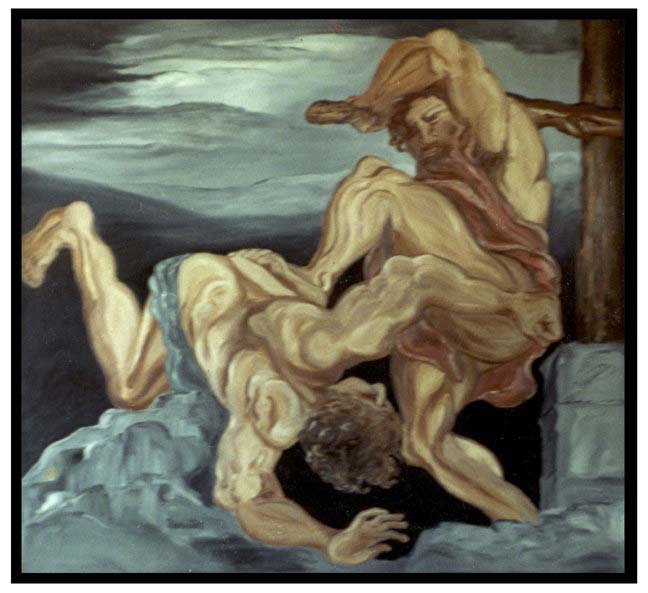
Unfortunately, “sacred books” such as the Bible and Qur’an, institute violence by its mention in their beginning chapters, re Genesis 4:9-16 and Qur’an 5:27-31. http://www.cyberstars.com/cain_&_abel.jpg This is not to deny the possibility that two human beings may kill each other upon meeting, however, Cain and Abel are the sons of Adam and Eve, and their a priori antagonism (an editorial fiat) sends signals that violence is a trait that can never be repressed to the point that it rears its head not later, but always sooner.

By making violence “natural” and inevitable, it becomes possible to propose that only “faith” will enable society to escape “original sin”. However, what is “faith” if not a will to believe in something for which there is no proof?

If non-violence is natural and violence a provocation (as this author claims), the dogma of the rulers to the contrary, that it is violence that is natural, it becomes necessary that society be converted to non-violence through “faith”—even if it means persecuting society in order to force it to such a “faith”. Those who resist the simplistic dogma, because they understand its implications—that a violent group wishes to determine say over what is violence—they may end up the losers. By transferring non-violence from natural habit to a habitat of “faith”, the rulers of the “faithful” are able to impose on society an order that holds that a non-violent social order needs to kill those who believe that a non-violent order may only be established through the founding violence of self-sacrifice.

The example of Cain and Abel in the Bible and Qur’an are part of the the dogma that establishes for violence a preeminent position. The said “sacred” documents—established as “sacred” by a caste of secular priests disguised as religious—prejudice society in favor of believing violence to be an unavoidable part of human nature.

“God” did not deliver either the Bible or the Qur’an from a printing house in heaven, but through men who were so used to violence that non-violent behavior was beyond their imagination. This fact suggests that by the time the “sacred” works were written (some scholars—Anatoly Fomenko, for example—claim that this happened no earlier than Middle Ages), self-sacrifice as a tool employed in avoidance of communal violence was already repressed.

Today society has developed and “grown” to the point that it needs violence to maintain what has been constructed by violence.

Monday, April 13, 2009


© Eso Anton BenjaminsNOT-VIOLENT TERROR
2 Terror In The Wind 1


The story of Jesus as told by the New Testament, gives the Passion of Jesus  special attention to elicit from the reader the profoundest of empathy with the horror of it all. The event is alleged to have happened in the 33rd year of Jesus’ life in the city of Jerusalem. This is according to the calendar of the Catholic Church and subsequently all Christian churches. According to the belief of orthodox neo-Christianity, Jesus was born 2010 years ago (counting backward from 2009) in Bethlehem, Palestine.


How was the time of the death of Jesus established?

The Council of Trent (1545-1563) commissioned Joseph Scaligeri (1540-1609) to create for Christendom a new historical chronology. While the argument for the need to establish such a chronology is generally believed to be the prevailing chaos in the chronology of history at that time, an equally good reason for putting history “in order” is that it allowed the Catholic Church to rewrite chronology the way it would like it. Indeed, the 16th century is when centuries of strife by the Church on behalf of the ruling princes against arch-Christianity have ended. The princes of the world and the church have won against the arch-“pagans and heretics”. While the history of money has just begun, there are no further obstacles in the way. The secular forces may proceed with capital accumulation and personal aggrandizement as never before.

Scaligeri was selected not on the grounds of his scholarship, but on grounds of his sympathy with Catholic (neo-Christian) theology. Which is to say, though the chronology of Scaligeri and his followers is interesting and new, can we be sure that Scaligeri is objective? Long before Scaligeri was even born, many books and documents were burned to erase other chronologies and locations of events, and countless forgeries of works alleged to have happened in times imagined were released to the public. Thus, while according to Scaligeri, Jesus was born in the year 1, and died in 33 CE, according to the mathematician and historian Anatoly Fomenko, Jesus may in fact have died sometime between the years of 1084 and 1195.

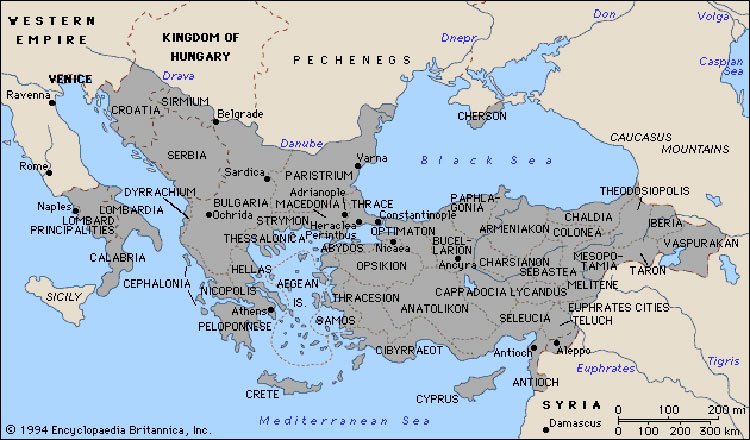
However, what if Jesus’ name was in reality Basil? Who is Basil? Basil was a holy man living in the Byzantine Empire. He was summoned to Constantinople by the Byzantine Emperor Alexius I (said to have lived 1081-1118), and there executed by the Emperor for of his “heretical” beliefs. Basil however did not die on the cross, but Alexius I’s executioners threw him into a pit of fire. The possibility that Jesus may originally have been Basil may come as a shock some, but the case is worth considering even if there is no final proof. On our answer depends the future, because as many now see, the past is ending on a note not only of a financial and economic crisis (likely to end with a crash), but that the crisis has deep roots in the history of the West. If that history is told contrary to the way it really was and the falsity has affected the way we think and behave, the crash may imbed the falsity for eternity. In that case, our children will repeat our mistakes.

According to Anna Comnena, daughter of Alexius I and author of “The Alexiad of Anna Comnena”*, the “Church” was infiltrated during her father’s reign by “heretics” known as Bogomils (a Slavic word meaning “Lovers of God”). Wishing to trap Basil (the name Vasily is a cognate of)  Alexius I invited him to his quarters, pretended great interest in his teachings, and got Basil to tell him what he believes about God and how one should live under such a God. As they conversed, Alexius I hid behind a curtain a court secretary, who recorded all that Basil told the king.

At the end of the interview the Emperor of Byzantium  rend open the curtain. He then revealed to Basil the text recorded by his secretary, and summoned a conference of “army chiefs and elders of the Church”. After hearing the content of Basil’s teachings, everyone expressed shock and condemned him. Though Basil is not quoted, according Anna Comnena, he “looked askance at our doctrine of the Divine Nature of Christ and wholly misinterpreted His human nature. He even went so far as to call the holy churches the temples of demons and treated as of little importance what among us is believed to be the consecrated Body and Blood of our first High Priest and Sacrifice.”

Basil’s teachings to the king earned Basil “burning and other tortures…”, despite which he [Basil] “…clung with all his might to his devil…. So a huge fire was kindled in the Hippodrome. An enormous trench had been dug and a mass of logs, everyone a tall tree, had piled up to a mountainous height. Then the pyre was lit….”

Brought before the pit, Basil’s woolen cloak was ripped from his shoulders and thrown into the flames. “Let us see if the fire will catch your clothes,” Anna records the executioners as saying with an inflection of contempt for Basil. The heat rising from the pit was so intense that the flames took the cloak into the air. “Look! My cloak flies up to the sky!” Basil is said to have responded to the executioners, who then “…lifted him up and thrust him… into the fire…. The flames… so thoroughly devoured the wretch that there was no odor and nothing unusual in the smoke except one thin smoky line in the centre of the flame.”

We should note that Anna Comnena does not name Jesus or Christ, but presumes it sufficient to call him the “first High Priest and Sacrifice.” Such an avoidance of name makes one think that Anna knows Christ only as a symbol. In fact, in antiquity “Christ” is a name that comes with no other name attached, but was drawn as an X, a cross. In short, Christ is as yet a word that does not represent any one individual, but many individuals who helped to make X so significant and dear.

Anna Comnena writes the story of Basil’s conflict with her Emperor father as if it was a conflict over religious belief. Of course, men do kill each other because of verbal disagreements. At stake may be the Empire—if the Emperor allows his opponent to gain so much public attention as to threaten his position. On the other hand, verbal opponents may also be killed not so much for what they say, but because what they say may give one of the parties to kill him for lateral reasons: the opponent may be standing in the way of acquiring to one gaining more power and/or wealth.


Asterisk & Notes of Interest:

* “The Alexiad of Anna Comnena”, transl. by E.R.A. Sewter, Penguin Books, 1969.

When it comes to the chronology of history, this writer agrees, more or less, with the new chronology of history as proposed by AnatolyFomenko.  .


Tuesday, April 7, 2009


© Eso Anton Benjamins


NOT-VIOLENT TERROR
1 What is terrorism?

The term “terrorism” originated with the Jacobins  during the “Reign of Terror” of the French Revolution. “Terror is nothing other than justice, prompt, severe, inflexible,” said Robespierre, Jacobin leader.


The word “terror” comes from (see Wikipedia) Proto-Indo-European tre-, meaning to shake, tremble, which reached Latin as terrorem (fright, fear).


However, fear and trembling are not synonyms for terror in all languages. In Finnish and Chinese, it is kauhu and kongbu respectively, which is closer to the English word combat. Since one often fights for one’s rights—rights that one believes to be one’s just claim—Robespierre’s definition is closer to the original meaning of the word than Latin. Of course, this is not to deny that the death sentences ordered by the Revolutionary Tribunal under Robespierre’s direction not only made thousands tremble, but the phrase “reign of terror” did indeed come to signify fright, fear, and a settling of accounts with but cursory procedures and verbally vague charges. To repeat Robespierre: “…promt, severe, inflexible”, a decision by man not inspired by presumed laws of God, but by man in full bloom of subjectivity polished by rhetoric.


Today, however, the word “terror”—familiar to society as a result of frequent wars, literary references, and more recently through the phrase “war on terror”—reflects back on many “legitimate” governments as being institutions in the “business” of sowing paranoiac fear among the public to increase their power beyond the limits of any Constitution. President Bush’s statement that the Geneva Convention did not protect “enemy combatants” at the Guantanamo Base detention camp, made it apparent that the United States wished to legitimize terror as a tool of government. http://tinyurl.com/ddacl4 In this sense, the Bush administration was a Jacobin as they come.


The threat of terror has served as a scare tactic for a long time. The Catholic Inquisition (beginning about 1184) used terror to persuade so-called “pagans” to convert to the Catholic version of Christianity, what this writer calls neo-Christianity. If one assumes (the whyfores anon) that “pagans” had a religion of greater virtue than the kind brought to them by the Inquisitors, then it makes good sense that only tactics of fear and persistent intimidation may break the hold (for dear life!) arch-Christians had on their virtues. Which raises the question, why—inspite centuries of reassurances to the contrary—would the Catholic Inquisition represent neo-Christianity and not its predecessors, the more virtuous arch-Christians?


The answer may beg belief for some, but is rather plain. “Pagan” religion never was just about fertility gods, thunder gods, dragons, the goddess of fate, and their like. That is a fiction created by the neo-Christian Church.


From the beginning, societies that were larger than life—that is, groups of people larger than a family of a mother and her children and perhaps a father or two—were obliged for their cohesion to self-sacrifice. While self-sacrifice may be said to be an every day experience (often imbedded in some tradition, as when, for example, the Chinese give the best morsel in their soup to their guest), the ultimate sacrifice was always necessary. It seared self-sacrifice as a value and virtue into the society’s mind. It was obvious to arch-Christians that their leaders must lead by example, and the example of ultimate self-sacrifice leaves no doubt that the sacrifice (necessarily by a leader of the community) puts the community’s interests above his own.


While neo-Christianity has its explanation of how Christendom or Christian society came into being, we should note that it has never been at peace with itself. It is of course wrong to argue that aboriginal societies practicing self-sacrifice are without problems, nevertheless, the “Christian sphere” has consistently found it necessary to resort to physical coercion and violence to assure hegemony.


This is why it is necessary to look behind the neo-Christian façade maintained with the support of violence, and pose the question whether neo-Christianity was preceded by what we may call arch-Christianity. Arguably, arch-Christianity would have shared its creation myth with—and, thus, been linked with—its aboriginal past.


What is arch-Christianity, the thing hid in the cellars of neo-Christianity?


Arch-Christianity would not have found it possible to imagine that it could send its founder to an imaginary Heaven to lose himself, and that the “people” could do without being a frequent witness to self-sacrifice or live within the psychic consequences of it. Arch-Christian leadership in and of itself could not have imagined that it could exist as a body outside the body of the people. The leadership of an arch-Christendom would necessarily have led a largely non-violent society by having it and themselves join frequent witness to self-sacrificial acts.


It has not been easy however to look behind the façade of “modern” (and post-modern) times, because, for one thing, it looks upon ultimate self-sacrifice—other than an exception in which case it is “good”—as sacrilege. Why is this? The answer is clear. The charisma that emanates from self-sacrifice comes with a command: Thou shalt love Thy community with thy life. Indeed, the charisma that attaches itself to the sacrifice both before and after death, threatens any power that rules by means that, as one American president had it, “speak softly but carry a big stick behind your back”. It is in this sense that we may begin to see the advantages of a society that does not carry either a stick or a gun, but governs through the not-violent terror of self-sacrifice.


Of course, today human sacrifice (by one’s self or others) has become a topic almost exclusively associated with “primitive” tribes. Ultimate self-sacrifice is not discussed unless it has some connection with the ultimate sacrifice made by a soldier in the nation’s military. For the neo-Christian man or woman, the topic appears only in the context of ancient or medieval times, and then only as a revolt against the king’s once sacred authority. [A sideline: No doubt the Catholic clergy wept when the French Revolution took not only the head of the last sacred king (presumed), but confiscated most of its real estate holdings. Well it might weep, because its long service to secular governments ended with the implicit replacement of neo-Christian disbelief with belief in what we today know as neo-liberalist economic solution.] It is not surprising that large segments of society in our day feel that the king was more often than not a traitor.


Asterisk & Notes of Interest:


1. This writer agrees, more or less, with the new chronology of history as proposed by Anatoly Fomenko.


2. A once common way of self-sacrifice. Look for the word “endura ”.


3. There are other ways to explain “Christianity” than the explanations given by orthodox authorities. For the latter explanation, see Acts 11-26, where we find the supposed first mention of “Christians”. However, the word has no certain chronology and words such as “very old” and “ancient” are appropriate. The word “Christianity” may be read as consisting of two parts: cross + yan; perhaps “cross” standing for here, this place, this individual; and J(Y)an standing as a name of an individual or the name of a place. Thus, the name Krishyan—still common in central Europe—used to stand for the name of a priest, i.e., Krish (likely a variation on the word “cross”, but Yan (likely derived from “gans”, herder, perhaps of geese) the Priest.


The second part of Krish-yan was deliberately obscured by neo-Christians (of the English-speaking variety in the English variant of the word) by replacing “Yan”with “ian” in order to cause the public to forget “Yan”. The name was likely associated with self-sacrifice. Similarly constructed words: Rama-yana; Mande-yana; Krish-yana.