Showing posts with label Basil. Show all posts

Tuesday, April 15, 2014

Eso’s Chronicles 329 / 5
Odds and Ends  
© Eso A.B.
 All comments appearing within brackets [ ] are editorial in origin.
THE SUPERNATURAL AND SUBJECTIVE (5 of 6)

We have read about the Resurrection, but have given little thought that in order for it to take place we need to return to superstition, a term, which was invented by the superstition of science that the mind dies with the body.

I will attempt to answer the question about the origins of ‘superstition’ in a later blog. On this occasion, I will try to stick with the Easter theme, which for the absence in our time of self-sacrifice is no longer accompanied by Resurrection—except as a meaningless word.

Easter is a time in which—so superstition tells us—Jesus rose from the dead. The creators of Easter hastened to celebrate their new Holyday before (the end of April or early May), when the Beltaines began their night and day orgy dedicated to the green fire.

While critics of literature shy away from making the connection, the Greek playwright Euripides wrote a reasonably accurate description of what went on during  “The Bacchae”. What we miss when we read the play is that King Pentheus did not lose his head due to the ‘madness’ of  his mother Agaue having eaten a basket full of fly agaric, but because the king had instituted a gender change for the Sun, which up to that particular festival had been known by her name in the feminine gender–Sonne (German and Old English), or Saule (Latvians).

For reasons of his own, that is to say, for subjective reasons, Euripedes likely believed that the old superstition of the Sun being the mother of all life on Earth (Zemele*) was so ingrained in the minds of the people of the wood that it could never be erased.

The clue of what the superstition about Saule/Sonne was is revealed in a Latvian folk poem, which tells that at Her rising and setting the rays of Sun (Saule, f.g.) shear the tree tops. We may remember here that King Pentheus had climbed to the top of a pine to better see the orgies below. When the Sun rose, her rays blinded the autistic and sex starved King, and when climbing out of the tree, for lack of sight, he lost his footing and grip and tumbled to the Earth below to be ‘devoured’ by his mother (Agaue or Zemele, take your pick).

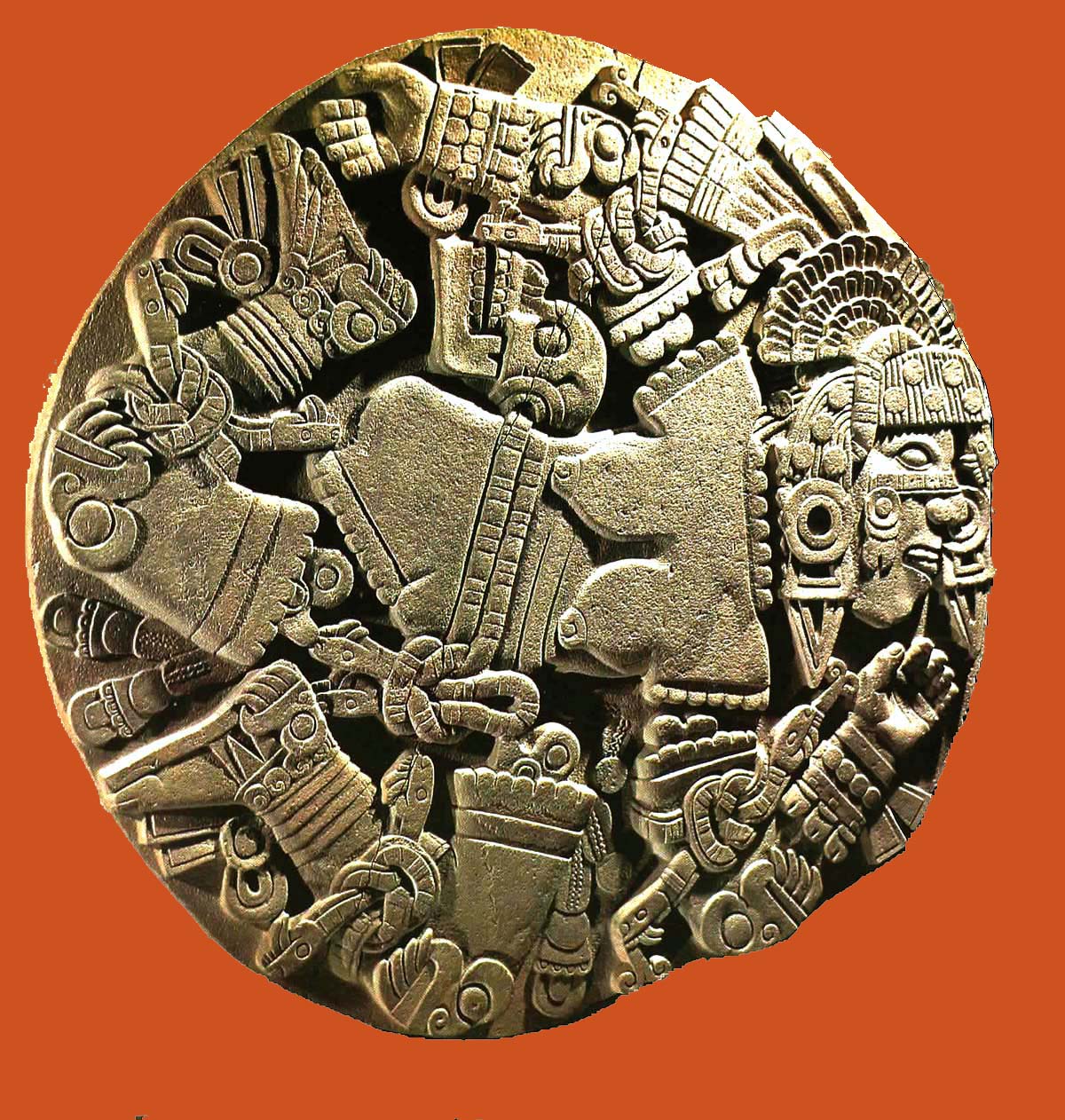
I believe that the same “Bacchae” event was reflected in the Aztec rites of human sacrifice at the top of Templo Major in what is now Mexico City. When the corpses of the sacrificed (at the top tier of the temple) were thrown down the steep steps, these were awaited below by a two dimensional sculpture of a dismembered Earth Mother— Tlaltecuhtli http://www.famsi.org/research/pohl/images/aztec3figure1.jpg . By a curious and paradoxical twist in the story, Coatlicue (aka ‘the serpent skirt’, the Mother of the Gods and all heavenly bodies, including the Sun) had given birth to the Sun as a male. As if to make up for the error, female sacrifices were also made at the temple (probably to give the Sun feminine aspects). The difference in the story of the Aztecs and Greek Dyonysians is that the Aztecs had the Sun give birth to the male gender as if to replace Her real feminine self. Realizing her mistake, She sacrifice herself to correct herself.

There are so many versions of who the Sun is among the Aztecs http://www.aztec-history.com/aztec-sun-god.html that all those who cared were very confused. To decide whose version is right without going to war over it, the Aztec Gods called for a big get together to see which one of them was able to sacrifice him or herself in lieu of a war by jumping in a pit of fire. None of the Gods proved brave enough. As among government officials today, none of the elite wished to lose life, when there was a surplus of peons available to die in their stead.

At last a God covered by open sores of a venereal disease (to indicate that he was both a God and a human) called Nanauatzin, later renamed Tonatuih, jumped into the fire. By being consumed in a fire (almost identical to the death of John Basil in old Byzantium), Nanauatzin connects to  the fires of the Dyonisian Bacchae Festival, the People of Johns Festival among the Latvians, the Beltaine Festival of Ireland and Scotland, and not least, the death of Jesus Christ (the traitorously renamed John Basil).

Being of pure fire, the Sun demands that in times of peace she is remembered by a display of fire, but in times of war, when the continuance of life appears in doubt, she must be remembered with a self-sacrifice. As the link below tells it, if ordinary sins were confessed by the Slavs in an ordinary hole in earth, sins against life demand a hole deep enough to reach fire.

*Zemele=Semele=Mat Zemlya http://en.wikipedia.org/wiki/Mat_Zemlya

Friday, June 21, 2013

Eso’s Chronicles 183/ 5
A Midsummer Supper
© Eso A.B.

A long time ago, at a time that may seem like fairy tale time, a ‘King’ was called ‘Basil’ http://en.wikipedia.org/wiki/Basil_(name) . A number of words that are still with us derive from that time. For example, the word ‘basilica’ or ‘church’ or cathedral; ‘basil’, the king of savories; ‘base’, which is synonymous with ‘headquarters’. The word derives from Greek language.

Thus, the sign “INRI” http://en.wikipedia.org/wiki/Jesus,_King_of_the_Jews  that is often seen in old paintings above the crucified Jesus, and which we are told is an acronym for ‘Iesu of Nazareth, King of the Jews’, was originally read as INBI, “Iesus Nazarenus, Basil Iudaeorum”.

Though a ‘king’ is a king by whatever name, what we should note is that ‘Basil’ stands for a special king—a king of the people. This is one reason why in former days many saints were given the name of Basil. This is as good a reason as any why originally Jesus was likely called Basil. Moreover, if ‘Iudae’ is a deliberate misspelling of ‘Ludi’ http://ancienthistory.about.com/od/games/g/ludiromani.htm  (games, from ludus, people), then INRI should read INBL, “Iesus Nazarenus, Basil Ludusorum”, Basil of the People; or ‘Basil Ludiorum’, Basil of (religious) Festival or Rites. As the link tells: “The ludi were public Roman religious festivals started, before 220 B.C., as annual communal games to give thanks to the gods.” The word ‘games’ in context can only be a cynical derivative from ‘religious rites’, the rite being a human sacrifice. Moreover, if ‘Roman’ stands for the Byzantine Empire, as the Russian mathematician and historian Anatoly Fomenko http://en.wikipedia.org/wiki/New_Chronology_(Fomenko)  claims, the date of the rite is closer to 1118 CE than it is to 220 BC. Notwithstanding post-modern historians, who view Fomenko’s work as that of a “fringe” and “pseudo” historian, the reverse is likely true.

In fact, the story of Jesus, as I have written in other blogs (srch ‘jesusthebogomil’), is the definitive False Flag of Western Civilization, with its post-modern banner seized by the ‘democracy’ of the U.S.

If the reader is familiar with the story of Jesus, he-she will remember that Jesus-Basil and his bookkeeper and disciple Peter are closely associated with a bonfire, that burns early on the morning of the day Jesus-Basil is to be (gamed) crucified http://en.wikipedia.org/wiki/Denial_of_Peter . While in Europe most traces of the ancient Rite meant to assure that the Sun rises have been erased, there remains enough to suggest that the Sun had indeed ceased to rise that day http://biblehub.com/luke/23-45.htm from “…about the sixth hour (in the morning)… there was a darkness over all the earth until the 9th hour… (in the evening)”. The ‘clock’ that measured the time was a sundial http://www.nist.gov/pml/general/time/revol.cfm .

While the reason given why the Sun is not moving is different from Aztec and Greek versions, it is no less weighty. It concerns the celebration of the Name’s Day https://en.wikipedia.org/wiki/Name_day  of the son of the Sun: Dionysus (Huan, Ian, Ivan, Jean, John, Zhan, etc.) by those who make laws on a planet where the wood has been cut, the land has been turned to desert, people have been driven into cities, and all other forms of life have been belittled as ‘the Devil’s work’ and are further exploited by corporation scientists through genetic modification. The Name’s Day of Iesu/ Iannis falls on Midsummer’s Eve or Summer Solstice Day, when for about three days the Sun appears to hang in one and the same place in the sky.

On the evening before he is betrayed by his Public Relations man, his disciple Judas, Jesus and his colleagues sit down to an uncommon meal. Jesus’ companion Mary Magdalene, said to be his ‘financial’ benefactor, presents as the main dish a very special kind of pie. The pie has baked into it a fingernail sized piece of coal. Mary Magdalene did not bake the pie herself, because the pie is to be part of a draw (in which she too participates): whoever draws the piece with the coal, must prepare him- or herself to offer his-her life to the Sun on the following day.

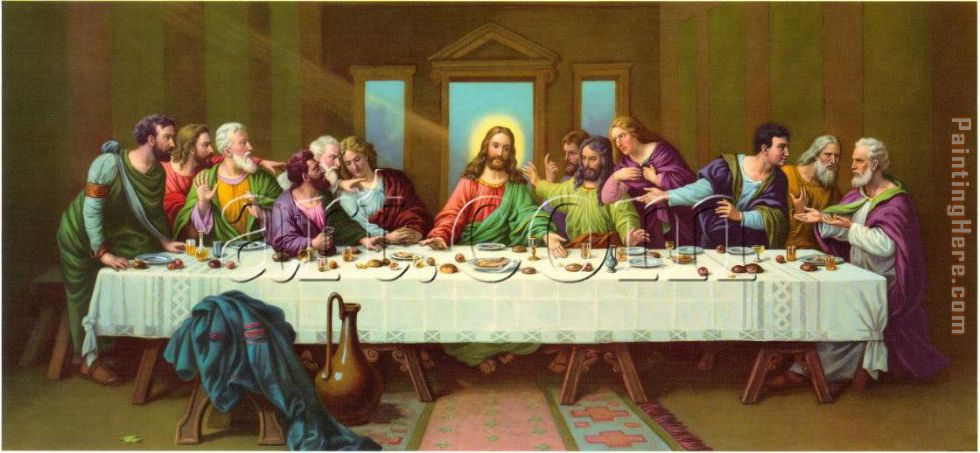
What we know as The Last Supper http://www.paintinghere.org/UploadPic/Leonardo_da_Vinci/big/picture%20of%20last%20supper.jpg occurred on the evening the day before Midsummer Day, a day that was also celebrated as Iesus’s Name’s Day. This fact elevates Iesu twice, first as Basil (King) of the day in his own right and, second, as the son of the Sun, who by giving him birth on that day also elevates herself to prominence.

The disciples of Iesu argued that Iesu should not be the only one to fight the laws made up willy-nilly by secular rulers. There was an agreement among them, that all would draw lots. By participating, all signaled that they were ready to offer their lives to the Sun. Iesu made no objections.

It happened that the ruler of Byzantium at the time was King Alexius I. The King had heard rumors of resistance to his ruling among the people. He, therefore, wanted to discover who their leader was. The Emperor had heard that a ‘King of the People’, came from a country of nomads—a people who moved with the Sun and the seasons and herded reindeer for their livelihood. Emperor Alexis sent spies try recruit a spy from among Iesus’s closest followers.

The follower most accessible was Judas. Judas had his reasons: he did not believe that the Sun was a divinity. He was recruited for thirty pieces of silver (we have no real idea of what it was worth then). It also happened that Judas’s piece of pie had the coal in it, but Judas did not let on and swallowed it. Later, a troubled Mary Magdalene spoke to the baker, but was assured that everything had been done right and there were witnesses to prove it. Iesu said: “Do not be concerned. It was and remains my lot to be the son of the Sun.”

While walking along the shore of the Bosphorus that night (there was a full moon), Judas, as if overcome with grief for Iesu’s lot, came up to him and embraced him. This was the signal waited for by the King’s spies, who were hiding among the people of Constantinople, who, too, were talking a walk and enjoying the moonlight.

Shortly thereafter, Iesu and his colleagues (also known as disciples) were surrounded by the Emperor’s armed police and taken into custody. Iesu was brought to the court of the High Priest. The name of the High Priest, some say, was Yannas. He headed Emperor Alexis’ own religion, which was named Christianity. The name was borrowed from the Slavs, among whom the word meant “criss-crossers or ‘markers’ of earth” or more simply plowmen. In those days agriculture had just made its appearance http://p2.la-img.com/249/28182/10780046_1_l.jpg . The ‘Christians’ had no plows as we know them today, but were using stumps of trees with the branches cut down to the length of a foot or a foot and a half. When a a man stood on the stump, and an ox or mule was made to pull it, the ‘plow’ scratches deep marks into the face of Earth.

To scare those who opposed his order to end all celebrations of the Sun (or Midsummer, or Johns Day) and Earth, Emperor Alexis had his gendarmes (armed police) dig a large pit at the Hippodrome. The pit was filled with logs and these set ablaze. The fire burned and sparks rose high into the air all night long and was the talk of Constantinople. Some said that the King had defeated his own purpose, which was to have ‘no’ celebration whatsoever.

There is great confusion about the ‘true’ story of Iesu Basil or what I prefer to call Iesu The Bogomil (Jesus God lover). The reason is that there are at least two stories of what happened.

The Catholic Christian or canonical version of the story has had a wide distribution. The story is accessible in every country and in nearly every language. The ‘Other’ story, however, is not only denied, but the fragments continue to be denied validity. Among the two best ‘other’ stories is that of Basil the Bogomil, whose death has been described in Anna Comnena’s biography of her father Emperor Alexius I of Byzantium http://en.wikipedia.org/wiki/Alexiad ; and in the story of Polycarp the Bishop of Smyrna https://en.wikipedia.org/wiki/Polycarp .

Unfortunately, the story of Jesus Christ is a wholly made-up story (probably by the forebears of the modern French) with nearly no recollection of things holy in proto-Christian times.


Thursday, April 25, 2013

Eso’s Chronicles 161
 ‘Survivors’ of Government Games (6)
© Eso A.B.

When children become ‘survivors’ whether as dead bodies (via our memories of Waco http://politix.topix.com/img/OFEI74R1PB2VRJSD-rszw514  or Beslan http://www.ajuaa.com/news/files.php?file=belsan__9__579804876.jpg ) or live adults enduring flashbacks of government originated violence, and when nearly all inhabitants of our planet may identify as children who ‘survived’, cider turns into blood running over the edges of a cider press.

Ours is a time when Eve gives birth with sadistic pleasure as she quickly ties the umbilical cord, then stuffs an apple in the mouths of all her crying ones, exulting in the knowledge that all her Adams came wearing a military uniform, and were sent by Commanders in Chief such as Obama, Bush, Blair, Cameron, Hollande (put your favourite name here ….).

A millenium after being chased from our safe democracy, the wood, where we had nature’s goods without cost, and after enduring centuries in the desert of the city, humankind (forced by VIPs to become citizens of VIP-made desert) has become a slurry of blood flavoured with chunky bits of pineapple by government controlled cooks of history, the (privately owned) media and designers (‘look! how creative we are!’).

Though one may appreciate the dilemma of government strung out to the point of disaster (an unintended consequence of institutionalized urban democracy), to this time no ‘survivor’ has declared himself ready to be in sympathy with the ‘disaster’. This is not surprising, because no one really remembers that the catastrophe is the consequence of a series of  deliberate  False Flag events such as ‘the Resurrection’, incinerations beyond counting, ‘9/11’, ‘Boston Marathon’, all ‘inspired’ by self-made mental disasters (murderous daydreams) among the leadership and those compulsively and ‘faithfully’ creative under their command.

What if those who staged the False Flag event at the Boston Marathon had not been ‘cogs’ in a bureaucratic wheel? What if the butchering of the two Chechen youths had not been carried out with the inevitability of a machine skipping a ‘yes, no’ of a digital switch? What if President Obama had done some thinking on his own and not put his seal of approval on the Boston Marathon as the successor event to ‘9/11’?

If a “survivor” of Stalin’s gulags had been informed that Stalin had died by his own hand and left a note saying: “I took my life as a token payback for the pain that I caused with my attempts to serve both the Russian and the world community….”, the “survivor” and his-her descendants would likely have borne their personal burdens as a “chosen people” for many generations. However, such an attitude of hope for recovery is not possible in an era, where governments are proxies of banks.

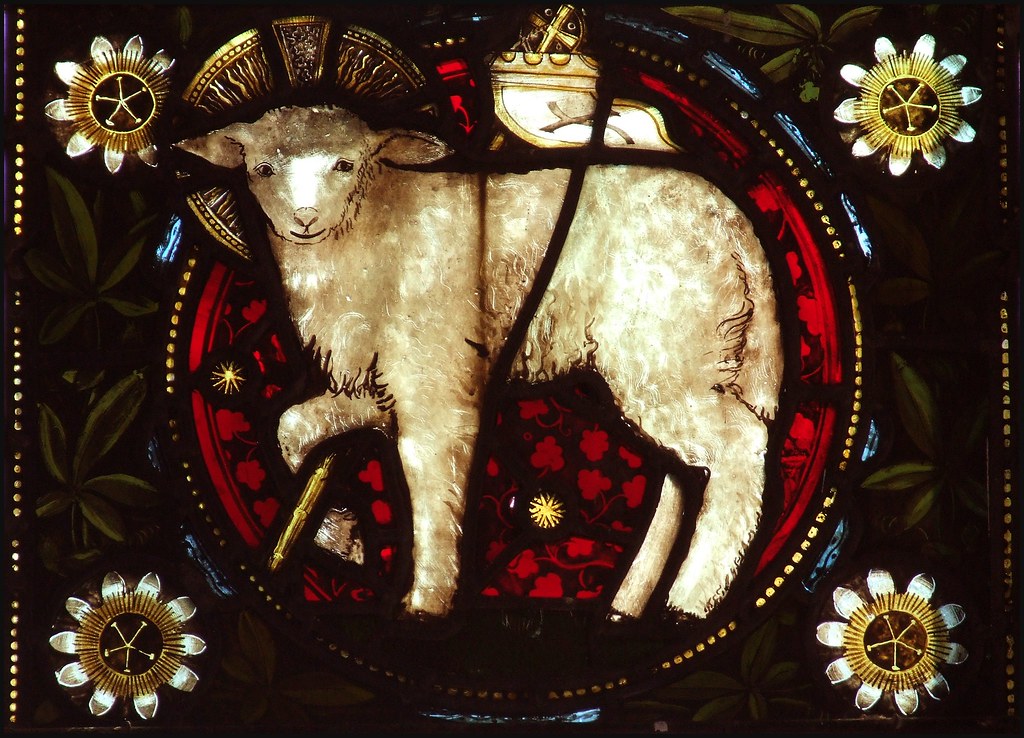
I may be wrong, and instead of a golden calf, I ought to be speaking of a gold fleeced lamb, an even meeker creature than a calf, and for this reason formerly used as a sacrifice the world over. For this cause, the lamb is a sacrificial symbol also among Christians http://farm3.staticflickr.com/2224/2393174660_5d1a7cd388_b.jpg . Unfortunately no Christian banker or government official has in our time offered to sacrifice his-her career on behalf of a nation or community, Perhaps we ought to seek such a sacrifice to come from the leadership of the Christian community?

Almost unbelievably (God given opportunity), such a sacrifice is available at the highest level of the Catholic Church, in the Pope emeritus, Joseph Ratzinger. As most readers know, the current Pope Francis http://en.wikipedia.org/wiki/Pope_Francis  came to office as a result of the previous Pope http://en.wikipedia.org/wiki/Pope_Benedict_XVI offering an unprecedented resignation (2013). The resignation is the second one in the history of the Catholic Church. The previous resignation was that of Pope Gregory XII http://www.nydailynews.com/news/world/pope-gregory-xii-pope-resign-article-1.1260755 , and happened in the year 1415, the year the famous Christian radical and heretic theologian, Jan Hus, was burnt in Constance, Germany. One of Hus’s heresies was to stand for education for children.

Those who read the link to Jan Hus to the end know the meaning of the saying “Holy simplicity”. The sentence's Czech equivalent ("svatá prostota!") is still used to comment upon a stupid-uneducated action. All things considered  http://en.wikipedia.org/wiki/Catholic_sex_abuse_cases , Benedict XVI is guilty of the ‘svatá prostata!’ not because of his resignation as Pope, but because one of the reasons for his resignation is the embarrassment to the institutional superego caused by the sexual behaviour of paedophile priests.

Why has sexual violence, including paedophilia, become such a potent issue in our time?

Is it perhaps because sex is no longer an act of nature, but an act out of the realm of the virtual?

If we look into the past, paedophilia (accepted as normal, even expected behaviour for men in ancient Greek society) has drawn increasingly negative reactions since the advent of the industrial age and the emergence of the Feminist Rights Movement, especially in its later stages. The condemnation centres on men, while the touching of children’s genitalia by mother is judged acceptable.

It is interesting to note that paedophilia seems to have drawn heightened condemnation from the societal superego with its increased acceptance of homosexuality. In other words, the campaign against paedophilia may be a compensatory activity by the superego in reaction of homosexual campaign against homophobia. Why such compensation is necessary is a subject for curiosity, but may have something to do with, both, loss of authority by religion, the arrival of an abusive (and overconfidently self-righteous) age of secularism rooted in virtual reality, and the tabu against nakedness. Apparently, such practices are ‘normal’ in a civilization that has turned wood and field into a desert, and has made its home in the camouflaged desert of the city.

It remains to note that long ago, when religion was as much part of society as nature (and biological mindset was ascendant and observing the practice of self-sacrifice, which included life sacrifice), sexuality played a profound role in the life of the community.

A self-sacrificial persona (we call it ‘victima’ today), the sacred king of a given community, would receive sexual gratification as a reward for his self-sacrifice (the sacrificer commonly was a male). There is no record of sexual exploitation of children, because the community likely interpreted such sex a paradox of sacrifice, an act analogous to child sacrifice.

The children of a community often were the offspring of the same father. In days when self-sacrifice was esteemed and in demand, women gave themselves to the sacrificial-king in the belief that the children conceived of such a union would be blessed by the Gods. The tracing of paternity of a woman’s children, was not—as it is popular to assert in our day—traceable to a collective of men (who knows who is father of which child!), but to the sacred king and the orgiastic festivals of Saturnalia http://en.wikipedia.org/wiki/Saturnalia and Ludi http://en.wikipedia.org/wiki/Ludi.

Given the post-modern concept that ‘immoral but legal government’ is ‘okay’ and that modern leaders seldom offer themselves in self-sacrifice to the community, the public may wonder whether the ex-Pope (mentioned above), having once stood in the shoes of ‘the vicar of Christ’ http://dictionary.reference.com/browse/vicar+of+christ , has given theological thought to the notion that the point of Christianity is not to Redeem the sins of government elites, but to lead society by example and denounce governments which repress the children of the ‘ludi’ to the point that they grow up to think of themselves as “survivors” of gross violence. Is it not time to demand that the Pope Emeritus takes on the cause of children and go take baptism in the river of Lethe? A public self-sacrifice by a Christian leader without, for once, resorting to violence will surely bring attention to the fact that humankind has successfully ‘survived’ governments by violence and a new age is at hand.

Basil the Bogomil, aka Jesus, called a child to him, and placed the child among the grownups. He said to his audience: “I tell you truly, unless you change and become like children, you will never enter the kingdom of heaven. Whoever is like this child is among the great. And whoever welcomes a child in my name welcomes love and refuses violence. (After NIV, Mat. 18)

What must a child of our time have seen to call him- and herself a “survivor” when grown to adulthood? Is not the nation he is born into led by cowards? Are the children of our age not worthy of redemption by Pope Emeritus?

Sunday, September 16, 2012

ORIGINS OF THE POLICE STATE
Copyright Eso A.B.

Coming to the launch of the underwater sculpture, My Crocodile, July 26, 2012
 THE GREAT MIGRATION WEST ENDS
From this writer’s perspective—influenced by Anatoly Fomenko's application of topological mathematics to history—our planet HAS NO RECORDED HISTORY worth paying attention to until the advent in the 10th century of the so-called Cluniac eclisiasts originating in the Benedictine Monastery in Cluny The monastery is located in what is now the approximate centre of France, about 50 km north of Lyon and 20 km west of Macon.

It was out of Bene-dictine Cluny that there arose the idea of “Order and Exclusion” or, if you will, the idea that government should be a closed system. The development of this system—presented most succinctly in a famous book by French author Dominique Iogna-Prat—is what created our world today.

Gatis and the Crocodile communicate
 St. Benedict of Nursia had little to do directly with the system that came to call it self "Catholic". Among religious 'historians' Benedict is a much disputed figure. Nevertheless, for a number of reasons, he is believed to be one of the founders of the West European culture. The following link identifies the name “Nursia” (Nur) with purity, the origin of which name is to be sought in the Far East and the Pashtun tribe of Afghanistan and Pakistan. While the link of the West with the Far East may seem far fetched to some, it makes good sense to those who remember that Ancient Christians and Moslems are closely related, and the so-called 'schism' is a consequence of the divisionism introduced by the violent creation of one-dimensional order by the Bene-dictine and Dominican orders of Cluny.

St. Benedict of Nursia was a monk who--it is possible--came to West from the Far East, and brought with him the example of the way of a disciplined life. Since the saint himself has little to do with the order that used his name, it is unlikely he is to be blamed for the Discipline with a large D that was turned into one of the foundation stones of the oppressive Western system of government of today. After all, discipline ought not to mean going to Prison. That kind of a conclusion may be imposed only  by a fundamentalist contrived observation of the ‘letter of the law’. Discipline at its best is to help create a community by living as an example.

Stefany and Biruta look My Crocodile over and learn
that he is 110 years old, and a 7 meter long oak trunk
Another reason for the arrival of a new system (whatever the old may have been) was that by the time of St. Benedict, the migrations of people from the East to the West were over, and Western Europe was being settled by people, who little by little  became sedentary, and no longer expended their energies in travel.

The leaders of the newly formed sendentarist society no longer needed to expend their energies in holding themselves together as a community; it was no longer of paramount necessity to keep the people from dispersing. The princes and boyars were settling down, too. However, because the latter inherited  their posts as a tradition going back to a time when the tribe was in motion over a woodland environment, the former nepotism (based on heroic acts) was becoming outmoded and needed to be transformed. The big question was: Would the path of least resistance lead nepotism to extinction or to survival as a corrupt institution?


NEPOTISM’S GREAT TRANSFORMATION

The cynics seized the day. Nepotism as practiced during the Great Wanderings transformed itself into a new system, one we know as feudalism. One of the symbols of sedentary feudal power is the medieval “donjon" , which stands for the central tower of a castle.


Volodya, Gatis, and author moving My Crocodile into the Bottomless Johns Pond
 With heroism and its  authority no longer a social necessity, those who held power were left with unspent and excess energies. This happened, because leadership was no longer expended at the pace it was during the time of the migration. The kings and their courts of past ages, once populated by court poets and with ‘heroes’, no longer needed them, if only because heroes no longer died at the once accustomed pace. With the community no longer in continuous motion, dangerous and unpredictable situations decreased. Moreover, the question of ‘What to do with my brothers?’ became a question of great and acute concern to the leader.

The top leader, generally a position inherited by the king’s eldest son, was more than happy if his sibling brothers turned to spiritual matters. This spiritual (or imaginary)  matter, because it was overlapping a tradition of martial authority, is whence came vertical social leadership.

An important initiator of vertical spiritual leadership was the Abbey at Cluny. There are a number of reasons for this. The foremost is that the Cluny Abbey monks, many of them being heirs to authority, wished to repress the earlier wandering Johns, shamans, and other self-confessed men of God or Gods, and then replace them with themselves, that is, the Bene-dictine (dictrine=auto-didactic) order. A sentimental or idealistic excuse or apologia may have been a vision of what ‘order’, subject to absolute or military type of obeisance, could accomplish over the long run. Hence the expansive idea that someday the Bible ought reach every corner of the world.


FROM JONASTERIES TO MONASTERIES

My Crocodile goes belly up and Gatis goes to the rescue
One phenomenon of the early Middle Ages was the spread of names and words originating in the word John. The mystery is resolved if we realize that "John" is indeed a unique name, and that its original meaning is to be looked for in the word “gens”. Gens, at its root, means a human being, as well as seed, but the name found its most common use in being applied to shepherds, goatherds, and swineherds. In the Latvian language, which has roots in the oldest strata of the Indoeuropean languages, a shepherd to this day is known as “gans”. Until recently (but no longer), the most popular Latvian name for male children was “Jans” (Jahnis). In short, the sound of G in “gens”, transformed itself into the sound of  I and Y. The name of gans-yon-yons-ivan-shepherd echoes also in the names of gendarme or jandarme, a herder and guardian of people, a policeman, even a gent-le-man.

The letter G, or J, or Y, curiously enough, also echoes to the letter D and M. We can hear the letter D in the name of the European river Donau, or Donava, re Yonava (yon=young), meaning a young maiden or virgin; the D in the Russian river Don, also echoes to the same meaning. We may find the letters G, H, I, J, Y, Z also in M—as in Mohammed = Johanned. While some argue that this writer uses the phenomenon of ‘paraidolia’ too liberally, he responds that ‘paraidolia’ has not been used liberally enough. While the phenomenon discocvers its widest application in music , it is used to no lesser extend in the shaping of the sometimes many vernaculars or dialects of one and the same language.

One informative anecdote happened when this writer tried to argue that “”donjons” (better known as “keeps” in England), the central towers of Middle Age castles, which may be seen in the castles and forts from France to Japan, actually use the name of John in one word twice, i.e., John of Johns. When I advanced the notion that “don”=John; and “jon”, too,=John, I was met with considerable scepticism. When I suggested that a donjon was likely to be found also in the Kremlin in (Moscow), a Russian reader gleefully denied it. Not knowing Russian, I  had to accept the argument—until I discovered the name in the Bell Tower of Ivan the Great, the main church on Kremlin grounds.


THE FLAT OR CLOSED CIRCLE
My Crocodile gets his bearings

In any event, this is how began a long journey through many labyrinths, which led to the modern police state. No less disconcerning is the news that NATO may as soon as 2016 be flying drones over my country home in Latvia.

Among the first acts of the monks of Cluny was to attempt to convert all manifestations of early and itinerant Christianity to the Cluniac way of thinking and being. The closest group of Old or Archaic Christians to the Abbey of Cluny were the Cathar Christians (close cousins of the Bogomils). The word ‘Cathar’ is—as we may guess—related to ‘Catholic’, the word ‘cath’ stemming fron Greek “katharoi”, pure.

As the act of staying and keeping one's self pure suggests (intense self-discipline being a given), that the conflict that arose as a result of the attempt to imposed discipline on the people of the wood was a bloody one. The Cluniac Bene-dictines were the leaders in dictating and subsequent violence. The secular king in northern France was their chief military ally. The Cathars were among the first Christian religious groups to be declared heretical and excommunicated, i.e., thrust from ‘civilization’ to return to the wood.

The Albigensian Crusade (1209-1255) also marks the start of major deforestation campaigns. This was because wood was necessary not only to build forts and castles, and villages and emerging towns about them, but was also required to bake an ever increasing quantity of fired or ceramic bricks.

It is noteworthy that the Albigensian Crusade resulted in renaming of the Bene-dictine order and  its reinstitutionalization as the Dominican (dictatorial) order. As the name suggests, ‘domini’ means to dominate over, and its purpose was to bear down and instill on the population the Bene-dictine doctrine--obviously no longer bene to the people, when bene becomes an imposition and an order. Though the Bene-dictines remains to this day, the Dominicans grew out of its foot as the sixth toe. It initiated the Inquisition, which dominated over older and archaic Christian orders through terror and anihilation.

As the Benedictine-Dominican Order imposed its ideas of a closed government system on the West, and these became the norm among the secular elite, it moved its tentacles East aiming to seize the city of Byzantium, later Constantinople (Istanbul today), which in those times was perceived as the Jerusalem (city of the lamb) of an unstructured and wood dominated space on our planet.

The first aggressive acts of the Western neo-Christian order was to persuade the Emperors of the East of the advantages of a closed system. This was done through a number of small but violent wars against Rome in the East, which was then located in what is Istanbul today. The French king, at that time was not limited to the territory that is now France, but had a number of kingdoms, some of them extending into the Middle East. Today our schoolbooks associate these Frankish kingdoms with the Carolingians and French knights. 

The link in the above paragraph provides a map of the times of early Middle Ages. What the story gets wrong, however, is that “Rome” was not yet relocated in the West, but remains in the East. If we read history with the idea that in the early Middle Ages Rome is not yet in the West, but is gradually--by hook and crook--transferred there from the East  through the Cluniac doctrine of imposing its order on all and sundry, we are close to what was actually going on at the time.

One event of major importance in consolidating the notions of Reality by the West was accomplished through the agency of the Byzantine Emperor Alexius I. Egged on by the Cluniac monks and Francs, Alexius arrested and then killed the most charismatic religious leader of the East, one John or Ivan Basil (King) of the Bogomil (God lover) religious community. One may say that with the death of Basil [his first name is this writer’s paraidolic guess], the West killed the Sacrificial Pope-King of the East; and therewith began the transference of Rome-East to Rome-West. The latter was (according to A. Fomenko) but a small town on the west coast of Italy, hence so little remains today of its allegedly glorious past.

The murder of Ivan Basil echoed like a scream throughout the yet unconquered East and as yet wooded Europe. It echoed in the West, in that the neo-Christian order of the West countered the outrage and protests among the populace by creating an ever more convincing story of how Jesus—universally perceived as the founder of Christianity (though he was by no means the only Sacrificial Spiritual King, but only the last one of them)—was killed by crucifixion, i.e. by being hung on a cross suspended from nails driven through his palms and feet.

While it is a physical impossibility for a man to hang on a cross from nails, without body tissue tearing through the metallic supports, it does make for a gruesome and dramatic story with which to impress the impressionable. By being able to divert the peoples' attention from Basil's death in a fire pit and put the blame on Alexius I, the Western princes were able to persuade and recruit a huge crowd of Western peasant volunteers to go on a Crusade against the East. We know this Crusade as the 4th Crusade, though some historians (Fomenko) say that it actually was the First. It is recorded in our history books as the Crusade that went to free Jerusalem of Saracens. Actually the military parade stopped at, then sacked and plundered Constantinople (~1204). Not surprisingly, the of the crusade consolidated the power neo-Christians.

Next, the Dominicans had major success in imposing their ideas of order on Poland (and hence on Lithuania) . By 1201, the Order reached Riga and had ideas of establishing a Jerusalem of the East there. To do this, Bishop Albert, the neo-Christian bishop of Riga, had to destroy Jersika, the capital of the proto-lett people located inland on the shore of the river Daugava (Yaunava=Virgin). "J/Gersika" was the indigenous peoples' way of pronouncing Jerusalem. Albertsdestroyed both the city and the king of the proto-letts.

The sacking of Constantinople caused what 'historians' today known as the “Great Schism”, between the East and the West. Ultimately, the East succumbed to the superior violence of the West (achieved through the West’s greater discipline). Nevertheless, the East never surrendered completely, but continued to resist the West, and this resistance (often no longer conscious of its origins) continues up to our time. In those far away days, the dissenting Eastern Christians moved their headquarters from Constantinople (Istanbul) to Kiev, later to Moscow, then to St. Petersburg, then back to Moscow again.

While this writer's primarily concern is to establish different major outlines of how the modern police state was begun, we cannot overlook the nature and importance of the order of the 'closed' or 'flat'  circle created by the Cluniac monks. The di-dact of the words, “flat circle”, originates in the visual image of a circle that turns in on itself and cannot be escaped from as is possible when moving along the surface of a topological circle. One of the consequences of being mentally stuck on a flat circle is a growing consciousness of “ownership”, which is a consequence of the limited space afforded by all things closed-in on themselves.

Thus, the idea of “ownership” is most clearly established in the West, where the expression “private ownership” is ubiquitous and has become a synonym for having a roof over one’s head. Of course, if space were infinite, then private ownership would ideally be enjoyed by everyone. Unfortunately, space is finite; and in our day this has created another Great Chasm —that between the wealthy (originally landowners of great tracts of land) and the poor (those who possess no or very little of property) who sleep in doorways.


DESTROYING THE WOOD AND EARTH
Witnesses to the launch of My Crocodile
By the time the Great Migration reached the West coast of Europe, agriculture was well on its way in the East. Feforestation, which created ever more arable land for sedentary landlords, began there.

While agriculture is said to have begun as long ago as 10,000 years, its began to greatly accelerate only with the end of the Great Migration in Europe. The end of this migration apparently coincided with the beginnings of the second millenium of our era.

As woods were cut down to build houses for an increasing population, which was fed by the growing grain supply from a princely landowning class, small villages turned into towns, and some towns turned into cities. Many villages turned into towns by virtue of trade from which there emerged a merchant class and wealth that was independent from princes.

History books invariably call the passage from wood to agriculture to towns and trading centres “progress”, but fail to mention that concurrently there was a rise in social instability due to a rise of material inequality. The control of the social instability was first left to the control of the organized religious such as the “preaching” order of Dominicans, who while preaching to a captive audience (church attendance was mandatory) were also engaged projecting control through rhetorical and public lies.

The “lie” of the neo-Christian orders consists mostly in discovering new ways of how to rhetorically pacify the have-nots within the new capitalist and closed system (churches as once a week obligatory prisons) society. Thus, while the message of Jesus, which taught meekness at the same time as it advocated opposition to greed by way of self-sacrifice, was presented at the churches  as unquestionable obedience to the orders of superiors.

In the course of time, those who determined the fate of the poor came to be identified with the elite and their effect over the middle class, which on balance weighs in with superior incomes over the common or low wage worker. Because one may argue that social equality between all human beings is a genetic inheritance that manifests as a psychological attitude or expression that begins with life itself, and among humans goes back to their shared time in the wood, social tension is inevitable and bound, on occasions of great inequality, to break out in violence. Though there are some who argue that this problem has been overcome by capitalism with the advent of science and its technologies, which, it is claimed, have a solution for every problem, time has not borne this out to be true.

Following the institutionalized discipline of the Cluniac monks, the retreat of the religious orders into rhetoric (which subplanted religious deeds) created opportunities for political forces with greater spiritual courage. Vetted by numerous rebellions, there arose philosophies and ideologies which opposed those who were the cause of inequality (the neo-Christians including) and unleashed Revolutions with a large and bold R.

The “French Revolution” was one such radical, and violently reassertive event of egality exercised by those who belonged to or sympathized with the economically disadvantaged.

Another Revolution born of inequality was the Russian Revolution led by Lenin and after Lenin’s death seized by Stalin. Though Stalin ruled by violence and terror, he nevertheless imposed radical changes on Russia. Unfortunately, both his and Lenin’s analysis of the causes of economic inequality—dependent on the economic theory of Marx. Marx failed to understand that the root of the cause of inequality is not Capitalism (though it certainly plays a significant part), but the destruction of nature, specifically the wood, and the replacement of the wood with agriculture, and, thus, institutionalizing profiteering at the expense of nature. Deforestation, agriculture [become more virtual than real through the genetically modified seeds by Monsanto], and mining are the foremost tools of such profiteering.


VIOLENCE VS NOT-VIOLENT
My Crocodile soaking up water for his undert-the-water lay
If one assumes as a premise the notion that the wood is the source of a democratic order in which repression of social order and imposition of economic inequality is immediately counteracted by a) forceful personal (sometimes violent) resistance; or b) further evolution (apparently as a survival mechanism), then one also begins to see that the democratic order among equals has little to do with democracy as a political system in our desertified "democratic" West.

This is not to deny that democracy is a “sacred value” even in an environment where it obviously is unable to function, but the value of it in our time exists only in the human mind and body as these twins remember the origins of themselves in the genetic constitution of being.

The ideological “sacred value” however does in fact have breaking points. These occur when after a long time of transgression against democracy, the liberal forces of the haves (who have most benefited by the anarchistic elements inherent in the life force) have overstepped the subjective boundaries of aforementioned “life force”, and the public at large collectively hears the sound of a “snap”.

The result is not simply like the removal of a tap to a explosive fuel mix, but is like a match put to the leak of said tap. Transgressed upon democracy then not only flees from its trap by bursting through it, but it has no hesitations in becoming explosive, of using extreme violence and death to achieve a true democratic (re: egalitarian) balance.

Though at the time of a Revolution all the economic and cultural blocks of society participate in the pulling down of the previous 'old' order and all contribute to “chaos” (“the centre cannot hold” as the poet said), a remembrance of order and community enters the fray nevertheless, generally, by selecting an individual to lead the violence, which duration, hence, depends on the chosen individual’s character.

During the French Revolution, the leader of the controlled violence was Maximilien Robespierre. The death machine, the guillotine, did its job quickly and without undue violence (except for extreme subjective fear) on the part of its victims. Eventually, the guillotine took off the head of Robespierre, as well.

In the Russian Revolution, the leader of terror became Joseph Vissarionovich Stalin. More than a hundred years had transpired since the French Revolution without the liberal forces ever taking to heart economic and social equality as being at the heart of every human being. Today there exist very mistaken and spacious observations of these two Revolutions: 1) The French loved their Napoleon; the Russians hate their Stalin. Such are  silly observations for so important events.

Terror took the lives of many millions of people on Soviet territory. This writer, too, lost family members to it. Nevertheless, Stalin’s terror was not senseless or personal power oriented as the liberal propaganda machine of the West now declares. Rather, by Stalin’s time, it had become clear to those oriented by egalitarian genes, that there was some singular cause why the interests of the community could not stand up against economic liberals. Though Stalin was an avid reader of history, there is no record of what he thought of Robespierre’s terror. It is plausible that, he thought it was not extensive enough. Therefore, Stalin’s terror was directed not only against individuals, but at economic classes, especially those most infected by motivations of liberalism.

However, it is unlikely that Stalin's terror was "extensive enough" either. Stalin recognized this himself, when he said at the beginning of his last terror campaign (against inequalitarian zionism embodied by certain Soviet Jews and Christians converted to the dominant neo-Christian order): "What will happen without me is that the country will die because you can't recognize your enemies." ['Stalin'' by Simon S. Montefiore, p. 631]  Stalin is long dead, but inequalitarianism embodied in parliamentary (de jure or de facto) democracy is at this very time marshalling forces for further one-dimensional crusades.

Here we may return to the human being as a creature of the wood, where a subsistence economy prevailed. In the wood the human being is not yet become a farmer. He is not yet exploited by the princes and boyars.

Today this creature of the wood has no forest to return to. Today the situation is much like the famous painting by Munch, called “The Scream" : an obviously terrified person, possibly a bald headed woman, turns back from wherever it is she was crossing a bridge to, and looking back is confronted not by a wood she can run into and hide, but by a painter, who is no less terrified by the imposingly empty solitude before him and behind her.

This causes us to ask: What kind of government did human beings have before deforestation defined the space we live in?


GOVERNMENT IN THE WOOD
Stefany standing in the Gates of Crocodile Alley

 The idea of a government in the wood is nicely presented in the Bavarian fairytale called “KingGoldenlocks" .
The link to the fairytale (a must read) presents us with interesting information.

First, the king’s castle and kingdom are located in a wood;
Second, the wood about the castle is ruled by a giant, a King of the Wood;
Third, the king regards the giant as a creature he has to capture;
Fourth, not everyone regards the wood as his-her enemy, the king’s son among them, perhaps because he senses that the wood is his original home;
Fifth, the son is to be killed (excluded from society through sacrifice) in the wood for releasing the giant or king of the wood from captivity;
Sixth, the son of the King of the Wood is a swineherd of wild pigs;
Seventh, the giant and his son, the swineherd, save the unfortunate prince who appears to love the wood for its own sake;
Eighth, the king of the wood is not averse to removing the usurping king Goldenlocks from the throne;
Ninth, the swineherd is a good actor/mimic and blends with and replaces the son of king Goldenlocks so perfectly that he eventually becomes the new king;
Tenth, the switch between prince and the swineherd is done through the sacrifice of the tenth finger, likely the pinky of the left hand, which is—one may presume—how ultimately the wood is saved from the axe.

If we take a closer look at item Five [the son is to be sacrificed in the wood, presumably to the (barbarian) King of the Wood], we note that the giant in the wood or King of the Wood does not accept a human sacrifice, but is willing to accept in its place one’s pinky, the little finger.

We may interpret the substitution of one’s pinky as a compromise, nevertheless, close enough to the sacrifice the whole body, because it is a sufficiently real touch of Reality. At the same time, the biting off of the little finger symbolizes the fact that before the son of King Goldenlocks is King Goldenlocks son, he is the grandson and heir of the giant King of the Wood, the Primordial Father/ Mother figure. The substitution of the pinky for the whole body is similar to King Solomon’s solution in case of the child, who is claimed to be their son by two women. The real mother is unwilling to see her child torn in half, but rather surrenders it to the woman who is staking a false claim.

We may deduce from the fairytale, that in due course the real and future government of humankind will make its home in a forest, not the city. This government in the wood will show its earnestness not through rhetoric, but some act, which for the given society is an individual sacrificing his-her little finger or its equivalent.


NOT-VIOLENT TERROR

Little Dans Anton was also a witness to My Crocodile launch.

At about the time of the rise of the Benedictine Order (and Exclusion) at Cluny circa the 10th century, the last sacrificial king—of many thousand year lineage—died.

The ancient tradition and charisma of order had been entrusted to the charisma of sacrifice. This trust died by neglect of the tradition and ultimately the murder of the Sacred King in a Revolution. The death and undermining of the tradition of self-sacrifice had been progressing as a cancer within society for many centuries (perhaps even for a millenium) before the final collapse overtook it.

Where the King died is not clear, but symbolically he may be represented by Basil, John or Ivan Basil, of the Bogomil religious community. Basil means King. Basil surely believed that God would return His love for Him by protecting him, Basil, from fire and other harm. He also believed that when faced by death, he had to be able to face it bravely and die if it came to that. Even if he did not believe in God, he knew that in order to hold a human community together, someone had to act as if he did believe in God. Hence the famous Bogomil cry, no doubt quoting Basil facing the pit of fire: "My God, my God, why hast thou forsaken me!?"

In short, Basil was one of the last Sacred Kings who was a leader of a community held together by the charisma of a self-sacrificial leader, a king still worthy of his office.

Bogomils are said to have originated in Bulgaria. The link informs that Bogomil origin is to be looked for in the reaction of the ‘ancient’ Christians (of the 10th century society) to the aggressive advances of Cluny Abbey militants. The latter desired to replace the “good news” of the sacred community with the “new news” introduced by neo-Christianity desiring to institute a secular order on behalf of the ruling princes. The death of Basil (by burning) in a pit of fire at the Hippodrome of what is now Istanbul can be seen as a Western inspired  change of order using the disciplinary device of expulsion, death, which excludes by causing a loss of memory.

Basil, like Quadafi of Libia, stood in the way of the ambitions of the West. He was put to death by fire, which turns the human body into ashes, which are then scattered over the landscape to be forgotten for lack of a place to build a memorial. This exemplifies the methods used to introduce what this writer calls 'The Order of the Closed Circle', the rule of the letter of the Law over the spirit of justice.

The “letter of the Law”, incidentally, lends itself readily to institutionalized and bureaucratic paraidolia, generally exercised by a “Supreme Court”, which has a self-instigated and self-applied legal right to reinterpret that famous phrase of the Nazis: “Arbeit Macht Frei” (Work Makes Free) into “Disciplin Macht Frei”, not to forget that “Zuchthaus (prison) Macht Frei”, which brings us to the notion that “Arbeit, Disciplin, and Zucthaus macht Frei” all who want a job, but cannot it, because prison labor 'jobs' are free, prisoners need not be paid, and hence you freer than ever.

Today there is no wood to escape to. While King Goldenlocks may still be alive (because his son is alive) their father and grandfather, the Kings of the Wood are dead and forgotten.


THE END OF TIMES BEGET NEW TIMES

Strange as it may seem, though the King of the Wood and his son the pig herd are dead, the wild hogs of the wood are not gone yet. On a small piece of land that I own in the Latvian countryside, there is a small damp depression in the midst of lumps of grass, where I see the wild pigs come and dig themselves a ditch and then come and wallow in the mud.

These are the reserve forces that someday I/we will unleash against the mind and body control police, and force the maxi-farmers to surrender their fields of agriculture, which they not to share, but make profit from. No hunting (policing) of wild pigs and hogs will be permitted on whatever a ‘new’ law defines to be a maxi-farm.

Remember the saying of the so-called "Peaceniks", who used the slogan: "Make Love, not War" when confronting the militarists? We may rewrite the saying and make it read:

“Hunters! Do not pull the trigger on wild hogs. It is more fun to let the love of your life zip open your pocket and stroke the trigger that makes you come alive.”


Sunday, August 30, 2009


Copyright E. A. Benjamins aka Jaņdžs
NOT-VIOLENT TERROR
24 A Function of Awe


The civil war that began round about the year 1117, when Alexius I threw Basil (according to my theses also known as Jesus or John) into the pit of fire continues to this day.

After killing Basil (and the subsequent destruction of the empire of Alexius I by the French in a “Crusade”), Basil-John’s Holy Office was removed (1305) from Constantinople to Avignon. Seventy-three years later, in order to make the priesthood in Avignon look less French, the office was moved once more, this time to Rome. The Byzantine people were not happy, but perhaps this spiritual violence was mitigated by a promise that Basil-John would sit in Rome, where western princes would surely protect him from oriental despots like Alexius I. The protection, if such was offered, proved a lie. No Pope has ever sacrificed his life as John-Basil and his retinue of Johns routinely did before secular kings put them to death. Instead, the early popes—the brothers or in-laws of kings—called (actually renamed) John Jesus and wrote a new myth about his divinity.

While today neo-Christianity is a show that entertains a dead God, western thinkers stubbornly cling to western (Scaligarian and Petavian) chronology of history. Even atheists cannot shake off this lighter than air God and remain bound to a God, they claim not to believe in.

From the very beginning of this religious civil war, which essentially polarizes people in two economic camps, the allies of Jesus have had the upper hand. It is thus that they are able to impose on the world their version of the story-history of John. Indeed, the princes invented the story about Jesus we know. At the same time, this invention is the reason why the fire pit death of Basil is practically unknown.

The civil war is at its bloodiest today, even though to one of the economic poles it may appear to be bloodless. No matter how many thousands of images of dismembered and dead men, women, and children are shown on the internet and television they are as if not seen. This is because such scenes take place far away from the viewers living inside the protected zones of the powers-that-be.

Being the apparent winner of the civil war, the successors of Alexius I (symbols of state power and righteousness) claim to speak in the name of love and peace, and let the bloodguilt fall on unnamed secularist armies (their own and that of their enemies) as though these appeared outside the bounds of western foreign policies. Worse, the oligarchs (or their like) have not only killed Basil-John and changed his name to Jesus, but have installed Jesus-Basil as the ruler of heaven, where all his energies are consumed trying to sit on air.

Perhaps the “victory” of the successors of Alexius I will be carried forward yet another thousand years. However, there are reasons to doubt this. The torn social bonds that are the price of appearing to be victor of this war have turned the populace into an army of the dumb. This is not without its corrosive effects. Unable to resist the oligarchs, the poor play a waiting game. That is, they wait for the rich and their own to exhaust the resources of our planet, because it is only after the resources are exhausted will everyone be able to let the Earth go fallow and gradually resume a normal life again.

Poets, often true, but physically weak seers, have watched—real time and their mind’s eye—ignorant armies http://tinyurl.com/qk7mqr rush to be devoured by chaos http://tinyurl.com/2lhyc4 . Brazen men with brazen promises are in leadership positions http://tinyurl.com/pdujkd . Mountaintops (bald for loss of snow and forest cover) and deserts (jumping from Africa to Europe) have replaced the ancient Johns with Apocalypse sans Jesus in real time.

Waiting still, the poets see no sacrifice charismatic enough (whether by John, Jesus, or anonymous soldiers blowing their heads off in the field) to save humankind. Governments with high decibel sugars glaze all protests.

But wait! Is it not curious that the present winners of the civil war appear to hate most “suicide terrorists”? Is it not a “suicide terrorist” one who takes not only his-her own life, but the lives of everyone around, the lives of the innocent as well as the guilty? Does not such self-sacrifice speak of utter moral depravity, which gives the ruling elite moral authority by default? Most likely this is because the powers-that-be presume such moral authority as much as the terrorists do.

At this time, the losing side, the poverty stricken and superfluous, use tactics that they have learned from the winning elite, who camouflage their violence from the eyes of the ordinary citizens by controlling the communications media. We hear of remote controlled drones killing the opposition leader, but it takes a long time for the news to reach us that along with the leader, the dead include the bride, the groom, and most of the wedding guests. http://tinyurl.com/ncgx2m . While the tactics of both sides of the civil war are roughly the same and equally brutal, it nevertheless appears that only the side of the poverty-stricken and superfluous ones, has the option to practice true self-sacrifice. At a time when the internet is replacing newspapers, radio, and television as primary media as the disseminator of news and other information, the tools are available that will record and broadcast the self-sacrificial deed and censure it and keep it anonymous. The failure to express protest by using self-sacrificial death as a tool (what John-Basil-Jesus taught), may be seeing the end of its days.

Slavoy Žižek, a Slovenian philosopher and at this time the director of the Birbeck Institute in London, approvingly cites Brecht, the German playwright. Writes Brecht (in “Baden Learning Play on Consent”): “To encourage a man for his death, the interveningly thinking one (der eingreifend Denkende) asks him to give away his goods. When the man gives away everything, what is left over is only life. Give away more, says the thinking one.” The ‘interveningly thinking one’, one assumes, is one’s own inner voice. [No doubt, the language is a bit heavy.]

Žižek then writes (“The Monstrosity of Christ”, pp 300): “This ‘give more’ is a true ethical answer to the false spirit of sacrifice: it hits the narcissistic satisfaction provided by sacrifice in the eye. Brecht’s real target here is the pathetic gesture of sacrifice….”

Nevertheless, one may object: What if sacrifice is essential, a kind of mirror of the Big Other mentioned in a previous blog, so that human kind will be reminded of itself by reminding itself to mind, which reminder is essential to the formation of a larger-than-life or virtual society?

What if with the mirror, which reflects back to one one’s true terror of death, puts the same one in awe of the (“pathetic”) sacrifice and breaks down the refusal of one’s otherwise ungovernable ego to submit to the compromise that is necessary to create a society larger than one’s immediate family and intimates?

If you copy this or otherwise mention the content of this blog, please credit the author and http://esoschronicles.blogspot.com/

Saturday, July 18, 2009


NOT-VIOLENT TERROR
13 The Unmaking of Jesus (cont.)

The story of the murder of the Bogomil leader Basil by the Byzantine Emperor Alexius I is a story well known in the 12th century when it took place. It is not so today. Today many people are likely to be shocked to hear that what happened to Basil is a story that parallels closely to what happened to Jesus. There is a reason and explanation for this.

The story of Jesus was created around the story of Basil. The dreadful events that overtook Basil provided a ready available armature for the story for then emerging neo-Christian church founded by the Byzantine emperor Alexius I. Of course, the new story is reaches us not only inverted in the reasons for it happening, but the main cathartic events were changed from burning to being nailed to a cross. The reasons for these changes, too, are founded on the need to divert the public’s attention from what really happened.

Most likely these events happened under the rule of the Byzantine empire’s Emperor Alexius I. The Emperor felt compelled to change the story and found a new church and a new religion, for two main reasons.

1. The arch-Christian church, what we today derogatorily call the cult of “pagans”—of which Alexius his predecessors and I had been the sacred kings—had for many years felt alienated from their king. The people had once called their kings “the sacred king”. However, something increasingly unacceptable happened. For several consecutive generations the sacred king began to fail to fulfill his sacred function—which was to act the role of the kingdom’s founding father—by reenacting the founding violent moment by self-sacrificing himself. Since time immemorial, the founding moment (of death and miraculous rebirth) was celebrated during the annual solstice festivals. The festivals, one in winter and one in summer, generally went by their local name, but for the most part retained the root name of the sacred being: John, Yan. We see this practice in such names as Ivan Kapusta, John the Baptist, Yannukah, Hunnapu, Yohammad, and so on. Depending on the age of the sacred king (whether young or old), the length of his reign was determined by priests. Usually the agon, the moment of self-sacrifice, came with an obviously old age.

In any event, the sacred king of the Byzantine empire began to act increasingly as merely a king, that is to say, a man with a standing army who could and often did rob his people, his neighbors, aggrandized himself, and dictated what people should or should not do and think. In short, there occurred mutual alienation between the king’s and the people. Eventually, this alienation reached a stage, where it broke out into a civil war. As part of his war effort, the emperor needed to kill not only the Johns, the wandering priests of arch-Christendom, but also to replace their ideas with ideas of his own.

2. It is probable hat the alienation between the sacred king and the people began when the king began to use a number of the priests to the Sun, as not only his bookkeepers, but collectors of the gifts that the people donated to the temple-palace. These priests, were self-castrated devotees of the Sun, and, thus, not attracted to women for sexual reasons. This made them attentive workers and bookkeepers. Unfortunately, since the priests were such competent gift collectors, the sacred king soon discovered a way to have them collect more gifts than was customary. In time, the word “gift” came to mean “tax”.

At first, the tax was used to build grander temples, which then became the sacred king’s palaces, which of course soon no longer pretended to be temples. As the sacred king abandoned the temple for the palace, he became what today we call a temporal or secular man, an atheist as religiously devoted to materialism, as the sacred king had once been devoted to the aura of charisma that held the community under its umbrage. The temple prostitutes (women who wished to make the temple especially attractive as a place for leaving gifts) became part of the king’s harem. The “gifts” paid for a standing army, employed an increasingly large number of artists and artisans, and so on. Indeed, the king abandoned the ancient practice of self-sacrifice and began to seek ways to escape death altogether. This is what is behind the stories where kings and heroes go out on adventures to seek the magic plant (usually guarded by a serpent), the eating of which will give one immortality.

However,

3. The priests of Iananna (the Johns) learned not only how to do bookkeeping and collect taxes, they needed to invent writing to do so. And they did so. With the invention of writing, the castrates learned not only how to record old stories, but invent new ones. Some of the stories, which the priests invented, did not sit well with the king. He began to fear that they would take power away from him. This fear was the cause for discovering various ways by which to bind the priests closer to the palace and alienate them from the temple.

This is how there developed two factions of priests. One faction stayed with the people. These were the wandering preachers, the Johns. The other faction became known as “Jews”, most likely a word that was semantically connected to words for gifts and taxes. The word “jewel” comes to mind. The Jews necessarily became involved in palace intrigue, while the Johns remained of the people.

Friday, July 17, 2009


NOT-VIOLENT TERROR
12 The Unmaking of Jesus (cont.)

Let us continue with the story.

It was midnight when Iananna reached Great Palace below Earth and the door of the room known as The Heart of the Dead. When Ereshkigal saw Iananna, she exclaimed: “Ha, ha! Naked bitch! Just look at you! What a sorry sight!” Her tone was full of obvious shadenfreude.

There was some truth in what Ereshkigal said. Iananna stood not only naked, but also seemingly burnt out. What had been firm and pointed breasts in the morning, were now hanging long and spent. Moreover, Ereshkigal was dressed in Iananna’s attire. Though Ianannas clothes had lost their color and turned grey, Ereshkigal looked like a queen in them. “Did the Earth get you down during your travels, sister? Here, have a glass of Black John wine. You will feel better.”

Iananna drankthe wine and started for her room, but Ereshkigal blocked her way. “If you please, sister, I would like you to sleep in the barn with the geese tonight,” she said. “Tonight I am having a ball in the great hall of your apartment. All the great stars of the night will be there.”

Iananna was about to ask why Ereshkigal had not invited her, too, when she felt faint (the poison in the wine had taken effect) and she fell.

Ereshkigal’s servants dragged Iananna to the barn, tied her jaws shut as if she were dead, cut off her long braids, tied them as a rope around her waist, and then hung her corpse by this belt on the horns of an old moon. “Sweet dreams, sister,” said Erishkigal with a grin on her face. Then she left for Iananna’s apartment to join the revels of the stars.

When the morning came, the Sun did not rise. John, Iananna’s son, awoke in his earthly home, but when he did not see the Sun, he imagined that he had woken up too early and went back to sleep again. Thus, John slept the whole of the next day. Indeed, he had a strange dream. He dreamt that he awoke in a hole in the ground. He and his mother Iananna lay side by side. He lay with his face up and could see the night sky filled with stars. Iananna, his mother, lay (Oh horror of horrors!) beside him and—in an apparent reversal of roles—suckled on his nipple.

John awoke and understood that his mother was in trouble. However, what was he to do? There was not a sliver of light anywhere. John felt about to see if perhaps his mother really lay beside him, but his hands found nothing to touch. Great fear and anxiety overcame him. However, John was smart enough to take a deep breath. This allowed him to get his bearings and understand he should rise up, no matter how dark the hour, and try find his mother. After all, it was Iananna, who, if he, John, died, would rejuvenate him by giving birth to him again.

Meanwhile, in the barn with the sleeping geese, Iananna slid off the horns of the old Moon. She floated as if dead for three days through the abyss before she was then caught on the horns of the new Moon. As the new Moon rose, Iananna was bathed by the dew and came to life again.

Iananna rose into the sky and a song that resembled a roar greeted her. It was a shout of joy. During the three days of Iananna’s absence, her creation had taken fright. Everyone remembered the three days of darkness as days that sent chills to the bone and stuck in the eyes like glue. The was like a flower opening. People drew a knife across their palms, then pressed the palms against their door as a sign of how much the Sun, Iananna, had been missed and how much she was loved.

Iananna rose more quickly to the zenith that day or so it seemed. She was anxious to see her son John. Like him, she had dreamt a strange dream. In it, she had come to the gates of a cemetery and discovered John to be its gatekeeper. When she wanted to enter, he had blocked her way. “This is no place for you, mother,” he had said. “Not for a thousand lives.”

“By what right do you keep me from passing?” she had asked.

“That of my life,” John replied.

“But don’t you want to live?”

“Of course, I want to live, but if you die there will be no sunrises.”

Iananna had not understood and had tried go past John. John had raised his hands, his palms facing her. They were stained with blood.

Iananna awoke from her dream her heart pounding. She raced up the night sky toward the dawn and then higher toward the zenith from where she could overlook everything on Earth. it was too late. John had died. Though Iananna lifted her skirt and touched John’s crotch, John’s rooster did not crow.