A Midsummer Supper
©
A long time ago, at a time that may seem like fairy tale time, a ‘King’ was
called ‘Basil’ http://en.wikipedia.org/wiki/Basil_(name)
. A number of words that are still with us derive from that time. For example,
the word ‘basilica’ or ‘church’ or cathedral; ‘basil’, the king of savories; ‘base’,
which is synonymous with ‘headquarters’. The word derives from Greek language.
Thus, the sign “INRI” http://en.wikipedia.org/wiki/Jesus,_King_of_the_Jews
that is often seen in old paintings
above the crucified Jesus, and which we are told is an acronym for ‘Iesu of
Nazareth, King of the Jews’, was originally read as INBI, “Iesus Nazarenus,
Basil Iudaeorum”.
Though a ‘king’ is a king by whatever name, what we should note is that
‘Basil’ stands for a special king—a king of the people. This is one reason why
in former days many saints were given the name of Basil. This is as good a
reason as any why originally Jesus was likely called Basil. Moreover, if ‘Iudae’
is a deliberate misspelling of ‘Ludi’ http://ancienthistory.about.com/od/games/g/ludiromani.htm
(games, from ludus, people), then INRI should read INBL, “Iesus Nazarenus, Basil
Ludusorum”, Basil of the People; or ‘Basil Ludiorum’, Basil of (religious)
Festival or Rites. As the link tells: “The ludi were public Roman
religious festivals started, before 220 B.C., as annual communal games to give
thanks to the gods.” The word ‘games’ in context can only be a cynical derivative from
‘religious rites’, the rite being a human sacrifice. Moreover, if ‘Roman’
stands for the Byzantine Empire, as the Russian mathematician and historian
Anatoly Fomenko http://en.wikipedia.org/wiki/New_Chronology_(Fomenko)
claims, the date of the rite is closer
to 1118 CE than it is to 220 BC. Notwithstanding post-modern historians, who
view Fomenko’s work as that of a “fringe” and “pseudo” historian, the reverse
is likely true.
In fact, the story of Jesus, as I have written in other blogs (srch ‘jesusthebogomil’),
is the definitive False Flag of Western Civilization, with its post-modern banner
seized by the ‘democracy’ of the U.S.
If the reader is familiar with the story of Jesus, he-she will remember
that Jesus-Basil and his bookkeeper and disciple Peter are closely associated
with a bonfire, that burns early on the morning of the day Jesus-Basil is to be
(gamed) crucified http://en.wikipedia.org/wiki/Denial_of_Peter
. While in Europe most traces of the ancient Rite meant to assure that the Sun
rises have been erased, there remains enough to suggest that the Sun had indeed
ceased to rise that day http://biblehub.com/luke/23-45.htm
from “…about the sixth hour (in the morning)… there was a darkness over all the
earth until the 9th hour… (in the evening)”. The ‘clock’ that
measured the time was a sundial http://www.nist.gov/pml/general/time/revol.cfm
.
While the reason given why the Sun is not moving is different from Aztec
and Greek versions, it is no less weighty. It concerns the celebration of the Name’s
Day https://en.wikipedia.org/wiki/Name_day
of the son of the Sun: Dionysus (Huan,
Ian, Ivan, Jean, John, Zhan, etc.) by those who make laws on a planet where the
wood has been cut, the land has been turned to desert, people have been driven
into cities, and all other forms of life have been belittled as ‘the Devil’s
work’ and are further exploited by corporation scientists through genetic
modification. The Name’s Day of Iesu/ Iannis falls on Midsummer’s Eve or Summer
Solstice Day, when for about three days the Sun appears to hang in one and the
same place in the sky.
On the evening before he is betrayed by his Public Relations man, his
disciple Judas, Jesus and his colleagues sit down to an uncommon meal. Jesus’
companion Mary Magdalene, said to be his ‘financial’ benefactor, presents as
the main dish a very special kind of pie. The pie has baked into it a fingernail
sized piece of coal. Mary Magdalene did not bake the pie herself, because the
pie is to be part of a draw (in which she too participates): whoever draws the
piece with the coal, must prepare him- or herself to offer his-her life to the
Sun on the following day.
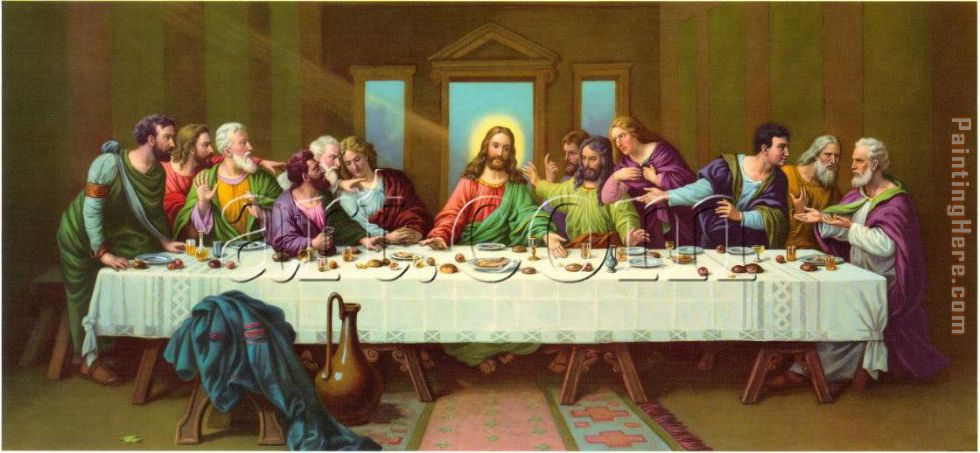
What we know as The Last Supper http://www.paintinghere.org/UploadPic/Leonardo_da_Vinci/big/picture%20of%20last%20supper.jpg
occurred on the evening the day before Midsummer Day, a day that was also celebrated
as Iesus’s Name’s Day. This fact elevates Iesu twice, first as Basil (King) of
the day in his own right and, second, as the son of the Sun, who by giving him
birth on that day also elevates herself to prominence.
The disciples of Iesu argued that Iesu should not be the only one to fight
the laws made up willy-nilly by secular rulers. There was an agreement among
them, that all would draw lots. By participating, all signaled that they were ready
to offer their lives to the Sun. Iesu made no objections.
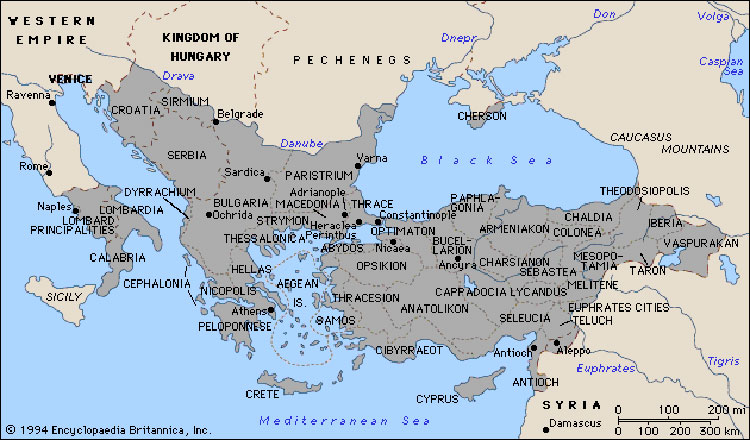
It happened that the ruler of Byzantium
The follower most accessible was Judas. Judas had his reasons: he did not
believe that the Sun was a divinity. He was recruited for thirty pieces of
silver (we have no real idea of what it was worth then). It also happened that
Judas’s piece of pie had the coal in it, but Judas did not let on and swallowed
it. Later, a troubled Mary Magdalene spoke to the baker, but was assured that
everything had been done right and there were witnesses to prove it. Iesu said:
“Do not be concerned. It was and remains my lot to be the son of the Sun.”
While walking along the shore of the Bosphorus that night (there was a full
moon), Judas, as if overcome with grief for Iesu’s lot, came up to him and
embraced him. This was the signal waited for by the King’s spies, who were
hiding among the people of Constantinople , who,
too, were talking a walk and enjoying the moonlight.
Shortly thereafter, Iesu and his colleagues (also known as disciples) were
surrounded by the Emperor’s armed police and taken into custody. Iesu was
brought to the court of the High Priest. The name of the High Priest, some say,
was Yannas. He headed Emperor Alexis’ own religion, which was named
Christianity. The name was borrowed from the Slavs, among whom the word meant
“criss-crossers or ‘markers’ of earth” or more simply plowmen. In those days
agriculture had just made its appearance http://p2.la-img.com/249/28182/10780046_1_l.jpg
. The ‘Christians’ had no plows as we know them today, but were using stumps of
trees with the branches cut down to the length of a foot or a foot and a half.
When a a man stood on the stump, and an ox or mule was made to pull it, the ‘plow’
scratches deep marks into the face of Earth.
To scare those who opposed his order to end all celebrations of the Sun (or
Midsummer, or Johns Day) and Earth, Emperor Alexis had his gendarmes (armed police)
dig a large pit at the Hippodrome. The pit was filled with logs and these set ablaze.
The fire burned and sparks rose high into the air all night long and was the
talk of Constantinople . Some said that the
King had defeated his own purpose, which was to have ‘no’ celebration
whatsoever.
There is great confusion about the ‘true’ story of Iesu Basil or what I
prefer to call Iesu The Bogomil (Jesus God lover). The reason is that there are
at least two stories of what happened.
The Catholic Christian or canonical version of the story has had a wide
distribution. The story is accessible in every country and in nearly every
language. The ‘Other’ story, however, is not only denied, but the fragments
continue to be denied validity. Among the two best ‘other’ stories is that of
Basil the Bogomil, whose death has been described in Anna Comnena’s biography
of her father Emperor Alexius I of Byzantium http://en.wikipedia.org/wiki/Alexiad
; and in the story of Polycarp the Bishop of Smyrna https://en.wikipedia.org/wiki/Polycarp
.
Unfortunately, the story of Jesus Christ is a wholly made-up story
(probably by the forebears of the modern French) with nearly no recollection of
things holy in proto-Christian times.