Showing posts with label Islam. Show all posts

Sunday, August 31, 2014

EC 409 / God’s War
© Eso A.B.
(blogs 402 and 403 have been excluded from the internet series for personal reasons. These may or may not appear in possible subsequent book versions.)
 
God’s War = Christian Civil War
 
The Peace Treaty of Westphalia (1648) ended religious wars in Europe http://www.schillerinstitute.org/strategic/treaty_of_westphalia.html . While Protestants, Lutherans specifically, were the obvious benefactors or the peace treaty, the ‘peace’ engendered new wars, of which the War of the Industrial Age, which began about the year 1800 and is ending about now, devastated the nature-at-large on our planet by unleashing secularized Capitalism (accumulation of anything) on a global scale.
 
The treaty also engendered and maintained many falsehoods. For example, my own country of Latvia, which was engendered by the Bohemian religious sect of Herrnhuters, were ultimately denied their accomplishment, because Lutherans were able to point to the treaty, which not only established sovereignty of nations, but created Lutheranism as a de jure revolutionary religious power. As a consequence of having established the middle class as the prevailing class, the treaty denied equal rights to the ludi, who were the ‘common people’, and who exuded an unpleasant ‘smell’ when coming in contact with the inhabitants of the city, where middle class Lutherans were largely residing.
 
In spite of such kudos, the peace treaty introduced a new calamity: it unleashed Capitalism and secularist Christianity (communism).
 
While we know that Capitalism and Communism fought among themselves a civil war known as the Cold War, and that this war was ‘won’ by Capitalism, the latter began an expansion toward the East, of which the current undeclared war in the Ukraine is the beginning of a much larger and more extensive war than presently imagined.
 
Under the rubric of ‘more extensive’ comes recognition of a new history, which is what my blogs are proposing a story for. Such a history will be necessary for the powers to the East of West to create the moral ground necessary to justify the devastation the war (likely to be a prolonged one) is likely to unleash.
 
The war will also release heretofore repressed religious forces as my previous blog (408) argues. By repressing religious wars, the Treaty of Westphalia left unresolved the nature of westernized history, which the defeat of Byzantium in an earlier age allowed the Catholic Church to introduce. The revised story of history resulted in many misinterpretations. For example, it may be argued that Lenin introduced communism, a secular and Christianized form capitalism, which, to use a current phrase, was to bear ‘a human face’. As we know, the ‘human face’ as interpreted by Stalin continued the war of revisionism (Marx and Engels) against the ludi. The immediate forebears of present-day Ukrainians bore much of the brunt of Stalin’s terror, which created irrational angst that supports Ukrainian nazism which is exploited by the federal government of the U.S.
 
The renowned ‘terrorists’ of our day, who claim the religion of the Islam as their own, are in large part a consequence of the Treaty of Westphalia. Prophet Mohammed created a ‘new’ religion out of his disappointment over the defeat of the early Christians (turned over to the Greek-Russian Orthodox Church) by the Gothic Christians of the West. While the Russian Orthodox Church has retained many ritualistic aspects of the early Christian congregations, it accepted the revised ‘New Testament’, written by those who favored forms of government created by the system of ‘new wealth’. Contrary to their wishful thinking, after the consolidation of taxation as ‘the new order’, the brunt of ‘the order of the eye of the pyramid’ was borne by the ludi.
 
The war in the Middle East, of which the war in the Ukraine is part, is a war arising from the repression of an extended map of Transcaucasian ludi https://www.google.com/?gws_rd=ssl#q=map+of+the+transcaucasus , who—as I have been arguing—coincide, more or less, with the former people of the wood exercising their right to their interpretation of longue durée history. It is they who give rise to the warriors, aka ‘terrorists’, and in due course deliver their inheritance as proto-communist warriors to Lenin and Stalin. If the same, now become Muslim ‘terrorists’ (of whom the Ukrainian Banderists are, not surprisingly, close cousins), gain the upper hand over the West (or East), where populations are largely neo-Christian in orientation, they will not hesitate to kill a large number of them in an irrational frenzy of anti-Stalinist revenge—though they will not know whence the motivation http://www.youtube.com/watch?v=NePChnsuMNs.
 
The above ought to give sufficient reasons to do further research on the chronology of history as proposed by the Russian mathematician Anatoly Fomenko. A new chronology and a new story will go hand in hand, and will inform us of what we will at a later time perceive as obvious. Last, but not least: Orthodox Christianity and Russia need to come clean on the nature of history—if either has the will to survive the attack of the Goths.
 

Friday, October 4, 2013

Eso’s Chronicles 220 / 6
Comeuppance! (6)
© Eso A.B.

While resistance to Christianity borne of (or  begot by) capitalism is as old as neo-Christianity itself, it almost ceased during the 20th century, when (paradoxically) many rebellious authors produced a number of books that hinted that the history of Christianity as presented in Western Universities was not quite up to standards and, thus, not quite up to correct answers.

This writer was among the avid readers of these books, beginning with Albert Schweitzer’s “The Quest of the Historical Jesus” and the more recent by Bart Ehrman, “Lost Christianities”.

What is wrong with most accounts about Jesus is that ll follow the same chronological outline as presented by the Catholic Church, which to this day claims to be the Mother of all Christian orientations http://en.wikipedia.org/wiki/Mother_Church .

Among the first challenges to affect the Catholic origins theory is the Russian mathematician turned historian Anatoly Fomenko. Though not the very first critic (Isaac Newton—17th cen.—was earlier), Fomenko’s criticism is well researched and lengthy. He is one of the latest doubters of the veracity of history as presented by the academicians of the West, who indeed never outgrew Catholic scholasticism and to this day mirror its prejudices. Though academicians haughtily ignore Fomenko (because as a Russian he is believed to think in reverse gear), refusing to listen to him evidences arrogance and colonialist chutzpah that has not yet been outgrown.  Like it or not, Fomenko has shaken the West’s identity and its version of history.

I presented a brief summary of how we arrived to the false flags that fly over Western government buildings today. A couple of blogs back (218), I wrote how the Franks (some will say it was the Goths) turned themselves into the French, took control of the West and then turned on the East whence they had come. [Nevertheless, some claim they came from the north and across the Baltic Sea and were known as Scandze—instead of Vikings.) The real story, as it has imprinted itself in this writer’s mind, went something like this:

After being chased from Byzantium by the Turks and settling in Europe in an area now known as the Benelux countries, the Franks http://www.youtube.com/watch?v=br_70Kbdpow , in order to set themselves apart from the Christians in the East, set about creating a new Christianity. To this day every European is taught to know these Eastern Franks as the founders of the Holy Roman Empire, a realm never yet real, but continuing to exist in the fantasy of European politicians as the European Union. That is to say, the Crusades, begun by the French, as confirmed by the President of the U.S., George Bush, will go on http://www.youtube.com/watch?v=br_70Kbdpow .

Following the dictates of Western educational institutions, the common belief is that the Holy Empire was founded by a Pope in Rome. But the real history is that there never was a ‘Western’ Holy Roman Empire, and even the idea of it was stolen from the actual Holy Roman Empire in the East, with its headquarters, at first, in Alexandria (remember the Coptic Church?), Egypt, moving on to Constantinople, Byzantine, when a Byzantine (true Roman) ‘Caesar’ met Phara-jones Cleopatra and took her on a Med cruise to better bed her. The transfer of the ancient capital cities from the South to the North Mediterranean began with a dalliance.

While the dalliance between Alexandria and Byzantium makes sense, the Holywood concoction of dalliance between Rome, Italy, and Egypt does not make sense, because according to Fomenko (at least) Western Rome never got going until the 15th century of the Western Era.

Because Fomenko is no lightweight historian, but a member of the Academy of Sciences in Moscow, I suggest that the Russian government (with international assistance from China, India, Iran, and others with a stake in the truth) support and finance renewed research of the chronology of history. Whether led by Fomenko or another scholar, it is time that the comedy we are presented with does not turn into a greater tragedy than it already has brought. We need to discover either the true chronology of our history or learn to live with history as an uncertainty, in knowledge that our cynicism is not of our making, but a mark of Cain stamped on our foreheads by our governments. The West is in profound need to reexamine its past, its claims of achievement, and presumption to determine our planet’s future.

A reexamination is important because the current version of history is used by the West as a political tool. Its claim insists not only on the right to the territories the West occupies (and expands on yet again at the expense of the East), but also declares the West to possess ‘the right’ kind of character suitable to possess our planet. On the basis of these claims, the West has not shirked to employ ‘terrorists’ to capitalist ends. Having despoiled its own spiritual heritage, the West today has turned to despoiling Islam by taking advantage of the jealousies of Muslims, who are unable to deal the West a deserved comeuppance.

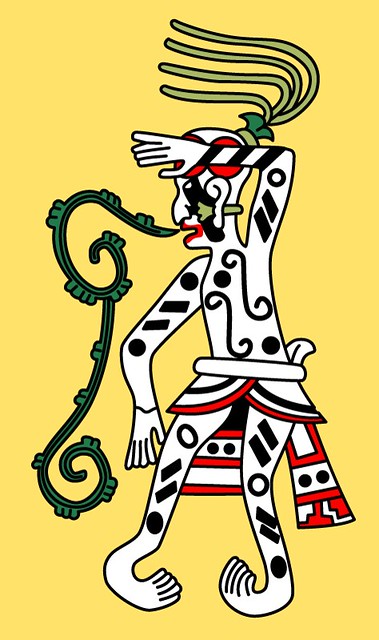
The corner the East is backed in today is a consequence of the False Flag history presented by the ruthlessness of the liberal West, even as it imitated the ruthlessness of one Emperor Alexis I, who destroyed Eastern Christianity with one push that cost its spiritual leader his life. That push is a story all by itself, now well camouflaged behind the Aztec story of Nanauatzin’s http://en.wikipedia.org/wiki/Nanahuatzin (image: http://farm9.staticflickr.com/8214/8343920314_90031212ec_z.jpg ) heroic leap into a fiery pit at the sacred city of Tenochtitlan in Mexico. This story cannot be found in historical accounts in the East or West, but Book 7 of the Florentine Codex http://en.wikipedia.org/wiki/Florentine_Codex  recorded by Bernardino de Sahagun a Franciscan monk http://en.wikipedia.org/wiki/Bernardino_de_Sahag%C3%BAn . Sensational, as such a replacement of a historical event in EuroAsia of the East may be, it is unlikely that it is mere happenstance that Sahagun was a Franciscan monk and the place to tell the truth happens is transferred to a newly discovered continent. What Sahagun reflects is an event in Constantinople affecting the Bogomils several centuries before the defeat and neo-Christianization of the Mexican people http://www.cathar.info/121212_comnena.htm .

Such juxtapositions of events is an ‘old’ tool employed by schemers sequestered in ‘think tanks’ in the West, and is employed to this day, because Common Man simply cannot imagine such dishonesty as the basis of history.

The reason the East has come to a desperate situation is that up to this time, there always was another step and a space to retreat to. This allowed the West to expand not only as colonizer of Eastern territories, but when colonization as such stopped, was able continue to short circuit economic exploitation by means of technology over Nature, not to mention make the Vatican a dictator over the chronology of history. Strange as it may seem, a major tool in the hands of the West is an ‘Early Christianity’, which  today we know as Islam, and which almost no one believes has its origins in Christianity. Today, the closest we get is as at the following link, re: encounter of eastern Christianity with early islam:  http://www.brill.com/encounter-eastern-christianity-early-islam .

For the cultures of the East (that of Russia, China, Iran, India) to regain their ground vis a vis the West and to neuter the ‘terrorists’, these have to respond to Western cynicism less with arms than with reeducation undermining of its intellectual presumptions.


Wednesday, May 1, 2013

Eso’s Chronicles 163
The Forgotten Christians of Tibet (7-2)
© Eso A.B.

I know of course that Christianity is supposed to have originated with the birth of Jesus in Bethlehem. For a long time, I, too, held to that belief, but the paradox of Christianity: that it acted more like a secular religion than a spiritual religion took its toll. It made no sense why religion should be so empty of ideas and will to resist the rampage of capitalism. I began to investigate the sources of Christian beginnings.

First of all, were historical sources of Christianity itself, and those who disputed these sources. In due course, I realized that the story of Christianity that is being propagated in our day and for some centuries in the past, may be a false Flag story, perhaps even a False Flag.

The first solid touchstone for the story of Jesus as a False Flag was my discovery of an alternate version for the story of King Oedipus by the Greek writer Sophocles. Rather than go along with tradition and Freud and see the play as a story of mother and son incest, I discovered—through my long time curiosity about the whyfores of ancient human sacrifice—that the story could even better be interpreted as a story of betrayal of religion http://oedipusrexrewritten.blogspot.com and community.

The second step, the discovery of the real story about Jesus, came quickly soon thereafter. Having read Anna Comnena’s “The Alexiad” and coming across the story of the Bishop Polycarp of Smyrna in Bart Ehrman’s fabulous book “Lost Christianities”, I realized that the story of Polycarp is a twin to the story of Basil the Bogomil in “The Alexiad”. True, the available stories tell us that Polycarp merely imitated Jesus; however, it is just as believable that Jesus’s name was replaced by that of Polycarp http://en.wikipedia.org/wiki/Polycarp . The meaning of the name ‘rich in fruit’ http://www.behindthename.com/name/polycarp is consistent with that of praise for a king, Basil, or, for that matter, Jesus. Besides, the name ‘karpos’, fruit, has an easy pareidolic association with ‘carp’, a fish. In days past, carp was the main ingredient in a dish of the poor, re gefilte fish http://en.wikipedia.org/wiki/Gefilte_fish .

Once I got that far into the labyrinth, I began to suspect that the assignation of religion to a specific originator was a story not likely to be true either.

The evidence for this came from my ethnic inheritance, the Latvian language. It happens that in Latvian the most needed teaching for the solidarity of a community is passed from parents, especially the mother, to children by way of the Latvian language itself. This is not by do or don’t directives, but by word inflections imbedded in the language, the inflection that makes a word an endearment. The Latvian language is capable of endearing every word that touches object and subject, including verb. Therefore, if a child is taught to use endearments, a Latvian was/is able to endear (no doubt, with irony) even his-her enemy. Unfortunately, due to the close interlink, neither the pedagogic or political systems are interested to pass this inheritance along.

For this linguistic phenomenon to occur and maintain its potential (though ignored) to our day, not only must a language be extremely old and untouched by a superego dictating laws from above, it likely enjoyed many centuries of freedom and experienced itself as being a worthwhile and practical tool of social intercourse.

Such discoveries as above, also led me to see the name of ‘John’, which has many cognates http://en.wikipedia.org/wiki/John_(given_name) (and the link gives only an inept sketch of the extensive use the name has been put to), in a new light. The name obviously reaches thousands of years into the past. One of the common links between the many cognates is that they denote travel, moving, roads, guardianship (jandarme), animal herding, kingship (Gengis), and sacred office. Of the latter, I especially note that the name of Mohammed, also lends itself to the pronunciation of Yohammed or Johan(m), i.e., John. It led me to see that the cognates were not limited to the consonant j or g as the first letter of a name, but that numerous consonants, such as b, d, g, h, j, p, v, w, and all the vowels were put to use as well.

One of the tools that I use to make my discoveries is pareidolia. A widely and deliberately overlooked method in scholarly circles, pareidolia is a device used by ‘the poet within’ every one of us. While our conscious self may pay no attention to parallel meanings or sounds, ‘the poet within’ may pick up on it without much effort or guilt. This often happens through words in a song, especially rhymes, either at the end of lines or imbedded in the text.

One word that could long ago have been put to better and more accurate use is ‘pagan’, but because of rigid academism never was. The word is far more telling when pronounced ‘pa-yan’, because then we clearly see that the prefix ‘pa-’ is meant as a put-down to the name of ‘Yan’. A full explanation will take more space than I have here, but  the pronunciation ‘pagan’ is trying to eliminate the association of ‘pa-yan’ with an archaic form of Christianity better pronounced as ‘cross-yan’ (X-yan), The prefix ‘pa’ erases the ‘X’ by reducing it to ‘pa’. X is of course nothing but a mark for a cross road , which is a place to gather and confer.

An entirely different story may be accessed through the name of ‘uriankkai’ http://en.wikipedia.org/wiki/Uriankhai , a forest dwelling people closely associated with the Evenks (see below). The Uriankha may have contributed to such modern names as Juri (a cognate of George), and by way of Korean to ‘orangutan’ (yorang…).

Having reached this level of familiarity and confidence, I began to look for patterns that might indicate the use of language as a tool to pass along communal values. Another language (aside from Latvian) that I read had the ability was the above mentioned Evenks (also known as Tungus) http://www.hunmagyar.org/turan/evenk/ , a herding people, who once used to follow reindeer herds with the seasons. I noted that if ‘evenk’ were to derive from the verb ‘to herd’, the verb of Jahnis (John) in Latvian would have been ‘to yanc’, which may have led to the verb ‘to dance’, originally meaning to milling around. When looking for information about the Evenk language, found little of the kind of information I was looking for. Academics appear mainly interested in grammar, not what a language aside from subject and object communicates or that it transforms itself with the help of pareidolia.

This is a long way about to come to the Tibetan people of whose efforts to resist their cultural elimination by the Chinese government through self-immolation is in current news. This Wikipedia link http://en.wikipedia.org/wiki/Religion_in_Tibet mentions that Christianity has been noted in Tibet in the early 5th and 6th centuries. Along with my theory that communal-moral-religious values were passed on through language, I suggest that indeed Tibetan Christianity preceded Western Christianity. If Bön, said to be a shamanistic Tibetan religion, may also be pronounced as Yon, then we have a link not through any specific historical name, but a transmission of religious values by their imbedment in sound http://www.youtube.com/watch?v=R_K_mMhZrPs  and languages.

Incidentally, Islam and early Christianity have the same roots, rather than the divisive separation created by secularist extremists on either extreme.