© Eso Antons Benjamins, a.k.a. Jaņdžs
NOT-VIOLENT TERROR
69 Climbing Mt. Citheron (II)
There is only one thing that is sufficiently inspired to bond a dysfunctional and dying old community that wants to yet live and see a better day. And there is only one thing that will bond a community that wants to rise. It is death. I am thinking of death as a willful occasion for self-sacrifice to create and/or maintain a community. I said so in the previous blog, and I repeat it here.
I propose that in order to survive as a community that will outlast a government that cultivates corruption as part of its root system, Latvians (and every people) need to discover some means to counter this regressive phenomenon. One means is through the application of a not-violent terror or, if you will, a way of death that will serve the will to live as it is given not only by Nature, but by the Nature of a psyche that has the power to will itself into being as a community. The alternative, as always, is death in bed.
A community cannot survive for long on the credits it imagines it has earned from a society that for some time has been dumbed down by capitalist interests. Such a dumbing down is often not admitted to by the first generation experiencing it, which is why a community may survive long enough for the next generation to grow up in complete unawareness of the facts. Sadly, the Latvian community’s seed pod has been so infiltrated by individualist rot and divisiveness (Latvians observe this divisiveness in themselves as “a manifestation of materialistic jealousy among outselves”) that it no longer knows that individuation and not individualization is what makes a community possible. Why is individuation preferable to individualism? Well, for one, it enables one to listen to all the intrusive advertising with a critical ear and know that behind it stands not a presumably infallible God, but a God whose Word was, is, and will remain unsubstantiated.
Unfortunately, Latvians today are bound to a string of Gods. There is the God of Ostentatious Cars; the God of Hunters and Hunters’ Orgies in Finnish style saunas; the God of Illegal Fishermen; the God of Chainsaws which buzz down trees. The next to last God is called Money. Money is bound, in turn, to the last of the Gods, God. What this last God looks like no one knows. Some say that for $10,000 anyone can call him, and God will turn the video on himself. However, the poor do not have such money, and the wealthy are not telling. When this writer went to search the internet, the rumored price was close to $100,000 per minute of looking. I decided to save up another $100,000, because the ads claim that for just $200,000 a seat, in a few years all that have such a sum can visit outer space in “SpaceShipTwo” rocket, made by a company named Virgin Galactica, which is owned by Richard Branson the Perpetual Youth. I imagine that for the money, Branson will also introduce us to God, who will come dressed in light reflecting armor made of a thousand fractured mirrors and issue some profound question such as “How now brown cow?”
The reader may not find my jokes funny, but anyway one looks at it, it tells of one of the reasons why today there are so many Latvians who are into individualism, and why the individualist’s secret (they will deny it) dream job is to be a politician. It is the perception that counts and, of course, the power to cause lies to levitate long enough to be forgot they are lies. If the population is dumbed down by an education system that makes no attempt to teach history, it helps put most lies in the past tense and have it serve as a long-term tool of social control. When the lie is discovered—and the day is sure to come—the pyramid of power collapses and we all die under the falling rubble.
Such a day of reckoning is facing most of the world today. On the world stage, it is revealed by the crumbling American dollar. Absent life and death controls and given over to manipulations of private financiers, the dollar has been the beneficiary of a virgin birth ever since the creation of the Federal Banking system. Nevertheless, suddenly, we discover that virgin birth has been nothing more than a charade, an act by government printing machines. True, the system still levitates, but then again, I have heard tell of the woodcutter who saw the tree falling straight toward him, and was so amazed it should happen that he never moved.
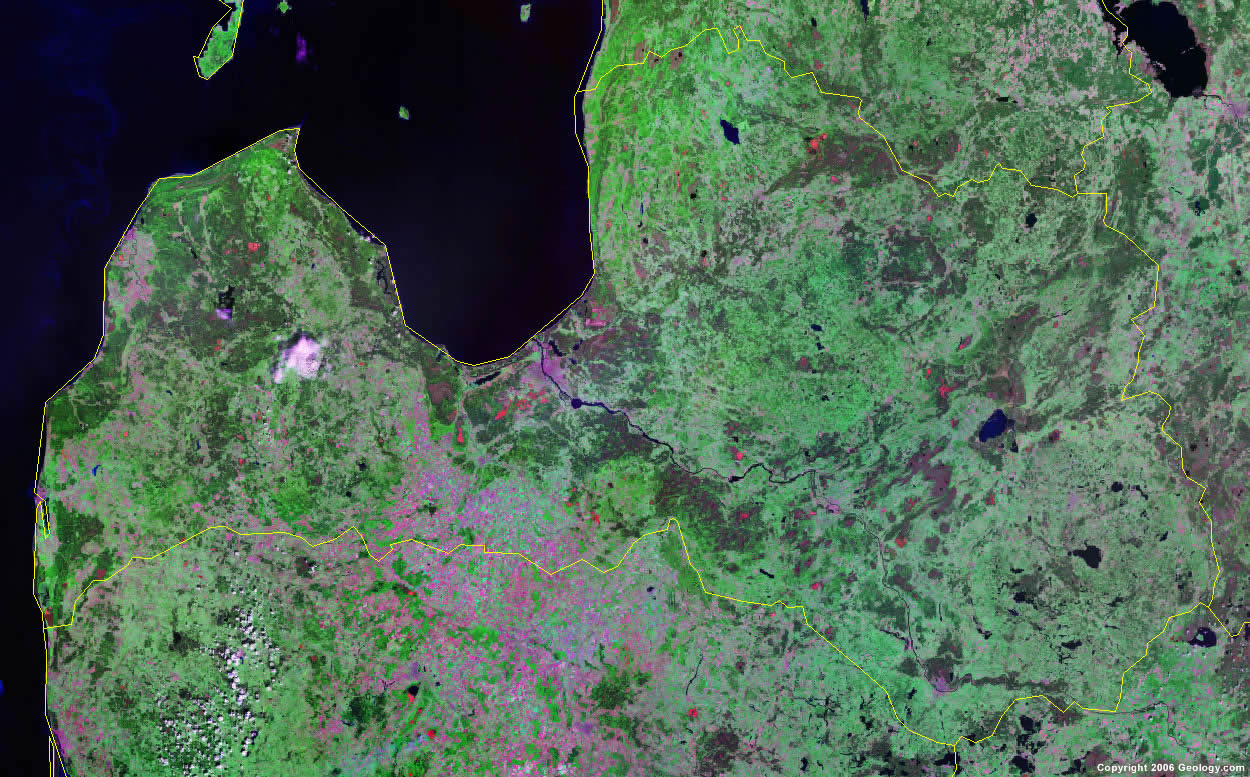
The Big Problem for Latvians is money as well. While money was to be had, it did not matter that the people, demoralized by several centuries of social instability and repressions of various sorts, no longer knew who they were. Naked life or what the Greeks called Zoe, and having a language were all that was thought to be necessary to form a government. For its part, the government maintains various old myths, the favorite being that of BearJawBreaker (Lahchplehsis), who, we are told, is a true Latvian. Having replaced the old community totem, Jahnis (John) with BearJawBreaker (the figure of Samson in Luther’s Illustrated Bible) over a hundred years ago, Latvians lost their sense of having had a past marked by their own traditions of the sacred. God, once a signifier signifying All or Allness, became filled with blood-red jelly, which was so real that it was removed to a place somewhere beyond the skies where it has been bleaching into pink ever since. The Holy days or Johns Days, culminating on Midsummer Eve or Johns Eve, became a ‘Family Day’ for some, but a day to get drunk for most young men. The songs of Johns or ‘Lihgo’, which once served to project the individuated skills of the participating singers (one was the leader, another the quick wit, yet others the sopranos and tenors, etc.) were forgotten. The people stood naked, so to speak, while the moneyed among them started going to ‘concerts’. Then, suddenly, Boom! yesterday, today, and tomorrow no more money; people leaving in droves for Ireland, England, wherever; suicides and alcoholism again on the increase. Who in such a ‘time of troubles’ has time to remember the Kingdom of Jersika of 1209 with its proto-Latvian inhabitants, most of who probably knew themselves as “Johns Children”, who visited and were visited by the Cathars of Languedoc, France, and who round about that time were chased into the swamps? Came 1209, the Pope put an end to the Jersika (Jerusalem) and the Cathars of Languedoc. Today the overwhelming feeling pervading Latvia is that of lost identity, even of the little that was believed to belong to ‘native’ traditions until about a century ago. [No, I am not speaking of ‘kultur’, which came with the 20th century.]
One often hears the phrase that when attacked, the best form of defense is a counter-attack. Perhaps the first thing that Latvians ought to remember is that they do not need to be cowering when it comes to saving their community—either in foreign chanceries or with regard to their own politicians. This is not to say that Latvians need war, nor could Latvians win a war as war is conventionally defined. Nonetheless, the community needs a war, or, to twist Clausewitz’s famous phrase that “war is diplomacy by other means”, the community needs to resist the annihilation it is facing by more effective means than the ludicrous positivism Latvian politicians campaign on in a nation they have stolen. The loaning of a people’s sovereignty to the corrupt and implicitly violent ones by politicians for the purpose of having a well paid job raises a nauseous stench. Latvia is not the only place this is happening. This is why the cardboard president of another country bows his head before the Nobel Peace Prize. This is why the sermon by the President of Latvia for Latvians: “Do not be afraid of the birth of Jesus” (24-12-2009). Still, the sponsorship, the exiling of John to welcome Jesus, does not fit well with the Latvian people’s historical character, which has little to do with the ruling partidocratic ‘kultur’ occupying the chairs in Saeima and Cabinet Ministers’ room.
Surprise of humiliating surprises! The Latvian peoples historical character is to be sought in the colloquial endearing word [Ieviņa for Ieva (Eva), Jahnihtis for Jahnis (John), for example], and the Latvians are grateful that every minority in their country originates in a language that knows and uses it.
The question of how to deal with the theft of their sovereignty and meager material resources is a question of survival for all cultural entities that have found domicile in Latvia. This is why Latvia needs a domestic and foreign policy all its own. However, alas! Latvians also know that their Foreign Ministry officials will not find the endearing word worthy of foreign policy. They know that the endearing word cannot be found in either today’s public media or among the documents of a government that neither speaks, writes or knows of such words. However, they know that for the lack of knowing it, we are having today’s revelations.
Asterisk & Notes of Interest:
On material deprivation in Latvia.
On the theme of “more-equal-than-others”, re: Animal Farm.
Of great interest to me this and like articles. It presents some of my reasons for supporting the cultivation of Johns Grass in Latvia.
These blogs tend to be a continuum of an idea or thought, which is why—if you are interested in what you read—you are encouraged to consider reading the previous blog and the blog hereafter.
Partial entries of my blogs may be found at LatviansOnline + Forum Home + Open Forum –ONLATVIANPOPULISM vs LATVIJASLABEJIE. If you copy this blog for your files, or copy to forward, or otherwise mention its content, please credit the author and http://esoschroniclnes.blogspot.com/
Friday, January 1, 2010
Tuesday, December 29, 2009
© Eso Antons Benjamins, a.k.a. Jaņdžs
NOT-VIOLENT TERROR
68 Climbing Mt. Citheron (I)
“Not-Violent Terror” is a charismatic element more commonly known as death. I believe that the reader readily understands why death is not-violent at the same time that it is ‘terror’ at least to those who have not learned to accept it. One of the reactions against the ‘terror’ of death is well expressed in the words of Dylan Thomas, the Welsh poet, in his poem: “Rage, rage against the dying of the light.” However, for all that an individual may rage against death, it is the element that is essential in the creation-building and maintenance of all long-term communities.
Some anthropologists and philosophers call such community founding deaths “founding violence”. Most expect “founding violence” to be aggressive and violent and directed at an “enemy”. Such ‘cooked-up violence’ is evident in the Zionist settler movement which uses a fabricated myth to justify the use of violence against indigenous Palestinians. For my part, I focus on not-violent death, that is, a violence denying death, from whence the title of this series.
My understanding of “founding violence” includes demonstrative deaths by individuals who wish to impress on their community the importance of social consciousness and solidarity, at the same time as they demonstrate that solidarity is not a given matter. I already have mentioned the Greek philosopher Socrates and his demonstrative death as an example of what I have in mind. Another example that I have mentioned is that of Adolfs Buķis of Latvia. Of course, neither the death of Socrates, or Buķis (Buchis), or Gandhi, or Jesus was without an element of self-directed violence. All these men purposely left open one or many doors for violent attacks against them. While I have little respect for the neo-Christian church for its failure to acknowledge that it came to its influence by way of serving the interests of secular princes, I respect the current Catholic Pope for leaving himself open to the “bumping” he received recently while on his way to say mass. It may be a hint that the neo-Christian church is maturing and coming out of its centuries long nihilist phase, best known for justifying and supporting “just wars” in unjust causes.
I believe it is unconscionable to deny any human being a death that he or she wills and executes by his-her own hand—as long as it causes no physical harm to another. I grant the ‘saviors’ that I, too, am against ‘suicide’, especially by the immature young. The more than 32,000 annual deaths in America (from a total of about 130 million inhabitants) and 527 deaths in Latvia (from a total of about 2.3 million inhabitants) that are the result of ‘suicide’ are a terrible commentary on the stressed social structures in which we are forced to live. On the other hand, if these ‘suicides’ were willed by mature minds and exercised in the name of ‘politics’, I would carry a sign supporting these sacrifices as “political action” of the highest caliber.
With regard to the political situation in Latvia, I mention Adolfs Buchis’s death (1993) in protest of government corruption. Buchis’ death occurs also in the context of ‘founding violence’. He discovered that self-sacrifice was essential for a realistic success of post-‘refounded’ Latvia (1991). For Latvia and perhaps the world, its renewed status as a sovereign nation was a moment of major historical importance, because—as we shall see below—the manner in which a ‘refounded’ Latvia was wired together, and the way it has played out during these years, 1991-2009, not to mention the happenstance that the world as a whole is going through a similar social, financial, and economic crisis, presents Latvia with the opportunity to solve some of the problems plaguing the world by how it solves its own. The opportunity arises from the fact that it is easier for a small ship of state to maneuver on the waters than a ship called “Titanic”. This is not to say that all Latvians wish to seize the opportunity. Many surely do not, but some may think on it, because the dying of the light in Latvia will not reverse itself because of wishful thinking.
Though the state of Latvia was reestablished on the 4th of May, 1991, and five people (two bystanders, two cameramen among them) died from live fire by Omon on January 21 of that year, two years later, in 1993, it was clear to Adolfs Buchis, a tool and dye maker from Jelgava, that the founding violence of 1991 had not reached deeply and effectively enough into of the post-Soviet Latvian social fabric to prevent the “stealing” of Latvia for the benefit of oligarchic interests. No doubt, those in power celebrate ‘the days at the barricades’ with projections of heroic myth, for example, by portraying BearJawBreaker (Lahchplehsis/ Lāčplēsis) http://www.bank.lv/images/img_lb/naudas/images/barikades_rev.gif at the barricades, and reintroducing neo-Christianity, with the President of Latvia taking the role of a neo-Christian evangelist. Nevertheless, a less sentimental analysis of the months of 1991, show that while indeed the expectations of the people were great (as we can see in pictures here and here) and that demonstrations and the reaction of authorities prove a high level of anxiety, the pain was not nearly such that those with political connections in the bureaucracy (which was never shown the door) could not subsequently test, find the new political system wanting, and “steal the country” from under the noses of the majority of Latvians. The Latvian nation beyond the region of Riga (and even in Riga) had no imaginary inkling of what the days centering on January 21, 1991, demanded of them. Of course, the people were happy to be ‘free’, but the lack of sufficient breadth to the ‘founding violence’ left a gap large enough for Adolfs Buchis perception that further efforts to try close with the self-sacrifice of his life was necessary. Buchis no doubt meant not only to bring attention to the theft of the country, but hoped that others may join in similar protests. Not surprisingly, the authorities found Buķis to be ‘mentally unbalanced’. Though they promised an investigation, it never took place. The written note or notes in Buchis pockets were never published, because the Latvian media never pursued the matter further. Very likely the editors were warned by the government that to pursue the matter [originally there was considerable publicity, especially in the newspaper “Atmoda” (long ceased publication) and Jelgava media] risked rousing ‘populist’ sentiments [against the government (corruption)]. Hindsight suggests that the ‘mentally unbalanced’ label attached to Buchis by government (by way of statements from Police officials in Riga) was not a matter of gratuitous innocence such as governments tend to automatically project, but at one level or another served those who had ‘stolen’ the nation’s sovereignty to serve their interests.
This is why this and the next few blogs are titled “Climbing Mt. Cytheron”. Mt. Cytheron is the holy mountain on which Oedipus as a newborn was to be exposed to the elements to see if he was fit to live and be raised to become King. Oedipus escaped the risk through the interference of his mother. The mother’s motives may have been part of an effort to regain for the feminine gender its stolen kingdom. One may argue that the interpretation is far fetched, except when we remember what is at stake. (For the play "Tiresias' Revenge", see blogs 40-47.)
Which is why “not-violent terror” does not necessarily deny ‘violence’ (a deadly moment), but, paradoxically, emphasizes its centrality. It is one of the raisons de etre of this series. I write on the subject as much to discover my own thoughts as to bring along anyone interested in the journey. The difference from a writer of a book in longhand and a writer of blogs is that blogs are ‘chapters’ and occur almost simultaneously in, both, public and private space. Some may object to this exhibitionism, to which I can only answer that I hope they will ignore my foolish persistence and pass by. One thing though, if the material ever finds itself on a disk for sale, there are likely to be three books—the original copy on the internet at http://esoschroniclnes.blogspot.com/, as link at this site, and an edited copy on the shelves of bookstores.
Asterisk & Notes of Interest:
On material depravation in Latvia.
On the theme of “more-equal-than-others”, see Animal Farm.
Of great interest to me this and like articles. It presents some of my reasons for supporting the cultivation of Johns Grass in Latvia.
These blogs tend to be a continuum of an idea or thought, which is why—if you are interested in what you read—you are encouraged to consider reading the previous blog and the blog hereafter.
Partial entries of my blogs may be found at LatviansOnline + Forum Home + Open Forum –ONLATVIANPOPULISM vs LATVIJASLABEJIE. If you copy this blog for your files, or copy to forward, or otherwise mention its content, please credit the author and http://esoschroniclnes.blogspot.com/
NOT-VIOLENT TERROR
68 Climbing Mt. Citheron (I)
“Not-Violent Terror” is a charismatic element more commonly known as death. I believe that the reader readily understands why death is not-violent at the same time that it is ‘terror’ at least to those who have not learned to accept it. One of the reactions against the ‘terror’ of death is well expressed in the words of Dylan Thomas, the Welsh poet, in his poem: “Rage, rage against the dying of the light.” However, for all that an individual may rage against death, it is the element that is essential in the creation-building and maintenance of all long-term communities.
Some anthropologists and philosophers call such community founding deaths “founding violence”. Most expect “founding violence” to be aggressive and violent and directed at an “enemy”. Such ‘cooked-up violence’ is evident in the Zionist settler movement which uses a fabricated myth to justify the use of violence against indigenous Palestinians. For my part, I focus on not-violent death, that is, a violence denying death, from whence the title of this series.
My understanding of “founding violence” includes demonstrative deaths by individuals who wish to impress on their community the importance of social consciousness and solidarity, at the same time as they demonstrate that solidarity is not a given matter. I already have mentioned the Greek philosopher Socrates and his demonstrative death as an example of what I have in mind. Another example that I have mentioned is that of Adolfs Buķis of Latvia. Of course, neither the death of Socrates, or Buķis (Buchis), or Gandhi, or Jesus was without an element of self-directed violence. All these men purposely left open one or many doors for violent attacks against them. While I have little respect for the neo-Christian church for its failure to acknowledge that it came to its influence by way of serving the interests of secular princes, I respect the current Catholic Pope for leaving himself open to the “bumping” he received recently while on his way to say mass. It may be a hint that the neo-Christian church is maturing and coming out of its centuries long nihilist phase, best known for justifying and supporting “just wars” in unjust causes.
I believe it is unconscionable to deny any human being a death that he or she wills and executes by his-her own hand—as long as it causes no physical harm to another. I grant the ‘saviors’ that I, too, am against ‘suicide’, especially by the immature young. The more than 32,000 annual deaths in America (from a total of about 130 million inhabitants) and 527 deaths in Latvia (from a total of about 2.3 million inhabitants) that are the result of ‘suicide’ are a terrible commentary on the stressed social structures in which we are forced to live. On the other hand, if these ‘suicides’ were willed by mature minds and exercised in the name of ‘politics’, I would carry a sign supporting these sacrifices as “political action” of the highest caliber.
With regard to the political situation in Latvia, I mention Adolfs Buchis’s death (1993) in protest of government corruption. Buchis’ death occurs also in the context of ‘founding violence’. He discovered that self-sacrifice was essential for a realistic success of post-‘refounded’ Latvia (1991). For Latvia and perhaps the world, its renewed status as a sovereign nation was a moment of major historical importance, because—as we shall see below—the manner in which a ‘refounded’ Latvia was wired together, and the way it has played out during these years, 1991-2009, not to mention the happenstance that the world as a whole is going through a similar social, financial, and economic crisis, presents Latvia with the opportunity to solve some of the problems plaguing the world by how it solves its own. The opportunity arises from the fact that it is easier for a small ship of state to maneuver on the waters than a ship called “Titanic”. This is not to say that all Latvians wish to seize the opportunity. Many surely do not, but some may think on it, because the dying of the light in Latvia will not reverse itself because of wishful thinking.
Though the state of Latvia was reestablished on the 4th of May, 1991, and five people (two bystanders, two cameramen among them) died from live fire by Omon on January 21 of that year, two years later, in 1993, it was clear to Adolfs Buchis, a tool and dye maker from Jelgava, that the founding violence of 1991 had not reached deeply and effectively enough into of the post-Soviet Latvian social fabric to prevent the “stealing” of Latvia for the benefit of oligarchic interests. No doubt, those in power celebrate ‘the days at the barricades’ with projections of heroic myth, for example, by portraying BearJawBreaker (Lahchplehsis/ Lāčplēsis) http://www.bank.lv/images/img_lb/naudas/images/barikades_rev.gif at the barricades, and reintroducing neo-Christianity, with the President of Latvia taking the role of a neo-Christian evangelist. Nevertheless, a less sentimental analysis of the months of 1991, show that while indeed the expectations of the people were great (as we can see in pictures here and here) and that demonstrations and the reaction of authorities prove a high level of anxiety, the pain was not nearly such that those with political connections in the bureaucracy (which was never shown the door) could not subsequently test, find the new political system wanting, and “steal the country” from under the noses of the majority of Latvians. The Latvian nation beyond the region of Riga (and even in Riga) had no imaginary inkling of what the days centering on January 21, 1991, demanded of them. Of course, the people were happy to be ‘free’, but the lack of sufficient breadth to the ‘founding violence’ left a gap large enough for Adolfs Buchis perception that further efforts to try close with the self-sacrifice of his life was necessary. Buchis no doubt meant not only to bring attention to the theft of the country, but hoped that others may join in similar protests. Not surprisingly, the authorities found Buķis to be ‘mentally unbalanced’. Though they promised an investigation, it never took place. The written note or notes in Buchis pockets were never published, because the Latvian media never pursued the matter further. Very likely the editors were warned by the government that to pursue the matter [originally there was considerable publicity, especially in the newspaper “Atmoda” (long ceased publication) and Jelgava media] risked rousing ‘populist’ sentiments [against the government (corruption)]. Hindsight suggests that the ‘mentally unbalanced’ label attached to Buchis by government (by way of statements from Police officials in Riga) was not a matter of gratuitous innocence such as governments tend to automatically project, but at one level or another served those who had ‘stolen’ the nation’s sovereignty to serve their interests.
This is why this and the next few blogs are titled “Climbing Mt. Cytheron”. Mt. Cytheron is the holy mountain on which Oedipus as a newborn was to be exposed to the elements to see if he was fit to live and be raised to become King. Oedipus escaped the risk through the interference of his mother. The mother’s motives may have been part of an effort to regain for the feminine gender its stolen kingdom. One may argue that the interpretation is far fetched, except when we remember what is at stake. (For the play "Tiresias' Revenge", see blogs 40-47.)
Which is why “not-violent terror” does not necessarily deny ‘violence’ (a deadly moment), but, paradoxically, emphasizes its centrality. It is one of the raisons de etre of this series. I write on the subject as much to discover my own thoughts as to bring along anyone interested in the journey. The difference from a writer of a book in longhand and a writer of blogs is that blogs are ‘chapters’ and occur almost simultaneously in, both, public and private space. Some may object to this exhibitionism, to which I can only answer that I hope they will ignore my foolish persistence and pass by. One thing though, if the material ever finds itself on a disk for sale, there are likely to be three books—the original copy on the internet at http://esoschroniclnes.blogspot.com/, as link at this site, and an edited copy on the shelves of bookstores.
Asterisk & Notes of Interest:
On material depravation in Latvia.
On the theme of “more-equal-than-others”, see Animal Farm.
Of great interest to me this and like articles. It presents some of my reasons for supporting the cultivation of Johns Grass in Latvia.
These blogs tend to be a continuum of an idea or thought, which is why—if you are interested in what you read—you are encouraged to consider reading the previous blog and the blog hereafter.
Partial entries of my blogs may be found at LatviansOnline + Forum Home + Open Forum –ONLATVIANPOPULISM vs LATVIJASLABEJIE. If you copy this blog for your files, or copy to forward, or otherwise mention its content, please credit the author and http://esoschroniclnes.blogspot.com/
Labels:
Dylan Thomas,
founding violence,
John,
Johns,
Latvia,
Latvian
Saturday, December 26, 2009
© Eso Antons Benjamins, a.k.a. Jaņdžs
NOT-VIOLENT TERROR
67 The Future of The Wuerzeltod (V)
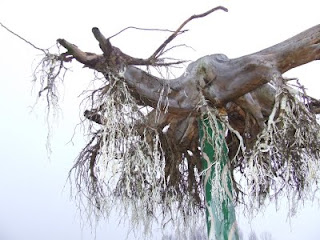
With levitation so capably performed on the deck of their sinking ship, moreover with such surreal earnestness on the faces of the high-end lumpenproletariat preparing itself for next year’s elections, the disconnection from reality may seem only virtual. Nevertheless, it is no fake uprootedness such as nearby treetops may reflect in a pond. After all, all the presidents, current and former, wishing to prove that they are not completely out of touch with reality attended church together and listened to the Lutheran Archbishop transmit a message from high above.
To be uprooted may not be as severe a condition as being Wuertzeltod. This is why hope prevails that the disconnections (neglect of education, health care, desertification of the land by deforestation, etc.) have not yet overwhelmed the body with total paralysis. Perhaps Latvians may yet grow conscious of their condition and attempt to grow new roots.
If being ‘uprooted’ is a curable condition, then sinking new roots is also possible. All the same time, it is no longer a matter of the current government saying so. The government (if not its officialdom) is dead (with some administrative functions, like the cut off tail of a lizard, are still thrashing about). The survival of Latvia as a culture under the umbrage of the current leadership as if guarding the people’s sovereignty is no longer possible. It is now entirely up to the people and the nature of their populist sentiments. Whether there is sufficient charisma left among the ranks to prevent death of the community only the future will tell. One may, however, be skeptical, because while personal tragedies as expressed by an increasing number of suicides are on the rise, none yet express themselves as sacrifices for the community.
It is up to the people—for the first time since the kingdom of Jersika in 1209—if they will remember and then accept their roots in the community of the Children of Johns and allow a rediscovered consciousness to define them as a people again. To prevent a still-birth the people need to remember that their loss—if once it could be stated in terms of loss caused by outsiders—that now it is 1) due to visitations of violence from a virus that has become internalized, and is pretending to be as ‘natural’ a gene as ‘original sin’ once was; 2) this internalization of the ‘bad’ gene is going unrecognized due to upteen ‘positivism’ campaigns, not to mention a shortage of social critics and analysts; and 3) due to a failure to understand that internalized violence can only be purged with a cleansing violence, also known as ‘founding violence’.
No doubt, founding violence is problematic issue. Thinking the problem through with the head is one thing; working it out in real life is another. Thinking with the head will not in and of itself create new roots or if created cause them to take root. A charismatic element is needed. And, indeed, I have been pointing at this need sometimes directly, sometimes indirectly, sometimes merely hinting at it since Blog 1. The need has been yeasting for a long time now, and it not only wants, but needs to break open for the sake of the survival of a vital tradition, overcome our disconnectedness from it, and survive as a people. If this does not occur, if the elite are permitted to dismiss populism yet again (they surely did it before 1918, and have been doing it ever since) with campaigns of ‘positivism’, and populist sentiments fail to send them on their way, then good bye Jersika, Baumaņu Kārlis, Rainis, sovereign state of Latvia, the pains and scars of 1941 and 1949, the People’s Front, and all that. As the saying goes, then “lyur, lyur, lyur”, the debt incurred by the government is not toward a better day, but for the bailing out of the Parex Bank and as Latvia’s burial fee.
The readers of “Not-Violent Terror” blogs ought to know that the charismatic element that this writer believes to be necessary is “death”. Of course, I am speaking of a not-violent death. This is why in the previous blog, I mentioned Socrates. Was his death a violent one? My answer is that violence by Socrates is imaginable only if we dare not or forbid ourselves to imagine a self-willed death in the service of the community. There is no charismatic other element sufficiently inspired to root and bond a community than death, i.e., self-sacrificial death. Socrates knew that, and it is not beyond our understanding.
In order to survive as a community Latvians need to rediscover not only not-violent terror, but the reasons for death. Death needs to be put in service of the will to live brought to us not only by Nature, but as the Nature of the nature of our psyche. As Michael Taussig, an anthropologist put it: “…it is useful to think of mimesis as the nature culture uses to create second nature, [but] the situation now is that this famous second nature is foundering and highly unstable.”* I am citing this passage, because to my understanding, second nature may refer to a second culture as well. In other words, if the first culture of humankind resembles that of the people from Fiero del Fuego in 1832, with absolute equality and no leadership as the prevailing cultural form, then what comes between it and our ‘advanced’ culture a la 2009 where banks control governments?
The answer is not in a five minute discussion. For one, such a discussion must remember that “Western civilization” willed itself to forget that the middle road could get us to “Most Advanced Civilization” status with no violence and with no ‘No-Future’ sign barring the road ahead. Why is Latvia so anxious to join this dead-end form of ‘Most Advanced Civilization’, when the latter has identified itself with war and violence to such an extraordinary degree?
The silence on this issue by the Latvian government, its Foreign Ministry in particular, is a practiced silence on behalf of a military system of defense. Does not a military force of European nations serve the EU (and Latvia) better than it being at the behest of NATO? One should think so. However, Latvians are consistently warned by the media that only NATO can protect us from Russia, the god-awful-giant-ever-gorging-Bear on the country’s eastern border. In other words, the Latvian public media is operating as much in a straight-jacket when it comes to thinking out loud than it was under any other regime of occupation.
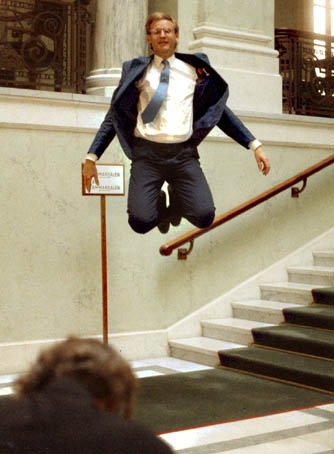
Incidentally, this writer has no trouble in visualizing the Soviet Army oppressing Latvia. I know well the brutality of the Stalinist regime from way back into my childhood and the prevailing ‘atmosphere’ in civil society at that time and during war ensuing. At the same time, with the Soviet regime gone and with no threat from the Russian government today, Latvia could elbow for itself more room than the visionaries at Latvia’s Foreign Ministry can muster [with apologies to the Swedish Foreign Miister (2007)]. In the setting that has led to and currently envelops Latvia in a financial and economic crisis, the Foreign Ministry gives the appearance of being in the service of “a greater will” (no transparency whatsoever as whom it may be) and having no will of its own. Once again, the Latvian people are being sacrificed to the ‘Lord’ (an empty signifier) above.
Once more one ought to remember that the act of Adolfs Buķis, the Latvian who sacrificed his life in an attempt to free Latvia of corruption in 1993 in Riga, issued an implicit plea for Latvians to think, speak, and do not as their government. That happened seventeen years ago. Alas, we now see that this cannot be done in a space where all those inside it are unfree and the ‘savior’ sits on his hands in Heaven.
Asterisk & Notes of Interest:
*Michael Taussig, Mimesis and Alterity, Routledge, 1993, p. 252.
On material depravation in Latvia.
On the theme of “more-equal-than-others”: Animal Farm
Of great interest to me this and like articles. It presents some of my reasons for supporting the cultivation of Johns Grass in Latvia.
These blogs tend to be a continuum of an idea or thought, which is why—if you are interested in what you read—you are encouraged to consider reading the previous blog and the blog hereafter.
Partial entries of my blogs may be found at Latvians Online + Forum Home + Open Forum –ONLATVIANPOPULISM vs LATVIJASLABEJIE. If you copy this blog for your files, or copy to forward, or otherwise mention its content, please credit the author and http://esoschroniclnes.blogspot.com/
NOT-VIOLENT TERROR
67 The Future of The Wuerzeltod (V)
With levitation so capably performed on the deck of their sinking ship, moreover with such surreal earnestness on the faces of the high-end lumpenproletariat preparing itself for next year’s elections, the disconnection from reality may seem only virtual. Nevertheless, it is no fake uprootedness such as nearby treetops may reflect in a pond. After all, all the presidents, current and former, wishing to prove that they are not completely out of touch with reality attended church together and listened to the Lutheran Archbishop transmit a message from high above.
To be uprooted may not be as severe a condition as being Wuertzeltod. This is why hope prevails that the disconnections (neglect of education, health care, desertification of the land by deforestation, etc.) have not yet overwhelmed the body with total paralysis. Perhaps Latvians may yet grow conscious of their condition and attempt to grow new roots.
If being ‘uprooted’ is a curable condition, then sinking new roots is also possible. All the same time, it is no longer a matter of the current government saying so. The government (if not its officialdom) is dead (with some administrative functions, like the cut off tail of a lizard, are still thrashing about). The survival of Latvia as a culture under the umbrage of the current leadership as if guarding the people’s sovereignty is no longer possible. It is now entirely up to the people and the nature of their populist sentiments. Whether there is sufficient charisma left among the ranks to prevent death of the community only the future will tell. One may, however, be skeptical, because while personal tragedies as expressed by an increasing number of suicides are on the rise, none yet express themselves as sacrifices for the community.
It is up to the people—for the first time since the kingdom of Jersika in 1209—if they will remember and then accept their roots in the community of the Children of Johns and allow a rediscovered consciousness to define them as a people again. To prevent a still-birth the people need to remember that their loss—if once it could be stated in terms of loss caused by outsiders—that now it is 1) due to visitations of violence from a virus that has become internalized, and is pretending to be as ‘natural’ a gene as ‘original sin’ once was; 2) this internalization of the ‘bad’ gene is going unrecognized due to upteen ‘positivism’ campaigns, not to mention a shortage of social critics and analysts; and 3) due to a failure to understand that internalized violence can only be purged with a cleansing violence, also known as ‘founding violence’.
No doubt, founding violence is problematic issue. Thinking the problem through with the head is one thing; working it out in real life is another. Thinking with the head will not in and of itself create new roots or if created cause them to take root. A charismatic element is needed. And, indeed, I have been pointing at this need sometimes directly, sometimes indirectly, sometimes merely hinting at it since Blog 1. The need has been yeasting for a long time now, and it not only wants, but needs to break open for the sake of the survival of a vital tradition, overcome our disconnectedness from it, and survive as a people. If this does not occur, if the elite are permitted to dismiss populism yet again (they surely did it before 1918, and have been doing it ever since) with campaigns of ‘positivism’, and populist sentiments fail to send them on their way, then good bye Jersika, Baumaņu Kārlis, Rainis, sovereign state of Latvia, the pains and scars of 1941 and 1949, the People’s Front, and all that. As the saying goes, then “lyur, lyur, lyur”, the debt incurred by the government is not toward a better day, but for the bailing out of the Parex Bank and as Latvia’s burial fee.
The readers of “Not-Violent Terror” blogs ought to know that the charismatic element that this writer believes to be necessary is “death”. Of course, I am speaking of a not-violent death. This is why in the previous blog, I mentioned Socrates. Was his death a violent one? My answer is that violence by Socrates is imaginable only if we dare not or forbid ourselves to imagine a self-willed death in the service of the community. There is no charismatic other element sufficiently inspired to root and bond a community than death, i.e., self-sacrificial death. Socrates knew that, and it is not beyond our understanding.
In order to survive as a community Latvians need to rediscover not only not-violent terror, but the reasons for death. Death needs to be put in service of the will to live brought to us not only by Nature, but as the Nature of the nature of our psyche. As Michael Taussig, an anthropologist put it: “…it is useful to think of mimesis as the nature culture uses to create second nature, [but] the situation now is that this famous second nature is foundering and highly unstable.”* I am citing this passage, because to my understanding, second nature may refer to a second culture as well. In other words, if the first culture of humankind resembles that of the people from Fiero del Fuego in 1832, with absolute equality and no leadership as the prevailing cultural form, then what comes between it and our ‘advanced’ culture a la 2009 where banks control governments?
The answer is not in a five minute discussion. For one, such a discussion must remember that “Western civilization” willed itself to forget that the middle road could get us to “Most Advanced Civilization” status with no violence and with no ‘No-Future’ sign barring the road ahead. Why is Latvia so anxious to join this dead-end form of ‘Most Advanced Civilization’, when the latter has identified itself with war and violence to such an extraordinary degree?
The silence on this issue by the Latvian government, its Foreign Ministry in particular, is a practiced silence on behalf of a military system of defense. Does not a military force of European nations serve the EU (and Latvia) better than it being at the behest of NATO? One should think so. However, Latvians are consistently warned by the media that only NATO can protect us from Russia, the god-awful-giant-ever-gorging-Bear on the country’s eastern border. In other words, the Latvian public media is operating as much in a straight-jacket when it comes to thinking out loud than it was under any other regime of occupation.
Incidentally, this writer has no trouble in visualizing the Soviet Army oppressing Latvia. I know well the brutality of the Stalinist regime from way back into my childhood and the prevailing ‘atmosphere’ in civil society at that time and during war ensuing. At the same time, with the Soviet regime gone and with no threat from the Russian government today, Latvia could elbow for itself more room than the visionaries at Latvia’s Foreign Ministry can muster [with apologies to the Swedish Foreign Miister (2007)]. In the setting that has led to and currently envelops Latvia in a financial and economic crisis, the Foreign Ministry gives the appearance of being in the service of “a greater will” (no transparency whatsoever as whom it may be) and having no will of its own. Once again, the Latvian people are being sacrificed to the ‘Lord’ (an empty signifier) above.
Once more one ought to remember that the act of Adolfs Buķis, the Latvian who sacrificed his life in an attempt to free Latvia of corruption in 1993 in Riga, issued an implicit plea for Latvians to think, speak, and do not as their government. That happened seventeen years ago. Alas, we now see that this cannot be done in a space where all those inside it are unfree and the ‘savior’ sits on his hands in Heaven.
Asterisk & Notes of Interest:
*Michael Taussig, Mimesis and Alterity, Routledge, 1993, p. 252.
On material depravation in Latvia.
On the theme of “more-equal-than-others”: Animal Farm
Of great interest to me this and like articles. It presents some of my reasons for supporting the cultivation of Johns Grass in Latvia.
These blogs tend to be a continuum of an idea or thought, which is why—if you are interested in what you read—you are encouraged to consider reading the previous blog and the blog hereafter.
Partial entries of my blogs may be found at Latvians Online + Forum Home + Open Forum –ONLATVIANPOPULISM vs LATVIJASLABEJIE. If you copy this blog for your files, or copy to forward, or otherwise mention its content, please credit the author and http://esoschroniclnes.blogspot.com/
Labels:
Greece,
Iannis,
Jersika,
John,
Johns,
Latvia,
Latvian,
nouveau riche,
Socratesl,
Terra del Fuego,
wuerzeltod
Wednesday, December 23, 2009
© Eso Antons Benjamins, a.k.a. Jaņdžs
NOT-VIOLENT TERROR
66 The Future of The Wuerzeltod (IV)
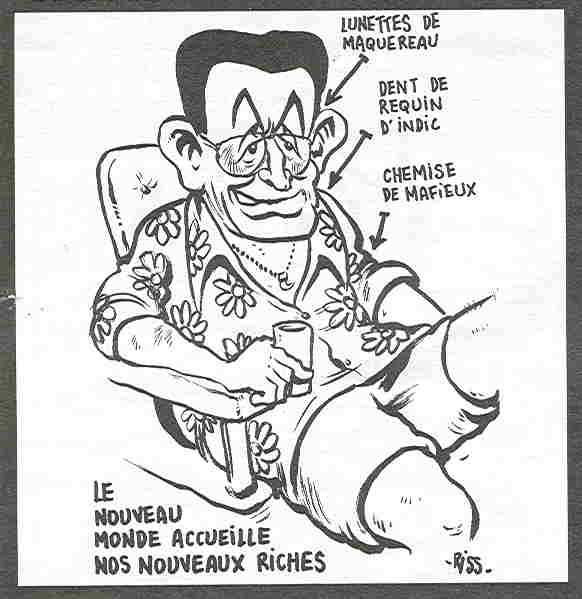
Whenever an Omega man (a rickshaw owner is a candidate for comparison) is ‘emerged’ (—it usually is not of his own doing, but a happenstance, therefore he is ‘emerged’/thrust forth), he overcompensates for his former lowest of social rankings and poverty by wishing to become a millionaire or in some other way reaching a status of equivalency with the high-end of society known as “old money”. There is a word in French for such emerged men and women: nouveau riche.
Sometimes some elements of the old nobility, though coming from a generally well educated class, make fun of the nouveau riche, thus letting everyone who has eyes to see see how arrogant and out of touch with reality some of the old class have become. Ideally though, the old nobility has close links (from way back when) with the temple, because the latter gains its wealth not for its high priest, but for the upkeep of the temple and for the high priest to redistribute a surplus of gifts as he sees it fit. One such person of ‘old nobility’ was Socrates, the Greek philosopher. While renowned as a philosopher, what is particularly striking is Socrates’ attitude toward and acceptance of death. He believed that by dying rather than trying to escape from a death sentence (which he received and had the opportunity to escape), he helped cement his society with greater bonds than can be done by mere law.
Sometimes however the nouveau riche emerges in such great numbers and accumulates such power in political circles (one way to gain equivalency with ‘old money’ is to overwhelm it by seizing control of politics) that they overwhelm both society and culture. That for the most part means the end of leadership of the old aristocracy (visualized in these blogs as a college of Johns) and its substitute with a pseudo democracy. The pseudo democracy is a ‘democracy’ that no longer exists among the common people, but operates among the nouveau riche or, as pointed out above, the heads of corporations. These millionaire upstarts, with a battalion of lawyers in tow, settle their differences ‘democratically’ in the court of law. While technology—originating in wealth making schemes—accelerates, the people of the land are neglected, deprived of a better education, and are ‘dumbed down’ (what an unpleasant but accurate phrase) to the function of laborers and consumers. At the same time, the ‘democracy’ now under control of the nouveau riche describes the peoples’ yearnings for justice and fair politics as populist. In countries like Latvia, words such as ‘populist’ and ‘populism’ are interpreted as synonyms of ‘harm’ and ‘harmful’ which harmful naming serves the interests of the nouveau riche “uzņēmēji”, i.e., producers, investors, anyone with a scheme to exploit nature and people at full throttle.
Currently Greece is in a similar situation as Latvia, except it has many more people and thus is able to expresses its unhappiness through greater social unrest. Furthermore, as one “anonymous” writer at another site put it (I hopeZeroHedge forgives me the steal): “Yes, the Greek public debt situation is unsustainable, but... if a country is idiotic (or captured, or likely both) enough to allow for the opportunity [it is old news].” Another “anonymous” observer writes: “…you can't live [in Greece] on the basic pension anymore. It was true for a long while, but now it's impossible…. Families largely make up for it—thankfully the social fabric is still largely intact in the sense that people feel obliged to cater to their own. But it's getting progressively harder for the average Yiannis (as in ‘average Joe’).”
We know that over the centuries Greek society has changed (like Latvian society) a number of times. First there was, so our history books tell us, “ur(very ancient)-ancient Greece”. This period goes back to the days before Homer, who sang a long poem to those ur-ancient times. Some researchers say that it may be that Homer’s Iliad and Odyssey is sourced in the Baltic area, that is to say, north of present-day Greece. Then comes ancient Greece proper with Socrates, Plato, Thucydides, et al. Then there is the Greece of Byzantium home of Basil, the holy man, whose death so closely parallels that of Jesus that it served the writers of the New Testament as a prototype to the Jesus story. Basil’s executor, Alexius I Commenus was an Alpha male (and one of many princes) emerged from and subject to the high-end lumpenprolitariat (‘Commenus’ by another name?) of his time. Commenus stands out as a crossroads from a community and temple oriented culture to one that robbed the temple for personal ends. Following the destruction of Jerusalem (then located in Constantinople) and the elimination of the Church of the Children of Johns in 1204 as a religious-political force, [John] Basil was replaced with Jesus, who was removed to a nonexistent place trick-a-treated into existence with ‘Heaven’ its name and other sweets.
Jerusalem, too, was relocated first to any land some bishop decided on (Bishop Albert and Riga, for example), later pushed further away from its homeland to Palestine. Of course, the Church of the Children of Johns, known as the Eastern Church today, was forced to take on a Western character, because John, transformed into Jesus in Heaven, could not oppose the secular princes as former Johns could and did. All these changes in “Greek” history had their echoes in the territories of the Slavs and the Balts. After the Eastern Church of Johns was forced to take on a Western cast, that is, after it was taken over by Westerners and/or their influence, the Children of Johns happily “converted” to (actually were coerced to) the worship a figure far removed from realities of life on Earth.
It is telling that eight hundred years after the princes secularized the temple, we have liberal capitalism become a ‘religion’. Its progress is seen in how “it's getting progressively harder for the average Yiannis (as in ‘average Joe’)” to survive not only in Greece, but also in Latvia. The scam known as “globalization”, while it confuses the poor and uneducated folk it addresses with high idealism, actually spells ‘pauperization’ not only for Yiannis, but Jahnis, Jean, Johammed, John, Johan, Han, Huan, Xian, etc. If I may put it bluntly, all these populist names and their bearers have been turned into rich g[y]uano (bird droppings) for the corporate powers that own the governments of our time. This is also why the name Jānis—once the most popular male name in Latvia—may soon disappear from popular names lists. Indeed, Janis (John) no longer appears one of the top ten names for baby boys. Such forgetfulness is the consequence of a cultural demoralization. Such was not imaginable a half a century ago. This tells us of great changes happening and yet to come.
Asterisk & Notes of Interest:
On material depravation in Latvia.
On the theme of “more-equal-than-others”, see Animal Farm.
Of great interest to me this and like articles. It presents some of my reasons for supporting the cultivation of Johns Grass in Latvia.
My most unappreciated work—so far, re “Tiresias’ Revenge”, my reinterpretation of Sophocles’ “Oedipus Rex”. I believe that Sophocles had to hide the true meaning of his play for political reasons. It is apropos of the political situation in the world today, also in Latvia. The play may be found at blogs 40 through 47. Start from Blog 40.
These blogs tend to be a continuum of an idea or thought, which is why—if you are interested in what you read—you are encouraged to consider reading the previous blog and the blog hereafter.
Partial entries of my blogs may be found at Latvians Online + Forum Home + Open Forum –ONLATVIANPOPULISM vs LATVIJASLABEJIE. If you copy this blog for your files, or copy to forward, or otherwise mention its content, please credit the author and http://esoschroniclnes.blogspot.com/
NOT-VIOLENT TERROR
66 The Future of The Wuerzeltod (IV)
Whenever an Omega man (a rickshaw owner is a candidate for comparison) is ‘emerged’ (—it usually is not of his own doing, but a happenstance, therefore he is ‘emerged’/thrust forth), he overcompensates for his former lowest of social rankings and poverty by wishing to become a millionaire or in some other way reaching a status of equivalency with the high-end of society known as “old money”. There is a word in French for such emerged men and women: nouveau riche.
Sometimes some elements of the old nobility, though coming from a generally well educated class, make fun of the nouveau riche, thus letting everyone who has eyes to see see how arrogant and out of touch with reality some of the old class have become. Ideally though, the old nobility has close links (from way back when) with the temple, because the latter gains its wealth not for its high priest, but for the upkeep of the temple and for the high priest to redistribute a surplus of gifts as he sees it fit. One such person of ‘old nobility’ was Socrates, the Greek philosopher. While renowned as a philosopher, what is particularly striking is Socrates’ attitude toward and acceptance of death. He believed that by dying rather than trying to escape from a death sentence (which he received and had the opportunity to escape), he helped cement his society with greater bonds than can be done by mere law.
Sometimes however the nouveau riche emerges in such great numbers and accumulates such power in political circles (one way to gain equivalency with ‘old money’ is to overwhelm it by seizing control of politics) that they overwhelm both society and culture. That for the most part means the end of leadership of the old aristocracy (visualized in these blogs as a college of Johns) and its substitute with a pseudo democracy. The pseudo democracy is a ‘democracy’ that no longer exists among the common people, but operates among the nouveau riche or, as pointed out above, the heads of corporations. These millionaire upstarts, with a battalion of lawyers in tow, settle their differences ‘democratically’ in the court of law. While technology—originating in wealth making schemes—accelerates, the people of the land are neglected, deprived of a better education, and are ‘dumbed down’ (what an unpleasant but accurate phrase) to the function of laborers and consumers. At the same time, the ‘democracy’ now under control of the nouveau riche describes the peoples’ yearnings for justice and fair politics as populist. In countries like Latvia, words such as ‘populist’ and ‘populism’ are interpreted as synonyms of ‘harm’ and ‘harmful’ which harmful naming serves the interests of the nouveau riche “uzņēmēji”, i.e., producers, investors, anyone with a scheme to exploit nature and people at full throttle.
Currently Greece is in a similar situation as Latvia, except it has many more people and thus is able to expresses its unhappiness through greater social unrest. Furthermore, as one “anonymous” writer at another site put it (I hopeZeroHedge forgives me the steal): “Yes, the Greek public debt situation is unsustainable, but... if a country is idiotic (or captured, or likely both) enough to allow for the opportunity [it is old news].” Another “anonymous” observer writes: “…you can't live [in Greece] on the basic pension anymore. It was true for a long while, but now it's impossible…. Families largely make up for it—thankfully the social fabric is still largely intact in the sense that people feel obliged to cater to their own. But it's getting progressively harder for the average Yiannis (as in ‘average Joe’).”
We know that over the centuries Greek society has changed (like Latvian society) a number of times. First there was, so our history books tell us, “ur(very ancient)-ancient Greece”. This period goes back to the days before Homer, who sang a long poem to those ur-ancient times. Some researchers say that it may be that Homer’s Iliad and Odyssey is sourced in the Baltic area, that is to say, north of present-day Greece. Then comes ancient Greece proper with Socrates, Plato, Thucydides, et al. Then there is the Greece of Byzantium home of Basil, the holy man, whose death so closely parallels that of Jesus that it served the writers of the New Testament as a prototype to the Jesus story. Basil’s executor, Alexius I Commenus was an Alpha male (and one of many princes) emerged from and subject to the high-end lumpenprolitariat (‘Commenus’ by another name?) of his time. Commenus stands out as a crossroads from a community and temple oriented culture to one that robbed the temple for personal ends. Following the destruction of Jerusalem (then located in Constantinople) and the elimination of the Church of the Children of Johns in 1204 as a religious-political force, [John] Basil was replaced with Jesus, who was removed to a nonexistent place trick-a-treated into existence with ‘Heaven’ its name and other sweets.
Jerusalem, too, was relocated first to any land some bishop decided on (Bishop Albert and Riga, for example), later pushed further away from its homeland to Palestine. Of course, the Church of the Children of Johns, known as the Eastern Church today, was forced to take on a Western character, because John, transformed into Jesus in Heaven, could not oppose the secular princes as former Johns could and did. All these changes in “Greek” history had their echoes in the territories of the Slavs and the Balts. After the Eastern Church of Johns was forced to take on a Western cast, that is, after it was taken over by Westerners and/or their influence, the Children of Johns happily “converted” to (actually were coerced to) the worship a figure far removed from realities of life on Earth.
It is telling that eight hundred years after the princes secularized the temple, we have liberal capitalism become a ‘religion’. Its progress is seen in how “it's getting progressively harder for the average Yiannis (as in ‘average Joe’)” to survive not only in Greece, but also in Latvia. The scam known as “globalization”, while it confuses the poor and uneducated folk it addresses with high idealism, actually spells ‘pauperization’ not only for Yiannis, but Jahnis, Jean, Johammed, John, Johan, Han, Huan, Xian, etc. If I may put it bluntly, all these populist names and their bearers have been turned into rich g[y]uano (bird droppings) for the corporate powers that own the governments of our time. This is also why the name Jānis—once the most popular male name in Latvia—may soon disappear from popular names lists. Indeed, Janis (John) no longer appears one of the top ten names for baby boys. Such forgetfulness is the consequence of a cultural demoralization. Such was not imaginable a half a century ago. This tells us of great changes happening and yet to come.
Asterisk & Notes of Interest:
On material depravation in Latvia.
On the theme of “more-equal-than-others”, see Animal Farm.
Of great interest to me this and like articles. It presents some of my reasons for supporting the cultivation of Johns Grass in Latvia.
My most unappreciated work—so far, re “Tiresias’ Revenge”, my reinterpretation of Sophocles’ “Oedipus Rex”. I believe that Sophocles had to hide the true meaning of his play for political reasons. It is apropos of the political situation in the world today, also in Latvia. The play may be found at blogs 40 through 47. Start from Blog 40.
These blogs tend to be a continuum of an idea or thought, which is why—if you are interested in what you read—you are encouraged to consider reading the previous blog and the blog hereafter.
Partial entries of my blogs may be found at Latvians Online + Forum Home + Open Forum –ONLATVIANPOPULISM vs LATVIJASLABEJIE. If you copy this blog for your files, or copy to forward, or otherwise mention its content, please credit the author and http://esoschroniclnes.blogspot.com/
Labels:
Greece,
Iannis,
Jersika,
John,
Johns,
Latvia,
Latvian,
nouveau riche,
Socrates,
wuerzeltod
Saturday, December 19, 2009
© Eso Antons Benjamins, a.k.a. Jaņdžs
NOT-VIOLENT TERROR
65 The Future of The Wuerzeltod (III)
The Alpha and Beta (see below and click on “canids” for explanation of terms) were incensed when they heard. “Is this how our mothers manipulate our baby brothers?” cried one. “We cannot allow this. We must put a stop to it,” cried another. “This is boy abuse. She is turning her sons into Omegas,” cried a third. “For shame,” cried a fourth. ”“But how are we going to stop them?” asked a fifth.
“I know,” said the shaman.
“What, give the boy a man’s nipple?” cried one of the men and all laughed.
“No. But we can put a scare in the baby,” answered the shaman.
“You mean scare the boy not to suck milk? You must be kidding. How are we going to do that?” [Click link and go to Question 4 for an answer of what happens to breastfeeding after the baby is given the treatment described below.]
“It will be quick and fast.”
“Alright, what is it that you have in mind?”
The ‘idea man’ or shaman gathered the men around him and explained. Some men objected saying they believed that nature meant things to be this way. Others agreed with the shaman and said that it was worth a try. All Alpha men agreed with the shaman. So, they decided to do it.
This is how it came about that all the Alpha and Beta men who lived in their own “men’s quarters” gathered together and walked over to the women’s and children’s quarters. As they expected, a number of women were breast feeding their babies, some of them boys. Without saying a word, the men seized the baby boys from their mothers. The shaman took his obsidian knife and quick as a flash cut off the foreskin of the babies’ penises. The women and babies screamed, but that was it. There was nothing they could do. The deed was done.
When done, the shaman motioned for the men to hand the screaming babies back to their mothers. When the mothers put the babies to their breasts to calm them, they would not take the breast, but continued screaming.
The shaman told the women to take their screaming babies away, then explained to the remaining women that he and the men had done what they had done because they wished to make sure that the boys always knew what tribe they belonged to. No raiders from other tribes could now come and steal the boys and make them one of their own. The explanation was, of course, a lie, but it sounded plausible, and the mothers had to accept it. Actually, the mothers had no choice, because they were told to keep quiet on the pain of death.
In the modern world circumcision is assisted by anaesthetics, and the baby suffers little or no trauma. Today circumcision is indeed a ritual for the sake of differentiation. Yet in the past, when the men first cut off the baby boy’s foreskin, it was different. There were no anaesthetics. It was done in the “raw”. Needless to say, the operation caused the baby such pain that it had what we call an out of body experience. It happened involuntarily. At a young age, when the body of the child has not separated from the head, a circumcision—which necessarily comes as a total surprise—comes like a blinding flash of near intolerable pain. The pain separates one from one’s body. Even if the baby forgets the event, its sentient effects not only linger, but have life long side effects.
From the moment he is taken from his mother’s lap and circumcised, the boy knows that he cannot trust his mother to protect him. The mother is soon seen as too weak to protect him, even though he is too young to remember his circumcision consciously. In any event, from the moment that they are circumcised, baby boys become distrustful. If any appear to forget the experience, distrust can be quickly reawakened.* If trained recruiters are ready, they will quickly join the ‘brotherhood’ commanded by the Alpha male. In other words, circumcision facilitates excessive male bonding. Indeed, whenever the ‘brotherhood’—now fear-based—suspects a threat (and it may be the result of pure fantasy), it may initiate ‘preventive’ action and attack.
Though the following link explains that based on their characteristics men can be grouped into three main categories: Alpha, Beta, and Omega males, I would like to add a fourth—‘canids’. (When reading this link, please give especial attention to the section discussing canids, although perhaps a better—more neutral—name for the circumcised males is ‘Cetas'). Made apprehensive of their mothers, Cetas tend to switch their trust and loyalty to the Alpha male, who becomes their lord not only in secular matters, but replaces Allness and becomes ‘Lord God’ of their imagination.**
The males of proto-Latvian Jersiks were probably not circumcised if it is true that at the time of Bishop Alberts attack on King Visvaldis, the king and the Children of Johns deferred to the Sun not only as a word synonymous with mother, but addressed the Sun as the object that best represented time as transcendent divinity. We may wish to remember that for proto-Latvians the word ‘God’ (‘Dievs’) did not exist, because they equated God with Visums, re Allness, Visums being reflected in the name of the Jersik king: Visvaldis, ruler over Allness.
The question therefore is, whence comes the word ‘Dievs’ (in our times, the closest word to it is the feminine ‘Diva’, Goddess, and, of course, the masculine ‘Dios’), God? The best etymology that I can discover is that Dievs evolved out of the Latvian word ‘dot’, to give. Another word deriving from ‘dot’ is ‘deva’, meaning a contribution or portion, from which the word ‘dahvana’, gift. Yet another is ‘dien(eht)’, to live out my days, to serve, as in ‘dieneht armiyah’, to serve (my days) in the army. If I were to say that you and I are “Visuma deva”, I would be saying that we are contributions or gifts from out of Visums, Allness. Similarly, the Sun is such a gift, too, whence the ‘deva’ or ‘dahvana’, a contribution, a gift, a portion of the Sun is ‘diena’, day, the light of day. A word that combines both ‘diena’ (day) and ‘dahvana’ (gift) is the old Latvian word (presently no longer used) ‘dievaine’ or ‘dievaines’, holy day, holy days, days separated out from ordinary day, ‘diena’. If we follow the above recipe for the evolution of the word, ‘Dievs’ (God) should be pronounced ‘Diens’. The reason why ‘n’ has been replaced by ‘v’ should not prevent us from accepting the recepe, because it may be explained by an intrusion of a colloquialism or another dialect. For example, words such as ‘dien-vids’ (today meaning ‘south’, but literally standing for ‘day-middle’) or perhaps David, the latter a compound of day + vid (day + middle, a space, also ‘a flash’, as in the Latvian word ‘pavideht’, to make a mark before disappearing). In short, ‘Dievs’ like the word ‘God’ is an empty signifier waiting to be filled with meanings that may be stuck to it by way of charisma or violence.
So, why is it that the post-Jersika proto-Latvians abandoned the Sun and replaced her with the male gender, which bid the Sun step aside and make place for God? I believe the answer can be discovered if we analyze the phrase Glaesa del Dios. Today the phrase is interpreted by neo-Christians as meaning the light or aura of God. However, if we remember that the word ‘Dios’ (God, Dievs) has its origin in the word ‘day’ (‘diena’ in Latvian), we may also translate the phrase as “aura of day”, i.e., light of day, light of the Sun.
It should suffice to say that the Sun was driven out of our forebears by violent acts. The violence induced an out of the body experience, as a result of which the men of Jersika became Omegas to the Alpha and Beta knights in Riga, and were forced by them to worship ‘God’. ‘God’ is—as pointed out above—in and of itself meaningless, empty, but its very meaninglessness allowed the violent ones to fill it with meaning.
The meaning chosen for the ‘empty’ word was ‘lord’, and the lord (lords actually) made laws that made and kept Bishop Albert and the knights wealthy. The hidden agenda of neo-Christianity is, if you will, to put a stop to gift giving among the natives and control the economy by forcing the natives to labor on behalf of the secular princes it serves.
Asterisk & Notes of Interest:
*Similar negative effects may be achieved with “christening” at an early age. The fact that a stranger lays his/her hands on the baby boy is sufficient proof to the baby that his mother has betrayed his trust in her.
** The same may be accomplished in other ways. As the link to the circumcision ritual shows, women can be ‘persuaded’ to show-mime happiness over circumcision of their sons, what with coercion having happened a long time ago and now internalized and become a habit and rote ritual. See Michael Taussig, “Mimesis and Alterity”, p. 85, Routledge: “For this sacred violence exists in two quite contrary ways. On the one hand the women and children, forming the ‘audience,’ have to pretend—to mime—on pain of death that what they are witness to are real gods and not their kinsmen acting as gods. In this way the public secret essential to mystical authority is preserved. On the other hand is the violence associated with the demasking of the gods that the male initiates are forced to witness in the privacy of the men’s house. Through the violence of demasking fused with laughter, the power of the mimetic faculty as a socially constitutive force is thereby transferred from the older to the younger men, the duped becomes one with the dupers….” For the entire context of this quote click here . The question that always remains is if the dupes remain dupes and the dupers dupe without ever awakening to the consequences. My bet is on the “no”—sacrifice is never eliminated.
On material depravation in Latvia.
On the theme of “more-equal-than-others” re Orwel's AnimalFarm.
Of great interest to me this and like articles like articles. It presents some of my reasons for supporting the cultivation of Johns Grass in Latvia.
Favored serendipitous click or “chronal mirage” on the internet. I was searching for a relationship between the burning of Jersika and heretics in Lanquedoc, France. You must read the text at near the end of the scroll, re image of “The Burning of St. Joan”, Monday, September 03, 2007, to get the point.
My most explicit statement as to the results that come from a failure to sacrifice, re “Tiresias’ Revenge”, my reinterpretation of Sophocles’ “Oedipus Rex”. I believe that Sophocles had to hide the true meaning of his play for political reasons. It is apropos of the political situation in the world today, also in Latvia. The play may be found at blogs 40 through 47. Start from Blog 40.
These blogs tend to be a continuum of an idea or thought, which is why—if you are interested in what you read—you are encouraged to consider reading the previous blog and the blog hereafter.
Partial entries of my blogs may be found at LatviansOnline + Forum Home + Open Forum –ONLATVIANPOPULISM vs LATVIJASLABEJIE. If you copy this blog for your files, or copy to forward, or otherwise mention its content, please credit the author and http://esoschroniclnes.blogspot.com/
NOT-VIOLENT TERROR
65 The Future of The Wuerzeltod (III)
The Alpha and Beta (see below and click on “canids” for explanation of terms) were incensed when they heard. “Is this how our mothers manipulate our baby brothers?” cried one. “We cannot allow this. We must put a stop to it,” cried another. “This is boy abuse. She is turning her sons into Omegas,” cried a third. “For shame,” cried a fourth. ”“But how are we going to stop them?” asked a fifth.
“I know,” said the shaman.
“What, give the boy a man’s nipple?” cried one of the men and all laughed.
“No. But we can put a scare in the baby,” answered the shaman.
“You mean scare the boy not to suck milk? You must be kidding. How are we going to do that?” [Click link and go to Question 4 for an answer of what happens to breastfeeding after the baby is given the treatment described below.]
“It will be quick and fast.”
“Alright, what is it that you have in mind?”
The ‘idea man’ or shaman gathered the men around him and explained. Some men objected saying they believed that nature meant things to be this way. Others agreed with the shaman and said that it was worth a try. All Alpha men agreed with the shaman. So, they decided to do it.
This is how it came about that all the Alpha and Beta men who lived in their own “men’s quarters” gathered together and walked over to the women’s and children’s quarters. As they expected, a number of women were breast feeding their babies, some of them boys. Without saying a word, the men seized the baby boys from their mothers. The shaman took his obsidian knife and quick as a flash cut off the foreskin of the babies’ penises. The women and babies screamed, but that was it. There was nothing they could do. The deed was done.
When done, the shaman motioned for the men to hand the screaming babies back to their mothers. When the mothers put the babies to their breasts to calm them, they would not take the breast, but continued screaming.
The shaman told the women to take their screaming babies away, then explained to the remaining women that he and the men had done what they had done because they wished to make sure that the boys always knew what tribe they belonged to. No raiders from other tribes could now come and steal the boys and make them one of their own. The explanation was, of course, a lie, but it sounded plausible, and the mothers had to accept it. Actually, the mothers had no choice, because they were told to keep quiet on the pain of death.
In the modern world circumcision is assisted by anaesthetics, and the baby suffers little or no trauma. Today circumcision is indeed a ritual for the sake of differentiation. Yet in the past, when the men first cut off the baby boy’s foreskin, it was different. There were no anaesthetics. It was done in the “raw”. Needless to say, the operation caused the baby such pain that it had what we call an out of body experience. It happened involuntarily. At a young age, when the body of the child has not separated from the head, a circumcision—which necessarily comes as a total surprise—comes like a blinding flash of near intolerable pain. The pain separates one from one’s body. Even if the baby forgets the event, its sentient effects not only linger, but have life long side effects.
From the moment he is taken from his mother’s lap and circumcised, the boy knows that he cannot trust his mother to protect him. The mother is soon seen as too weak to protect him, even though he is too young to remember his circumcision consciously. In any event, from the moment that they are circumcised, baby boys become distrustful. If any appear to forget the experience, distrust can be quickly reawakened.* If trained recruiters are ready, they will quickly join the ‘brotherhood’ commanded by the Alpha male. In other words, circumcision facilitates excessive male bonding. Indeed, whenever the ‘brotherhood’—now fear-based—suspects a threat (and it may be the result of pure fantasy), it may initiate ‘preventive’ action and attack.
Though the following link explains that based on their characteristics men can be grouped into three main categories: Alpha, Beta, and Omega males, I would like to add a fourth—‘canids’. (When reading this link, please give especial attention to the section discussing canids, although perhaps a better—more neutral—name for the circumcised males is ‘Cetas'). Made apprehensive of their mothers, Cetas tend to switch their trust and loyalty to the Alpha male, who becomes their lord not only in secular matters, but replaces Allness and becomes ‘Lord God’ of their imagination.**
The males of proto-Latvian Jersiks were probably not circumcised if it is true that at the time of Bishop Alberts attack on King Visvaldis, the king and the Children of Johns deferred to the Sun not only as a word synonymous with mother, but addressed the Sun as the object that best represented time as transcendent divinity. We may wish to remember that for proto-Latvians the word ‘God’ (‘Dievs’) did not exist, because they equated God with Visums, re Allness, Visums being reflected in the name of the Jersik king: Visvaldis, ruler over Allness.
The question therefore is, whence comes the word ‘Dievs’ (in our times, the closest word to it is the feminine ‘Diva’, Goddess, and, of course, the masculine ‘Dios’), God? The best etymology that I can discover is that Dievs evolved out of the Latvian word ‘dot’, to give. Another word deriving from ‘dot’ is ‘deva’, meaning a contribution or portion, from which the word ‘dahvana’, gift. Yet another is ‘dien(eht)’, to live out my days, to serve, as in ‘dieneht armiyah’, to serve (my days) in the army. If I were to say that you and I are “Visuma deva”, I would be saying that we are contributions or gifts from out of Visums, Allness. Similarly, the Sun is such a gift, too, whence the ‘deva’ or ‘dahvana’, a contribution, a gift, a portion of the Sun is ‘diena’, day, the light of day. A word that combines both ‘diena’ (day) and ‘dahvana’ (gift) is the old Latvian word (presently no longer used) ‘dievaine’ or ‘dievaines’, holy day, holy days, days separated out from ordinary day, ‘diena’. If we follow the above recipe for the evolution of the word, ‘Dievs’ (God) should be pronounced ‘Diens’. The reason why ‘n’ has been replaced by ‘v’ should not prevent us from accepting the recepe, because it may be explained by an intrusion of a colloquialism or another dialect. For example, words such as ‘dien-vids’ (today meaning ‘south’, but literally standing for ‘day-middle’) or perhaps David, the latter a compound of day + vid (day + middle, a space, also ‘a flash’, as in the Latvian word ‘pavideht’, to make a mark before disappearing). In short, ‘Dievs’ like the word ‘God’ is an empty signifier waiting to be filled with meanings that may be stuck to it by way of charisma or violence.
So, why is it that the post-Jersika proto-Latvians abandoned the Sun and replaced her with the male gender, which bid the Sun step aside and make place for God? I believe the answer can be discovered if we analyze the phrase Glaesa del Dios. Today the phrase is interpreted by neo-Christians as meaning the light or aura of God. However, if we remember that the word ‘Dios’ (God, Dievs) has its origin in the word ‘day’ (‘diena’ in Latvian), we may also translate the phrase as “aura of day”, i.e., light of day, light of the Sun.
It should suffice to say that the Sun was driven out of our forebears by violent acts. The violence induced an out of the body experience, as a result of which the men of Jersika became Omegas to the Alpha and Beta knights in Riga, and were forced by them to worship ‘God’. ‘God’ is—as pointed out above—in and of itself meaningless, empty, but its very meaninglessness allowed the violent ones to fill it with meaning.
The meaning chosen for the ‘empty’ word was ‘lord’, and the lord (lords actually) made laws that made and kept Bishop Albert and the knights wealthy. The hidden agenda of neo-Christianity is, if you will, to put a stop to gift giving among the natives and control the economy by forcing the natives to labor on behalf of the secular princes it serves.
Asterisk & Notes of Interest:
*Similar negative effects may be achieved with “christening” at an early age. The fact that a stranger lays his/her hands on the baby boy is sufficient proof to the baby that his mother has betrayed his trust in her.
** The same may be accomplished in other ways. As the link to the circumcision ritual shows, women can be ‘persuaded’ to show-mime happiness over circumcision of their sons, what with coercion having happened a long time ago and now internalized and become a habit and rote ritual. See Michael Taussig, “Mimesis and Alterity”, p. 85, Routledge: “For this sacred violence exists in two quite contrary ways. On the one hand the women and children, forming the ‘audience,’ have to pretend—to mime—on pain of death that what they are witness to are real gods and not their kinsmen acting as gods. In this way the public secret essential to mystical authority is preserved. On the other hand is the violence associated with the demasking of the gods that the male initiates are forced to witness in the privacy of the men’s house. Through the violence of demasking fused with laughter, the power of the mimetic faculty as a socially constitutive force is thereby transferred from the older to the younger men, the duped becomes one with the dupers….” For the entire context of this quote click here . The question that always remains is if the dupes remain dupes and the dupers dupe without ever awakening to the consequences. My bet is on the “no”—sacrifice is never eliminated.
On material depravation in Latvia.
On the theme of “more-equal-than-others” re Orwel's AnimalFarm.
Of great interest to me this and like articles like articles. It presents some of my reasons for supporting the cultivation of Johns Grass in Latvia.
Favored serendipitous click or “chronal mirage” on the internet. I was searching for a relationship between the burning of Jersika and heretics in Lanquedoc, France. You must read the text at near the end of the scroll, re image of “The Burning of St. Joan”, Monday, September 03, 2007, to get the point.
My most explicit statement as to the results that come from a failure to sacrifice, re “Tiresias’ Revenge”, my reinterpretation of Sophocles’ “Oedipus Rex”. I believe that Sophocles had to hide the true meaning of his play for political reasons. It is apropos of the political situation in the world today, also in Latvia. The play may be found at blogs 40 through 47. Start from Blog 40.
These blogs tend to be a continuum of an idea or thought, which is why—if you are interested in what you read—you are encouraged to consider reading the previous blog and the blog hereafter.
Partial entries of my blogs may be found at LatviansOnline + Forum Home + Open Forum –ONLATVIANPOPULISM vs LATVIJASLABEJIE. If you copy this blog for your files, or copy to forward, or otherwise mention its content, please credit the author and http://esoschroniclnes.blogspot.com/
Tuesday, December 15, 2009
© Eso Antons Benjamins, a.k.a. Jaņdžs
NOT-VIOLENT TERROR
64 The Future of The Wuerzeltod (II)
A friendrecently asked: “Why do we always end up in a two-tiered society?”
My answer is simple and straight forward.
We have destroyed and disappeared the wood.
The wood—ever since the creation of humankind—has been humankind’s first line of defense with regard to human freedom and liberty.
The wood is the home of democracy. So-called democracy of the urban environment, the city, is nothing but utopian thinking in retrospect. Human beings did not become democrats in the process of social evolution, but they were born democrats, and democracy is because it began in the wood.
The wood and the individual tree stand as a shield against exploitation. Both the wood and the individual tree in the wood is the physical object that enables man and woman to defend themselves against any attackers of their democratic privilege.
Both now and in the long ago, many men became rich, wealthy, and ‘important’ by cutting down the wood. It was not always thought as an act of terrorists. To the contrary, it was often believed to be a creative act by pioneers (http://www.fiddleheadsbarandgrill.com/pdf/darlingtour.pdf ) and ‘smart generals’, as, for example, when the Roman General Varus lost three legions to the freedom loving Germanic tribes. The strategy of the men of the wood was a simple one, they attacked the Romans from out of the Teutoburg wood http://en.wikipedia.org/wiki/Teutoburg_Forest and then ran back into the wood to hide in the marshes and swamps there. After their defeat, the Romans always cut the wood about them when encamping or building a fort; and no number of brave and heroic wood dwellers could then dislodge or defeat the disciplined ranks of the Roman urbanites.
The tragedy for democracy and the wood began with the arrival of agriculture. Up to that time, human beings made their dwellings by clearing out a piece of land in the forest. The cleared land was used to grow various edible roots, berry bushes, and fruit trees, while the wood and its marshes were used as hunting and fishing grounds.
With the arrival of agriculture, which brought with it taxation (of grain) and hording by the boyars (originally probably ‘bully boys’). who built fortifications for their hoard. The fortifications used a large amount of lumber. In turn, this resulted in the clearance of sizeable areas of the forest. When some people of the wood found it convenient to build their dwellings along the outer edge of the wall of the boyars’ castles-forts, there arose the first towns and cities. Worse, there arose conceit among the “city” dwellers against the people of the wood and farmers. The conceit was most likely based on the ‘superiority’ of violence that the city people could bring to bear against the dwellers of the wood.
The cutting of forests continues to our day, We now call this cutting of trees “desertification”, because we can clearly see that we are not only destroying trees, but have created a whole culture of extreme resource exploitation along with it.
This brings us back to the question that opens this blog: “Why do we have a two-tiered society?”
Answer: Because we no longer have people dwelling in the wood. We no longer are protected by the wood. We can no longer ambush the Roman legions from behind trees. Our wood huts along the wall of the fort have become numbered cubicles in an “urban environment”. A modern American folk song called “Little Boxes” http://www.youtube.com/watch?v=2_2lGkEU4Xs&feature=related describes the situation well.
Speaking only for myself, I consider myself “terrorized” by all those who have terrorized the wood to extinction. In order to protect my interest in freedom and democracy, I have purchased a few hectares for myself in Latvia and have built there a “temple” dedicated to the wood. The centerpiece of the temple is not a God or Goddess, but the trunk of an oak tree with sawn off limbs. The “tree” stands on a concrete platform that has been built over the foundations of what used to be an old cowbarn and a hayloft.
This brings me to the literary critic, philosopher, and essayist Walter Benjamin. I am particularly interested in Walter Benjamin’s thought, because very possibly he helps to explain the thought processes of our forebears (and of course my own).
Writes Benjamin: “If the theory is correct that feeling is not located in the head …but, rather, in the place where we see it, then we are, in looking at our beloved, too [in this instance the wood and trees], outside ourselves.”
In other words, we experience our experience of the object in a sentient manner, as it beings outside ourselves. When we see a tree that commands our attention, we do not look at it as an actor may, with our head and conscious selves studying the tree in every detail, but as if the tree were that instant become a part of us. Such an entry of our self into the wood’s or tree’s self allows us to see he tree as copy of our selves. [I owe this latter insight to Michael Taussig’s book, re “Mimesis and Alterity”.] This is why sometimes the sawing down of a tree affects us with emotions that make us want to scream murder!

It is thus that we sacralize, make holy, a place, where the oak tree grows (or grew), and, in turn, the tree and its place sacralizes us. NOT-VIOLENT TERROR
64 The Future of The Wuerzeltod (II)
A friendrecently asked: “Why do we always end up in a two-tiered society?”
My answer is simple and straight forward.
We have destroyed and disappeared the wood.
The wood—ever since the creation of humankind—has been humankind’s first line of defense with regard to human freedom and liberty.
The wood is the home of democracy. So-called democracy of the urban environment, the city, is nothing but utopian thinking in retrospect. Human beings did not become democrats in the process of social evolution, but they were born democrats, and democracy is because it began in the wood.
The wood and the individual tree stand as a shield against exploitation. Both the wood and the individual tree in the wood is the physical object that enables man and woman to defend themselves against any attackers of their democratic privilege.
Both now and in the long ago, many men became rich, wealthy, and ‘important’ by cutting down the wood. It was not always thought as an act of terrorists. To the contrary, it was often believed to be a creative act by pioneers (http://www.fiddleheadsbarandgrill.com/pdf/darlingtour.pdf ) and ‘smart generals’, as, for example, when the Roman General Varus lost three legions to the freedom loving Germanic tribes. The strategy of the men of the wood was a simple one, they attacked the Romans from out of the Teutoburg wood http://en.wikipedia.org/wiki/Teutoburg_Forest and then ran back into the wood to hide in the marshes and swamps there. After their defeat, the Romans always cut the wood about them when encamping or building a fort; and no number of brave and heroic wood dwellers could then dislodge or defeat the disciplined ranks of the Roman urbanites.
The tragedy for democracy and the wood began with the arrival of agriculture. Up to that time, human beings made their dwellings by clearing out a piece of land in the forest. The cleared land was used to grow various edible roots, berry bushes, and fruit trees, while the wood and its marshes were used as hunting and fishing grounds.
With the arrival of agriculture, which brought with it taxation (of grain) and hording by the boyars (originally probably ‘bully boys’). who built fortifications for their hoard. The fortifications used a large amount of lumber. In turn, this resulted in the clearance of sizeable areas of the forest. When some people of the wood found it convenient to build their dwellings along the outer edge of the wall of the boyars’ castles-forts, there arose the first towns and cities. Worse, there arose conceit among the “city” dwellers against the people of the wood and farmers. The conceit was most likely based on the ‘superiority’ of violence that the city people could bring to bear against the dwellers of the wood.
The cutting of forests continues to our day, We now call this cutting of trees “desertification”, because we can clearly see that we are not only destroying trees, but have created a whole culture of extreme resource exploitation along with it.
This brings us back to the question that opens this blog: “Why do we have a two-tiered society?”
Answer: Because we no longer have people dwelling in the wood. We no longer are protected by the wood. We can no longer ambush the Roman legions from behind trees. Our wood huts along the wall of the fort have become numbered cubicles in an “urban environment”. A modern American folk song called “Little Boxes” http://www.youtube.com/watch?v=2_2lGkEU4Xs&feature=related describes the situation well.
Speaking only for myself, I consider myself “terrorized” by all those who have terrorized the wood to extinction. In order to protect my interest in freedom and democracy, I have purchased a few hectares for myself in Latvia and have built there a “temple” dedicated to the wood. The centerpiece of the temple is not a God or Goddess, but the trunk of an oak tree with sawn off limbs. The “tree” stands on a concrete platform that has been built over the foundations of what used to be an old cowbarn and a hayloft.
This brings me to the literary critic, philosopher, and essayist Walter Benjamin. I am particularly interested in Walter Benjamin’s thought, because very possibly he helps to explain the thought processes of our forebears (and of course my own).
Writes Benjamin: “If the theory is correct that feeling is not located in the head …but, rather, in the place where we see it, then we are, in looking at our beloved, too [in this instance the wood and trees], outside ourselves.”
In other words, we experience our experience of the object in a sentient manner, as it beings outside ourselves. When we see a tree that commands our attention, we do not look at it as an actor may, with our head and conscious selves studying the tree in every detail, but as if the tree were that instant become a part of us. Such an entry of our self into the wood’s or tree’s self allows us to see he tree as copy of our selves. [I owe this latter insight to Michael Taussig’s book, re “Mimesis and Alterity”.] This is why sometimes the sawing down of a tree affects us with emotions that make us want to scream murder!

While a mutual blessing may occur every time that I (we) and the tree meet (as when it grows in my yard), the communal ritual of sacralization (with the whole community participating) generally occurs on the basis of a local tradition, among Latvians, specifically, on Johns Eve.
In Latvia, Johns’ Eve is the time when a man presents himself to himself and the community with an oak leaf wreath on his head, a symbol of strength, endurance, greening, and life giving. In the instance of the oak tree, its fruit are the acorns that feed bird and beast. The woman appears with an oak leaf crown on her head as well (flowers are for medicinal tea and fulfill the sentiments of modern city dwellers), and both man and woman wear loafers (pastalas) made of linden tree bark made pliable after having been soaked in water.
To break meaning down further, the oak speaks for mindfulness as if it were a hat, while the linden speaks for being in touch with Earth. When the linden is in bloom, she is visited by thousands of bees; and if the bees think not with their heads, but are sentient in their being, then the linden tree, bees, and humans together create an aura within a special sound space. Latvians call this sound “sann-eht”. This ‘sann’ sound may only be heard properly when we are standing under a blooming linden filled with bees and with you and me present. So, if one wishes to hear how the linden, its flowers, the bees, and we sann together, you and I have to go there, where we will meet in the here and now.
We can rebuild this planet and recreate an un-tiered (egalitarian) society when and if we start using our brain to create ways to live in the wood again. Presently, it is still a movement toward the city, yet the computer makes the city unnecessary--at least as far as communication and education is concerned. Factories need not be so large as to consume a landscape. We dont need cars. We do need a good monorail http://en.wikipedia.org/wiki/Monorail system , bycycle paths, and a way to quickly attach a bicycle to the rail.
We also have to reinterpret history. That is why I have turned to Anatoly Fomenko as my orienter and guide in history. The current and popular version of history destroys our (my) sense of sentience regarding events by removing the events further into the background than they really are.

As recently as the 17th century, daily life was still enveloped by the wood. The machine, the great distancer of reality (television and the chainsaw being best examples), was not yet. Jesus on the cross (replacing Jesus thrown into a fire pit on the Hippodrome (11th or 12th centuries) in Constantinople did not yet fill the imaginary space with a phantasm better fit for the consumption of an urban dweller. Death by burning was a more sentient experience, the last victim of the Inquisition being Giordano Bruno in 1600, but the imaginary suffering of Jesus is made to appear more immediate.
In short, the current version of history (re: 2012 years since the birth of Jesus) denies, certainly handicaps Walter Benjamin’s theorizing and relevance. Propaganda takes precedence over sentience. The linden tree may as well be a linden in Unter den Linden http://www.ww2incolor.com/d/483493-4/1__007 c. Berlin, WW2.
Asterisks; Notes of Interest:
On material depravation in Latvia.
On the theme of “more-equal-than-others” Animal Farm.
An eyeball view of Latvia (and its forests) company map; satellite. While some sources claim that Latvia is 47% covered by forests, none of it is old growth forest. The Latvian news media provides little coverage of the rapid pace of deforestation. Anecdotal evidence of deforestation in progress from a neighbor: “There were fewer mushrooms this fall than last year. Forests we used to visit are gone.”
Google software to tell effects of deforestation.
Of great interest to me this and like articles like articles. It presents some of my reasons for supporting the cultivation of Johns Grass in Latvia.
Favored serendipitous click or “chronal mirage” on the internet. I was searching for a relationship between the burning of Jersika and heretics in Lanquedoc, France. You must read the text at near the end of the scroll, re image of “The Burning of St. Joan”, Monday, September 03, 2007, to get the point.
My most unappreciated work—so far, re “Tiresias’ Revenge”, my reinterpretation of Sophocles’ “Oedipus Rex”. I believe that Sophocles had to hide the true meaning of his play for political reasons. It is apropos of the political situation in the world today, also in Latvia. The play may be found at blogs 40 through 47. Start from Blog 40.
These blogs tend to be a continuum of an idea or thought, which is why—if you are interested in what you read—you are encouraged to consider reading the previous blog and the blog hereafter.
Partial entries of my blogs may be found at LatviansOnline + Forum Home + Open Forum –ONLATVIANPOPULISM vs LATVIJASLABEJIE. If you copy this blog for your files, or copy to forward, or otherwise mention its content, please credit the author and http://esoschroniclnes.blogspot.com/
Friday, December 11, 2009
© Eso Antons Benjamins, a.k.a. Jaņdžs
NOT-VIOLENT TERROR
63 The Future of The Wuerzeltod (I)
When Bishop Albert sent his knights to burn and destroys Jersika, he was hoping not only to destroy a kingdom, but to disembody proto-Latvians who were its inhabitants by burning their idols. If he were to succeed in his endeavor, the exercise would not kill so many people as make those not killed “Wuerzeltod”. Wuerzeltod means, in this setting, a people become spiritually-psychologically dead to their roots, an uprooted people in their own garden. That is how a people can keep their language, but the language loses much of its spirit, which is replaced by, let us say, a foreign object.
Without their idols (cultural objects instilled over the centuries with memories of traditions, which had the power to heal the soul every time some defeat, including illness, visited the people) the Jersiks would be unable to re-embody their bodies with their former spiritual selves. In effect, Bishop Albert hoped to make the Jersiks obedient to him and other lords in Riga. Under Riga’s tutelage [Riga, the new para-normal Jerusalem] the defeated and humiliated Jersiks would be denied the right to repossess their former and own spirits. They would be remade as neo-Christians, i.e., post-Jersika Jersiks become Wuerzeltod to their old spirit as well as spirits.
The burnt idols of Jersika were replaced by various neo-Christian saints, all of who implicitly and explicitly denied their predecessors, the itinerant Johns, existence. Denied, too, were the shamans-healers (dziednieki, literally sing-healers), priests, and all that was sacred to those who—through struggles of many millennia—had created their own vision of Jerusalem*. The Jersiks and all people about were caused to pray to a chronal mirage sent by Rome. The mirage was of the head of a man enveloped by a circle, a halo laid down by goldleaf, which gave it a para-normal appearance. But whereas the Jersiks would have called the icon the head of John (Jānis), Son of the Sun, the man from Rome, the Pope, called it Jesus Christ, Son of God. No doubt, the Wuerzeltod, that is to say, the body with little or no memory of its past, transferred its need for a spirit to Jesus. The process of transference was made easier through many para-psychological tricks, violence being its primary tool. Because Jesus himself had been one of the Johns and was killed by the Brotherbund of Rome, John was reembodied in Jesus by violent conversion, which was then glued to the communal memory through the demand of continuous confession and a written history that never was. Since the art of writing and the art of printing belonged to the powers that be, the Brotherbund was able to force the graft to grow roots.
Given such a background, we now must move forward in our reconstruction of the Latvian myth as it might have moved forward had the making of myth not been forbidden to proto-Latvians. We must return to John Visvaldis, King of Jersika, and ask: Why had the Jersiks followed this leader? What was his magic attraction?
If the Children of Johns in King John Visvaldis’ keep had followed their “John Awesome” [Visvaldis = (literally) Ruler Over Allness, an Allness that is an equivalence not of ‘all’ (viss), but Visums (Allness)], they most likely did so in deference to the not-violent terror the King inspired. Such an inspiration from the King came by way of the King’s forebears, all of who had ended their life at a ripe old age, but which age was ended by way of what the Cathars called the endura. When the Cathar perfecti or priests felt that their hour had come, they called for their descendant-to-be to offer them consolamentum (literally to consol them), after which they no longer took food. The offering of consolamentum was also a form of oath-taking by the one who offered it, that is, he-she swore to uphold not-violent rule in the same manner than the one who was taking the consolance and was departing. When a perfecti died, he transferred to his-her descendant(s) great charismatic authority. Similar practices were in existence among most of the heredici—including (we surmise) the Children of Johns of Jersika.
The neo-Christian brethren were able to destroy the old bonds of loyalty among the Children of Johns because they were in effect aliens. They were not of the culture of Johns, but belonged to what in our own day is known as capitalist culture, a culture that enriches its adherents and not the temple. In due course, the para-normal sheen of gold on the halo of the icon is scraped off and converted to coin.
To be awesome is to inspire no ordinary respect, but to be inspired by terror, not-violent terror. Even if appearing fearless before death may not be all that it seems (all are apprehensive before it), it, nevertheless, has enough traction-terror to prevent a community of which John(s) are the leaders from dissolving into Wuerzeltodness—rootlesness.
King John Visvaldis was the root, stem, and branch of the Children of Johns. We might say, that the Jersiks, the Children of Johns, were the leaves of the tree trunk that represented the king. Neither leaves could be without the trunk, nor the trunk could be without the leaves. Ideally speaking, if a storm felled a tree, the roots would send forth new shoots, and the kingdom, the stem (or the Donjon, Don-Jon, who stands for ‘John of Johns’) would have another go at sprouting and growing into a tree peopled by a society of leaves.
At the same time that not-violent terror created, bonded, and maintained a society, no one who was of it ever forgot that both individuals and society are not immortal. Before immortality immortalized itself upon society with such violence as overcame the Jersiks and has become commonplace in our day, mortality was accepted as a reality of the Great Being itself. This is why a seed was and remains such a wonder. It flies to the winds of fate, and fate finds it another place to root or not. Meanwhile, King John Visvaldis held the community of the Children of Johns together whether the community was in situ or in motion, travelling.
Asterisk & Notes of Interest:
*Jerusalem = Yaroslav. The meaning of this name is hid behind a thick veil, but it becomes easier to decipher if we split the word into yaro + slav. Yaro is somehow related to ‘year’, which may reflect a tradition of an ancient annual sacrifice ritual. In Latvian the word ‘yehrs’ (jērs) means lamb. For ‘slav’ see here and read under Ethnonyms until you come to the theory that the name may once have meant worshippers. In my interpretation the name stands for ‘the lamb of peace’ sacrificed at an ancient ritual invoking peace. Thus, the name ‘Jersika’ in Latvian may once have meant “the land of peace”.
On material depravation material depravation in Latvia.
On the theme of “more-equal-than-others”, re Animal Farm.
An eyeball view of Latvia (and its forests) company map; satellite map. While some sources claim that Latvia is 47% covered by forests, none of it is old growth forest. The Latvian news media provides little coverage of the rapid pace of deforestation. Anecdotal evidence of deforestation in progress from a neighbor: “There were fewer mushrooms this fall than last year. Forests we used to visit are gone.”
Google software to tell effects of deforestation deforestation.
Of great interest to me this and like articles this and like articles. It presents some of my reasons for supporting the growing of Johns Grass in Latvia.
Favored serendipidous click or “chronal mirage” on the internet. I was searching for a relationship between the burning of Jersika and heretics in Lanquedoc, France. You must read the text at near the end of the scroll, re image of “The Burning of St. Joan”, Monday, September 03, 2007, to get the point.
My most unappreciated work—so far, re “Tiresias’ Revenge”, my reinterpretation of Sophocles’ “Oedipus Rex”. I believe that Sophocles had to hide the true meaning of his play for political reasons. It is apropos of the political situation in the world today, also in Latvia. The play may be found at Blogs 40 through 47. Start read with Blog 40.
These blogs tend to be a continuum of an idea or thought, which is why—if you are interested in what you read—you are encouraged to consider reading the previous blog and the blog hereafter.
Partial entries of my blogs may be found at LatviansOnline LatviansOnline + Forum Home + Open Forum –ONLATVIANPOPULISM vs LATVIJASLABEJIE. If you copy this blog for your files, or copy to forward, or otherwise mention its content, please credit the author and http://esoschroniclnes.blogspot.com/
NOT-VIOLENT TERROR
63 The Future of The Wuerzeltod (I)
When Bishop Albert sent his knights to burn and destroys Jersika, he was hoping not only to destroy a kingdom, but to disembody proto-Latvians who were its inhabitants by burning their idols. If he were to succeed in his endeavor, the exercise would not kill so many people as make those not killed “Wuerzeltod”. Wuerzeltod means, in this setting, a people become spiritually-psychologically dead to their roots, an uprooted people in their own garden. That is how a people can keep their language, but the language loses much of its spirit, which is replaced by, let us say, a foreign object.
Without their idols (cultural objects instilled over the centuries with memories of traditions, which had the power to heal the soul every time some defeat, including illness, visited the people) the Jersiks would be unable to re-embody their bodies with their former spiritual selves. In effect, Bishop Albert hoped to make the Jersiks obedient to him and other lords in Riga. Under Riga’s tutelage [Riga, the new para-normal Jerusalem] the defeated and humiliated Jersiks would be denied the right to repossess their former and own spirits. They would be remade as neo-Christians, i.e., post-Jersika Jersiks become Wuerzeltod to their old spirit as well as spirits.
The burnt idols of Jersika were replaced by various neo-Christian saints, all of who implicitly and explicitly denied their predecessors, the itinerant Johns, existence. Denied, too, were the shamans-healers (dziednieki, literally sing-healers), priests, and all that was sacred to those who—through struggles of many millennia—had created their own vision of Jerusalem*. The Jersiks and all people about were caused to pray to a chronal mirage sent by Rome. The mirage was of the head of a man enveloped by a circle, a halo laid down by goldleaf, which gave it a para-normal appearance. But whereas the Jersiks would have called the icon the head of John (Jānis), Son of the Sun, the man from Rome, the Pope, called it Jesus Christ, Son of God. No doubt, the Wuerzeltod, that is to say, the body with little or no memory of its past, transferred its need for a spirit to Jesus. The process of transference was made easier through many para-psychological tricks, violence being its primary tool. Because Jesus himself had been one of the Johns and was killed by the Brotherbund of Rome, John was reembodied in Jesus by violent conversion, which was then glued to the communal memory through the demand of continuous confession and a written history that never was. Since the art of writing and the art of printing belonged to the powers that be, the Brotherbund was able to force the graft to grow roots.
Given such a background, we now must move forward in our reconstruction of the Latvian myth as it might have moved forward had the making of myth not been forbidden to proto-Latvians. We must return to John Visvaldis, King of Jersika, and ask: Why had the Jersiks followed this leader? What was his magic attraction?
If the Children of Johns in King John Visvaldis’ keep had followed their “John Awesome” [Visvaldis = (literally) Ruler Over Allness, an Allness that is an equivalence not of ‘all’ (viss), but Visums (Allness)], they most likely did so in deference to the not-violent terror the King inspired. Such an inspiration from the King came by way of the King’s forebears, all of who had ended their life at a ripe old age, but which age was ended by way of what the Cathars called the endura. When the Cathar perfecti or priests felt that their hour had come, they called for their descendant-to-be to offer them consolamentum (literally to consol them), after which they no longer took food. The offering of consolamentum was also a form of oath-taking by the one who offered it, that is, he-she swore to uphold not-violent rule in the same manner than the one who was taking the consolance and was departing. When a perfecti died, he transferred to his-her descendant(s) great charismatic authority. Similar practices were in existence among most of the heredici—including (we surmise) the Children of Johns of Jersika.
The neo-Christian brethren were able to destroy the old bonds of loyalty among the Children of Johns because they were in effect aliens. They were not of the culture of Johns, but belonged to what in our own day is known as capitalist culture, a culture that enriches its adherents and not the temple. In due course, the para-normal sheen of gold on the halo of the icon is scraped off and converted to coin.
To be awesome is to inspire no ordinary respect, but to be inspired by terror, not-violent terror. Even if appearing fearless before death may not be all that it seems (all are apprehensive before it), it, nevertheless, has enough traction-terror to prevent a community of which John(s) are the leaders from dissolving into Wuerzeltodness—rootlesness.
King John Visvaldis was the root, stem, and branch of the Children of Johns. We might say, that the Jersiks, the Children of Johns, were the leaves of the tree trunk that represented the king. Neither leaves could be without the trunk, nor the trunk could be without the leaves. Ideally speaking, if a storm felled a tree, the roots would send forth new shoots, and the kingdom, the stem (or the Donjon, Don-Jon, who stands for ‘John of Johns’) would have another go at sprouting and growing into a tree peopled by a society of leaves.
At the same time that not-violent terror created, bonded, and maintained a society, no one who was of it ever forgot that both individuals and society are not immortal. Before immortality immortalized itself upon society with such violence as overcame the Jersiks and has become commonplace in our day, mortality was accepted as a reality of the Great Being itself. This is why a seed was and remains such a wonder. It flies to the winds of fate, and fate finds it another place to root or not. Meanwhile, King John Visvaldis held the community of the Children of Johns together whether the community was in situ or in motion, travelling.
Asterisk & Notes of Interest:
*Jerusalem = Yaroslav. The meaning of this name is hid behind a thick veil, but it becomes easier to decipher if we split the word into yaro + slav. Yaro is somehow related to ‘year’, which may reflect a tradition of an ancient annual sacrifice ritual. In Latvian the word ‘yehrs’ (jērs) means lamb. For ‘slav’ see here and read under Ethnonyms until you come to the theory that the name may once have meant worshippers. In my interpretation the name stands for ‘the lamb of peace’ sacrificed at an ancient ritual invoking peace. Thus, the name ‘Jersika’ in Latvian may once have meant “the land of peace”.
On material depravation material depravation in Latvia.
On the theme of “more-equal-than-others”, re Animal Farm.
An eyeball view of Latvia (and its forests) company map; satellite map. While some sources claim that Latvia is 47% covered by forests, none of it is old growth forest. The Latvian news media provides little coverage of the rapid pace of deforestation. Anecdotal evidence of deforestation in progress from a neighbor: “There were fewer mushrooms this fall than last year. Forests we used to visit are gone.”
Google software to tell effects of deforestation deforestation.
Of great interest to me this and like articles this and like articles. It presents some of my reasons for supporting the growing of Johns Grass in Latvia.
Favored serendipidous click or “chronal mirage” on the internet. I was searching for a relationship between the burning of Jersika and heretics in Lanquedoc, France. You must read the text at near the end of the scroll, re image of “The Burning of St. Joan”, Monday, September 03, 2007, to get the point.
My most unappreciated work—so far, re “Tiresias’ Revenge”, my reinterpretation of Sophocles’ “Oedipus Rex”. I believe that Sophocles had to hide the true meaning of his play for political reasons. It is apropos of the political situation in the world today, also in Latvia. The play may be found at Blogs 40 through 47. Start read with Blog 40.
These blogs tend to be a continuum of an idea or thought, which is why—if you are interested in what you read—you are encouraged to consider reading the previous blog and the blog hereafter.
Partial entries of my blogs may be found at LatviansOnline LatviansOnline + Forum Home + Open Forum –ONLATVIANPOPULISM vs LATVIJASLABEJIE. If you copy this blog for your files, or copy to forward, or otherwise mention its content, please credit the author and http://esoschroniclnes.blogspot.com/
Subscribe to:
Posts (Atom)