Showing posts with label Omega. Show all posts

Saturday, December 19, 2009

© Eso Antons Benjamins, a.k.a. Jaņdžs


NOT-VIOLENT TERROR
65 The Future of The Wuerzeltod (III)

The Alpha and Beta (see below and click on “canids” for explanation of terms) were incensed when they heard. “Is this how our mothers manipulate our baby brothers?” cried one. “We cannot allow this. We must put a stop to it,” cried another. “This is boy abuse. She is turning her sons into Omegas,” cried a third. “For shame,” cried a fourth. ”“But how are we going to stop them?” asked a fifth.

“I know,” said the shaman.

“What, give the boy a man’s nipple?” cried one of the men and all laughed.

“No. But we can put a scare in the baby,” answered the shaman.

“You mean scare the boy not to suck milk? You must be kidding. How are we going to do that?” [Click link and go to Question 4 for an answer of what happens to breastfeeding after the baby is given the treatment described below.]


“It will be quick and fast.”

“Alright, what is it that you have in mind?”

The ‘idea man’ or shaman gathered the men around him and explained. Some men objected saying they believed that nature meant things to be this way. Others agreed with the shaman and said that it was worth a try. All Alpha men agreed with the shaman. So, they decided to do it.

This is how it came about that all the Alpha and Beta men who lived in their own “men’s quarters” gathered together and walked over to the women’s and children’s quarters. As they expected, a number of women were breast feeding their babies, some of them boys. Without saying a word, the men seized the baby boys from their mothers. The shaman took his obsidian knife and quick as a flash cut off the foreskin of the babies’ penises. The women and babies screamed, but that was it. There was nothing they could do. The deed was done.

When done, the shaman motioned for the men to hand the screaming babies back to their mothers. When the mothers put the babies to their breasts to calm them, they would not take the breast, but continued screaming.

The shaman told the women to take their screaming babies away, then explained to the remaining women that he and the men had done what they had done because they wished to make sure that the boys always knew what tribe they belonged to. No raiders from other tribes could now come and steal the boys and make them one of their own. The explanation was, of course, a lie, but it sounded plausible, and the mothers had to accept it. Actually, the mothers had no choice, because they were told to keep quiet on the pain of death.

In the modern world circumcision is assisted by anaesthetics, and the baby suffers little or no trauma. Today circumcision is indeed a ritual for the sake of differentiation. Yet in the past, when the men first cut off the baby boy’s foreskin, it was different. There were no anaesthetics. It was done in the “raw”. Needless to say, the operation caused the baby such pain that it had what we call an out of body experience. It happened involuntarily. At a young age, when the body of the child has not separated from the head, a circumcision—which necessarily comes as a total surprise—comes like a blinding flash of near intolerable pain. The pain separates one from one’s body. Even if the baby forgets the event, its sentient effects not only linger, but have life long side effects.

From the moment he is taken from his mother’s lap and circumcised, the boy knows that he cannot trust his mother to protect him. The mother is soon seen as too weak to protect him, even though he is too young to remember his circumcision consciously. In any event, from the moment that they are circumcised, baby boys become distrustful. If any appear to forget the experience, distrust can be quickly reawakened.* If trained recruiters are ready, they will quickly join the ‘brotherhood’ commanded by the Alpha male. In other words, circumcision facilitates excessive male bonding. Indeed, whenever the ‘brotherhood’—now fear-based—suspects a threat (and it may be the result of pure fantasy), it may initiate ‘preventive’ action and attack.

Though the following link explains that based on their characteristics men can be grouped into three main categories: Alpha, Beta, and Omega males, I would like to add a fourth—‘canids’. (When reading this link, please give especial attention to the section discussing canids, although perhaps a better—more neutral—name for the circumcised males is ‘Cetas').  Made apprehensive of their mothers, Cetas tend to switch their trust and loyalty to the Alpha male, who becomes their lord not only in secular matters, but replaces Allness and becomes ‘Lord God’ of their imagination.**

The males of proto-Latvian Jersiks were probably not circumcised if it is true that at the time of Bishop Alberts attack on King Visvaldis, the king and the Children of Johns deferred to the Sun not only as a word synonymous with mother, but addressed the Sun as the object that best represented time as transcendent divinity. We may wish to remember that for proto-Latvians the word ‘God’ (‘Dievs’) did not exist, because they equated God with Visums, re Allness, Visums being reflected in the name of the Jersik king: Visvaldis, ruler over Allness.

The question therefore is, whence comes the word ‘Dievs’ (in our times, the closest word to it is the feminine ‘Diva’, Goddess, and, of course, the masculine ‘Dios’), God? The best etymology that I can discover is that Dievs evolved out of the Latvian word ‘dot’, to give. Another word deriving from ‘dot’ is ‘deva’, meaning a contribution or portion, from which the word ‘dahvana’, gift. Yet another is ‘dien(eht)’, to live out my days, to serve, as in ‘dieneht armiyah’, to serve (my days) in the army. If I were to say that you and I are “Visuma deva”, I would be saying that we are contributions or gifts from out of Visums, Allness. Similarly, the Sun is such a gift, too, whence the ‘deva’ or ‘dahvana’, a contribution, a gift, a portion of the Sun is ‘diena’, day, the light of day. A word that combines both ‘diena’ (day) and ‘dahvana’ (gift) is the old Latvian word (presently no longer used) ‘dievaine’ or ‘dievaines’, holy day, holy days, days separated out from ordinary day, ‘diena’. If we follow the above recipe for the evolution of the word, ‘Dievs’ (God) should be pronounced ‘Diens’. The reason why ‘n’ has been replaced by ‘v’ should not prevent us from accepting the recepe, because it may be explained by an intrusion of a colloquialism or another dialect. For example, words such as ‘dien-vids’ (today meaning ‘south’, but literally standing for ‘day-middle’) or perhaps David, the latter a compound of day + vid (day + middle, a space, also ‘a flash’, as in the Latvian word ‘pavideht’, to make a mark before disappearing). In short, ‘Dievs’ like the word ‘God’ is an empty signifier waiting to be filled with meanings that may be stuck to it by way of charisma or violence.

So, why is it that the post-Jersika proto-Latvians abandoned the Sun and replaced her with the male gender, which bid the Sun step aside and make place for God? I believe the answer can be discovered if we analyze the phrase Glaesa del Dios. Today the phrase is interpreted by neo-Christians as meaning the light or aura of God. However, if we remember that the word ‘Dios’ (God, Dievs) has its origin in the word ‘day’ (‘diena’ in Latvian), we may also translate the phrase as “aura of day”, i.e., light of day, light of the Sun.

It should suffice to say that the Sun was driven out of our forebears by violent acts. The violence induced an out of the body experience, as a result of which the men of Jersika became Omegas to the Alpha and Beta knights in Riga, and were forced by them to worship ‘God’. ‘God’ is—as pointed out above—in and of itself meaningless, empty, but its very meaninglessness allowed the violent ones to fill it with meaning.

The meaning chosen for the ‘empty’ word was ‘lord’, and the lord (lords actually) made laws that made and kept Bishop Albert and the knights wealthy. The hidden agenda of neo-Christianity is, if you will, to put a stop to gift giving among the natives and control the economy by forcing the natives to labor on behalf of the secular princes it serves.


Asterisk & Notes of Interest:

*Similar negative effects may be achieved with “christening” at an early age. The fact that a stranger lays his/her hands on the baby boy is sufficient proof to the baby that his mother has betrayed his trust in her.

** The same may be accomplished in other ways. As the link to the circumcision ritual shows, women can be ‘persuaded’ to show-mime happiness over circumcision of their sons, what with coercion having happened a long time ago and now internalized and become a habit and rote ritual. See Michael Taussig, “Mimesis and Alterity”, p. 85, Routledge: “For this sacred violence exists in two quite contrary ways. On the one hand the women and children, forming the ‘audience,’ have to pretend—to mime—on pain of death that what they are witness to are real gods and not their kinsmen acting as gods. In this way the public secret essential to mystical authority is preserved. On the other hand is the violence associated with the demasking of the gods that the male initiates are forced to witness in the privacy of the men’s house. Through the violence of demasking fused with laughter, the power of the mimetic faculty as a socially constitutive force is thereby transferred from the older to the younger men, the duped becomes one with the dupers….” For the entire context of this quote click here . The question that always remains is if the dupes remain dupes and the dupers dupe without ever awakening to the consequences. My bet is on the “no”—sacrifice is never eliminated.

On material depravation  in Latvia.
On the theme of “more-equal-than-others” re Orwel's AnimalFarm

Of great interest to me this and like articles like articles. It presents some of my reasons for supporting the cultivation of Johns Grass in Latvia.

Favored serendipitous click or “chronal mirage” on the internet. I was searching for a relationship between the burning of Jersika and heretics in Lanquedoc, France. You must read the text at near the end of the scroll, re image of “The Burning of St. Joan”, Monday, September 03, 2007, to get the point.


My most explicit statement as to the results that come from a failure to sacrifice, re “Tiresias’ Revenge”, my reinterpretation of Sophocles’ “Oedipus Rex”. I believe that Sophocles had to hide the true meaning of his play for political reasons. It is apropos of the political situation in the world today, also in Latvia. The play may be found at blogs 40 through 47. Start from Blog 40.

These blogs tend to be a continuum of an idea or thought, which is why—if you are interested in what you read—you are encouraged to consider reading the previous blog and the blog hereafter.

Partial entries of my blogs may be found at LatviansOnline  + Forum Home + Open Forum –ONLATVIANPOPULISM vs LATVIJASLABEJIE. If you copy this blog for your files, or copy to forward, or otherwise mention its content, please credit the author and http://esoschroniclnes.blogspot.com/

Tuesday, December 15, 2009

© Eso Antons Benjamins, a.k.a. Jaņdžs
NOT-VIOLENT TERROR

64 The Future of The Wuerzeltod (II)

A friendrecently asked: “Why do we always end up in a two-tiered society?”


My answer is simple and straight forward.

We have destroyed and disappeared the wood.

The wood—ever since the creation of humankind—has been humankind’s first line of defense with regard to human freedom and liberty.

The wood is the home of democracy. So-called democracy of the urban environment, the city, is nothing but utopian thinking in retrospect. Human beings did not become democrats in the process of social evolution, but they were born democrats, and democracy is because it began in the wood.

The wood and the individual tree stand as a shield against exploitation. Both the wood and the individual tree in the wood is the physical object that enables man and woman to defend themselves against any attackers of their democratic privilege.

Both now and in the long ago, many men became rich, wealthy, and ‘important’ by cutting down the wood. It was not always thought as an act of terrorists. To the contrary, it was often believed to be a creative act by pioneers (http://www.fiddleheadsbarandgrill.com/pdf/darlingtour.pdf ) and ‘smart generals’, as, for example, when the Roman General Varus lost three legions to the freedom loving Germanic tribes. The strategy of the men of the wood was a simple one, they attacked the Romans from out of the Teutoburg wood http://en.wikipedia.org/wiki/Teutoburg_Forest and then ran back into the wood to hide in the marshes and swamps there. After their defeat, the Romans always cut the wood about them when encamping or building a fort; and no number of brave and heroic wood dwellers could then dislodge or defeat the disciplined ranks of the Roman urbanites.

The tragedy for democracy and the wood began with the arrival of agriculture. Up to that time, human beings made their dwellings by clearing out a piece of land in the forest. The cleared land was used to grow various edible roots, berry bushes, and fruit trees, while the wood and its marshes were used as hunting and fishing grounds.

With the arrival of agriculture, which brought with it taxation (of grain) and hording by the boyars (originally probably ‘bully boys’). who built fortifications for their hoard. The fortifications used a large amount of lumber. In turn, this resulted in the clearance of sizeable areas of the forest. When some people of the wood found it convenient to build their dwellings along the outer edge of the wall of the boyars’ castles-forts, there arose the first towns and cities. Worse, there arose conceit among the “city” dwellers against the people of the wood and farmers. The conceit was most likely based on the ‘superiority’ of violence that the city people could bring to bear against the dwellers of the wood.

The cutting of forests continues to our day, We now call this cutting of trees “desertification”, because we can clearly see that we are not only destroying trees, but have created a whole culture of extreme resource exploitation along with it.

This brings us back to the question that opens this blog: “Why do we have a two-tiered society?”

Answer: Because we no longer have people dwelling in the wood. We no longer are protected by the wood. We can no longer ambush the Roman legions from behind trees. Our wood huts along the wall of the fort have become numbered cubicles in an “urban environment”. A modern American folk song called “Little Boxes” http://www.youtube.com/watch?v=2_2lGkEU4Xs&feature=related describes the situation well.

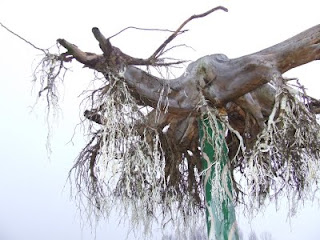
Speaking only for myself, I consider myself “terrorized” by all those who have terrorized the wood to extinction. In order to protect my interest in freedom and democracy, I have purchased a few hectares for myself in Latvia and have built there a “temple” dedicated to the wood. The centerpiece of the temple is not a God or Goddess, but the trunk of an oak tree with sawn off limbs. The “tree” stands on a concrete platform that has been built over the foundations of what used to be an old cowbarn and a hayloft.

This brings me to the literary critic, philosopher, and essayist Walter Benjamin. I am particularly interested in Walter Benjamin’s thought, because very possibly he helps to explain the thought processes of our forebears (and of course my own).

Writes Benjamin: “If the theory is correct that feeling is not located in the head …but, rather, in the place where we see it, then we are, in looking at our beloved, too [in this instance the wood and trees], outside ourselves.”

In other words, we experience our experience of the object in a sentient manner, as it beings outside ourselves. When we see a tree that commands our attention, we do not look at it as an actor may, with our head and conscious selves studying the tree in every detail, but as if the tree were that instant become a part of us. Such an entry of our self into the wood’s or tree’s self allows us to see he tree as copy of our selves. [I owe this latter insight to Michael Taussig’s book, re “Mimesis and Alterity”.] This is why sometimes the sawing down of a tree affects us with emotions that make us want to scream murder!

It is thus that we sacralize, make holy, a place, where the oak tree grows (or grew), and, in turn, the tree and its place sacralizes us.

While a mutual blessing may occur every time that I (we) and the tree meet (as when it grows in my yard), the communal ritual of sacralization (with the whole community participating) generally occurs on the basis of a local tradition, among Latvians, specifically, on Johns Eve.

In Latvia, Johns’ Eve is the time when a man presents himself to himself and the community with an oak leaf wreath on his head, a symbol of strength, endurance, greening, and life giving. In the instance of the oak tree, its fruit are the acorns that feed bird and beast. The woman appears with an oak leaf crown on her head as well (flowers are for medicinal tea and fulfill the sentiments of modern city dwellers), and both man and woman wear loafers (pastalas) made of linden tree bark made pliable after having been soaked in water.

To break meaning down further, the oak speaks for mindfulness as if it were a hat, while the linden speaks for being in touch with Earth. When the linden is in bloom, she is visited by thousands of bees; and if the bees think not with their heads, but are sentient in their being, then the linden tree, bees, and humans together create an aura within a special sound space. Latvians call this sound “sann-eht”. This ‘sann’ sound may only be heard properly when we are standing under a blooming linden filled with bees and with you and me present. So, if one wishes to hear how the linden, its flowers, the bees, and we sann together, you and I have to go there, where we will meet in the here and now.


We can rebuild this planet and recreate an un-tiered (egalitarian) society when and if we start using our brain to create ways to live in the wood again. Presently, it is still a movement toward the city, yet the computer makes the city unnecessary--at least as far as communication and education is concerned. Factories need not be so large as to consume a landscape. We dont need cars. We do need a good monorail http://en.wikipedia.org/wiki/Monorail system , bycycle paths, and a way to quickly attach a bicycle to the rail.

We also have to reinterpret history. That is why I have turned to Anatoly Fomenko as my orienter and guide in history. The current and popular version of history destroys our (my) sense of sentience regarding events by removing the events further into the background than they really are.


As recently as the 17th century, daily life was still enveloped by the wood. The machine, the great distancer of reality (television and the chainsaw being best examples), was not yet. Jesus on the cross (replacing Jesus thrown into a fire pit on the Hippodrome (11th or 12th centuries) in Constantinople did not yet fill the imaginary space with a phantasm better fit for the consumption of an urban dweller. Death by burning was a more sentient experience, the last victim of the Inquisition being Giordano Bruno in 1600, but the imaginary suffering of Jesus is made to appear more immediate.

In short, the current version of history (re: 2012 years since the birth of Jesus) denies, certainly handicaps Walter Benjamin’s theorizing and relevance. Propaganda takes precedence over sentience. The linden tree may as well be a linden in Unter den Linden http://www.ww2incolor.com/d/483493-4/1__007 c. Berlin, WW2.


Asterisks; Notes of Interest:

On  material depravation in Latvia.

On the theme of “more-equal-than-others” Animal Farm.

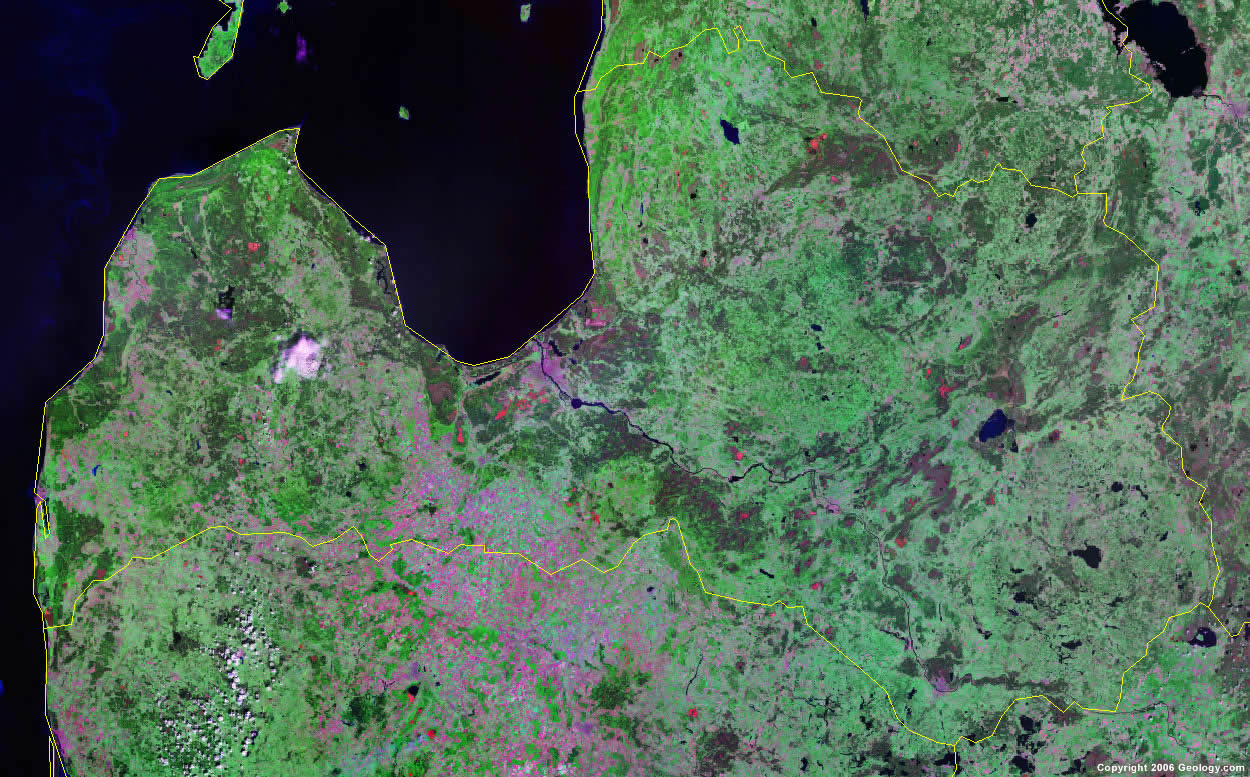
An eyeball view of Latvia (and its forests) company map; satellite. While some sources claim that Latvia is 47% covered by forests, none of it is old growth forest. The Latvian news media provides little coverage of the rapid pace of deforestation. Anecdotal evidence of deforestation in progress from a neighbor: “There were fewer mushrooms this fall than last year. Forests we used to visit are gone.”

Google software to tell effects of deforestation.

Of great interest to me this and like articles like articles. It presents some of my reasons for supporting the cultivation of Johns Grass in Latvia.

Favored serendipitous click or “chronal mirage” on the internet. I was searching for a relationship between the burning of Jersika and heretics in Lanquedoc, France. You must read the text at near the end of the scroll, re image of “The Burning of St. Joan”, Monday, September 03, 2007, to get the point.

My most unappreciated work—so far, re “Tiresias’ Revenge”, my reinterpretation of Sophocles’ “Oedipus Rex”. I believe that Sophocles had to hide the true meaning of his play for political reasons. It is apropos of the political situation in the world today, also in Latvia. The play may be found at blogs 40 through 47. Start from Blog 40.

These blogs tend to be a continuum of an idea or thought, which is why—if you are interested in what you read—you are encouraged to consider reading the previous blog and the blog hereafter.

Partial entries of my blogs may be found at LatviansOnline + Forum Home + Open Forum –ONLATVIANPOPULISM vs LATVIJASLABEJIE. If you copy this blog for your files, or copy to forward, or otherwise mention its content, please credit the author and http://esoschroniclnes.blogspot.com/