Showing posts with label Greece. Show all posts

Saturday, December 26, 2009

© Eso Antons Benjamins, a.k.a. Jaņdžs


NOT-VIOLENT TERROR
67 The Future of The Wuerzeltod (V)

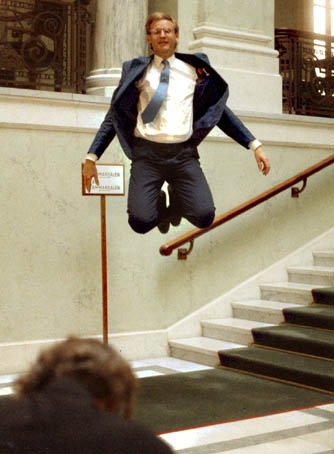
With levitation so capably performed on the deck of their sinking ship, moreover with such surreal earnestness on the faces of the high-end lumpenproletariat preparing itself for next year’s elections, the disconnection from reality may seem only virtual. Nevertheless, it is no fake uprootedness such as nearby treetops may reflect in a pond. After all, all the presidents, current and former, wishing to prove that they are not completely out of touch with reality attended church together and listened to the Lutheran Archbishop transmit a message from high above.

To be uprooted may not be as severe a condition as being Wuertzeltod. This is why hope prevails that the disconnections (neglect of education, health care, desertification of the land by deforestation, etc.) have not yet overwhelmed the body with total paralysis. Perhaps Latvians may yet grow conscious of their condition and attempt to grow new roots.

If being ‘uprooted’ is a curable condition, then sinking new roots is also possible. All the same time, it is no longer a matter of the current government saying so. The government (if not its officialdom) is dead (with some administrative functions, like the cut off tail of a lizard, are still thrashing about). The survival of Latvia as a culture under the umbrage of the current leadership as if guarding the people’s sovereignty is no longer possible. It is now entirely up to the people and the nature of their populist sentiments. Whether there is sufficient charisma left among the ranks to prevent death of the community only the future will tell. One may, however, be skeptical, because while personal tragedies as expressed by an increasing number of suicides are on the rise, none yet express themselves as sacrifices for the community.

It is up to the people—for the first time since the kingdom of Jersika in 1209—if they will remember and then accept their roots in the community of the Children of Johns and allow a rediscovered consciousness to define them as a people again. To prevent a still-birth the people need to remember that their loss—if once it could be stated in terms of loss caused by outsiders—that now it is 1) due to visitations of violence from a virus that has become internalized, and is pretending to be as ‘natural’ a gene as ‘original sin’ once was; 2) this internalization of the ‘bad’ gene is going unrecognized due to upteen ‘positivism’ campaigns, not to mention a shortage of social critics and analysts; and 3) due to a failure to understand that internalized violence can only be purged with a cleansing violence, also known as ‘founding violence’.

No doubt, founding violence is problematic issue. Thinking the problem through with the head is one thing; working it out in real life is another. Thinking with the head will not in and of itself create new roots or if created cause them to take root. A charismatic element is needed. And, indeed, I have been pointing at this need sometimes directly, sometimes indirectly, sometimes merely hinting at it since Blog 1. The need has been yeasting for a long time now, and it not only wants, but needs to break open for the sake of the survival of a vital tradition, overcome our disconnectedness from it, and survive as a people. If this does not occur, if the elite are permitted to dismiss populism yet again (they surely did it before 1918, and have been doing it ever since) with campaigns of ‘positivism’, and populist sentiments fail to send them on their way, then good bye Jersika, Baumaņu Kārlis, Rainis, sovereign state of Latvia, the pains and scars of 1941 and 1949, the People’s Front, and all that. As the saying goes, then “lyur, lyur, lyur”, the debt incurred by the government is not toward a better day, but for the bailing out of the Parex Bank and as Latvia’s burial fee.

The readers of “Not-Violent Terror” blogs ought to know that the charismatic element that this writer believes to be necessary is “death”. Of course, I am speaking of a not-violent death. This is why in the previous blog, I mentioned Socrates. Was his death a violent one? My answer is that violence by Socrates is imaginable only if we dare not or forbid ourselves to imagine a self-willed death in the service of the community. There is no charismatic other element sufficiently inspired to root and bond a community than death, i.e., self-sacrificial death. Socrates knew that, and it is not beyond our understanding.

In order to survive as a community Latvians need to rediscover not only not-violent terror, but the reasons for death. Death needs to be put in service of the will to live brought to us not only by Nature, but as the Nature of the nature of our psyche. As Michael Taussig, an anthropologist put it: “…it is useful to think of mimesis as the nature culture uses to create second nature, [but] the situation now is that this famous second nature is foundering and highly unstable.”* I am citing this passage, because to my understanding, second nature may refer to a second culture as well. In other words, if the first culture of humankind resembles that of the people from Fiero del Fuego in 1832, with absolute equality and no leadership as the prevailing cultural form, then what comes between it and our ‘advanced’ culture a la 2009 where banks control governments?

The answer is not in a five minute discussion. For one, such a discussion must remember that “Western civilization” willed itself to forget that the middle road could get us to “Most Advanced Civilization” status with no violence and with no ‘No-Future’ sign barring the road ahead. Why is Latvia so anxious to join this dead-end form of ‘Most Advanced Civilization’, when the latter has identified itself with war and violence to such an extraordinary degree?

The silence on this issue by the Latvian government, its Foreign Ministry in particular, is a practiced silence on behalf of a military system of defense. Does not a military force of European nations serve the EU (and Latvia) better than it being at the behest of NATO? One should think so. However, Latvians are consistently warned by the media that only NATO can protect us from Russia, the god-awful-giant-ever-gorging-Bear on the country’s eastern border. In other words, the Latvian public media is operating as much in a straight-jacket when it comes to thinking out loud than it was under any other regime of occupation.

Incidentally, this writer has no trouble in visualizing the Soviet Army oppressing Latvia. I know well the brutality of the Stalinist regime from way back into my childhood and the prevailing ‘atmosphere’ in civil society at that time and during war ensuing. At the same time, with the Soviet regime gone and with no threat from the Russian government today, Latvia could elbow for itself more room than the visionaries at Latvia’s Foreign Ministry can muster [with apologies to the Swedish Foreign Miister (2007)]. In the setting that has led to and currently envelops Latvia in a financial and economic crisis, the Foreign Ministry gives the appearance of being in the service of “a greater will” (no transparency whatsoever as whom it may be) and having no will of its own. Once again, the Latvian people are being sacrificed to the ‘Lord’ (an empty signifier) above.

Once more one ought to remember that the act of Adolfs Buķis, the Latvian who sacrificed his life in an attempt to free Latvia of corruption in 1993 in Riga, issued an implicit plea for Latvians to think, speak, and do not as their government. That happened seventeen years ago. Alas, we now see that this cannot be done in a space where all those inside it are unfree and the ‘savior’ sits on his hands in Heaven.


Asterisk & Notes of Interest:

*Michael Taussig, Mimesis and Alterity, Routledge, 1993, p. 252.

On material depravation in Latvia.

On the theme of “more-equal-than-others”: Animal Farm

Of great interest to me this and like articles. It presents some of my reasons for supporting the cultivation of Johns Grass in Latvia.

These blogs tend to be a continuum of an idea or thought, which is why—if you are interested in what you read—you are encouraged to consider reading the previous blog and the blog hereafter.

Partial entries of my blogs may be found at Latvians Online + Forum Home + Open Forum –ONLATVIANPOPULISM vs LATVIJASLABEJIE. If you copy this blog for your files, or copy to forward, or otherwise mention its content, please credit the author and http://esoschroniclnes.blogspot.com/

Wednesday, December 23, 2009


© Eso Antons Benjamins, a.k.a. Jaņdžs

NOT-VIOLENT TERROR
66 The Future of The Wuerzeltod (IV)

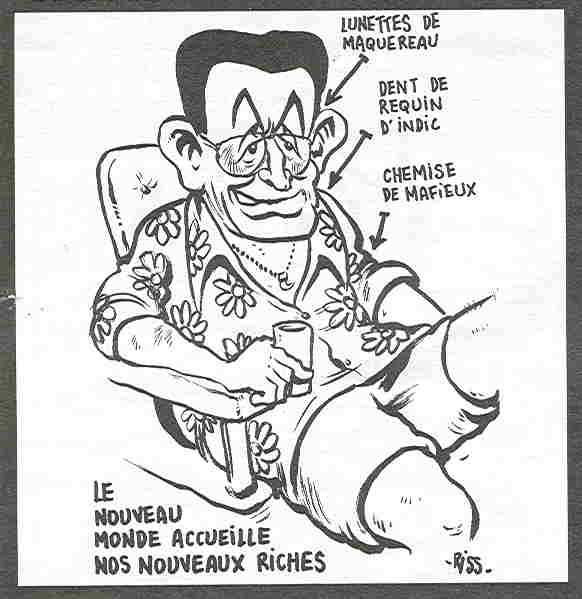
Whenever an Omega man (a rickshaw owner is a candidate for comparison) is ‘emerged’ (—it usually is not of his own doing, but a happenstance, therefore he is ‘emerged’/thrust forth), he overcompensates for his former lowest of social rankings and poverty by wishing to become a millionaire or in some other way reaching a status of equivalency with the high-end of society known as “old money”. There is a word in French for such emerged men and women: nouveau riche.

Sometimes some elements of the old nobility, though coming from a generally well educated class, make fun of the nouveau riche, thus letting everyone who has eyes to see see how arrogant and out of touch with reality some of the old class have become. Ideally though, the old nobility has close links (from way back when) with the temple, because the latter gains its wealth not for its high priest, but for the upkeep of the temple and for the high priest to redistribute a surplus of gifts as he sees it fit. One such person of ‘old nobility’ was Socrates, the Greek philosopher. While renowned as a philosopher, what is particularly striking is Socrates’ attitude toward and acceptance of death. He believed that by dying rather than trying to escape from a death sentence (which he received and had the opportunity to escape), he helped cement his society with greater bonds than can be done by mere law.

Sometimes however the nouveau riche emerges in such great numbers and accumulates such power in political circles (one way to gain equivalency with ‘old money’ is to overwhelm it by seizing control of politics) that they overwhelm both society and culture. That for the most part means the end of leadership of the old aristocracy (visualized in these blogs as a college of Johns) and its substitute with a pseudo democracy. The pseudo democracy is a ‘democracy’ that no longer exists among the common people, but operates among the nouveau riche or, as pointed out above, the heads of corporations. These millionaire upstarts, with a battalion of lawyers in tow, settle their differences ‘democratically’ in the court of law. While technology—originating in wealth making schemes—accelerates, the people of the land are neglected, deprived of a better education, and are ‘dumbed down’ (what an unpleasant but accurate phrase) to the function of laborers and consumers. At the same time, the ‘democracy’ now under control of the nouveau riche describes the peoples’ yearnings for justice and fair politics as populist. In countries like Latvia, words such as ‘populist’ and ‘populism’ are interpreted as synonyms of ‘harm’ and ‘harmful’ which harmful naming serves the interests of the nouveau riche “uzņēmēji”, i.e., producers, investors, anyone with a scheme to exploit nature and people at full throttle.

Currently Greece is in a similar situation as Latvia, except it has many more people and thus is able to expresses its unhappiness through greater social unrest. Furthermore, as one “anonymous” writer at another site put it (I hopeZeroHedge forgives me the steal): “Yes, the Greek public debt situation is unsustainable, but... if a country is idiotic (or captured, or likely both) enough to allow for the opportunity [it is old news].” Another “anonymous” observer writes: “…you can't live [in Greece] on the basic pension anymore. It was true for a long while, but now it's impossible…. Families largely make up for it—thankfully the social fabric is still largely intact in the sense that people feel obliged to cater to their own. But it's getting progressively harder for the average Yiannis (as in ‘average Joe’).”

We know that over the centuries Greek society has changed (like Latvian society) a number of times. First there was, so our history books tell us, “ur(very ancient)-ancient Greece”. This period goes back to the days before Homer, who sang a long poem to those ur-ancient times. Some researchers say that it may be that Homer’s Iliad and Odyssey is sourced in the Baltic area, that is to say, north of present-day Greece. Then comes ancient Greece proper with Socrates, Plato, Thucydides, et al. Then there is the Greece of Byzantium home of Basil, the holy man, whose death so closely parallels that of Jesus that it served the writers of the New Testament as a prototype to the Jesus story. Basil’s executor, Alexius I Commenus was an Alpha male (and one of many princes) emerged from and subject to the high-end lumpenprolitariat (‘Commenus’ by another name?) of his time. Commenus stands out as a crossroads from a community and temple oriented culture to one that robbed the temple for personal ends. Following the destruction of Jerusalem (then located in Constantinople) and the elimination of the Church of the Children of Johns in 1204 as a religious-political force, [John] Basil was replaced with Jesus, who was removed to a nonexistent place trick-a-treated into existence with ‘Heaven’ its name and other sweets.

Jerusalem, too, was relocated first to any land some bishop decided on (Bishop Albert and Riga, for example), later pushed further away from its homeland to Palestine. Of course, the Church of the Children of Johns, known as the Eastern Church today, was forced to take on a Western character, because John, transformed into Jesus in Heaven, could not oppose the secular princes as former Johns could and did. All these changes in “Greek” history had their echoes in the territories of the Slavs and the Balts. After the Eastern Church of Johns was forced to take on a Western cast, that is, after it was taken over by Westerners and/or their influence, the Children of Johns happily “converted” to (actually were coerced to) the worship a figure far removed from realities of life on Earth.

It is telling that eight hundred years after the princes secularized the temple, we have liberal capitalism become a ‘religion’. Its progress is seen in how “it's getting progressively harder for the average Yiannis (as in ‘average Joe’)” to survive not only in Greece, but also in Latvia. The scam known as “globalization”, while it confuses the poor and uneducated folk it addresses with high idealism, actually spells ‘pauperization’ not only for Yiannis, but Jahnis, Jean, Johammed, John, Johan, Han, Huan, Xian, etc. If I may put it bluntly, all these populist names and their bearers have been turned into rich g[y]uano (bird droppings) for the corporate powers that own the governments of our time. This is also why the name Jānis—once the most popular male name in Latvia—may soon disappear from popular names lists. Indeed, Janis (John) no longer appears one of the top ten names for baby boys. Such forgetfulness is the consequence of a cultural demoralization. Such was not imaginable a half a century ago. This tells us of great changes happening and yet to come.


Asterisk & Notes of Interest:

On material depravation in Latvia.

On the theme of “more-equal-than-others”, see Animal Farm.
Of great interest to me this and like articles. It presents some of my reasons for supporting the cultivation of Johns Grass in Latvia.

My most unappreciated work—so far, re “Tiresias’ Revenge”, my reinterpretation of Sophocles’ “Oedipus Rex”. I believe that Sophocles had to hide the true meaning of his play for political reasons. It is apropos of the political situation in the world today, also in Latvia. The play may be found at blogs 40 through 47. Start from Blog 40.

These blogs tend to be a continuum of an idea or thought, which is why—if you are interested in what you read—you are encouraged to consider reading the previous blog and the blog hereafter.

Partial entries of my blogs may be found at Latvians Online + Forum Home + Open Forum –ONLATVIANPOPULISM vs LATVIJASLABEJIE. If you copy this blog for your files, or copy to forward, or otherwise mention its content, please credit the author and http://esoschroniclnes.blogspot.com/