Friday, April 18, 2014

Eso’s Chronicles 332 / 8
Odds and Ends  
© Eso A.B.
 All comments appearing within brackets [ ] are editorial in origin.

THE PRIESTHOOD OF KILL (2)

A ‘selfie’ is a photograph taken of ourselves by ourselves. Generally a ‘selfie’ is also an arms length close-up.

But if a ‘selfie’ was to be taken by an aborigine, who believes that a photograph takes away some of his spirit or, better, dilutes the spirit, then a ‘selfie’ becomes a little bit of a ‘suicide’. Were John or Jesus alive today would they take a ‘selfie’ photograph of themselves?

I believe that ‘No’ they would not.

Again, from the perspective of an aborigine, a photograph of him (or ourselves) is a frightening and self-denying thing. We can best see this when we see an aborigine who paints his face and body http://www.veniceclayartists.com/wp-content/uploads/2012/04/2860915373_09e1131ac9.jpg , and compare it to a selfie photograph http://www.theguardian.com/media/2014/mar/07/oscars-selfie-most-retweeted-ever .

The difference between an image of an aborigine of himself and a ‘selfie’ is that the first projects his inner or subjective being himself, while the ‘selfie’ projects him- and ‘others’ as a bunch of smiling undead, whereas when given to a pop artist, the image tends to be projected as a corpse https://blogger.googleusercontent.com/img/b/R29vZ2xl/AVvXsEipmVSEq8Ac7ocHuieC8Hm0XhB04GAh4jkn99d2OizUa07cfBaRhbxv15jBCjE22sXFIS8oCMt2lQhgJqWSRAxQWrVIytka3S_1UAZqL7a0NIwF33jetigmwXo2sSKSVk8qhgfUEGn2aGw/s1600/IMG_0655.PNG .

The images provided by the links above show us how the images differ if we project 1) from inside ourselves, 2) how we look from the outside through the ‘dead eye’ of a camera, and 3) through the eye of ‘another’, who sees 1) and 2) as a joke or, if you will, a kind of and sort of undead.

The difference in the images gives us an insight into the politics of the past and present.

In the past, when most humans lived in the wood and were surrounded by trees and other life, humankind projected itself from within.

Today the artist attempts, consciously or unconsciously, to take the perspective of the government, which he-she believes to be the real ‘artist’ (good, bad, or indifferent) behind the shaping of the people who populate our planet today.

The difference in perception of ‘reality’ is radically different.

Let us imagine that the ‘artist’ is a ‘psychologist’ in the hire of government. The very fact of being hired by the government turns the psychologist into sort of a potter at a potter’s wheel.

In some sense the ‘potter’ also becomes something of a political scientist, who given the facts that 1) is dead and gone, and 2) is a game of children, becomes 3) a new fangled creature [1)+3)], no longer lives in the wood, but the urban desert. The potter-artist attempts to manipulate the 1) or subjective self of the rest of us through becoming an agent working for the NAS, CIA, FBI, or becoming a government mercenary. The inescapable ‘creative’ result is is not an agnostic, but an ‘atheist’.

A consequence of inverting the wood into an urban desert projects as an image of Jacob wrestling with an angel http://uploads8.wikipaintings.org/images/gustave-dore/the-wrestle-of-jacob-1855.jpg . Jacob succeeds  in ‘pinning’ the angel to the floor, and thereby becomes an anticipant of the atheist.

In real life, this event happened thrice.

1)    When King John or John Basil (aka the Bogomil) was picked a fight with by Emperor Alexis I of Byzantium.  The Emperor built a burning pyre and forced John Basil to stand next to it. In his defense, Basil began to “[talk] marvels and boasting that he would be seen unharmed in the middle of the fire, [while] they [the mercenaries of the Emperor] took his cloak and said, ‘Now let us see whether the fire will touch your garments’, and they threw it right into the middle of the pyre. But Basil was so uplifted by the demon that was deluding him that he said, ‘Look my cloak floating up to the sky!’ Then they… pushed him [Basil], clothes, shoes and all, into the middle of the pyre….”

The other story tells of the death of Jesus, who was substituted for Basil:

2)    The story is at Matthew 27:32-56: http://www.biblegateway.com/passage/?search=Matthew+27%3A32-56

The two stories differ little from each other, except in the version told of Jesus, a) Jesus acknowledged taxation, while John Basil never does. Also, b) the disbelief of Jesus as the Son of God is corrected by the rending of the curtain in the temple and the soldiers exlaiming: “Surely he was the Son of God!”

There is, however, one more story, a lie, that tells the difference between John Basil of the People and Jesus of the Jews: the Bogomils believed that John was the eldest Son of God, whom the inventors of Jesus renamed John by changing and rewriting his name from Saint Ian to Sant-[Y]aniel, the Devil.

*Most of the information in this blog taken from Dmitri Obolensky’s “The Bogomils”. 1948, Cambridge U. Press.

Thursday, April 17, 2014

Eso’s Chronicles 331 / 7 
Odds and Ends  
© Eso A.B.
All comments appearing within brackets [ ] are editorial in origin.

THE DEATH OF 1st CHRISTIANITY (1)

We are told by the consensual historians of the West and East that in 1240 Kiev was captured by the Mongols of Ghegis Khan [John (possibly Angus) the King]. Russian mathematician and historian Anatoly Fomenko disagrees, and argues that the Mongols were never plentiful enough to make an invasion.

My own view agrees with Fomenko, but for a different reason.

In my view the Mongols were invented by the Russian Orthodox Church to cover up the fact that it had accepted the Western version of Christianity. In fact, the Mongol invasion was a continuation of the invasion that was  begun by Western un with the so-called 4th Crusade (1204), which mysteriously stopped at the gates of Byzantium and did not continue on to Jerusalem as the organizers of the Crusade had first told.

The Christianity reigning in Kiev and Eastern Europe as a whole before 1204 and 1240 was forced underground and little by little over the next several centuries destroyed.

Let us remember the Crusade of 1208 against the Cathars (?Bogomils) in Languedoc, now France, and Yersika, now Latvia. These events were not new enterprises, but a continuation of the 1204 attack on Byzantium, which thereafter was renamed Constantinople. In southern France and the Baltics, too, the old or first Christianity was liquidated in favor of one invented by the West [with considerable help from one called St. Augustine and many other paid agents (Bishop Albert in Livonia being one of them)].

The ‘hereticism’ according to the consensual establishment (the boyars and princes with their lobbyist the priests and various specnaz groups of monks known as Holy Orders) came as ‘hereticism’ by way of the East, from Iran and Syria, and were known as Asian Manicheans, Neo-Manicheans, Massalians, Patarenes, Dualists, and more.

As for who these ‘heretics’ were in actuality, we may discover by taking a closer look at the name Patarenes. In fact, this group was known in then Livonia as ‘Pastaljāņi’ or later ‘Pastalnieki’. Even today, anyone who is long on his or her prayers is said to be saying ‘Pahtari’. The name ‘pastala’ in Latvian means a primitive form of a ‘shoe’ cut from pig leather http://www.kasjauns.lv/galerijas/pastala_by_linda_leen/peleka_pastala.jpg . It is still sold as a souvenir item in Riga to tourists. The nearest use today of the pastala is as a ballerina shoe, with the difference that it has a hardened toe.

The manner in which the name of ‘pastala’ found its way in the name of the Patarenes is when the consonant L began to be pronounced as an R. Thus, former Amsteldam is now known as Amsterdam, and ‘pastala’ became the root for ‘Pastarene’, aka the Traveling or Wandering weaver, aka the Wandering Jew—Ahasverus. Weaving, a necessary art in those days, was adapted by the Pastelenes in Livonia and elsewhere as their mobile tradesmark; it opened many doors to them and their Christian or Christian King John’s message.

Due to the dogmatic pressures of the Lutheran Church, the Latvians to this day do not connect one of their most sacred folk relics, the belt from Lielvarde https://www.google.lv/search?q=Lielvardes+josta&tbm=isch&tbo=u&source=univ&sa=X&ei=ldBPU-muL4nnywO3kIDACw&ved=0CCgQsAQ&biw=1093&bih=426 , as the work of the Pastarenes or Bogomils.

The 4th or was it the 1st Crusade(?) was a political movement on behalf of the elites that lasted a very long time. Thus, the 1240 invasion of Kiev by the ‘Mongols’ and the 1360 convocation of the Bulgarian Church Council, the latter (‘Orthodox Christianity’) especially aimed to condemn Judaism and Bogomilism, which appear to have had close contacts at that time. The hold on Bulgaria of the First Christianity was strong and thus especially abhorrent to the elites from the West.

The strength of the Bogomils arose from the fact that it had roots in the indigenous population—then still mostly people of the wood. For example, the Synodicon of the Tsar Boril describes Bogomils thusly*: “…those who on the 24th of June, the birth of John the Baptist [I read it as ‘Ian the Basil’] practice magic and gather fruits and that night perform foul mysteries like the pagan [pa-yan] rites.”

The 24th of June marks the date of the summer solstice, and it is still celebrated by the Latvians (as Jāņu diena) and southern Slavs as ‘Ivani deni’.

Because the 2nd Christianity of the elites (then called Catholics, now fully secularized as Globalists) eventually prevailed over the 1st Christians, the latter became increasingly identified with pagans (pa-yans), with magic, and popular superstitions. Indeed, there came a time when Bogomils lost all leadership and their most important rite became a ‘folk festival’.

As for the leadership of the Bogomils, most of them met their fate on a pile of burning wood. This was the first ideologically motivated act of deforestation. It is from this time on that the People of  Byzantium and now the entire world were subject to taxation of the State at its will.

*Most of the information in this blog taken from Dmitri Obolensky’s “The Bogomils”. 1948, Cambridge U. Press.

Wednesday, April 16, 2014

Eso’s Chronicles 330 / 6
Odds and Ends  
© Eso A.B.

CITY AND WOOD DO NOT RELATE (5 of 5)

The concerns about the warming of the climate pushed by the ‘greens’ of all shades is touching, but as we all can see—of no significance in effecting any ‘real’ changes on our planet.

The reason for this is simple, but escapes notice: people who live in an urban environment differ significantly from people who used to live in the environment of the wood or countryside farm. The processes of thinking in the two environments differ radically from one another.

While we keep hearing the urban ‘greens’ argue for a ‘better’ environment, we never hear them argue that our civilization’s ‘speedy’ ‘progress’ toward ‘negative horizon’* has to be stopped in its tracks if the environment is to be prevented from collapsing and life reduced to moth and worm.

The link below leads to environmental news from China, one of the worst polluters of our planet. That country’s leadership makes-believe that it brings us ‘good news’ by issuing a new environmental ‘law’ that may somehow curb the ‘progress’ of pollution the government achieved after the meeting of ‘Mao-Kissinger-Nixon’ in 1972.  

Try as they might to revive their of Confucian tradition http://www.huffingtonpost.com/2014/04/15/china-expected-to-elevate-environment_n_5150010.html?utm_hp_ref=green , it no longer stands for reason, if the government proceeds with its plans to move 100 million peasants from the countryside into cities by the year 2020 http://gizmodo.com/chinas-ambitious-plan-to-move-100-million-people-from-1545817164 .

The ‘greens’ of China, that is to say the International Confucian Ecological Alliance (ICEA) may solicit a hundred Harvard professors to invoke Confucius (and “the classic Chinese trinity of Heaven, Earth and Man”) times 24/7/365, but if they cannot think for themselves and change the word ‘man’ to ‘life’, today even Confucius becomes inconsequential; re: http://www.globaltimes.cn/content/831535.shtml#.U014dWeKA5g .

As I see it, the problem lies in making a switch from thinking communism through ‘progress’ to thinking communism through ‘autarchy’ and self-sufficiency.

This, of course, applies to all countries. The failure of the U.S. economy ought to be a shining example of what ‘progress’ as thoughtless capitalism leads to http://libertyblitzkrieg.com/2014/04/14/the-homeless-in-nyc-are-now-living-in-tiny-spaces-in-the-frame-of-the-manhattan-bridge/ .

Virilio argues that the “negative horizon” has been instituted by a State dedicated to “indefinitely perpetuating extermination”. He explains that the ‘extermination’ began with “Athenian autochthony… [and] a ceremony leading the panathenaeans up the Acropolis from the cemetery of the Kreameikos, from birth to the public death of these ‘sons of the fatherland, for whom time is annulled in the irrevocable return from the end to the origin”.**

Perhaps my criticism of Virilio is contained in the fact that I am unwilling to follow the neo-elite of our times to whatever their Acropolis. This means that I would be gripped by fear strong enough to cause me to step out of the line winding its way up-hill and run down the hill instead.

Rather, than return to the cemetery of the Kreameikos, I am hoping that I will be intercepted by the ‘deforested’ wood ‘miraculously’ resurrecting itself before my sight and step, and that with the genes of an ancient Slav in my blood, I would fall on my knees and praise God and Mother Earth.

Yes, a humankind practicing autarchy will think radically different from todays ‘best and brightest’. And, yes, such radical thinking is necessary, but will not come without an imposition of autarchic regimes the world over. Like my sudden fall on my knees, the sylvan environment necessarily encourages superstition and fearlessness before the scientific criminals from MIT, Silicon Valley, and Southern Cal and, who knows, where else.

But how are we to make this sudden transition from violent urban capitalism to a peaceful sylvan autarhy?

I believe that we must remember the old say by John (also  Jesus): “…for all they that take the sword shall perish with the sword (Matthew 26:52, King James).

As I have argued in numerous blogs, the sword was first brought to autarchic civilizations of the wood by the Vikings fleeing the harsh environment of Scandinavia by the river routes provided by the Volga, Dniepr, Donau, and other. The rivers led the demoralized herders back to the regions of the Black Sea where they had originally come from. It is worth noting that upon their return the once peaceful herders (Johns) had become zhans d' armes (from Dutch), i.e. armed men taking suck of blood rather than reindeer milk.

Instead of milking reindeer, the Vikings now killed them for their fur and instituted a thousand year long Reich of taxation. And the men and women of the wood who resisted them, they raped and then killed, forcing their descendants to take up arms, and thus creating an armed civilization. They also substituted the religion of Gods and God of the people of the wood with an agod (? Godo) born of the city in the desert.

It is not a coincidence that the forces of NATO today are led by a presumptuous Dane named Rasmussen http://en.wikipedia.org/wiki/Anders_Fogh_Rasmussen#NATO_Secretary_General , and that this man is telling the Slavs that they are making “a historic mistake” http://www.dw.de/natos-rasmussen-warns-russia-against-historic-mistake-in-ukraine/a-17550618 by presuming the Ukraine a territory of their historical past.

It is neither Rasmussen or all the universities of the West put together that know what their history is, and that the history that they pretend is all a lie and a violence. Today history in the Ukraine acts on a psychosomatic disorder all its own.

*A term first used by Paul Virilio in the title of his book “L’Horizon Negatif”,  1984.
** Ibid, p. 175.

Tuesday, April 15, 2014

Eso’s Chronicles 329 / 5
Odds and Ends  
© Eso A.B.
 All comments appearing within brackets [ ] are editorial in origin.
THE SUPERNATURAL AND SUBJECTIVE (5 of 6)

We have read about the Resurrection, but have given little thought that in order for it to take place we need to return to superstition, a term, which was invented by the superstition of science that the mind dies with the body.

I will attempt to answer the question about the origins of ‘superstition’ in a later blog. On this occasion, I will try to stick with the Easter theme, which for the absence in our time of self-sacrifice is no longer accompanied by Resurrection—except as a meaningless word.

Easter is a time in which—so superstition tells us—Jesus rose from the dead. The creators of Easter hastened to celebrate their new Holyday before (the end of April or early May), when the Beltaines began their night and day orgy dedicated to the green fire.

While critics of literature shy away from making the connection, the Greek playwright Euripides wrote a reasonably accurate description of what went on during  “The Bacchae”. What we miss when we read the play is that King Pentheus did not lose his head due to the ‘madness’ of  his mother Agaue having eaten a basket full of fly agaric, but because the king had instituted a gender change for the Sun, which up to that particular festival had been known by her name in the feminine gender–Sonne (German and Old English), or Saule (Latvians).

For reasons of his own, that is to say, for subjective reasons, Euripedes likely believed that the old superstition of the Sun being the mother of all life on Earth (Zemele*) was so ingrained in the minds of the people of the wood that it could never be erased.

The clue of what the superstition about Saule/Sonne was is revealed in a Latvian folk poem, which tells that at Her rising and setting the rays of Sun (Saule, f.g.) shear the tree tops. We may remember here that King Pentheus had climbed to the top of a pine to better see the orgies below. When the Sun rose, her rays blinded the autistic and sex starved King, and when climbing out of the tree, for lack of sight, he lost his footing and grip and tumbled to the Earth below to be ‘devoured’ by his mother (Agaue or Zemele, take your pick).

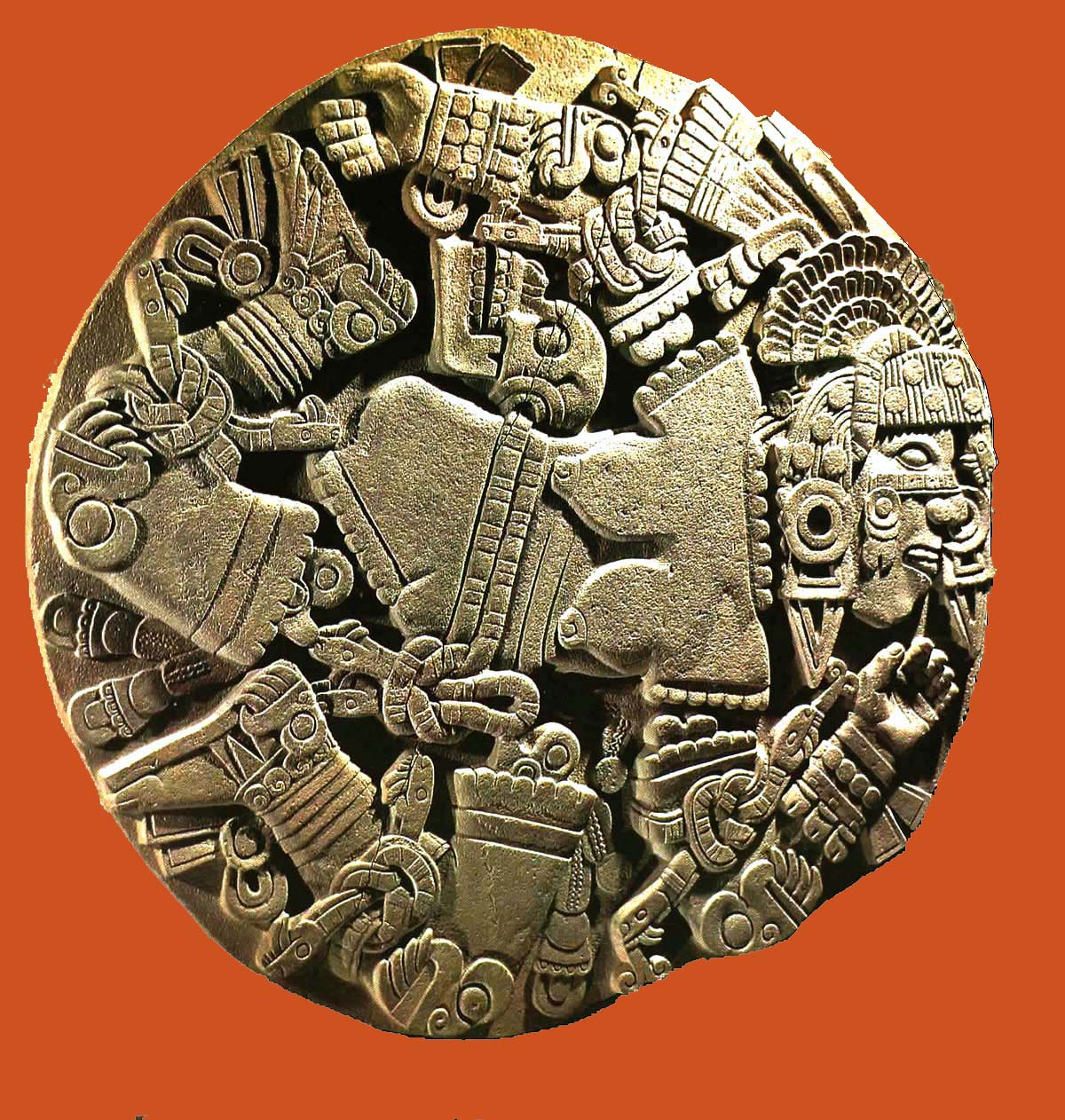
I believe that the same “Bacchae” event was reflected in the Aztec rites of human sacrifice at the top of Templo Major in what is now Mexico City. When the corpses of the sacrificed (at the top tier of the temple) were thrown down the steep steps, these were awaited below by a two dimensional sculpture of a dismembered Earth Mother— Tlaltecuhtli http://www.famsi.org/research/pohl/images/aztec3figure1.jpg . By a curious and paradoxical twist in the story, Coatlicue (aka ‘the serpent skirt’, the Mother of the Gods and all heavenly bodies, including the Sun) had given birth to the Sun as a male. As if to make up for the error, female sacrifices were also made at the temple (probably to give the Sun feminine aspects). The difference in the story of the Aztecs and Greek Dyonysians is that the Aztecs had the Sun give birth to the male gender as if to replace Her real feminine self. Realizing her mistake, She sacrifice herself to correct herself.

There are so many versions of who the Sun is among the Aztecs http://www.aztec-history.com/aztec-sun-god.html that all those who cared were very confused. To decide whose version is right without going to war over it, the Aztec Gods called for a big get together to see which one of them was able to sacrifice him or herself in lieu of a war by jumping in a pit of fire. None of the Gods proved brave enough. As among government officials today, none of the elite wished to lose life, when there was a surplus of peons available to die in their stead.

At last a God covered by open sores of a venereal disease (to indicate that he was both a God and a human) called Nanauatzin, later renamed Tonatuih, jumped into the fire. By being consumed in a fire (almost identical to the death of John Basil in old Byzantium), Nanauatzin connects to  the fires of the Dyonisian Bacchae Festival, the People of Johns Festival among the Latvians, the Beltaine Festival of Ireland and Scotland, and not least, the death of Jesus Christ (the traitorously renamed John Basil).

Being of pure fire, the Sun demands that in times of peace she is remembered by a display of fire, but in times of war, when the continuance of life appears in doubt, she must be remembered with a self-sacrifice. As the link below tells it, if ordinary sins were confessed by the Slavs in an ordinary hole in earth, sins against life demand a hole deep enough to reach fire.

*Zemele=Semele=Mat Zemlya http://en.wikipedia.org/wiki/Mat_Zemlya

Monday, April 14, 2014

Eso’s Chronicles 328 / 4
Odds and Ends
© Eso A.B.
All comments appearing within brackets [ ] are editorial in origin.

THE TRAGEDY OF JOHN AND IESU (3 of 4)

In some ways John the Baptist or Christener and Jesus Christ may be one and the same person, and their basic message of love may be the same.

Still, there are some important differences between the two.

Even while the New Testament admits that John precedes Jesus and that he Baptized or Christened Jesus, there are some substantial differences. A careful reader will have noted that my two previous blogs, 326 & 327, dwell on how deliberate and politically motivated changes in the meaning of names set the stage for the Big Lie.

We discovered that the word pagan, really means pa-Yan, a word that stands for a ‘belittled’ reindeer (or other forest animals) herder in the Eurasian woods. A neighbor of mine, who was born in Siberia, reminded me that the word ‘pa-gan’ also rhymes with the Russian word for the fly-agaric (aka amanita muscaria), the famous red mushroom capped by white dots, frequently used by native shamans of the wood https://www.google.lv/#q=images+of+fly+agaric . Its Russian name spells ‘pa-gan-ka’.

It is easy to imagine how a townie alienated from nature, would in later years condescendingly call a dweller of the wood a Paganka. This name calling does not differ much from today’s city or government elite calling a marihuana smoker a ‘pothead’.

Nevertheless, John Allegro wrote a controversial book, which he called “The Sacred Mushroom and the Cross”, in which there are a number of images from ancient art showing the use of the mushroom for visionary purposes http://psypressuk.files.wordpress.com/2011/03/mushroom-in-christian-art.jpg . Since we live in a cultural atmosphere that accepts that the thinking process is a matter of digitization, the chemical process as a facilitator of visions has been viciously denied and repressed by do-gooder political organizations and religious organizations lobbied by secular governments. The “yes-no” process of “yes-no”, “yes-no” ad infinitum has unfortunately brought our urban desert civilization to the state of near idiocy.

The fact that both John and Jesus were men of the wood and not from Nazareth or the river Jordan, is hid by contrary statements, such as Matthew 3:4, calls the wood ‘wilderness’ and describes John wearing “a garment of camel's hair and a leather belt around his waist””; while Jesus is popularly believed to have been either a carpenter or the son of a carpenter, a belief derived from Matthew 13:55: “"Is not this the carpenter's son?”

Who but men living in the wild of nature (if not the wood) wear a garment of camel’s hair and are expert handlers of wood, that is to say, are  carpenters? While most hominids of the times of John and Jesus were not urbanites as today’s popular prejudice of churchmen encourages us to believe, they all surely knew that the wolf could imagine having eaten Little Red Ridinghood only if he had eaten a fly agaric.

And why would a wolf eat a fly agaric? Probably because he mistook it for menstrual blood. As the color red is associated with the color of blood and hence is a sacred color, and the muscaria amanita is known to lower blood pressure, it may have been used by women during their menstrual periods. Whether it was used externally, I do not know, but Red Ridinghood is not a name of an ‘innocent’ little girl wearing a red hat in the days when color red could be afforded only by royalty.

Yet, while John and Jesus both stood for enduring suffering and pain in the name of love as a human condition, there was also a distinct difference between them.

John was clearly a man of the wood. His color was green, that of vegetation coming back to life in the spring. In northern climes his month was April-May, the Beltaine Festival of Ireland (remember the clover leaf as its symbol) and Scotland come to mind http://www.britannica.com/EBchecked/topic/60147/Beltane . It was a fire festival, because it is in these months that leaf and grass as if catches fire and bursts from sleepy earth. Beltaine is also a word that consists of two words: Belt + aine. While the meaning of ‘belt’ may derive from ‘vert’, green or ‘velt’ to swell, ‘aine’ clearly rhymes with yaine or ian. In other parts of Europe this festival is celebrated in June on the Summer solstice and is known as Johns Festival. It, too, is associated with the color green and fire; it is a day when everyone in Latvia of old and of the wood wore a green-leafed wreath http://www.kasjauns.lv/Otkrito_Foto/22.06.2010/1_Glavnaja-big.jpg  or when it comes to today, wears a green spray attached to his-her garments.

As the summer solstice is the day of the Goddess Sun, the celebrants in Latvia are called “children of Johns”, however, the word ‘children’ may be a religio-political substitute for the word ‘llaudis’ (Jāņu ļaudis), People. As I pointed out in blog 326, “…the acronym INRI (Latin: Iēsus Nazarēnus, Rēx Iūdaeōrum) should be substituted with the letter L [in place of I], in which case the acronym reads ‘Lūdaeōrum’, which means ‘King of the People’ not of Jews.” Indeed, in Latvian folk belief the Kings of the People are all named John.

Still, when Catholic Christianity arrived to substitute the Christianity that arose of itself in the wood and of ‘Lūdaeōrum’, the word was substituted by “Iūdaeōrum” or Jews (a people compelled to become tax collectors), not only was there begun a tradition of prejudice by the elite against human beings living in nature, but the nature of Christianity itself was changed for a faith imposed on the People by princes and barons. In short, the name of John was changed to Iesu, and this Iesu had no objections to either tax collectors or tax collecting.

Sunday, April 13, 2014

Eso’s Chronicles 327 / 3
Odds and Ends
© Eso A.B.
All comments appearing within brackets [ ] are editorial in origin.

HOW DOES ‘GENU’ BECOME ‘IESU’? (2 of 4)

With a small clue, such as discovering that the word ‘pagan’ does not mean ‘heathen’, but consists of two parts, ‘pa’ and ‘gan’, we can make long strides such as daddy longlegs, a member of the arachnids called an  Opilione makes, whence it is also known as a Harvest Spider or Harvestman or Shepherd.

That’s pure gobbledygook, no? Not so fast.

Again, let us note that the word ‘opilione’ consists of two parts: Opil + ione. ‘Opil’ derives from ‘opal’ or color (https://www.google.lv/?gws_rd=cr&ei=BytJU6jYHaOGywOq6IGoAg#q=meaning+of+opalescent ) and stands for daddy longlegs many eyes, while ‘ione’ is easily read as ‘ian’, whence the English name for John. In this case, the word ‘harvestman’ derives from the word shepherd, which itself originally meant herder and was pronounced as Ian, or Yan, Ivan, Ion, Johann, Jan, Xian, x 100. Since herders were replaced by agriculturalists, the name was transferred to the latter; thus, also John, Ian, Xian, Janis, Jean, Zhan, etc., become peasants.

As for ‘pa + gan’, the ‘gan’ word also spells Jan, because the letter G may be easily pronounced as J in John or J in gendarme.

So, the many eyed ‘opilione’ stalks on and comes to a stop at the Italian name for ‘peasant’ or ‘paisan’. Is this word not the same as the ‘pagan’ of the Balts? The word, too, consists of two parts: ‘pa’ + ‘isan’. Interestingly, we note that ‘gan’ (or yan) is now spelled ‘isan’. A long time ago, I had a dear friend of Italian extraction, whom I often greeted by addressing him as “Paisan!” meaning not peasant or heathen, but ‘friend’.

Thus, it goes with words and names; and we can now return to the word ‘Genu’ in the title of these blogs and see more easily how it is connected to the ancient herders or Ians, and how Ians was also a name commonly held by kings—such as King John, Ivan the Terrible, Ghegis Khan, Prester John—all because the people who used these names saw a connection between herders of sheep, or goats, or reindeer, or pigs, or cows with a person who was responsible for keeping track of a herd or a community.

Perhaps we can also see how ‘’pa-gan’ becomes ‘pa-isan’ or the other way around, though we cannot necessarily explain how the letter G becomes IS or IS becomes G. Yet we cannot now deny giving consideration to the possibility that John or Ian came to be known as IESU, especially since one John the Baptist (known as John the Christener in other languages) is said to be his forerunner.

Seeing that Easter is soon upon us, we can go on to speculate of how the word ‘Christ’ derives from the word ‘skusts’, after the latter  metamorphosed into the word ‘krusts’ or ‘cross’.

In the Latvian language, the word ‘skusts’ comes from when a woman puts her four cornered shawl across her shoulders, then crosses the two loose ends across her breast and tucks them into her belt or knots them http://en.wikipedia.org/wiki/File:Quechua_Woman_in_Peru.JPG . The pattern that the wearer of the skusts then carries on her body is clearly a ‘cross’. If we now return to our favorite act of ‘pareidolia’, we may note that ‘skusts’ also echoes in such words as ‘skuhpsts’ (kiss) in Latvian, and the word ‘skull’, which we generally see with two shinbones crossed behind it.

If we wish, we may use our pareidolia also to touch the famous Latin American shawl known as a ‘ruana’. It is pictured in the link above. While the origin of the word according to the Chibcha people is derived from the word meaning ‘land of blankets’ http://en.wikipedia.org/wiki/Ruana , I will still dare to link the word to the time when the consonant L changed its pronunciation and became an R. Thus originally, a Ruana may have read Luana, a blanket of the people made of the wool of Llamas https://www.google.lv/#q=image+of+llama .

( To be continued.)

Saturday, April 12, 2014

Eso’s Chronicles 326 / 2
Odds and Ends
© Eso A.B.
All comments appearing within brackets [ ] are editorial in origin.

HOW DOES ‘GENU’ BECOME ‘IESU’? (1 of 4)

Anyone who reads my blogs, probably knows that I am hooked on calling Jesus (INRI http://en.wikipedia.org/wiki/Jesus,_King_of_the_Jews ) as John Basil. Now that Easter is upon us, it may be the time to return to the question ‘why?’

The main question does not center on the name of ‘basil’ or ‘king’, because the words clearly are a translation from Greek into English http://en.wikipedia.org/wiki/Basil_(name) . Still, it is interesting that if the S in the name ‘Vasil’ (from which derives ‘Basil’) is substituted by an N, we get ‘Vanil’. So, how do we get the S sound become an N sound? The answer is that Basil is the name also for a king of the herbs used in food seasoning; and if we continue to think of the name in terms of flavors, it is easy to transfer Basil to Vanil.

Speaking of letters, it also seems that the letter I in the word ‘Iūdaeōrum’ in the acronym INRI (Latin: Iēsus Nazarēnus, Rēx Iūdaeōrum) should be substituted with the letter L, in which case the acronym reads ‘Lūdaeōrum’, which means ‘King of the People’ not Jews http://en.wikipedia.org/wiki/Ludi . This common misreading in religious text is clearly a politically motivated misreading. The word ‘Lūdaeōrum’ has with time undergone many changes. For example, in German the name for People is ‘Leute’, also King Ludwigs name means King of the People, whereas in Latvian it is ‘ljaudis’. We ought not be surprised that originally the name Jew meant Ludi, the People, which is whence also the English name for those who were against the Age of the Machine, re Ludites.

Since I am not a grammarian or a linguist, but a lay person, who for his own cultural and political reasons finds the changes of sound or phonetics in words interesting and worth while a pursuit, I do not feel bound to scholarly method, but go my own way—sometimes taking a wrong turn. Then again, the turn may take me not only from Vasil to Basil to Vanil, or from Jew to Leute, but it can introduce a line of thought that appear to be persuasive enough to change the direction of all of Western history.

My inspiration or motivation to persist in the (?questionable) pursuit, is that by preconceiving that the name of ‘Jesus’ (Iesu) was originally the name ‘John’ (Ian) on the basis of no more than a ‘wild guess’ and contrariness, I arrived at a theory that disputes the entire history of the West as a False Flag event. True, the original hint came by way of reading Anatoly Fomenko’s book “History: Fiction or Science?” Fomenko is a Russian mathematician specializing in topology, the latter which he uses to create what he calls a  ‘new chronology’ that aims to ‘rewrite’ and topple the Scaligerian history that was originated by the Catholic Church http://en.wikipedia.org/wiki/Anatoly_Fomenko .

I received an additional impetus for my ‘rewrites’ from the fact that my ancestors arrived in Latvia from the region of Croatia or thereabout after the Great Northern War between Russia and Sweden, which wae ended in Livonia in 1710. My forebears came here as Herrnhuters, a ‘deviant’ Christian sect with roots in the Jan Hus movement of the 15th century, which movement may itself be a derivative of the early Eastern Christian sect known as the Bogomils. The Bogomils were exterminated by the Catholics in the 14th century, at which point the remnant went underground and became the stimulus of later ‘Protestant’ movements. Interestingly, the Bogomils were able to survive a little longer in the Croatia region due to support for it by local princes, whom the Catholic Church—for reasons of its own politics—left to themselves. While the Herrnhuters were ‘exterminated’ for reasons of church politics in Latvia, they survive today as the Moravian Church in North Carolina, the U.S. http://www.moravian.org/the-moravian-church/the-moravian-church/history.html and a few other places.

In any event, the Herrnhuters came to Latvia on the invitation of a local German baroness (from the town of Valmiera) to revive the civil society (composed mostly of wood dwelling people and nascent peasants) after the trauma of the war, which left the northern region of what is now Latvia nearly without a population. The ‘new’ population arrived from what is now eastern Latvia, a region named Latgale, then mostly Catholic and land starved, because the families of Latgalians tended to have many children.

The Herrnhuters, who arrived in Livonia in 1739, ‘reeducated’ the remnant and the new arrivals, and in the process of teaching and preaching, created the foundation of a new and revitalized culture—that of the Latvians. This achievement was later taken from them by a jealous Lutheran church, which used the Herrnhuter connection to the German overlords in the post-French Revolutionary period (1789-1799) http://en.wikipedia.org/wiki/French_Revolution to politically exterminate them often by making use of the tool of the Inquisition: fire. My family history is intimately tied to this history: my grandfather (whose mother was falsely accused of burning down her husband’s inn), when he was himself denied and frustrated as a would-be Herrnhuter preacher, turned to choir directing, teaching, and later (at early middle age) founded a newspaper that played a significant role in helping shape the character of the Latvian national. This is not to say that the Herrnhuters were unsympathetic to the emerging ‘new age’ ideas. My grandfathers own grandfather, married a local woman named Anna, born 1770. While her maiden name remains unknown, she is proudly listed (I presume in the church wedding calendar) as “the daughter of Liberts” (Liberta meita), i.e., the daughter of a free man, one not bound as a serf to a local baron.

As the Latvians, after gaining independence, attempted to further guess and shape their characteristics, they were as exposed to the unknown as we all are, but since they had been effectively under foreign domination since the 12th century, there was very little direct input about their history from their own. This made history for Latvians the Great Unknown. The Christian Eastern Church claimed influence going back to the 11th century from the ‘Eastern Orthodox Church’, while the ‘Western’ church claimed arrival in the 12th century from Luebeck, Germany. The latter, having arrived with Bishop Alberts, in or about 1201, claims to be the founder of Riga, now the capital of Latvia.

Bishop Albert also managed to soon (1208) wage a Crusade against King Visvaldis of Jersika (possibly a colloquialism for Jerusalem). The crusade coincided with the Crusade of the Catholic Church, begun that same year, against the Cathars in Languedoc in southern France. Was there no spiritual or cultural connection between these two geographical sites?

Due to the political influence of the Lutheran church—which paradoxically based its influence on the dominant position of the Baltic Germans until an agreement between Hitler’s Reich and Stalin’s Soviet Union, caused most of them to leave for Germany—the connection between the Cathar Church in Languedoc (who many say had an affinity with the Bogomils) and the destruction of Jersika, Latvia, was never investigated.

As a consequence, such early Christian influences in proto-Latvia, the ‘new’ Latvians (of the 20th century) chose to believe (in spite of circumscribed and limited evidence to support the theory) that their ancestors had been bound to archaic Gods. Hence, many call themselves ‘pagans’ to this day. This new pseudo-religion of ‘true believers’ (Dievturi), in spite of the group’s small membership, held strong sway over the Latvian community’s subconscious even among the refugees from the Soviet Regime in North America and the renewed Latvian State (1991-…). Again, since the Lutheran church often acted as a center for the community of refugees abroad, the ‘pagan’ element was given leave be, because it provided no competition worth mentioning to the ‘established’ church or faith.

The status quo in Latvian culture remains in place ever since the Herrnhuters were pushed aside by the Lutherans, about the middle of the 19th century to this day. For example, no one wishes to notice that ‘pagan’ is a word that is not a synonym of the word ‘heathen’, but is conjunct of two words, re: ‘pa’ + ‘ian’ or in Latvian pa-Jānis. ‘Pa-’ is often used in conjunction with a prefix to a word if the user wishes to diminish the status of the addressed—be it a living or inert object.

( To be continued.)