Saturday, March 18, 2017


Of Cities and Citybred Monsters
By © E. Antons Benjamiņš, 2017

It has finally come to be that the atheist-controlled community of government has become the fake Godhead over the community of Nature.

What’s In A Name?

Our time and especially its youth proudly and with conceit claims itself to represent an age of exeptionalist individualism. Be that as it may, there is no proof that individualism has brought humankind any great benefit. To the contrary, one may argue that individualism has been a cause of human devolution, because it is destructive of individuation, Individuation is not necessarily relativist, which individualism is.

This author takes the view that due to individualism the demise of humankind has been gradually accerating for at least a thousand years. However, it is only  in the last two hundred years or so that individualism has reached exponential proportions, and nothing can escape the degeneration of intelligence unless it is met with a catastrophe.

Let us compare our time to the time that existed in the early days of human kind.

We all are born without a name, which is to say, as infants we all are of same one and undifferentiated spirit. Our specific nature, eclosed in a single organism, takes time to develop and manifest itself. This is why among tribes that live in the wood or on the plain, names of individuals take time to reveal themselves, often not before puperty. As the scientists at the link indicate, the concept of time is not inate to life, but is revealed in tribes untouched by the concept of time only through a change in names. For example, Jumping Badger was later in his life renamed Sitting Bull. A child is often first identified by a generic name, such as ‘line’ or ‘lena’, which long ago meant ‘a through’ or ‘a run’, whence Liene/Lina, Ade+line, Cathe+rine, Jo+lene, Magda+lena, or Mar+lene, indicating a person with a slit (a rend*) at the juncture of the legs, hence a woman.

*I reach many of my conclusions as to the meaning of words by assuming that over a period of time many consonants, such as L may change their prodnunciation into R. Thus, Lena=Rena; Line=Rene/Rend.

By not naming a child until, say, puperty, a mother gives the newborn the opportunity to develop his-her inborn or God-given traits, at the same time allowing the child to absorb the culture and values of the community. As an old Latvijan folk poem puts it: even God must earn a name: “Dear God, what will you do when we all die? You have no mother, you have no father. You will have no one to praise (name) you.” (My prose translation.) Is this perhaps why mothers and Divine Beings sing their children lullabies?

In the course of time, the ancient tradition of taking time in giving a child his-her name, has been reversed. In the Western Jewish and Christian tradition, a child is ‘jewdaized’ or ‘christianized’ long before reaching conscious age. In fact, neither the Jewish or Christian tradition allows the child to arrive at a name naturally and through God, but is subject to the agency of a secular priesthood that circumcises and waterboards.

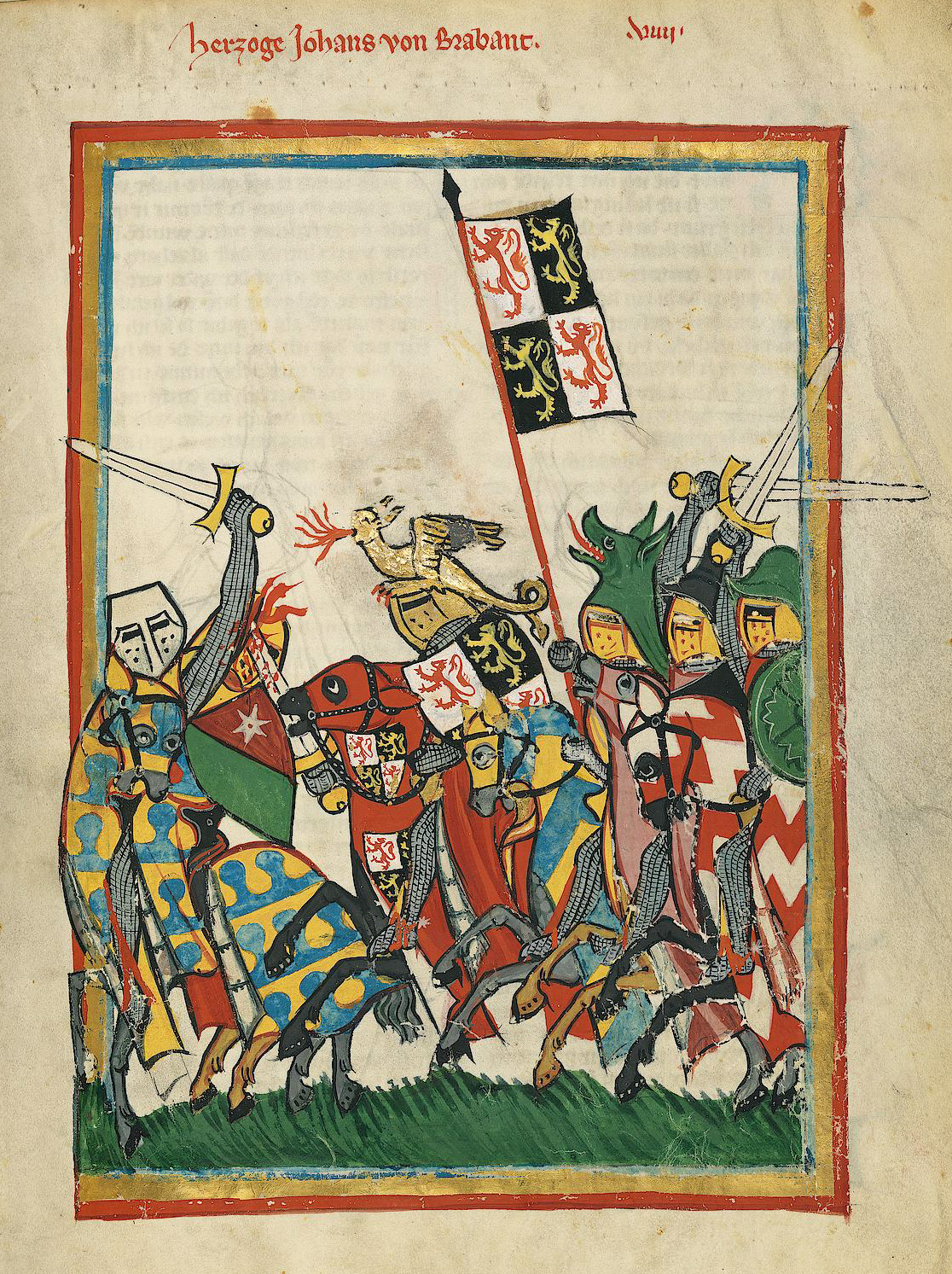
A step that bests the priest, and replaces the Sacred King with the Secular king, is the assignation of the communal spirit to that of a flag. The flags in the painting (see link) clearly show the transition from Sacred Ark, here already reduced to the image of the icon of the Sacred King, to the shield and flag of armies.

Needless to say, the identifying marks that set apart an individual or community are many. At one time the mark was a ‘Holy Ark’ that was carried or rowed along with the King, perhaps in a palanquin, from place to place. At a later date the ark was replaced by a flag (with the image of the Sacred King emblazoned on it), because it was carried more easily. This happened when there were ‘standing’ armies, which marched more often to ever more disastrous ends. This is how the flag became the identifying mark of the city, which then became the state (city-state), which federated itself with other city-states and became an empire of nations ruled by their cities.

By the time the ark was replaced by a flag, the city had dramatically changed its nature—from being Jerusalem, or home, temple, and refuge of herders, it had turned into a castle or fort for a ruling mafia composed, first, of warrior, later of political and religious princes. For this reason, the flag became identified with conquest. The Sacred Self-sacrificial King, the beacon of the people of the wood and field, became a tool for opening a can of worms. Note the crucified man (in the link) imbedded in the body of the twice crowned eagle.*

*The story of the twice crowned eagle is told in my preceding  book “Kirrti Mukkha”. Briefly, the story tells of twin brothers who but for the self-sacrifice of the Sacred King and the awe he instils are destined to kill each other. Through a make-believe inclusion of the Sacred King in the body of the eagle representing an Empire (see centre of image), humankind is tricked into believing that the Empire is a benign entity. Though the origin of the twice crowned eagle is to be found in the story about  a twin headed bird (see Panchatantra), the ‘twice crowned’ is a more accurate description of what the story really tells and represents.

The story of how humankind arrived from the concept of the city as Holy Jerusalem to that of Sodom and Gomorrah is a long and a complicated one. It has been made even more complicated by a pot pourri of lies. It will be well to remember that before the Fourth Crusade (1204 AD), the most notable of Jerusalems was located at Constantinople*, and that Constantinople (a Christian city) was attacked and sacked by the ‘Christian’ city of Venice. The destruction of the city of God destroyed also Ancient Christianity.

*Other Jerusalems may have been locaged at Jersika, Livonia; Avignon or Avenhon in Occitania; Templo Major in Tenochtitlan, Mexico. The former two were attacked in 1209; Tenochtitlan was destroyed in 1521. Most likely there were other such cities (in Japan, China, Indonesia, Myamar, India, etc).

Despite evidence that The Great Lie continues to rule, it goes overlooked and unacknowledged to this day. To put it in as few words as possible, the Lie involves the reversal of historical events: it was not Catholic Christianity that was being threatened by heretics, but Ancient Christian tradition* was threatened by a newly arisen Catholic faction led by secular princes, possibly originating in the Viking conquest of, both, northwestern, now called Benelux countries, and southeastern Europe centering on the Black Sea and Byzantine Empire areas.

*A reminder of Ancient Christian tradition in Occitania was revealed to a young peasant girl (who was accompanied by her two sisters) through the miracle of Lourdes in 1858. Lourdes continues to attract pilgrims, who go there to partake of the healing waters of a well. Be that as it may, the miracle of Lourdes has become conflated in the popular mind (not to be confused with the mind of the ‘faithful’) with the miracle of Fatima (1917), where likewise three children, shepherds, were witness to a visitation by the Virgin Mary. The conflation is the reasons why in 1960 the Vatican put the 3rd miracle (which would likely have revealed the true history of Occitania) under ‘absolute seal’. For those who seek a rational explanation for this extraordinary remembrance of Ancient Christianity in Occitania and the surround, and the slaughter of its believers, the Cathars (600 years ago), one can only suggest a closer look at history as a longue durée event. Much like a fairy tale, the story was apparently passed along by village peasants, until venturies later it was envisioned in the Real by some of their children.

With most records burned or buried, the bare minimum of the murder of the original Christs (cross roads) is now remembered as the Great East-West Schism of 1054. Also overlooked (and misinterpreted) is the story of the murder of King Laius* by his son Prince Oedipus at the cross road to Thebes. The king and the prince are both symbolic figures, one representing the past, the other representing the present.

*Laius’s name may have its origin in the name ‘Ludis’ (also Louis, Ludwig, na-lud (from Russian narod), whence the English Revolutionaries known as the Ludites, which name is an old name for ‘the people’ deliberately overlooked by English politicians and historians.

At the root of the attempt to destroy communities on planet Earth is greed and individualism most likely unleashed by the marauding princes of the Vikings, who divided the landmass of the planet in private parcels among themselves. To maintain their gains, the princes transformed their forts into cities, and by various economic devices unleashed the cities until they mutated into a major plague, which atomized and devolved the ludis (the people) to the level of worms in cans made of concrete.

Saturday, March 11, 2017


Of Cities and Citybred Monsters
By © E. Antons Benjamiņš, 2017


Of
Cities
and Citybred
Monsters


The city is our weapon, its monster is our spirit.

By © E. A. Benjamins, 2017


Foreword

Something happened. Nobody quite knows what. But it happened, and the consequences of it are wreaking devastating results to our own days. This short book attempts to explain what it was that ‘happened’.

Unless human beings originated on planets beyond planet Earth, which this author is not sure about, human beings most likely originated in the warm climate of Africa, whence they spread outward to occupy the planet.

While we dwelt in warm climates, we walked mostly naked, or used dry grasses or salvaged animal pelts for dress. Our dress came from the animal herds we herded for the sake of milk and cheese, which we supplemented with roots, berries, fruit, and mushrooms, which we had learned to pick at an earlier time. Later, during the summer time, when we drove our herds north to the tundra, we learned to become meat eaters, and used animal furs more extensively. Indeed, we we were “herders and gatherers”, not “hunters and gatherers” as today’s city bred anthropologists are trying to tell us.

As the young men, sometimes accompanied by their girl friends drove the herds of their homesteads to pasture in spring and returned “home” in the fall, our “home”, initially no more than a hut in a tree, or a cave, or a dwelling made of bamboo by the river bank, became more substantial, increased in number, and formed a cluster, which setting was to become a village city, and later still, a city with a temple at its center.

As the dispersal of early humans and their animal herds gained humans experience and ever increasing confidence in themselves, the city became of ever increasing importance as “home”. However, to remain a “home”, the city had to be a friendly and welcoming place. Else, the herders might not come home, but what with their wifes and children turning into ‘camp followers’ stay in parts unknown, become alienated, and perhaps even enemies .of the stay-at-homes.

To maintain themselves as ‘friendly places’, early cities could not afford to become the impersonal piles of glass and concrete, run by direct, parliamentary, or pseudo ‘democratic’ governments, they have become today. Thus, the early governors of cities were sacred kings, who gave their lives to maintain the necessarily friendly ‘morphic field’ that resonated far and wide and enticed the herders to come back home.

It is this attraction of home as temple why, in the early days of history (according to Anatoly Fomenko*), the name Jerusalem was generic for all cities.

*On Jerusalem, re Anatoly Fomenko, “Hidtory: Fiction or Science”. Vol. 1.


The Sphinx as an Extraterrestrial

When I began to rewrite the story of King Oedipus, I did not yet have the answer for the riddle of the Sphinx. I continued to be  beholden to verbal trickery implicit in the Sphinx’s question: ‘Who stands first on four, then two, then three legs?’ Artistic renditions showed that the Sphinx stood on four, Prince Oedipus on two legs. Who stood on three?

School had taught me to accept the orthodox answer “an old man” with a cane. But this answer seemed too obvious and, therefore, suspect. Only later did it occur to me that the problem is with the questioner, who was not necessarily Oedipus. If so, then the Sphinx, too, is not necessarily as portrayed by convention.

For plague ravaged Thebes (or New York, London, Brussels, Moscow, Riga, or Beijing), the relevant question is not the one that issues out of the mouth of the Sphinx, but that of its city-zens, i.e.: “What plagues us, what plagues Thebes?”

Today Oedipus’s answer to the City or citizens of Thebes is: “Your mindset;” which as anthropologists insist also means: our environment.

Just look at the mindset of the Monster that has ensconced itself in the Forbidden City of Beijing or in the Trump Tower in New York City. Tnis is not to say the present occupants of said places (Chinese President Xi Jinping and President Donald Trump) have any idea of the consequences of their thoughts or that they imagine themselves in any way guilty of the consequences of their limitations. Like King Oedipus, they and thousands of government officials like them kill without giving the act a thought. They kill without knowing  what they do, and go unrecognized for who they are by their fellow city-zens or courts of law.

This is not to say that I am against cities. But I am against the overbuilding of cities by citizens (city-zens=cityjohns) who are building they know not what to know not what end.

Incidentally, the biologist (in the link) who puts the blame for extinction of life on fossil fuels or companies who produce them is no less guilty of being a killer than those he blames, as he is no less a city dweller than those who use fossil fuels the most. This is not to say that city people are knowingly killers, but to suggest that they know not what the consequences are of what they do. For that matter, they also know not what they think, because they live in a world that has little to do with the real world..

In short, Sophocles play “Oedipus the King” is, next to the Biblical story (Gen. 19) of Sodom and Gomorrah, among the first documents that put the blame for the attempt to destroy God’s Creation on city dwellers and city governments. One ought not to be surprised that the first city is built by Cain who killed his brother Abel.

When Prince Oedipus approaches Thebes and meets the Sphinx in the wood just outside of the city gates, he does not realize that the Sphinx is an para-projection of what used to be the Soul of Thebes, and that he, Oedipus, is the mirror image of the Sphinx, the misfortune of Thebes.

Saturday, March 4, 2017


Fragments (winding down)
By © E. Antons Benjamiņš, 2017

15. The Shebang

In past blogs, I have written of my interest in out of body experiences, especially as these occur to those who have had a near death experience (nde). While nde is worthy of attention as an inter-mind (inside the head and body) phenomenon alone, it also suggests that at the time of death the individual may be connecting with a dream-and-mind-space that exists beyond our body container.

I have also written of my interest in the mushroom called ‘Fly Agaric’ or Amanita muscaria, especially in its use as described by John Allegro in his book “ The Sacred Mushroom and The Cross”. Because the mushroom grows within a short walking distance from my country home, I use the opportunity and come mushroom season gather a bucket full. I then separate the caps from the stems and dry the caps on the branches of a dried out sapling tree. The latter is necessary, because the caps are very fragile, and when strung on a string, the rope quickly cuts through the soft caps and they fall to the ground.

In the Latvian language the Amanita Muscaria is called ‘Mušmire’ (š=sh), which when translated into English means ‘Fly death’ or, less literally, the mushroom that kills flies. I remember from my childhood that the caps of the Fly Agaric were placed on a flat dish in which was poured a small amount of denatured (purple) alcohol. The purple was to distinguish the poisonous alcohol from drinkable alcoholic spirits. After a few hours, the dish and table about was dotted with the bodies of dead flies. To a child, the scene was something of a ‘killing field’ of flies fooled by the bright red mushroom.

As I grew older, I put aside childish things and began to think a little differently. For one, as I have already pointed out, the consonants of L nd R are sometimes interchangeable according who, when, or where the word that contains it is spoken. Therefore, ‘mušmire’ (mire = death) may also be pronounced ‘mušmīLe’ (‘mīla’ in Latvijan=’love’ in English), which means the very opposite of ‘the killer of flies’; in effect, a mere change of a consonant causes the word to change its meaning to ‘lover of flies.’

As anyone who tries to dry Amanitas will notice, the caps are prone not only to being brittle, but also to quickly turning into gooey mush. And there is nothing that flies love more than gooey mush.

Therefore, I concluded that when the people of the wood were not brainwashed by secularized Christian preachers (and they in turn by their baron masters), the mushroom was likely known as ‘the lover of flies’ or ‘mušmīle’. Incidentally, ‘muš(-a)’ or ‘house fly’ transliterates into English as ‘mush’. It is a sound that makes one think that in the long ago the Latvian name ‘muš’ did not mean fly, but referred to the mush or jellied soup that the cap of a fly agaric turns into a day or two when left be.

After the caps dried, I crushed them and rubbed them into a powder that resembled bread crumbs. I then placed the crumbs of the mushroom into a coffee cup and poured hot water over them, which I then mixed and let stand and seep for some twenty minutes or more. A few hours before bedtime, I drank the brew, and waited to see the results.

During the first few times after I drank the brew nothing much happened, exept proved (at least to me) that the mushroom was not deadly poison to me. This allowed me to increase the number of spoons of the dry powder that I added to my ‘mush tea’.

There then followed a couple of dreams which distinguished themselves from my other dreams by presenting themselves as a direct experience or what is sometimes called a lucid dream. In one of the dreams, I was witness to a German soldier sans his rifle, running down a country road. I was a sniper on a small hill trying to put the fleeing man into my sights. My shot hit the man, but apparently only wounded him as he kept running until he ran into a city. Somehow the dream let me know that the name of the city was ‘Yelgava’, which is a city in Latvija about 41 km (25 mi) south of Riga. Nowadays it is a bedroom suburb of Riga*. Next, I found myself in a hospital, where the soldier had been placed. I was looking with a nurse through his medical files. This is where the dream ended.

*In the 16-18th centuries Jelgava was the capital for he Duchy of Courland.

Yelgava (spelled ‘Jelgava’ in Latvian) was once also known by its German* name as Mitau. The origin of the name is still being disputed. Some claim that the name of Jelgava derives from the word jālgab (=jālgaV), meaning, as the link claims, "town on the river”. Others say that the name comes from the German word ‘mittel’, that is to say, a town of middle men. The latter appers  to compliment the name of Riga, which derives from ‘liga’ (=Riga), meaning it was a member of a ligue of towns and cities. On the other hand, Jelgava lies in the middle of a plain that was once part of the Gulf of Riga, wherefore (before the waters of the Baltic Sea retreated to its present location) the town was likely located at the edge of the sea*. This makes it possible that originally the town was called Litau (=German for Lithuania); and as the link informs, the Lithuanians did not give up on their city until 1345, which date approximates the time the German globalist (Catholic) invaders destroyed the Kingdom of Jersika and Uppsala.

*A similar change of topology is said to have occurred in Uppsala, Sweden. The three holy mounds pictured in the link are said to have once been at the edge of the sea. The rise of the land mass after the retreat of the glaciers about 12,000 BC was rapid, which fact is hardly recognized by today’s historians or pressed by geologists. Indeed (take a closer look at the topological link), Jersika, the capital of the proto Latvian kingdom of Jersika, may once nave been a harbor city rather than a city by the Daugava River.

Rememering our consonant conversion formula (L=R; V=B; V=D**; G=J), the name Litau may also refer to a city of Livs. The Livs* were a Finno-Ukrainian people who had settled (as herders of livestock) in Livonia before the Balts sought refuge there from the Viking marauders who were victimizing the inhabitants of the Dniepra River basin.

*The Germans occupied the territory of Livonia for about 700 years (1201-1918).  **The Liv name for Daugava, the river that cuts through Latvija, was Vaina, which makes for the possibility that its early Latvian name was Daina, which I have translated elsewhere as ‘Jaunava’, but perhaps should be read as ‘Dainava’ or ‘Donava’.  ***Vaina translates into Latvian as the name for scar or guilt.

All this pushing around of letters, and topology, not to mention consonants, suggests yet other possibilities for the origin of the name of ‘jārgab’ (=Jālgav or Ģērgav), for example, lamb slaughterhouse or leather curing place.

Indeed, such a seemingly far fetched interpretation of the topological map of the Baltics (surely encouraged by Anatoly Fomenko’s groundbreaking theories about history), necessarily blends with my theory that the (not so) ancient Kingdom of Jersika (=Jerusalem = Jēruzeme) used to be a sister community of the ancient Kingdom of Langvedoc (formerly Occitania) in southern France, which just like Jersika and Uppsala was destroyed in the aftermath of the Albigensian Crusade. The Crusade was led by a pope (possibly a viking expelled from Jerusalem/ Constantinople) from his regional residence in Avignon in collaboraton with descendants of Vikings who had settled in northern France. The one was after booty and property, the other after taxable land.

The amanita mush tea is capable of loosing many subjective pathways not imaginable to orthodox consciousness. Thus, on another occasion, I had just walked up the short flight of stairs that lead from my kitchen to my bedroom, when I realized that I was walking in a space of ‘empty air’. When I stopped to concentrate on the experience, I realized that I stood in a cocoon of space that was different from my usual experience of space. I felt outside of the latter. In fact, the space felt so strange that for a moment, I entertained the thought that perhaps I had died.

To prove to myself that I was alive, I waved my hand in front of my eyes, but my hand appeared where it ought to appear. I looked at the clock on the wall, and the dial of the second-hand was moving as it normaly does. Yet I felt somehow separated and outside of the time shown by the clock. It occurred to me that I had entered the ‘no space’ of a mirror: An uncomfortable question came to mind: “Why did God bother to create such a world?” Given the emptiness or Nothing I found myself in, it seemed like a logical question. Since my bed was but a few feet away, I went to lay down; and promptly fell into a dreamless sleep. Even so, the experience stayed with me.

Some months later, when I had made tea of what remained of my Aminita teapowder, I stayed up a few hours (to let the brew enter my blood stream). Then I went to bed hoping for a dream that would not be of the ordinary kind.

The dream brought me once again into a space that was outside the sense of time. However, because I was in a dream, I perceived the out-of-time space as a movement within a circle in which two space-times moved about each other like the half-circles within the circle of a ying and a yang. I observed the movement as occurring far below me. When the movements of the two spaces ceased, I found myself in a space like that of an elevator shaft in which the elevator was a parachute descending. Since I was located above the parachute and was looking downward, I was anxious about falling into it and messing up the dream and my descent back into space-time.

Fortunately, nothing ontoward happened, and I appeared to remain in control of the situation. At some point of my descent the parachute disappeared, and I saw at the bottom of the shaft waiting for me a taxi driver, but he was not sitting in a car on a street, but in a canoe in water. I was then roved into a dark and barely lit cave that contained a large lake, into which I then dived. As I swam, I became fearful that I may drown. I then saw a large salmon colored piece of submerged flesh come floating into sight. At that moment I awakened back in my body.

So? Why tell a subjective dream from the location of orthodox space? For one, if those who have a near death experience describe seeing their ghost rise into a shaft of light, ‘birth into time’ (if that is what the end of my dream was about) had me descend a birth canal presented as an elevator shaft.

Perhaps Einstein’s Theory of Relativity regarding spacetime is not correct, and there is but a time that becomes ever slower until it becomes a fata morgana within a mirror.

If this is so, then so called ‘dream time’ is a misnomer, because it actually refers to dream space. In effect, the ‘I’ of my nameless ghost lives in the space of a (my) body, which manifests itself as anxious consciousness in the no-time space of dreams.Time is the invention of an anxious mind that finds itsellf in a dead space. Though I cannot share with others my body time, except perhaps through brief sexual contacts with my beloved, the objects in my dream-space are interchangeable with others, as none exist other than as images in a mirror, wherefore, as but a symbol.

In other words, much as I may disbelieve it, the image in the mirror, when on its own, becomes a subject (a photo image) that has no object. But for the discovery of the mirror and invention of photography, the object would have no subject and would remain unknown to himself. It is this image of the subject that Walter Benjamin (see EC573) perceives as the fata morgana that city-zens (including Walter Benjamin himself) misperceive as real. This real has no object but for the one that is itself: virtual, (ultimately) fake, and ever so destructive of the object* that is the reason of its being.

*Because the ‘object’ is destined to become a mere phenomenon, its autonomous nervous system becomes critically anxious and impaired. Indeed, the ‘exceptionalist government’ of the United States of America perceives itself to be the heir of Catholic Rome, declares itself to be representing the Court of a Secular God, and leaves God no alternative but to resort to war that will return the ‘shebang’ to the wood.