Showing posts with label Carl Schmitt. Show all posts

Wednesday, January 1, 2014

Eso’s Chronicles 267 / 7
The King & I
© Eso A.B.
All comments appearing within brackets [ ] are editorial in origin. This blog series begins at 264.
 
NEITHER GOD, NOR NOMOS, BUT KING
 
Having begun this series on the ‘King’ with Slavoy Žižek’s mischievous conjoining of the King with bureaucracy (The King and his Bureaucracy, Ch6, ‘Interrogating the Real’), it is only proper to conclude with the no less mischievous comparison that the pop philosopher makes of subjectivity with “dangerous hubris”, insisting that the claim to “authentic essence of humanity” lies “outside the domain of subjectivity”. Žižek posits the subject of authentic essence in Antigone and its human counterpoint in her sister Ismene.
 
I would call the other name of the “subject” that Žižek imagines—a “mask”. However, Žižek quickly becomes inconsistent and contradicts himself, when he decides to dedicate his book to an old Slovene communist, who in 1943 led an uprising of some 2000 starved Yugoslav prisoners against 2200 Italian soldiers who are their guards.
 
The Slovene prisoners succeed in disarming the Italian soldiers. After the war, the Slovene communist is arrested (no reason given why--by the succeeding communist-Stalinist government) and ten years later, he is forced to participate in the building of a monument that celebrates the uprising he led.
 
It is an ironic story, surely.
 
Knowingly or unknowingly, Žižek then tops off the irony by putting Stalin into role of the ‘King’, while the role of the ‘bureaucracy’ passes to Stalinist  communists, those who are enforcing Stalin’s ‘will to power’.
 
This leaves the reader confused as to why Žižek holds an old communist in such high esteem, for obviously the man revolted against the guards of the prison on the basis of his subjective feelings and decisions. The problem resolves itself only if one assumes that Žižek contradicts himself or Stalinists are the new Catholics.
 
I agree that the monument, the ‘subject’ of the ‘’monumental building project, stands for the ‘mask’ of the old communist and his rebellious comrades, who, I assume, are meant to stand for the ‘authentic essence’ of humanity.
 
But why should one believe that the monument stands also for ‘dangerous hubris’? Is that not like a Catholic priest demanding a pagan to renounce his old Gods (who up to the moment are a part of the man’s subjectivity) for the authentic subject of an ‘outside’ God, aka Nomos https://www.google.lv/#q=meaning+of+Nomos ? And is not Nomos synonymous with such repressive organizations of pacification as the Inquisition, the Gestapo, the KGB, and the CIA/NSA? Is not dismissing subjectivity as ‘hubris’ a matter of continued repression and denial of privacy? Therefore, is the monument not a monument to Homo Sacer: http://en.wikipedia.org/wiki/Homo_sacer --the man who cannot be murdered, sacrificed, but only killed, because all he is is naked?
 
This brings us to “god” with a small ‘g’, because Catholicity (and Christianity derived from globalist Catholicism) surely discredited god when written with a capital G, and here Žižek and Schmitt discredit him with a small g. So, why not replace the missing figure of Trust with the long neglected figure of King?
 
Would not a King serve the 900,000 Latvians forced into economic exile as de facto ‘homo sacer’ better than the bureaucratic totalitarian democracy, which with the backing of the totalitarian democracy of the EU takes upon itself the authority to make them de facto homo sacer or, in other words, homeless?
 
There will be those who will claim that I would reinstall subjectivity in place of an objective (rational law) government that a Hegelian http://en.wikipedia.org/wiki/Hegelianism bureaucracy presumes itself to represent. As Schmitt asserted: “all significant concepts of the modern theory of the state are secularized theological concepts”. Here we may remember that Catholic Christianity spent many centuries violently persecuting and inquisitorially repressing an earlier Christianity now identified with Bogomils, Cathars, and Krist-Yans.
 
The repression was necessary because like Žižek (a Hegelist), Catholicism believes human subjectivity to be a hubristic element rather than an inherent element of being human. In short, we have biocentered human beings http://en.wikipedia.org/wiki/Biocentrism_(ethics) opposed by virtual or ‘man-made’ human beings, who are created by words imbued with violent attributes gained through innumerable acts (? 900,000) of de facto (unacknowledged de jure) murders.
 
To discuss the means by which the King may return is a task beyond these blogs, which are meant to argue against the totalitarianism of liberal democracy in an attempt to overturn its dictatorial order that has taken the helm in Latvia. Even so, we may say—in agreement with Carl Schmitt—that the nature of democracy is to behold the rights of the rulers and the ruled as one. In other words, this is what makes democracy a charismatic force, whereas today it has become an alien and an enemy.
 
I have argued for the return of humankind to the wood and leaving urbanism as a minimal element, an element to be determined by none other than the post-urbanist age itself (certainly not by a carbon tax).
 
I am arguing that Latvians make a serious attempt to recapture for their political estate the King. In a preceding State (1918-1939), though not the post-Soviet Latvia, Latvians did indeed experiment with the notion of the ‘king’s’ return, even though the word was seldom used. This experiment was enjoined by one of the founders of the national community, Karlis Ulmanis, who became President of the country as a result of a coup d'état in 1933.
 
Ulmanis was condemned as a dictator, and many hold him such to this day. I argue, however, that Ulmanis was ahead of his time, and that political science had not yet made such strides as it has made by our time. Be that as it may, a great many Latvians praise Ulmanis’ leadership, but suffer not expressing the praise because they find themselves under a totalitarian liberal democratic regime, which in turn is under the umbrella of a liberal totalitarian ‘democratic’ regime in European Union.
 

Monday, December 30, 2013

Eso’s Chronicles 265 / 5
The King & I
© Eso A.B.
All comments appearing within brackets [ ] are editorial in origin. This blog series begins at 264.
 
THE KING & PREUSSENSCHLAG
 
Though kings in our time have no other function than perhaps a ceremonial one and have been dismissed as a politically outdated institution, some of the arguments of Carl Schmitt, reputedly a Nazi legal expert

http://en.wikipedia.org/wiki/Carl_Schmitt , are worth noting and given greater attention than he is presently accorded.

As the link notes, Schmitt justified dictatorial power not as a consequence of being dictatorial per se, but because “If the constitution of a state is democratic, then every exceptional negation of democratic principles, every exercise of state power independent of the approval of the majority, can be called dictatorship.”

In the case of my own country of birth, Latvia, the ‘exceptional negation’ most recently occurred when the ‘democratic’ state refused to hold a referendum, which is mandated by the Constitution. Such a referendum would clearly bring up and let the people debate and vote with regard of whether to join or not join the Euro monetary union. As it is, the State refused to hold the referendum, arbitrarily upped the number of people required to sign the petition that would ask to hold such a referendum (from 10,000 to 30,000), and argued, instead, that Latvians had voted for the Euro when they agreed to join the European Union as such.

This arbitrary and authoritarian negation of the Latvian people’s right to determine their future as a sovereign nation, but to submit to the dictates of the European Central Bank (ECB) has undermined the community’s (ethnic* or national ability to cultivate and develop its own culture. Of course, this applies not only to Latvia, but in so far as it is a member of the EU, effects the futures of all European nations, especially the smaller ones. For lack of a handicap of size that sometimes affords an advantage, Latvia has no such thing as a culture that it may call its own.

Admittedly, the cultural difficulties of Latvia are many and among the foremost are the consequences of a lengthy occupation (roughly half a century, 1940-1991) of its territory by the Soviet Union and that Union’s planned dilution of the ethnic base of the Latvian Soviet Republic. Another problem is the privatization of its land subsequent to the country’s joining of the EU, which facilitated the loss of productive land to proxies solicited by foreign investors, who then left the land underutilized. Another disastrous consequence of renewed independence was the “shock” transition to a capitalist economic system, which in effect forced an economic outmigration of some 900,000 Latvians (out of a base of about 2 million) and a consequent demographic collapse of population statistics. This has also left Latvia with little of a literary culture it may call its own. Though the Latvian language persists, most books published at this time are translations, autobiographical works, but there is little to nothing of what may be called original literature. With the dismissal of the director of the National Opera Company in Riga, the last bastion of ‘high’ culture has been surrendered to the invasive influence of Western and other foreign ‘pop’ cultures.

Given the collapse of a national and/or ethnic cultural base, one necessarily looks for its causes, which are not only to be found in the above mentioned, but derive from the imposition of parliamentary democracy by an alleged ‘greater democracy’ said to have its base in the European Union. In effect, ‘democracy’ came to Latvia, when it was not prepared to make a sudden and essentially uninformed transition to it, and when its own political intelligentsia was undereducated and could be taken easy advantage of by commercial interests indifferent to the country and its people as entities of dignity.

In fact, ‘democracy’ was imposed on Latvia by an authoritarian ‘democracy’ based in the very institution of the EU, and succumbed to this ‘foreign’ influence beyond its ability to recover (due to the unavoidable exposure of its weakened institutional base to various commercial corruptions)—unless such a recovery is enjoined by a ‘King’ like authority.

This brings up the question of how such a ‘king-like’ authority may be legitimately enjoined? This takes us back to Carl Schmitt and the case called “Preussenschlag”; which, re (at above link) led: “…to the de facto destruction of federalism in the Weimar republic…." One is probably justified in believing that an effort to deny the federalization of the EU will find supporters not only among Latvians, but many smaller European States similarly threatened by forced federalization into a Parliamentary, liberalist, and authoritarian ‘democracy’ of the EU to form an illegitimate Empire that is of an advantage only to its own bureaucracy, government heads including.

*Ethnic—a word that in our times has lost its meaning. It would be, in my opinion, proper to replace it with the word ‘organic’; thus not an ‘ethnic Latvia’, but an ‘organic Latvia’, ‘organic Scotland’, and not their current mechanical ‘democratic’ equivalents.
 

Tuesday, January 12, 2010

© Eso Antons Benjamins, a.k.a. Jaņdžs


NOT-VIOLENT TERROR
72 Climbing Mt. Citheron (V)

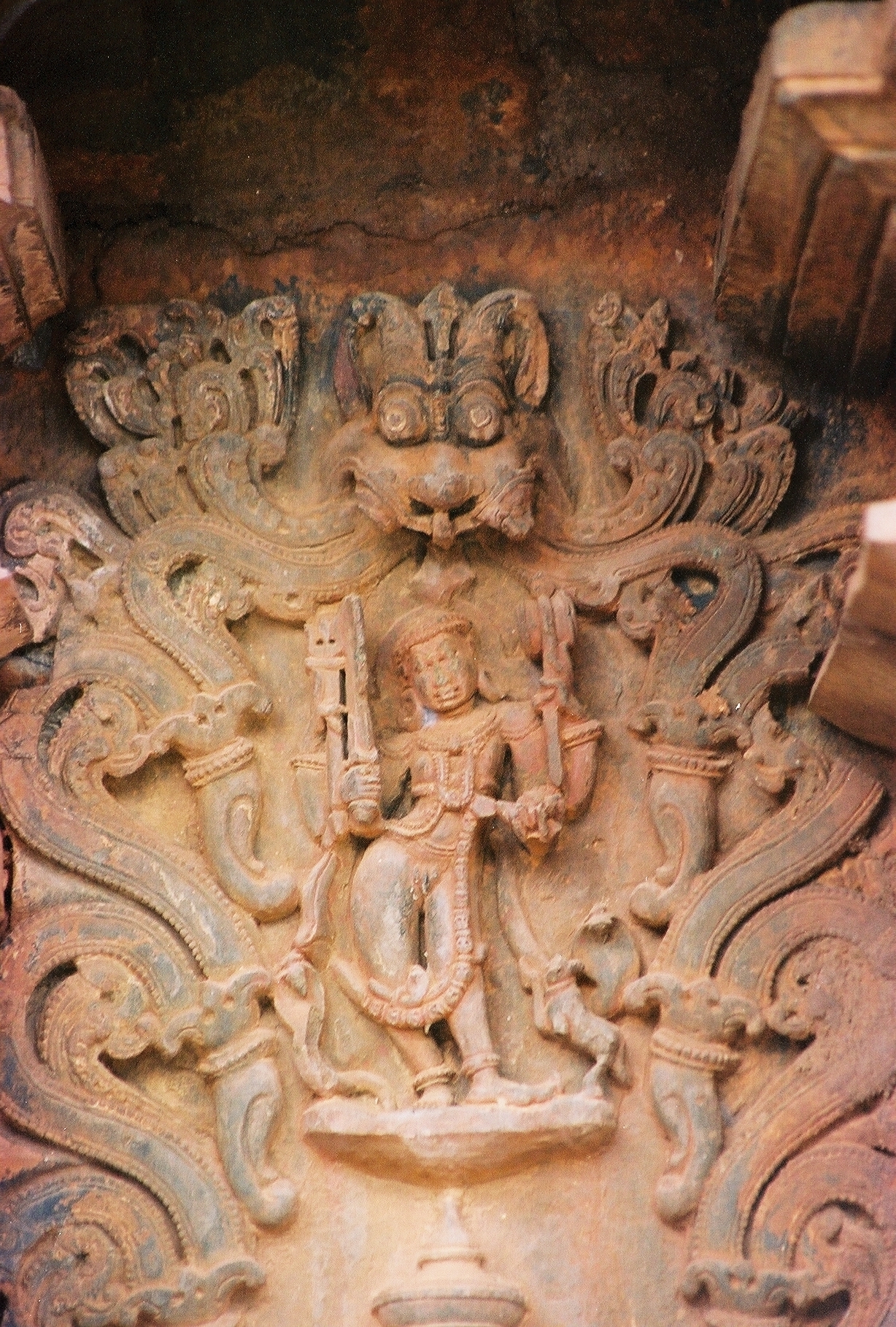
Strange as it may seem, the myth of Kirtimukha repeats itself in modern politics. It appears, for example, in the work of the German scholar of jurisprudence and political philosopher Carl Schmitt , for whose importance I will quote Chantal Mouffe, his prominent critic, but also one who has developed his ideas further, but other direction.

Writes Mouffe: “[For] Carl Schmitt… the defining feature of politics is struggle and that ‘there always are concrete human groupings which fight other concrete human groupings in the name of justice, humanity, order, or peace.’”* Mouffe concurs with Schmitt that it is essential in political struggle (as opposed to a bureaucratic foreclosure of dissent) to have an “enemy”. The differences in the two thinkers’ ideas lie in that Carl Schmitt does not believe that liberal democracy is able to cope with the potential of violence inherent in the system and, therefore, under conditions of exception, needs a leader to resolve the matter, while Mouffe tilts toward a resolution of conflicts by means of a resolve to use hands (i.e., words), not weapons. The last sentence in Mouffe’s book, “The Return of the Political” reads: “Instead of shying away from the component of violence and hostility inherent in social relations, the task is to think how to create the conditions under which those aggressive forces can be defused and diverted and a pluralistic democratic order made possible.” One of these conditions as I understand it is hegemony contingent on the ability of interest groups or equivalences to come together against a common adversary in a time of crisis. This hegemony is populist in nature.

However, thought and conclusions alone, without a substantial transference of authority to implement thought and its conclusions (words alone will not do the job), are for naught. As Mouffe herself says: “The absence of power embodied in the person of the prince and tied to a transcendental authority preempts the existence of a final guarantee or source of legitimation; society can no longer be defined as a substance having an organic identity. What remains is a society without clearly defined outlines, a single or universal point of view. It is in this way that democracy is characterized by the ‘dissolution of the markers of certainty.**’” This is a radical idea indeed, if one considers that with the dissolution of the markers of certainty there will also dissolve all charisma, attraction. For me the rub comes when I have to imagine the latter, because I cannot get that abstracted.

How will the “dissolution of the markers of certainty” be bridged? I argue that the “substance [lacking] an organic entity” (which I presume makes it behave as any bureaucratic instrument) remains, a serpent in the grass, a proto-social being (as in a ‘naked human being’ in the Greek concept of Zoē). A “larger than life” society on the other hand is a development that has gone past this proto stage and is already bound by the charismatic force of death, whether self-sacrificial or violent. This is the stage when Kirtimukha bites its tail and propels itself as a wheel. Its substance is diminishing (no institution is immortal) by being turned into energy. It has bit its tail and moves no longer with a winding slither, but with a roll. We have become a substance (inorganic on a contingency basis) which moves inexorably toward its denouement—sooner than later—if we do not stop before the window of our faces.

What the neo-liberal Latvian government is engaged in at this time is to twist Latvian society under the aegis of the neo-liberal West in a way that it becomes like a twisted bicycle wheel. Given enough of a push, such a wheel will move forward for a few turns, but then tip over. It urgently needs a tuning. The present (2010) Latvian government, a collective of right-wing partidocracies in its make-up (i.e., sponsored by its own team of oligarchs and with only a few members from the public), may be a better transport vehicle for the baggage in its baggage container than having no wheels at all, but having already suspended disbelief several times in order to believe that a partidocracy led to a better future, Latvians may no longer vote to save the organic leeches in their swimming pool.

One proof of failure of the Latvian government may be deduced from its refusal to speak about the future. This is evident in its unceasing lambasting (and implicit repression) of “populism”, the interests of which demand the neo-liberal elite to tell the people about the future the state envisions. Since the government has consistently failed to do so, it is apparent that the future is already here. It consists of leeching the people as if they do not matter. This also makes it evident that the enemy of choice for right-wing partidocratic politicians is the Latvian public, even though partidocrats have no juridical authority in and of itself except as a subjectivism that may be as personal as it is coincidental with that of the greed of the oligarch collective. Given that the word ‘populist’ emerged from the Latin ‘populus’ (plebs and people), ever wonder who the ‘enemy’ of the Latvian people may be? Not that the politicians would want you to know, but ultimately it is the people’s authority that is sovereign. Unfortunately, it is the politicians, who failing in humility and presuming they represent the norm of the superstructure (parliament as a collective of oligarchs each with his own party), try to steal it from them.

Rather than roll down a hill as it is capable of doing, the serpent (zalkts) for fear of failure starts to devour itself. This is the situation the present Latvian partidocratic government has put Latvia in. The partidocracy is destroying the country by causing it to become an empty place, both, by out migration and by way of the negativity (hopelessness) from those forced to stay. To paraphrase Moffe’s words, [it means] ‘that we cannot distinguish within a given regime of truth between those who respect the strategy of argumentation and its rules, and those who simply want to impose their power’. This is why ‘apocalyptical postmodernism… characterized by drift, dissemination, and the uncontrollable play of significations’, does indeed ordain for Latvia a radically new epoch. *** Unfortunately, “strategic argumentation and its rules” will not work without enablement by self-sacrifice.

The tragic drift of the Welsh people into Englishness will either be repeated by the Latvians (as Richard Burton surrendered to the seductive Elizabeth Taylor, Latvia may be seduced by someone named Pop) or the current of time will bring them to a chronal moment that will spring forth as a revelation. Instead of the partidocracies holding a royal flush that sucks up the last of the common good and communal bond, Latvians may have luck and draw a queen of spades followed by a joker called John, followed by a king of hearts, who, having been dealt the ace of hearts, calls the hand of his opponents and wins by invoking a near forgotten sovereign right to change the rules of the game. It is on this or a similar occultation of cards that Latvian populists must be make their bets. In short, it will be a new game with new rules. It will be won not by saying “yea” to a system gone sour (as if it can be unsoured by one more suspensions of disbelief), but by creating in a flash of inspiration a hegemony of “nays”, and electing a radical and plural democracy that acknowledges the need of the not-violent terror of self-sacrifice by drawing the Face of Glory on its flag.


Asterisk & Notes of Interest:

*Chantal Mouffe, The Return of the Political, Verso (paperback) 2005, p. 113.


**Claude Lefort, Democracy and Political Theory, Oxford 1988, p. 19.


*** Chantal Mouffe, ibid., p. 15.


On material deprivation  in Latvia.


On the theme of “more-equal-than-others”, re Orwell’s fable Animal Farm.


A recommended read: “The Theory and Practice of Oligarchical Collectivism” by Emmanuel Goldstein (A book within a book from George Orwell's Nineteen Eighty-Four). An article to orient yourself on populism in America (and hear the echo in Latvia), re "Retrieving the Democrats’ Reason for Being" by Sam Smith.


Of great interest to me is this and like articles. It presents some of my reasons for supporting the growing of Johns Grass in Latvia.

These blogs tend to be a continuum of an idea or thought, which is why—if you are interested in what you read—you are encouraged to consider reading the previous blog and the blog hereafter.


Partial entries of my blogs may be found at LatviansOnline + Forum Home + Open Forum –ONLATVIANPOPULISM vs LATVIJASLABEJIE. If you copy this blog for your files, or copy to forward, or otherwise mention its content, please credit the author and http://esoschroniclnes.blogspot.com/